
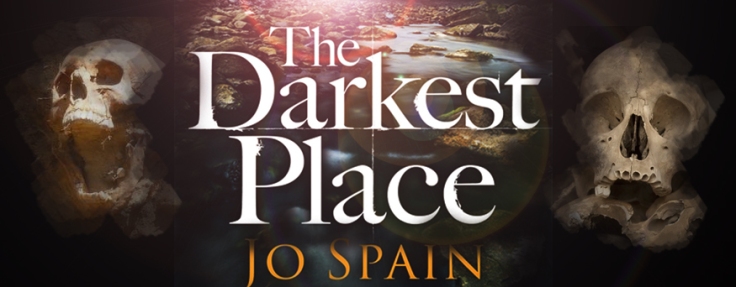
There can be few tropes – either using visual imagery or words – to match the allure of an disused and desolate lunatic asylum. The more Victorian and ‘Gothick’ the building is, the more it is likely to attract both those brave but foolhardy folk known as Urban Explorers – and writers of atmospheric thrillers. Place the building on a desolate island off the south western coast of Ireland and we have a dream – or nightmare – location for a murder mystery. Then let the tale be told by one of our finest modern writers of crime fiction and, as Wilkins Micawber once said, “Result, happiness.” Happiness at least for those of us who love a good read, but there is less joy for the characters in Jo Spain’s latest novel, The Darkest Place.
 Dublin copper DI Tom Reynolds is summoned from the dubious delights of his family Christmas to solve a murder. Readers of the previous three Tom Reynolds books might think there is little remarkable about that, but this time the corpse has been in the ground for rather longer than usual. Forty years, in fact. On the island of Oileán na Caillte, the pathologists have been disinterring corpses from a mass grave of the unfortunates who passed away as patients of the long-defunct psychiatric institution, St Christina’s. Those involved in the grim task discover nothing illegal, as all the residents of the burial pit were laid to rest in body bags, tagged and entered onto the hospital records. With one exception. That exception is the corpse of one of St Christina’s medical staff Dr Conrad Howe, who mysteriously disappeared forty Christmases ago. No body bag or tag for Dr Howe, but a rather surreptitious last resting place wedged between two other corpses.
For Howe’s widow Miriam the discovery comes as a shock but a release of sorts. For all the Christmases in between she has, like a latter day Mrs Hailsham, laid out the seasonal trappings in the same way each year, half hoping that her husband would return. Her children, now grown up, have humoured her in this ritual up to a point, as has a doctor colleague of her husband’s, Andrew Collins, who retains his connection to Oileán na Caillte. The fact that Collins has been hopelessly in love with Miriam all this time is not lost on Reynolds as he tries to discover who killed Howe with – as tests on his bones reveal – a length of electrical flex which left copper traces on his thoracic vertebrae.
Reynolds is no-one’s fool. As he pores through the almost indecipherable scrawl of Howe’s diary (we share that task with him, but minus the scrawl) he realises that the truth about who killed the idealistic physician involves not only the dead of Oileán na Caillte, but those who are still very much alive. One of the most telling lines in the diary says:
“It is though we are sharing this island with the devil.”
 Other than that dark angel, the cast of suspects includes another former physician, now himself just days away from death, and others whose culpability in the inhuman treatment of St Christina’s patients has left psychological scars, some of which have become dangerously infected. Of course, this being, among other things, a brilliant whodunnit, Jo Spain (right) allows Tom Reynolds – and us readers – to make one major assumption. She then takes great pleasure, the deviously scheming soul that she is, in waiting until the final few pages before turning that assumption not so much on its head as making it do a bloody great cartwheel.
Jo Spain is a brilliant writer. It really is as simple as that. She takes the humble police procedural and not only breathes new life into it, but makes it dance and jitterbug like a flapper on cocaine. Not content with that, she shifts a heavy old stone covering some of the less palatable aspects of her country’s history, and lets us gaze squeamishly at some of the nasty things that click and scuttle about beneath, disturbed by exposure to the light.
The previous Tom Reynolds novel was Sleeping Beauties, and you can check that out by clicking the blue link. Do the same to see the review of her brilliant standalone novel The Confession. The Darkest Place is published by Quercus and will be available on 20th September.

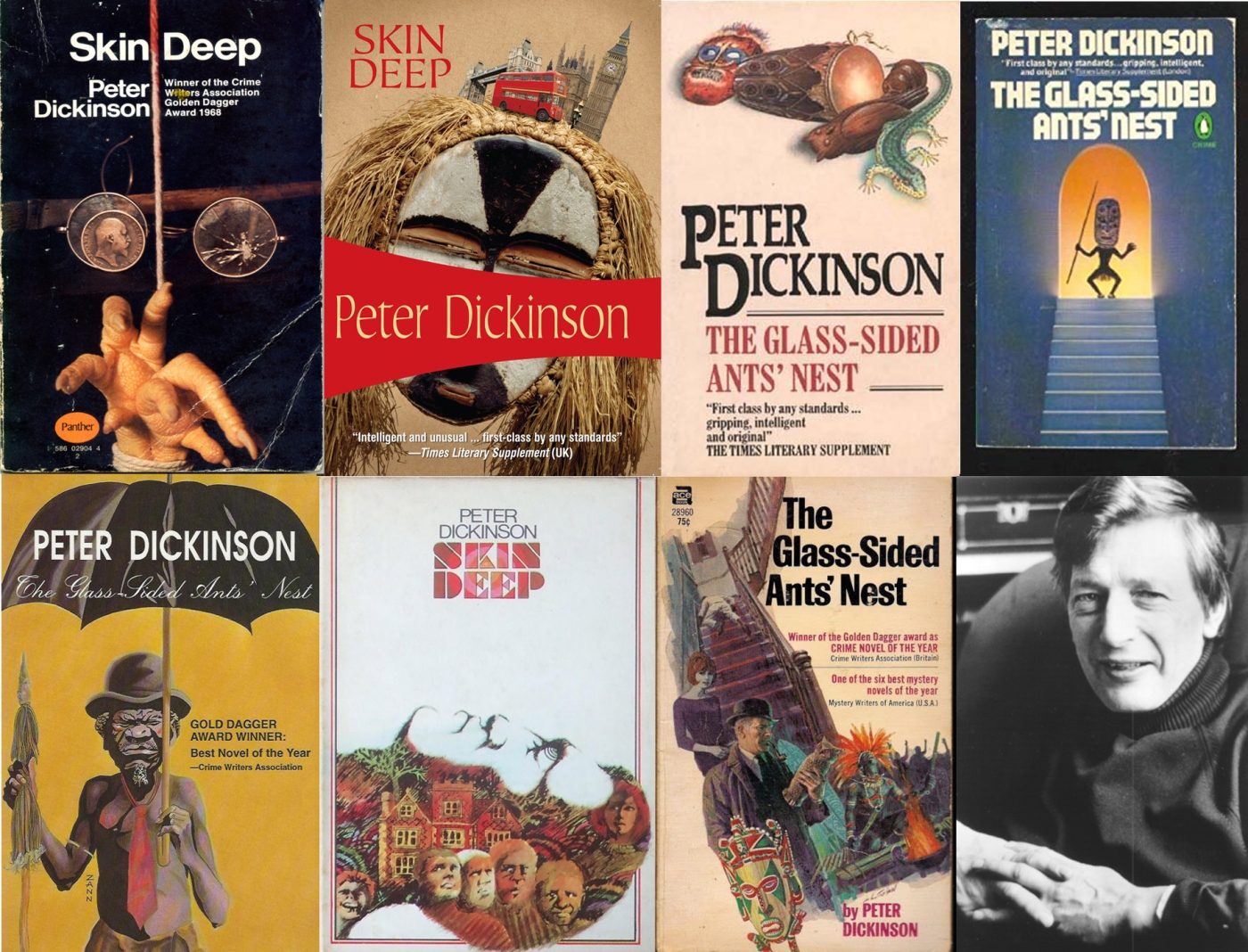
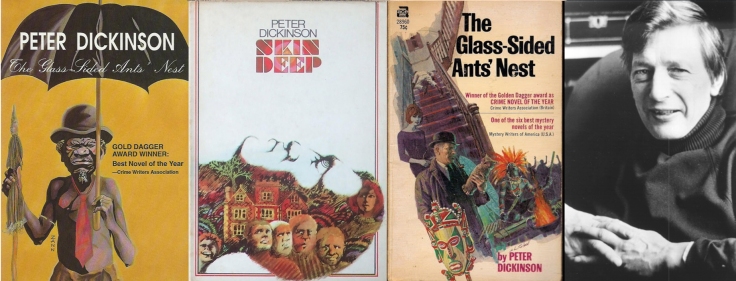
 Incidentally, I don’t think there are many Old Etonian authors around these days, but Dickinson (left) was there from 1941 to 1946, and it is tempting to wonder if he ever rubbed shoulders in those years with another Eton scholar by the name of Robert William Arthur Cook, better known to us as the Godfather of English Noir

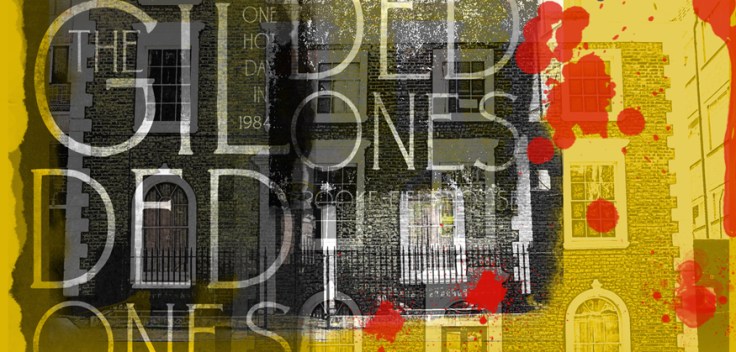
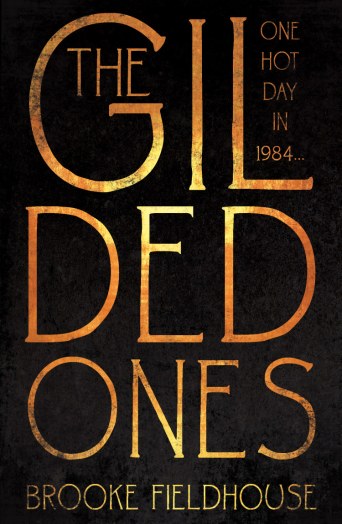
 This is a curious and quite unsettling book which does not fit comfortably into any crime fiction pigeon-hole. I don’t want to burden it with a flattering comparison with which other readers may disagree, but it did remind me of John Fowles’s intriguing and mystifying cult novel from the 1960s, The Magus. I am showing my age here and, OK, The Gilded Ones is about a quarter of the length of The Magus, it’s set in 1980s London rather than a Greek island and the needle on the Hanky Panky Meter barely flickers. However we do have a slightly ingenuous central character who serves a charismatic, powerful and magisterial master and there is a nagging sense that, as readers, we are having the wool pulled over our eyes. There is also an uneasy feeling of dislocated reality and powerful sensory squeezes, particularly of sound and smell. Author Brooke Fieldhouse (left) even gives us female twins who are not, sadly, as desirable as Lily and Rose de Seitas in the Fowles novel.
 Lloyd Lewis is the Magus-like figure. He is so thumpingly male that you can almost smell him, and he rules those around him, with one exception, with an almost feral ferocity. So who are ‘those around him’? Ever present psychologically, but eternally absent physically, is his late wife Freia, the subject of Pulse’s dream. Martinique is Patrick’s girlfriend, and loitering in the background are his children, step-child and office gofer Lauren. Lauren, who has “thousand-year-old eyes”, is of the English nobility, but quite what she is doing in the Georgian townhouse we only learn at the end of the book. The one person to whom Patrick defers is his Sicilian friend Falco. Equalling the Englishman’s sense of menace, the sinister Falco appears briefly but is, nonetheless, memorable.
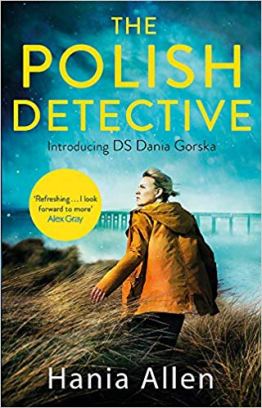 Dania Gorska has come to work in Dundee after starting her career in London with the Met. A divorce from husband Tony (watch out for the clever twist) has left her footloose and fancy free. Her exemplary record has meant she has enjoyed a swift and welcome transfer to Police Scotland. She lodges with her brother Marek, who is an investigative journalist.
 The Polish Detective is in some ways a standard police procedural which chugs along nicely on its accustomed rails. All the usual characters are present and correct; no such story would be complete without a dyspeptic senior officer, the obligatory post mortem scene with a sarcastic medical professor wielding the bone saw, the male junior detective who thinks he’s Jack – or perhaps Jock – the Lad, and the mind numbing tedium of the door knocking and CCTV scanning that sits behind every brilliant solution to a murder mystery. What lifts this book above the average is the character of Dania Gorska herself, and in particular her musical passion for, naturally, her great countryman Frédéric François Chopin and his sublime piano music. Hania Allen (right) describes herself as a pianist who makes up in enthusiasm what she lacks in talent, but under the fingers of DS Gorska, the great man’s preludes and nocturnes shimmer and sparkle throughout the pages, and the darker notes of the Polish soul are never far away.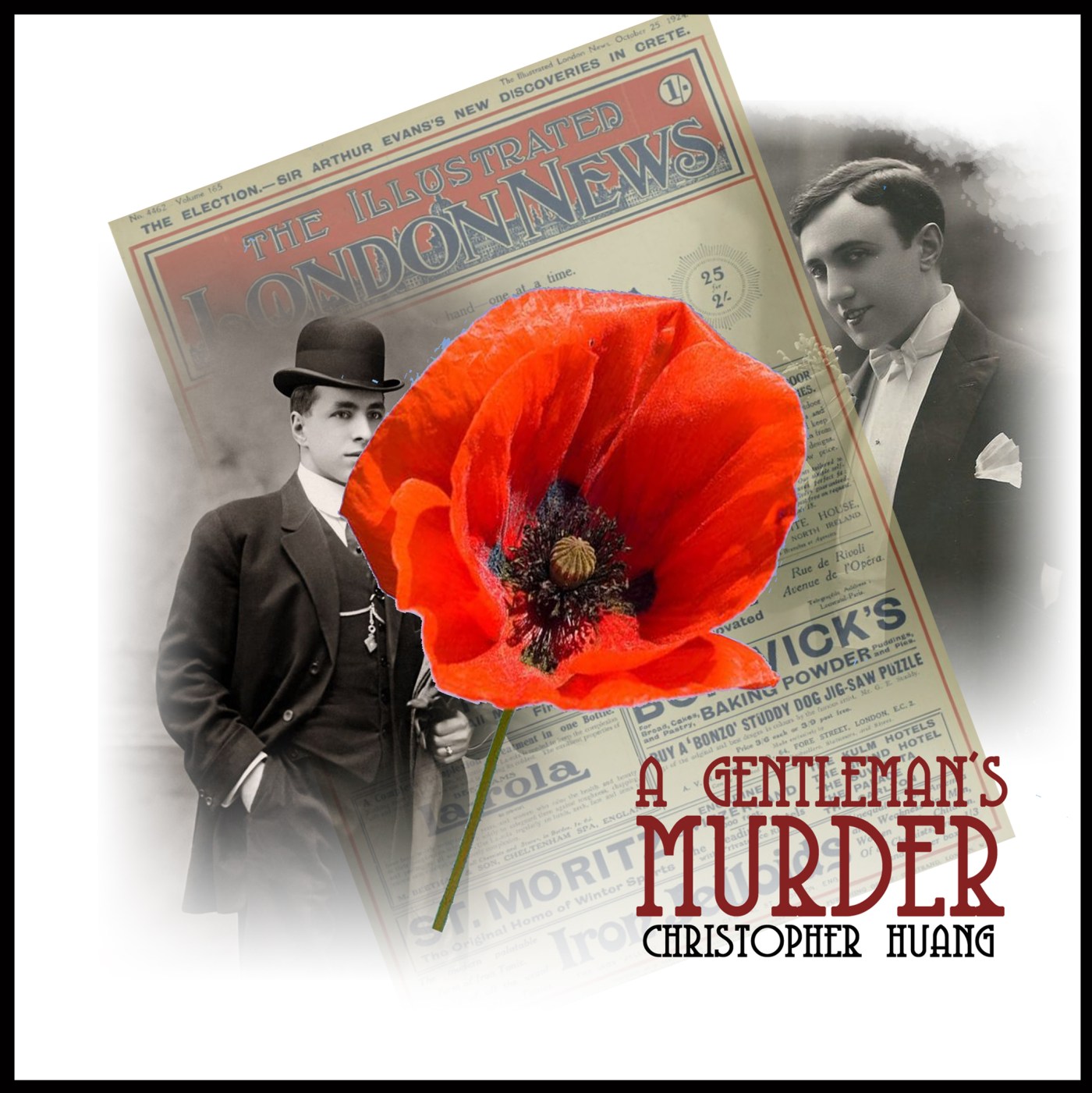
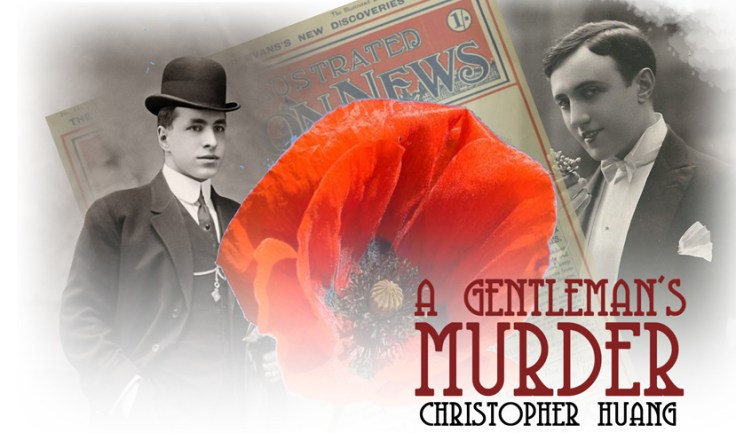
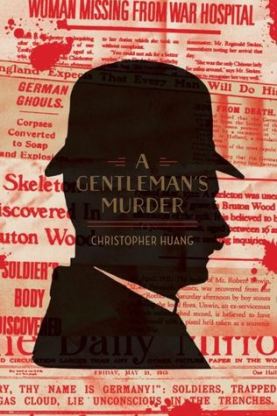 Eric Peterkin is one such and, although he carries his rank with pride, he is just a little different, and he is viewed with some disdain by certain fellow members and simply tolerated by others. Despite generations of military Peterkins looking down from their portraits in the club rooms, Eric is what is known, in the language of the time, a half-caste. His Chinese mother has bequeathed him more than enough of the characteristics of her race for the jibe, “I suppose you served in the Chinese Labour Corps?” to become commonplace.
 Christopher Huang (right) was born and raised in Singapore where he served his two years of National Service as an Army Signaller. He moved to Canada where he studied Architecture at McGill University in Montreal. Huang currently lives in Montreal.. Judging by this, his debut novel, he also knows how to tell a story. He gives us a fascinating cast of gentleman club members, each of them worked into the narrative as a murder suspect. We have Mortimer Wolfe – “sleek, dapper and elegant, hair slicked down and gleaming like mahogany”, club President Edward Aldershott, “Tall, prematurely grey and with a habit of standing perfectly still …like a bespectacled stone lion,” and poor, haunted Patrick “Patch” Norris with his constant, desperate gaiety.


 Watching You by Lisa Jewell takes us to the chic urban village of Melville Heights. Jack Mullen is a successful consultant in cardiology, while his wife Rebecca is “something in systems analysis.” A couple of doors down live the Fitzwilliam family. Tom is a charismatic and nationally renowned Head Teacher with an impressive record of turning round failing high schools. His adoring wife Nicola has no CV as such, unless you want to list an over-awareness of body image and a devotion to the latest fads in fashion and diet. Their teenage son, Freddie – an only child, naturally – is very keen on all things technical, particularly digital binoculars, spy software, and a fascination with the lives and movements of anyone he can see from his bedroom window.
 This is a clever, clever murder mystery. Lisa Jewell gives us the corpse right at the beginning – while keeping us guessing about whose it is – and then, by shrewd manipulation of the timeline we are introduced to the possible perpetrators of the violent death. By page 100, they have formed an orderly queue for our attention. Of course there’s beautiful, feckless Joey and her husband Alfie. Freddie Fitzwilliam is clearly at the sharp end of the Asperger spectrum, but what about his bird-like – and bird-brained mother? Schoolgirls Jenna and Bess are clearly fixated – for different reasons – on their headteacher, and as for Jenna’s mum, with her persecution complex and incipient madness, she is clearly on the brink of doing something destructive, either to herself or someone else. And who is the mysterious woman who flew into a rage with Tom ten years earlier while the Fitzwilliams were on a family holiday to the Lake District?
 Lisa Jewell peels away veil after veil, but like Salome in front of Herod, she tantalises us with exquisite cruelty. Just when we think we have understood the truth about the complex relationships between the characters, we are faced with another enigma and a further conundrum. There are flashes of absolute brilliance throughout this gripping novel. The relationship between Jenna and Bess is beautifully described and even though we suspect he may end up with blood on his hands, Freddie’s strange but exotic view of the world around him makes him completely appealing. In the end, of course,we learn the identity of the corpse and that of the murderer but, just like the Pinball Wizard, there has got to be a twist. Lisa Jewell (left) provides it with the last 39 words of this very special book, and it is not so much a twist as a breathtaking literary flourish.


 I have a close friend who keeps himself fit by walking London suburbs searching charity shops for rare – and sometimes valuable – crime novels. On one particular occasion he was spectacularly successful with a rare John le Carré first edition, but he is ever alert to particular fads and enthusiasms of mine. Since I “discovered” PM Hubbard, thanks to a tip-off from none other than
  Seldom, however, can a treasure have been protected by two more menacing guardians in Aunt Elizabeth and her maid-of-all-work Coster. Remember Blind Pew, one of the more terrifying villains of literature? Remember Tod Browning’s Freaks (1932) and the decades that it was hidden from sight? With a freedom that simply would not escape the censor today, Hubbard (right) taps into our visceral fear of abnormality and disability. Hubbard has created two terrifying women and a dog which is makes Conan Doyles celebrated hound Best In Show. The dog first:
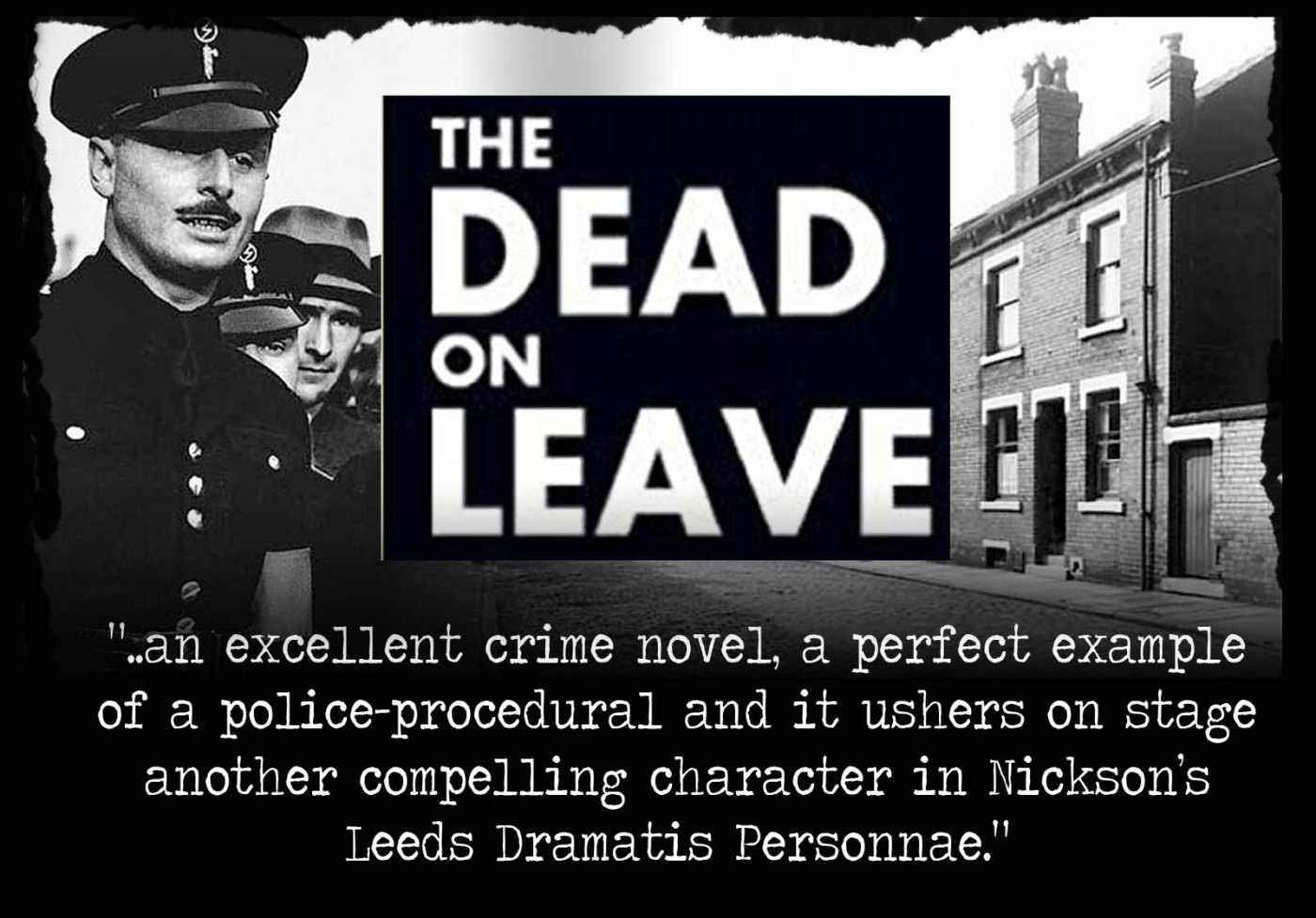

 It appears the dead man is a would-be follower of Sir Oswald Mosley, charismatic leader of the British Union of Fascists and, after an appearance in Leeds by Mosley and his Blackshirts turns into a riot, it is tempting for the police to think that the murder is politically inspired. As Raven tries to make sense of the killing, he has his own demons to face. Like many other Yorkshiremen, Raven is a Great War veteran, even though his war was brief and horrific. Only able to see active service in the dog-days of the conflict, he was unlucky enough to be close to a fuel dump which was hit by a stray shell. There’s a line from a song about that war, which goes,
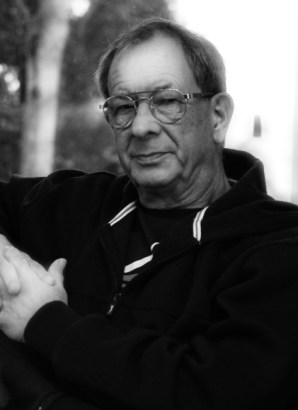 The Dead On Leave is very bleak in places. Hope is in short supply among the working people in Leeds, and men have no qualms about building a wooden platform for Moseley to rant from, because a job is a job; consciences are a luxury way beyond the reach of folk whose families have empty bellies. Nickson (right) is a writer, with social justice at the front of his mind and he wears his heart on his sleeve. I doubt that he and I agree on much in today’s political world, but I can think of no modern British author who writes with such passion and fluency about historical social issues.


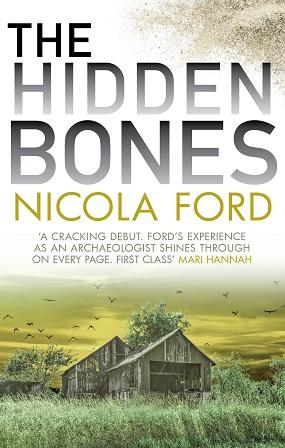 Clare Hills is an archaeologist who is struggling to hold her life together after the death of her husband. Her grief at his passing is tempered by the fact that he has left her virtually penniless. When she is invited by her former tutor, Dr David Barbrook, to help explore and archive the papers of Gerald Hart, she welcomes the chance to use her expertise. Hart was a gentleman archaeologist whose Palladian villa, Hungerbourne Manor, was the centre of his life’s work – investigating the Hungerbourne Barrows. The Bronze Age burial sites were Hart’s obsession, but whatever secrets they held, he seems to have taken them with him to his grave.
 I have many guilty pleasures, and one of them is being a sucker for a crime novel where the landscape plays a vital part in the plot. My two particular favourite writers in this regard are Phil Rickman and Jim Kelly, but with this excellent debut novel, Nicola Ford (right) has elbowed herself into their company.


 fullybooked2017