There are locations for British crime novels that fit certain moods. You can have rural idylls which are shattered by evil deeds – the Cotswolds, the Yorkshire Dales and the majestic Scottish Highlands all fit that bill. Then you have the criminals hiding behind the bright lights of cities like London, Glasgow, and Manchester. James Henry has chosen a rather more understated milieu for his Nick Lowry police novels – Essex, and in particular, the garrison town of Colchester.
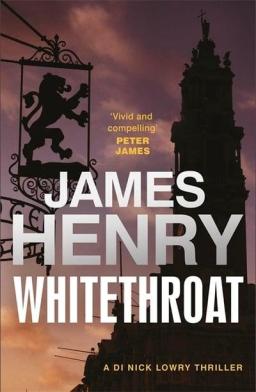 Essex has become something of a trigger word in recent years, conjuring up images such as lavish mansions owned by London gangsters and dumb bottle-blondes with their perma-tanned, medallioned boyfriends. James Henry, however, takes us back forty years to the 1980s. DI Nick Lowry and his boss, Chief Superintendent Sparks, inhabit a police HQ which leaks, has rotten floorboards, and is maybe only months away from the demolishers’ wrecking ball. Sparks contemplates his desk:
“He studied the wooden surface of his desk. Countless semicircles, rings from years of mugs, cups, scotch glasses, placed carelessly and staining the untreated grain. The there were more pronounced wounds and scars: cigarette burns, knife scores, unusual marks – traces of events only the man behind the desk could read.”
Since Roman times, the history of Colchester has been inextricably intertwined with that of soldiering, and it is the death of a young ‘squaddie’ (an unranked private soldier) that Lowry investigates. Improbably, it seems that the dead man was shot in a Victorian-style duel, complete with gentlemanly observance and the presence of Seconds. With the help of his friend Captain James Oldham, of the Military Police, Lowry discovers that the two men had been fighting over a woman. But who was the other duellist, and who was the woman?
The plot goes this way and that, but this is a book that is always about the quality of the prose. Lowry has a young subordinate called Kenton, who has been on leave since being traumatised by the death of a young girl. Kenton is clever, well-educated, but enjoys his stimulants. In pursuit of the more legal kind, he observes pub life:
“..it was different being here as a punter. You saw the place through different eyes; peaceful and inviting and shabbily familiar. Flaking paintwork, worn hardwood surfaces, the yellow, cracked ceiling; a naked aging structure smoothed by the warmth of alcohol and density of cigarette smoke.”
And again:
“The first to arrive were the regulars. Men in their sixties. One, Wilf, was already in situ, perched quietly at a corner table, steadfastly drinking IPA. He would sut there until last orders, then leave as silently as he had arrived. Around midday, the bohemian set – ‘intellectual dossers’, Sparks called them – would drift in. Young men clutching tatty paperbacks. Sucking the end of biros and staring pensively into the middle distance.”
Like most self-respecting fictional police detectives, Lowry’s personal life is something of a wasteland. He is divorced, and his wife has poisoned their son against him. He feels that the years are taking their toll on him, but he remains compassionate:
“Lowry moved to place his arm across Sparks’s shoulders, but instead grasped the nearest arm, squeezed the firm bicep and bowed his head. He was winded by a surge of sympathy, revealing an attachment to the older man that seldom surfaced. Even now – more and more, in fact, the older he became – life caught Lowry out, introducing unsolicited emotions and concerns, age bringing with it a new sort of awareness.”
 The plot is the least important part of this fine novel, but it unfolds gradually. The woman whose favours are being fought over by the duellists is not a woman at all, but a fifteen year-old schoolgirl, the daughter of a local businessman. He, in turn, has unfinished business with a local enrepreneur, and business that dates back to a racial attack three decades earlier. We are in a world of simmering resentment born out of old slights, and the result? The proverbial dish that is best served cold.
Whitethroat is bleak, downbeat and mesmerising; a subtle, compassionate and beautifully written novel that is something of an elegy to a way of policing – and living – that is gone for ever. James Henry (above right), as James Gurbutt, has also written prequels to RD Wingfield’s Jack Frost series. Whitethroat is published by Riverrun and will be out in hardback on 9th July. The two previous Nick Lowry novels are pictured below.


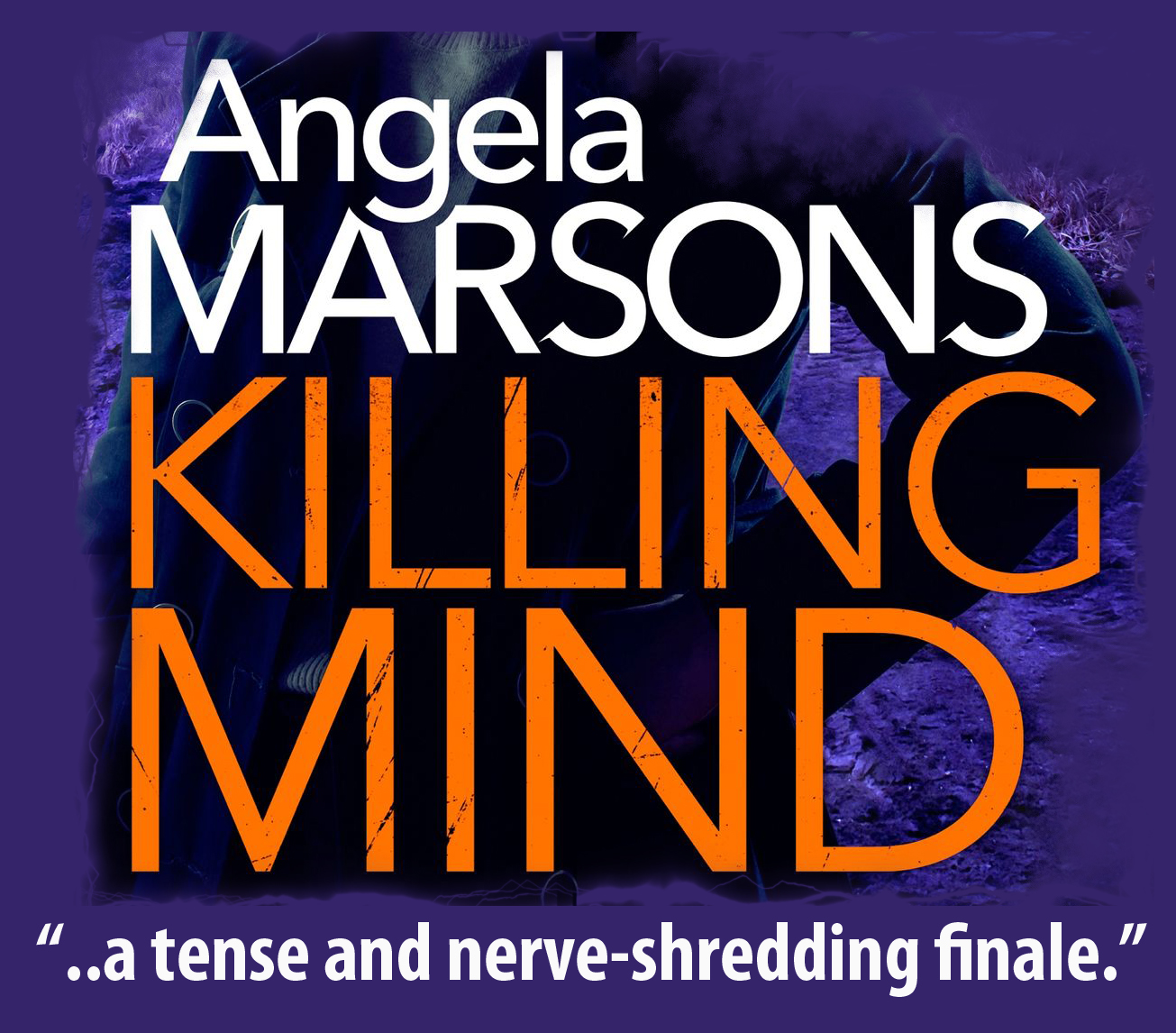

 came late to the party regarding Angela Marsons and her Kim Stone series of police procedurals set in England’s West Midlands, but I thoroughly enjoyed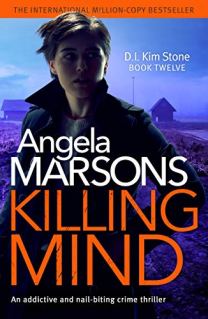
 eanwhile, Stone’s assistant, DS Bryant, has his own fixation to deal with. He was involved in the capture, trial and conviction of a notorious killer, Peter Drake, and has become involved with Richard Harrison, father of one of Drake’s victims. A previously unrepentant Drake has, suspiciously, turned over a new leaf in jail and has become a model prisoner, thus transforming his application for parole from a forlorn hope into a distinct probability. Both Harrison and Bryant are powerless to prevent Drake’s release. Both have a sense of foreboding about what may follow.
 hen Stone makes the decision to send one of her younger officers into Unity Farm, posing as a distressed and unhappy young woman, things do not turn out according to plan and Marsons orchestrates a tense and nerve-shredding finale to the book. When the murderer is unmasked, it came as a cleverly constructed surprise. Killing Mind is published by Bookouture, and







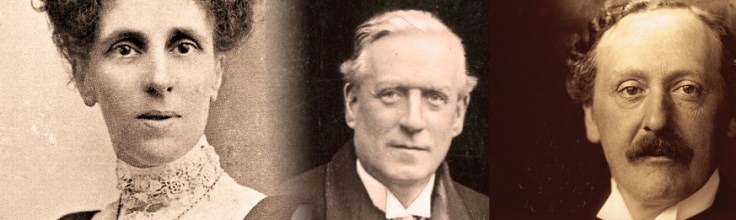
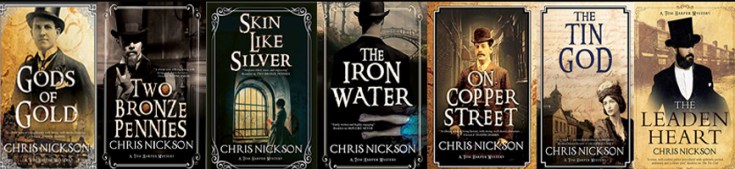
 We first met Leeds policeman Tom Harper in Gods of Gold (2014) when he was a young CID officer, and the land was still ruled by Queen Victoria. Now, in The Molten City, Harper is a Superintendent and the Queen is seven years dead. ‘Bertie’ – Edward VII – is King, and England is a different place. Leeds, though, is still a thriving hub of heavy industry, pulsing with the throb of heavy machinery. And it remains grimy, soot blackened and with pockets of degradation and poverty largely ignored by the wealthy middle classes. But there are motor cars on the street, and the police have telephones. Other things are stirring, too. Not all women are content to remain second class citizens, and pressure is being put on politicians to consider giving women the vote. Sometimes this is a peaceful attempt to change things, but other women are prepared to go to greater lengths.


 ames Oswald’s Edinburgh copper Tony McLean is something of a fixture in the crime fiction firmament these days, and Bury Them Deep is the tenth in the series. For those readers picking up one of his cases for the first time, a little of his back story might be helpful. He is based in Edinburgh and now, of course, works for Police Scotland. He was (unhappily) educated in English independent schools thanks to his wealthy family, some of whose riches he has inherited, thus making him ‘a man of means’. He lives in an old and impossibly roomy house, left to him by his grandmother. He has a fragile relationship with partner Emma, and it is fair to say that their life together has been punctuated by both drama and tragedy. McLean drives a very plush Alfa Romeo, enjoys an occasional glass of cask-strength single malt whisky and, aside from his instinct for police work, has been known to be susceptible to stimuli and influences that are not, as Hamlet remarked, “dreamt of in your philosophy.” After many successful cases, he is now Detective Chief Inspector McLean, but if his superiors imagine he will settle for a life behind a desk, they are very much mistaken.
 Anya Renfrew is a rather dowdy and dull police civilian worker who seems devoted to her job, which is mastering the many databases which keep investigations fed with information. She has never had a day off in her life, and so when she goes missing it is considered rather unusual. Her mother is a former – and legendary – police superintendent, but Grace Ramsay is now old and infirm, living in a care home. Police are never more active than when investigating actual or possible harm to one of their own, and when McLean searches Anya’s house, what he finds hidden in her wardrobe indicates that Ms Renfrew’s private life was more exotic – and dangerous – than colleagues might have imagined.
 cLean’s professional life already has one big complication. A five-times serial killer called Norman Bale is in a secure mental hospital, thanks to McLean’s diligence and bravery. Now, he asks to speak to McLean, and what he has to say is both shocking and improbable. Are his words just the ramblings of a psychological disturbed killer, or does his suggestion – that Anya Renfrew’s disappearance and the moorland bone-pit are linked to a sinister piece of folklore – have any substance?
 t takes a bloody good writer to mix crime investigation with touches of the supernatural. John Connolly, with his Charlie Parker books is one such, but James Oswald (right) makes it work equally as well. The finale of this novel is as deeply frightening as anything I have read for a long time. Despite the drama, Oswald can use a lighter touch on occasions. There is dark humour in the way McLean sometimes needs to ingratiate himself with Edinburgh’s smart set. At an art gallery opening night he listens politely as two guests discuss one of the objets d’art: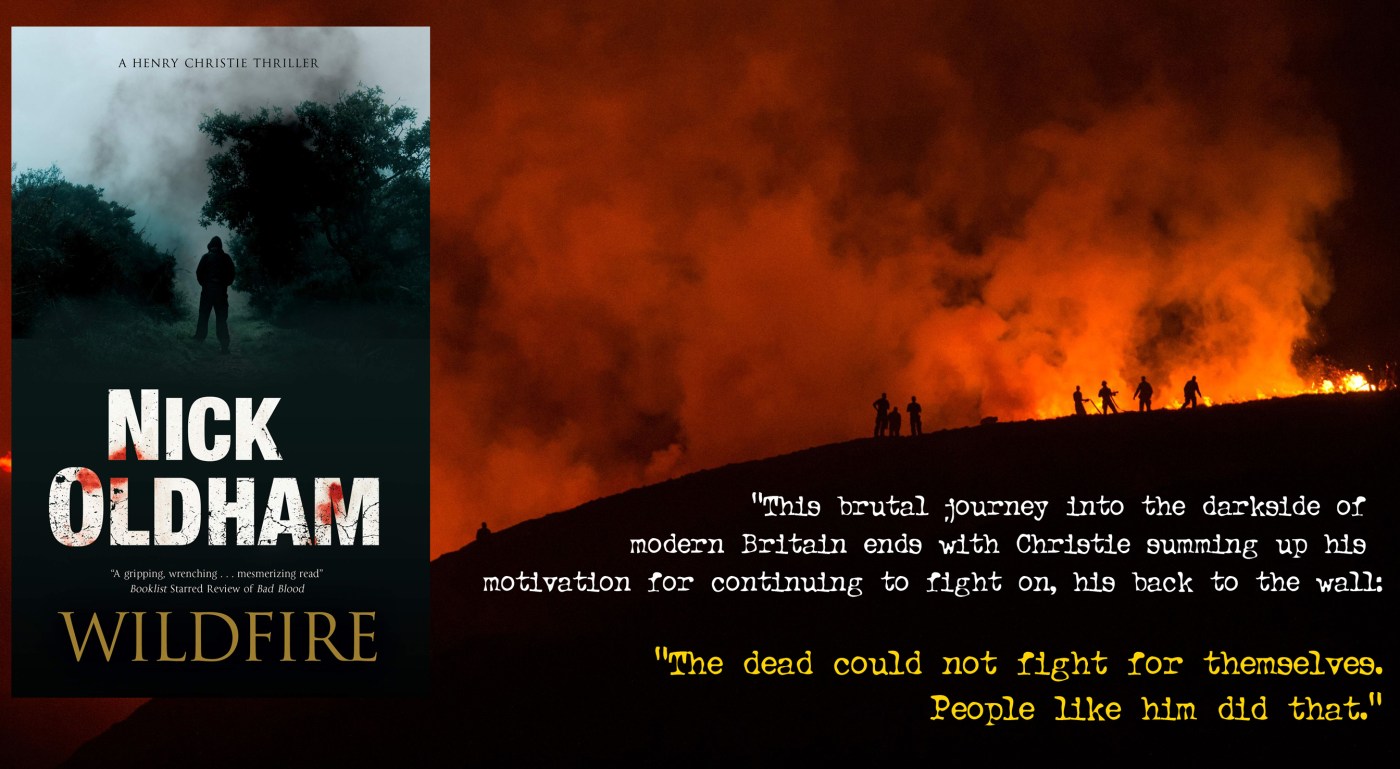

 ack in the day, before authors and their publishers trusted me with reviewing novels, I did what the vast majority of the reading public did – I either bought books when I could afford them or I went to the local library. I had a list of authors whose latest works I would grab eagerly, or take my place in the queue of library members who had reserved copies. In no particular order, anything by John Connolly, Jim Kelly, Phil Rickman, Frank Tallis, Philip Kerr, Mark Billingham, Christopher Fowler and Nick Oldham would be like gold dust.
 Oldham’s Henry Christie was a particular favourite, as his adventures mixed excellent police procedure – thanks to Oldham’s career as a copper – a vulnerable and likeable hero, and an unflinching look at the mean and vicious streets of the Blackpool area in England’s north-west. Wildfire is the latest outing for Henry Christie, who has retired from the police and now runs a pleasant village pub set in the Lancashire hills.
 ventually, the wildfires of both kinds are extinguished, at least temporarily, but not before Henry Christie is forced, yet again, to take a long hard look at himself in the mirror, and question if it was all worth the effort.
 his brutal journey into the darkside of modern Britain ends with Christie summing up his motivation for continuing to fight on, his back to the wall:
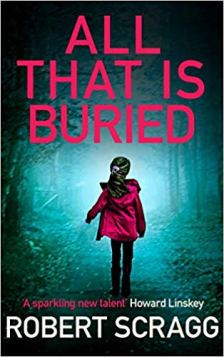 All the fun of the fair? They are strange throwbacks to an earlier, perhaps more innocent time, these funfairs that travel the country setting up in this or that town for a few days of loud music, strings of multicoloured light bulbs swinging in the wind, the shrieks of excited children and the unique smell of candyfloss and toffee apples. All That Is Buried, the latest case for Robert Scragg’s coppers Jake Porter and Nick Styles begins with an abduction in one such fair, pitched on a field in a London suburb. We see some of the story through the eyes of the killer. Our man – if he is indeed the culprit – describes the fair: