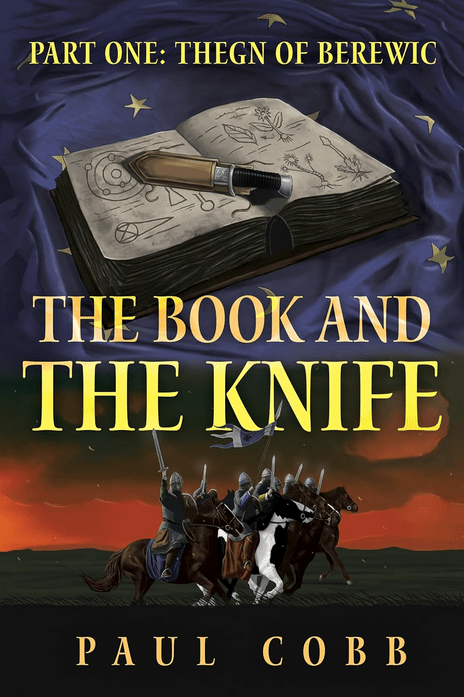

The story begins in 8th century Toledo, but then quickly skips on in time. Same place, but we are in 1031. Three people sit at a table, and there is something close to a seance. The young woman, Samra, is a Sephardic Jew. Felipe is a Benedictine monk from France, while the second man is called Alhacen, and he is an Arabian scientist.. The centre of attention is an ancient book. A spirit voice materialises and, I must confess, my heart sank for a moment, as it seemed I had blundered into some kind of sword and sorcery novel which I avoid like the plague. My fears were unfounded, however, as the narrative soon switches to Sussex, England, also 1031.
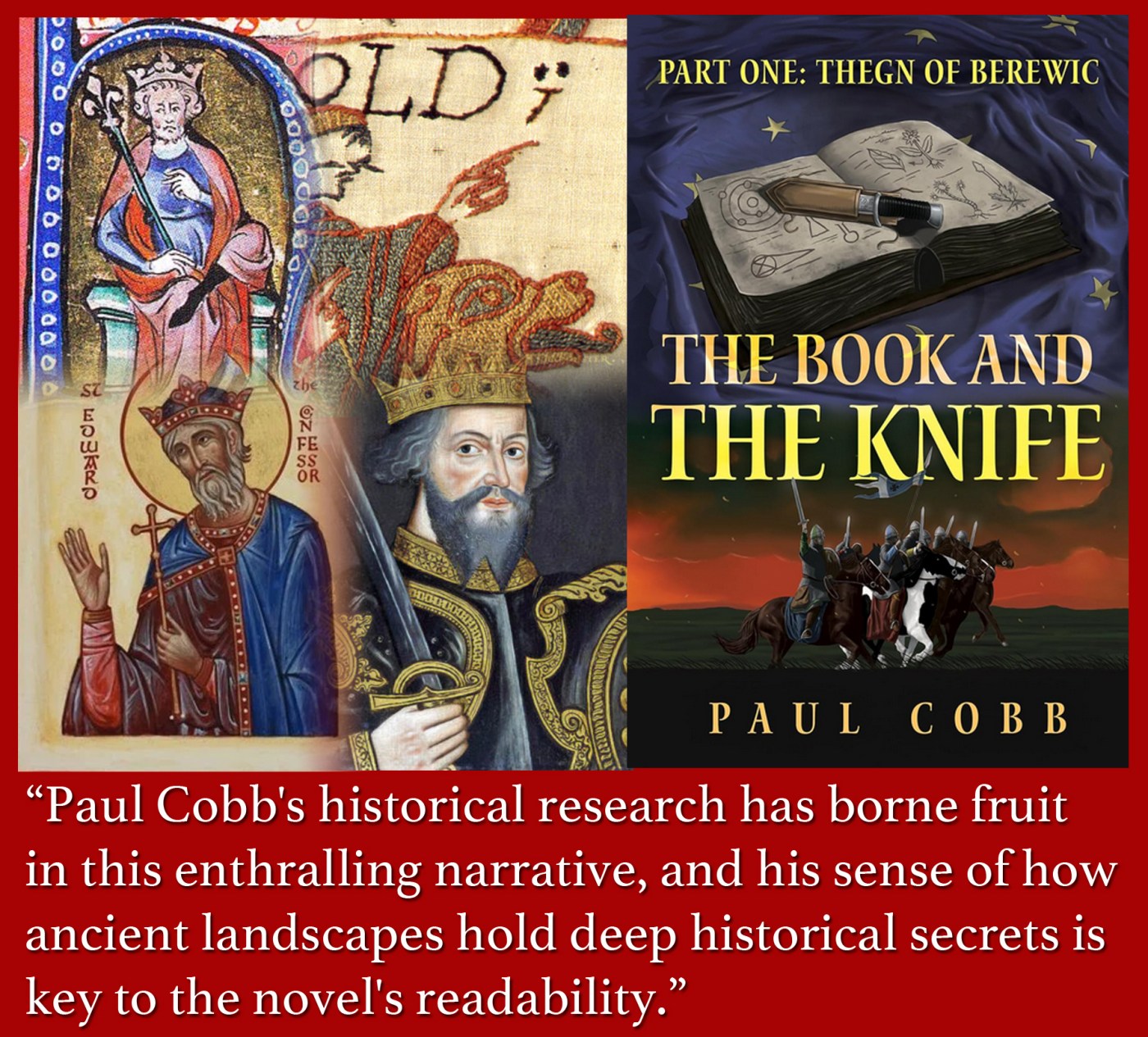
A quick historical heads-up. England in 1031 was ruled by the relatively benevolent Dane, Cnut, while the Moors still ruled much of Spain, as they would until the 15th century. Central to the novel is the dynastic struggle between the House of Wessex, basically descendants of King Cnut, and including Edward the Confessor – and the House of Godwin, headed by Earl Godwin, and then his son Harold. In the background, of course is Duke William of Normandy, who we first meet as an eight year-old boy. On a less regal level, Cobb peoples the villages, fields and forests of southern England and Normandy with convincing characters such as Gilbert, the forester from Valognes, and his daughter Estraya.
The titular objects are not in themselves of deep significance to the lordly participants in this drama, but they are of personal moment to certain individuals. That is, until the powerful men battling to rule England, come to believe that the book and knife between them contain powerful portents that will predict the outcome of the conflict. Then, possession of the treasures, becomes a matter of life and death.The book, an ancient repository of learning, science and astronomy, is eventually entrusted to Felipe, while the knife, with the enigmatic inscription, ‘I save a life, I take a life, I make a life’ on its blade is carried by Samra.
For me, the most powerful chapter of the book, called A King Returns, describes how, on a September day in 1041, on a beach in what we now call Hampshire, the exiled Edward of Wessex returned after banishment. Greeted by a potentially hostile group of Godwin’s soldiers, Edward stepped ashore. He would be crowned King of England in April 1043. Our history remembers him as “The Confessor”. Cobb describes Godwin’s men:
“Like Wulfstan, many of these English were blond-haired. Being brought up in an English family, speaking English as much as Norman French, the two young men had thought themselves English. But now that they could see the waiting line of men clearly, their long hair and broad features, the axes some had at their belts, the round shields with heavy centre bosses that one or two carried, they looked a different race.And everywhere the glint of gold from fine metal work on shield and sword, on belt and helm, to fine needlework on cuff and hem. Truly, this was a race of gods, not men.”
Paul Cobb’s historical research has borne fruit in this enthralling narrative, and his sense of how ancient landscapes hold deep historical secrets is key to the novel’s readability.
“England had greater manors in size, wealth and status, but Berewic had what it needed to prosper. It had a thegn of standing, freemen and villeins to work their own land and do his service and slaves to do theirs. It had light workable land on the slopes above the village to go with the fertile wet meadows in the valley bottom. Woodland behind it to draw fuel and timber from. And the river that provided fish and brought vessels and trade from the sea to its little quay.”
The Book and The Knife is published by Troubador, and is available now.