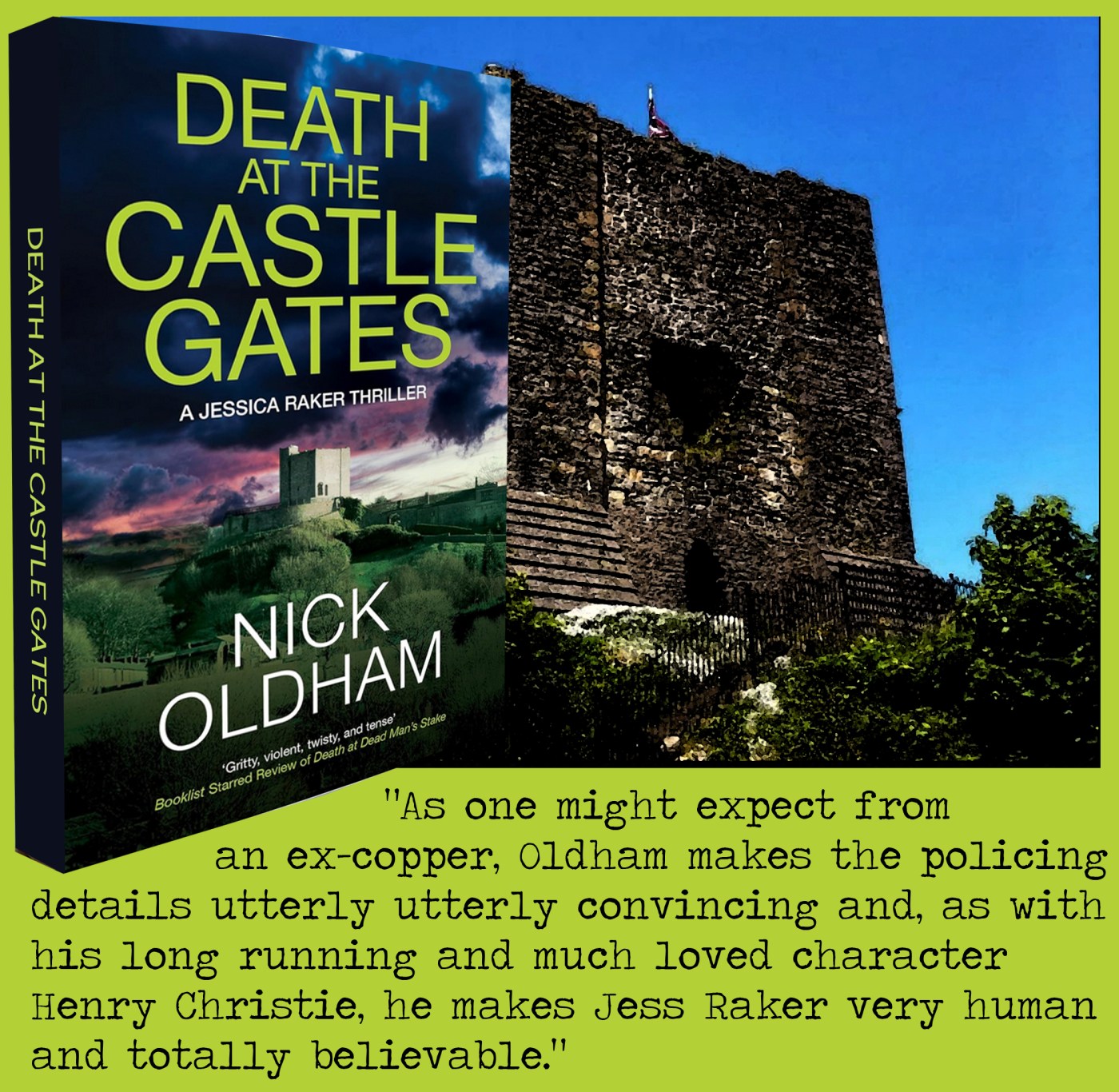
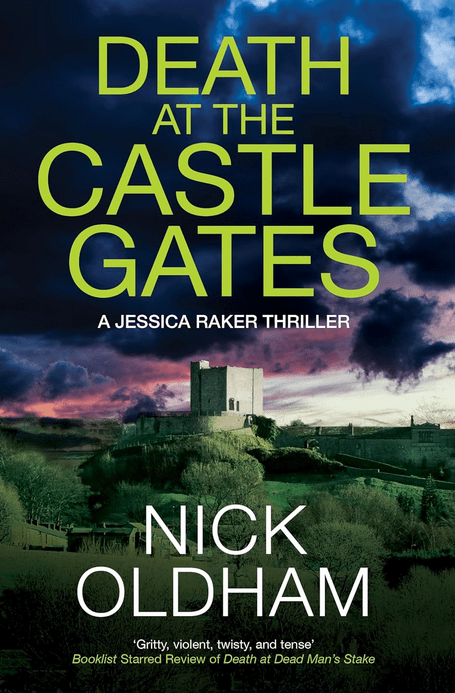
We are back on duty with Nick Oldham’s gutsy Lancashire cop, Sergeant Jessica Raker. We are in the unpretentious town of Clitheroe, and Raker’s colleague DC Doolan is in the final stages of pancreatic cancer, but is determined to do his job until the – literally – bitter end.
They are hunting a local low-life called Rory Walton, now wanted for murder, after he fire bombed his girlfriend’s house. She subsequently died while in intensive care. Although a raid on Walton’s hideout goes pear-shaped, the police discovered a cache of cannabis and firearms. More importantly, it triggers a memory in Doolan’s mind – the shadow of a twenty year-old unsolved murder case, which Oldham gives us a glimpse of in a brief prologue.
Hanging over the book, the series even, is the baleful shadow of Mags Horsefield (nee Goss) a once beautiful but always formidable woman who ruled with a local criminal reign of terror, but has now disappeared, along with her daughter Caitlin, a great friend of Jess’s daughter Lily.
We soon learn that Mags is alive and well. With Caitlin, she is living in a secure villa in Malta, protected by bodyguards and the same ferocious XL Bully dogs who terrorised her Lancashire scrapyard. Her criminal web is largely intact, and she sits at its centre, like a malevolent spider, controlling her empire via burner phones. Back in Clitheroe, Jess Raker’s life becomes ever more complex. Her absent – and errant – husband, living away because of work, seems likely to become very ‘ex’. Rory Walton has teamed up with his equally-criminal brother, and she has to concoct a plan to take them down.
Her Boss, DI Price is determined to belittle her at every opportunity and is (unknown to her) in the pay of serious criminals. Added to those problems, she has encountered the spirits of two children murdered in Victorian times. It is unusual for Nick Oldham to venture into supernatural territory, and I was intrigued to see how this thread would be resolved. As one might expect from an ex-copper, Oldham makes the policing details utterly utterly convincing and, as with his long running and much loved character Henry Christie, he makes Jess Raker very human and totally believable. Death at the Castle Gates will be published by Severn House on 2nd June. To read my reviews of earlier novels in this series, click this link.
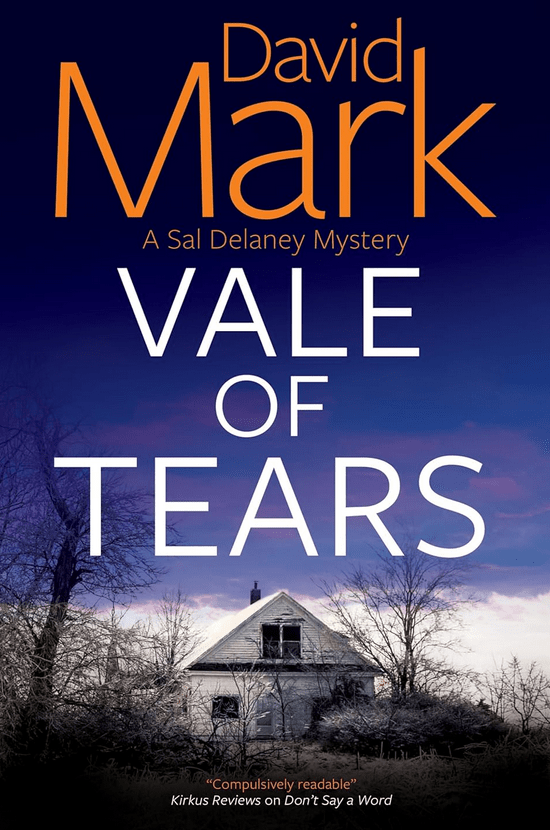
Salome (Sal) Delaney is different from your run-of-the-mill fictional copper. Her speciality is investigating road accidents for Cumbria police and preparing cases for investigation if criminality is involved. It’s certainly unglamorous – and can be gory. Her home situation is also unusual. She lives in Carlisle with Lewis Beecher, fitfully recovering from a catastrophic head injury – and his young daughters. There is a backstory, which is as grim as it is complex. We have Wulfric Hagman, a former copper who served years in jail for a murder he didn’t commit. Dagmar Scrowther MBE, a widely lauded social worker and children’s advocate is now in a secure hospital, serving time for murders she certainly did commit. And then we have Jarod Delaney, Sal’s twin brother. He has taken himself off. To ‘find himself’? Explore the student trail in Bali and Thailand? No-one knows.
Crime novelists who use the device of a prologue have to be careful. A prologue has to appear unconnected to the central narrative timeline, and is meant to keep the reader guessing. For me, if the writer makes us wait too long before revealing the connection, then the device becomes an irritation. Here, David Mark gives us the link fairly quickly. One of Sal’s unofficial stepdaughters is Nola and she, with other friends, has gone out in a boy’s car, to investigate a notorious ruined cottage historically called the Murder House. There, they discover a much more recent cadaver. As they leave in panic, a 4×4 plunges off the road and down the hillside. The woman driver is now in intensive care, fighting for her life.
When Sal attends the RTA, a hill walker alerts her. He, too, has found the corpse in the Murder House. The link? The seriously injured driver is the mother of the boy who drove Nola and her friends out to the old house. As ever in a David Mark novel, just when you think it couldn’t get any darker, he comes up with something to make the reader squirm with yet more unease. Dagmar Scrowther, sitting in her hospital cell, has perfected a ‘dotty old lady’s persona. Brilliantly feigning amnesia she is sitting, like a particularly loathsome spider, waiting for the tell-tale twitches that tell her that yet another gullible victim is stuck in her web.
Another malignant presence hiding in plain sight is Chief Inspector Magda Quinn. Corrupt and ambitious, she has history with Sal and her extended family. The body in the Murder House is identified as that of Rollo Savage a local eccentric, who was obsessed with the unexplained death of Trevelyan Mara in 1880, the event which gave the house its local nickname. Years earlier, Savage had been innocently involved with the Jesus Fraternity, a cult of evangelical Christians subsequently exposed as sexual predators and fraudsters.
David Mark has a dark sense of humour:
“The police constable guarding the scene looks so young that for a moment Sal wonders whether she’s missed an email and that today is really Bring Your Children To Work Day. His fluoro jacket hangs on him as if still on the hanger; There’s a smudgy mustache of pimples across his upper lip and air of general vacancy behind the eyes. Sal can’t help thinking she may be looking at a future chief constable.”
There is a brooding atmosphere of the supernatural that runs through the novel, although it comes from people seeking to find phantoms, rather than the spectres actually appearing. The old practice of scrying is mentioned, an attempt by humans to gaze into mirrors or glass in an attempt to pierce the vale and discover the truth about the past – in this case the real story behind the death of Trevelyan Mara.
Salome herself is not psychic in the accepted sense, but she is sensitive to objects and places that hold particular significance, especially relating to her tortuous – and tortured upbringing. David Mark has a talent for creating memorable and truly nasty villains, but he also peoples his novels with kinder souls whose hearts beat with human compassion. Vale of Tears will be published by Severn House on 2nd June. If you click the author image (above left) the link will take you to my reviews of other David Mark novels.
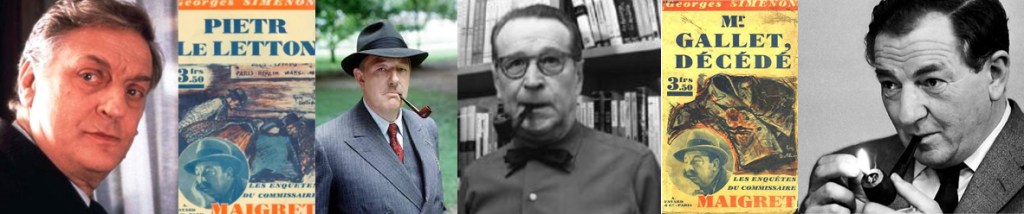
Maigret’s method? It is both complex and simple. Its complexity is deeply rooted in his own humble upbringing in the country, and his understanding of the ways of villagers still in an almost feudal relationship with the Comte in his Chateau. This is tempered with his more recently acquired world-weary awareness of the men and – mostly – the women who live in the demi monde of the Paris streets. The street girls who; “… were young and retained a certain freshness; in some respects they seemed barely more than children …. and there were too many disgusting images in their no longer sparkling eyes.” He also has the uncanny ability to put himself inside the minds and metaphorical shoes of witnesses and suspects. He is also deeply empathetic, particularly with criminals who are the victims of circumstances and their own human weakness. The simplicity lies in one abiding principle. Maigret is slow to judge and never, ever jumps to premature conclusions. Someone asks him, “Do you still think he killed Lulu?” His answer occurs frequently both on the page and on the screen; “I don’t think anything” Here I quote the preface to the Penguin editions of the Simenon novels. “Simenon always resisted identifying himself with his famous literary character, but acknowledged that they shared an important characteristic. “”My motto, to the extent that I have one, has been noted often enough, and I’ve always conformed to it. It’s the one I’ve given to old Maigret, who resembles me in certain points…..”Understand and judge not.”” Rather less cerebral, but pivotal to many of the stories and their adaptations, is Simenon’s love of boating. His aunt kept a shop on the banks of the Meuse and, as a child, he would help out there. He loved pleasure boating, but the massive and ponderous progress of the huge barges patiently hauling their cargoes along the Seine, or the wide canals, left a lasting impression, and it is no coincidence that so many of the novels (and their adaptations) feature barge captains, lock keepers, waterside cafes and their patrons. One of the many joys of the Maigret novels is Simenon’s love of superimposing bizarre or incongruous details onto the squalid business of murdered citizens. In Maigret and the Man on the Bench, the body of Louis Thouret is found in a dingy alley with a knife in his back. When his widow is taken to the mortuary she is flabbergasted to see that he is wearing greenish-yellow shoes and a bright red tie. She avers that she would never have allowed him out of the house ‘looking like that’. As in all other long running crime series, time stands still in the Maigret novels. In The Late Monsieur Gallet (1931) we learn that Maigret is already 45 years old, heavily built and – according to the translation I read – wears a bowler hat. He was born, then, in 1886. This probably explains why he didn’t fight in WW1, because at the age of 28, he was already a policeman, and probably exempt from conscription. This early novel does not feature The Faithful Four. Neither does Madame Maigret appear, except for the briefest of mentions right at the end. Incidentally the solution to Monsieur Gallet’s demise is one of the most bizarre and unlikely all the novels, but that is another story. The final full length Maigret novel was written in 1972, so in terms of society, ambience, manners and procedure the earlier books in particular must fall into the genre of historical crime fiction. Everything is so different; Maigret and his officers drink all the time; they take regular breaks for meals, despite occasionally pulling ‘all-nighters’ with difficult interrogations. There is, occasionally, violence meted out to prisoners; Maigret answers an accusation of such treatment by a defence barrister by admitting, “I boxed his ears, as I might have done to my own son.” When the barrister asks him if he actually has children of his own, the Chief Inspector has to dig deep into personal regret by replying that he had a daughter, but she didn’t survive. We are left to assume that Madame Maigret, years ago, miscarried, or that the baby died soon after birth. Maigret always treats children fondly, and Simenon often puts him into schools, or introduces children as witnesses.Think Maigret and the Seven Little Crosses or Maigret Goes to School Simenon continued to publish Maigret novels during WW2, but wisely steered clear of what the actual Paris Police Prefecture were doing at the time, which was providing a very efficient helping hand to the Gestapo in their quest to round up and deport Jews. The author had his own brush with the system when he was accused of being Jewish. He was able to refute the accusation with appropriate certificates of birth and baptism.
Where, then, does Simenon stand in the pantheon of great 20th century crime writers? In part one, I suggested that he would share the podium with Conan Doyle and Chandler. “No Christie?”, comes the cry, followed by equally impassioned advocacies for Sayers, Mitchell and, in the espionage field, “Le Carre, Deighton and Ambler. I’ll stick with my three. We must not forget that Simenon was certainly the most prolific of the three. As well as the Maigret stories, he wrote longer, more literary novels which he classed as ‘Romans durs’ (literally ‘hard novels’) which we might classify ask ‘Noir’. These have not had the enduring appeal, at least for English readers, as the Maigret stories. Apart from the four longer books, all the Sherlock Holmes adventures were short stories, as were the Brigadier Gerard tales, The full novels such as The White Compan, Sir Nigel, and Micah Clark are little read today. For me, the decider is that here in the UK most of us read Maigret in translation. We can never be entirely sure that what we read is entirely what Simenon intended. In contrast, when Chandler wrote – “There was a desert wind blowing that night. It was one of those hot dry Santa Anas that come down through the mountain passes and curl your hair and make your nerves jump and your skin itch. On nights like that every booze party ends in a fight. Meek little wives feel the edge of the carving knife and study their husbands’ necks. Anything can happen. You can even get a full glass of beer at a cocktail lounge.” – we know precisely what he meant, even if we have been no further west than Llandudno. Philip Marlowe was far too complex and conflicted ever to attract TV producers, so we must be grateful that the relative brevity of the Holmes and Maigret tales have made them them attractive to producers and popular with viewers.
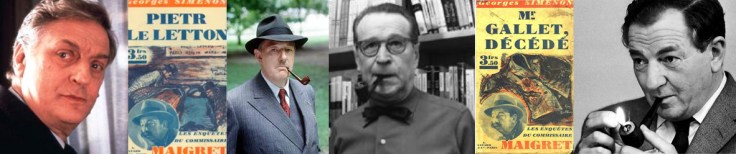
Maigret. The immortal creation of Georges Simenon. The Paris detective was the subject of 75 novels and a number of short stories. He was portrayed on TV by Rupert Davies, Bruno Cremer, Michael Gambon and Rowan Atkinson. What do we know of Jules Maigret? He was raised in the country, where his father was an estate worker. He enjoys his pipe (as did his creator). His wife, Louise, is usually Madame Maigret. In real life, Simenon thrived on a diet of alcohol, tobacco and sex. Maigret is much more restrained. He is steady, thoughtful and insightful. If there were a crime fiction podium, then I suggest that the three finalists would be Simenon, Conan Doyle and Chandler. Who takes the gold is a matter of opinion. Like thousands of otherBritons of a certain age, my first experience of Maigret was through the 55 minutes TV dramas filmed by the BBC in the 1960s. Broadcast on Monday night, they were unmissable. Rupert Davies was middle aged, wavy haired and avuncular. Madame (Helen Shingler) was ever present, but always the tolerant and long-suffering supporter of her husband. At work there was the indefatigable Lucas (Ewen Solon), the keen new boy Lapointe (Neville Jason) and the slightly chaotic but intimidating Torrence (Victor Lucas). When he was killed in one of the episodes, Maigret lamented, ‘he was a lion’. For some reason, there was no Janvier, a copper who featured in the Bruno Cremer series. The biggest problem for me is the fact that the Maigret novels, and I have read dozens of them, were written in French. I have schoolboy and tourist French, but nothing like the knowledge required to read the books in their original tongue. As an ‘A’ level task, I read a Simenon short story, Le Temoignage de l’enfant Choeur, but it was only recently, in a translation, that I finally understood what had happened. What stands between us and the original text is the translator. These good people are linguists, but frequently neither poets not writers. I hope we are better served by translators these days than when Geoffrey Sainsbury translated the first *British editions of the novels. He became notorious for for taking significant liberties with the text, often renaming characters and altering titles. It wasn’t until 1952 that Simenon finally had enough of his English collaborator.and ended the partnership. It has been suggested that the translations were always handed over to Simenon for approval. This was somewhat disingenuous, as Simenon could neither speak or read English.
*The first translations in English began in 1932 and were the work of Anthony Abbott, and published in New York.
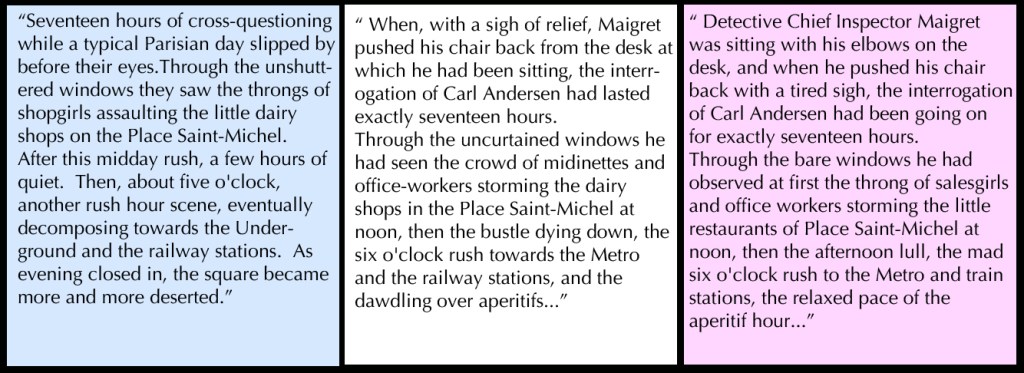
To illustrate the extent to which English readers are at the mercy of translators, the following graphic shows, side by side, three different opening paragraphs of Maigret at The Crossroads. Left is that by Anthony Abbott (1933). Centre is by Robert Baldick, thirty years later, while the one one the right is the work of Linda Coverdale in 2014. My thanks to colleague Stuart Radmore for providing these comparisons.
The egregious “train stations” in the 2014 account will tell you that this is an American translation but, that aside, apart from the fact that Maigret has been interviewing someone for a long time, and that two of the versions mentions his name, the styles are completely different. In part two, I will examine Maigret’s method, take a look at Maigret’s life, and draw some conclusions about where Simenon’s novels stand in the pantheon of 20th century fiction.
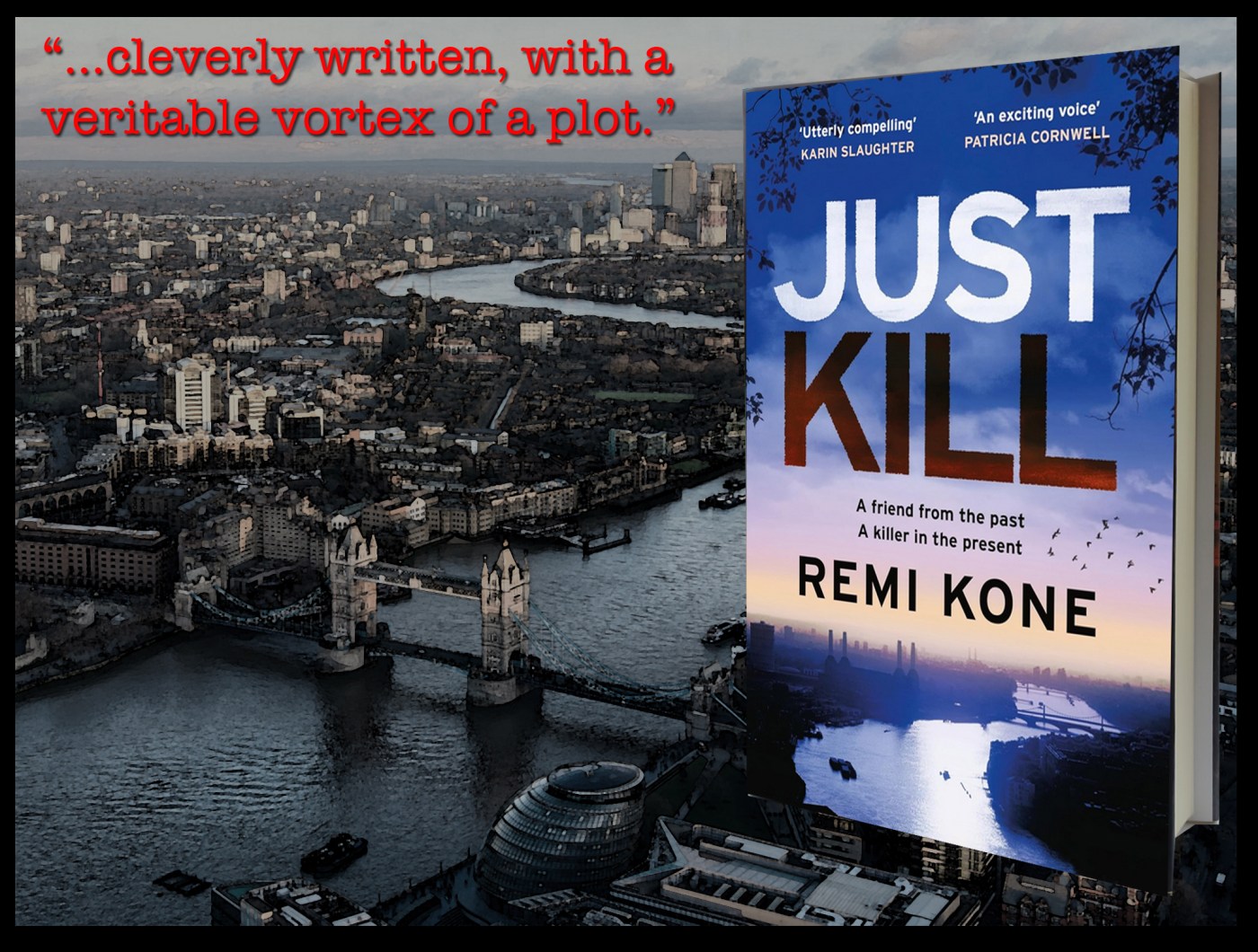
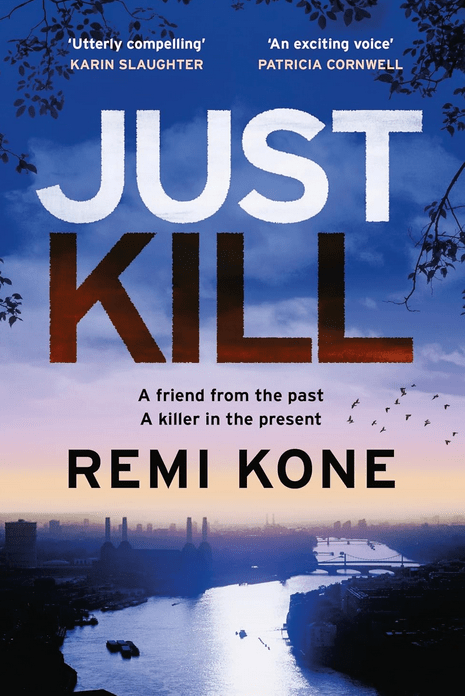
Leah Hutch is a detective working with London’s Metropolitan Police, and she has two murders to solve. That of Ray King is bizarre. His corpse is found on the downstairs sofa of Gabriel McMahon – who swears he has never met the dead man. Sarah Franks, a teacher with a drug problem is found with her throat cut in her dingy flat. It is an unwritten rule of crime fiction, at least in Britain, that police detectives have to be emotionally damaged in some way. I could list examples, but most CriFi fans will know what I mean. Leah Hutch ticks most of the boxes. Her father, Eli Carson, murdered her mother and boyfriend when Leah was little, and is now serving a life sentence. Leah was brought up by her paternal grandmother, Margaretta who was loving – but in her own peculiar way. A friend from Hutch’s schooldays, Sami Mograbi, is found near the scene of Sarah’s murder, but there is no evidence to connect him with the killing.There is also an apparently unconnected parallel plot. A teenager, Zechariah Okoro – known as Zed – is troubled, because his mother has gone missing. The conundrum about what Zed has to do with the story resolves in dramatic fashion. The boy, alone in his mother’s bouse for 24 hours, has noticed a man watching the property. After following the stranger across London, Zed sees the man leave his home, apparently for a run. Zed breaks in. The next thing we know is that Hutch and her sidekick Randle have decided to pay Gabriel McMahon a visit. No reply to their knocks. They phone him and hear his mobile ringing inside the house. After forcing an entry, they find two people. McMahon is dead. Very dead, his blood spattered over the walls. The second person is a terrified Zed, in a foetal crouch, hiding in a wardrobe. Approaching the half way point of the novel, we have are led to believe that there is a professional killer at work. We know him as Chris. He is currently employed by someone as yet unknown, and we assume he is responsible for the deaths of Sarah Franks, Ray King, Gabriel McMahon and – possibly – the disappearance of Zed’s mother. My initial reaction was that Chris doesn’t ‘disappear’ people – he simply murders them and leaves their corpses to provide puzzles for the police. Zed’s mother, Ogechi Okoro, is eventually found alive, after being kidnapped and tortured. Hutch finally discovers a link between Okoro, McMahon and Mograbi. They all studied medicine together at university. But what of Sarah Franks, and Ray King? That question is temporarily pushed to one side when Mograbi is found dead, killed by the same clinical slash to the carotid artery that ended the lives of Sarah Franks and Gabriel McMahon. Hutch discovers something else about the three former medical students – they each took time out to do what was basically work experience in Ghana. Hutch flies to Ghana to investigate – unofficially – and what she discovers not only links the three med students, but also Ray King and Sarah Franks. We also learn that a woman called Bisi, who we know has been followed by the mysterious killer, Chris, was also in the same Accra hospital. There is yet another turn in the plot road, but this time it is more of a hairpin than a gentle bend. The killer of Sarah, Gabriel and Sami is brought to justice, and the final pages hint at a resolution to one of Hutch’s Great Unknowns – the location of her murdered mother’s grave. British Nigerian Emmy-nominated producer, Remi Kone has worked on a number of well-known television dramas, such as KILLING EVE, SPOOKS and LEWIS. She lives in London, and Just Kill is her second novel. It is cleverly written, with a veritable vortex of a plot, is published by Quercus and is available now.
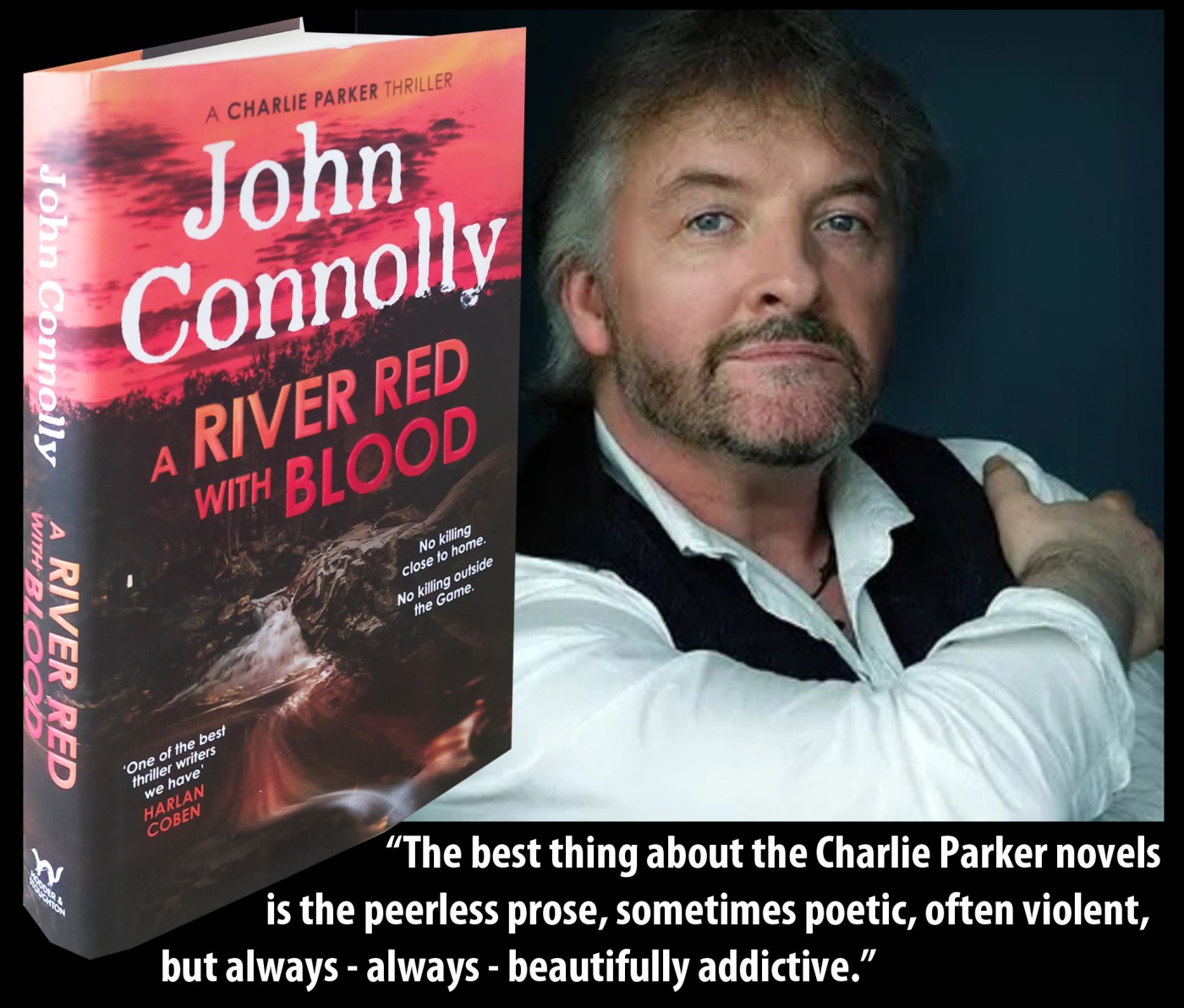
This is the twenty-third in a series that began in 1999, with Every Dead Thing and here, our man investigates the apparent drowning of a troubled teenager, Scott Thierault, who had absconded from an institution set up to provide ‘hard love’. His father, a career criminal serving a jail term, hires Parker out of a mix of deep parental guilt, and a sense that something is ‘just not right’. In an apparently unconnected thread we meet three men who call themselves ‘The Game’. They were once a quartet, but that is another story. Kenney, Teal and The Saint are sexually sadistic serial killers. They target prostitutes, vulnerable addicts and other women who are on ‘the wrong side of society’. Their kills are planned with military precision, forensic awareness, and scrupulous attention to local CCTV capability. We don’t have to wait long before learning the link between the players of The Game and Parker’s new case. When he does his preliminary research into the death of Scott Theriault Parker discovers that another Maine teenager, Mallory Norton, went missing at about the same time. Meanwhile, in a Detroit bar, Teal and Kenney are wondering if their partner The Saint has gone rogue, and may be responsible for whatever has happened to Mallory Norton. We learn about The Spero, the institution from which Scott Theriault absconded. The building itself seems to be cursed. It had been built by the Cistercians in the 1950s, but by the 1990s they had given up on the insect ridden summers and bitter winters, and moved out. It became a National Guard training HQ but, likewise, those tough guys couldn’t hack it. The present owners bought it for a song, and it must be said that Spero School LLC are categorically not a ‘not for profit’ educational provider. We are less than halfway through the book when we learn two things; the identity of The Saint, and what happened to Scott Theriault. Also, a spiritualist medium called Sabine Drew is at work in the county, attempting to ‘get a sense’ of what happened to Scott and Mallory. Unfortunately for Kenney and Teal, their last victim, a woman they took to be a prostitute, was something else altogether, and now they have some very dangerous people, with limitless resources, on their track. Parker’s connection to the world of the supernatural is, of course central to the series, and you either get it or you don’t. Way back in the day, Parker’s wife and daughter were brutally murdered, and now Jennifer, his daughter, occasionally appears to him as some kind of dark angel, not malevolent, but often the harbinger of bad things which are about to happen to her father. The best thing about the Charlie Parker novels is the peerless prose, sometimes poetic, often violent, but always – always – beautifully addictive. A close second, though, comes the reliable repertory company of subsidiary characters. There’s Moxie Costin, Parker’s lawyer: sharp as a tack, as slick as oil, but actually a deeply moral man. As for the Fulci brothers, Tony and Paulie, they are barrel-shaped human wrecking balls: men who are easy with violence but, once again, with a strange ethical perspective. Then we come to Parker’s longstanding confreres, Louis and his life partner Angel. Louis is, again, a man of violence, his nature tempered by his memories of racial intolerance in The South: Angel; scruffy, Latino, but with an intense intelligence nurtured in a criminal past. Readers, we are in impressive company. There are two endings to the story, neither of which contradicts the other; the first is purely human and criminal, while the second definitely belongs in another world altogether. A River Red With Blood will be published by Hodder and Stoughton on 7th May. Reviews of earlier novels in the series can be found here.
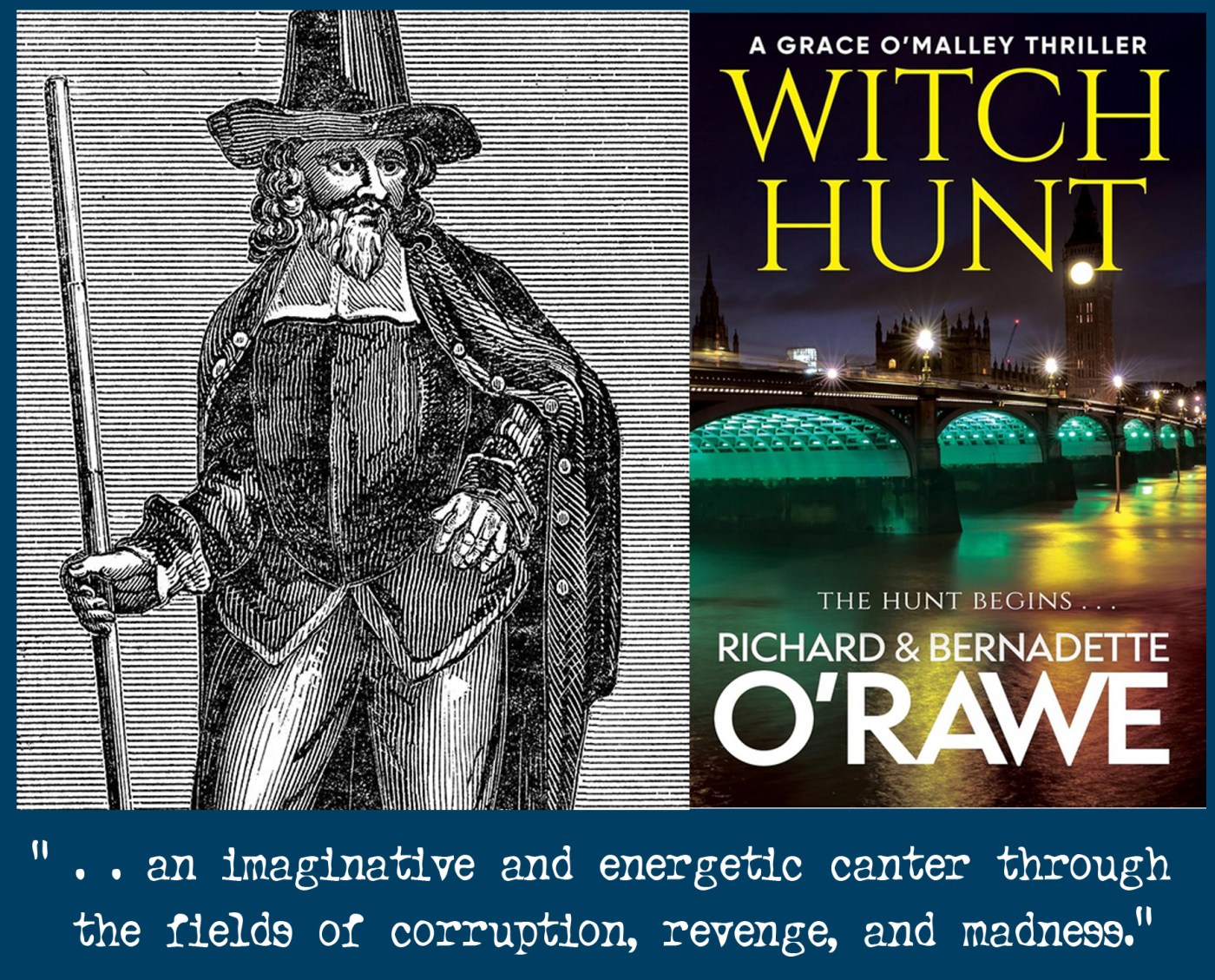
Detective Superintendent Grace O’Malley, of London’s Met Police, is not going to feature in a Sunday evening TV prime time cosy crime series any time soon. She rides a Harley, is rude and abrasive and, for good measure, her husband has a penchant for BDSM sex with students looking to supplement their income. In another part of the city (it is Halloween) we have Juliette Boucher, a TV journalist. She receives a bizarre phone call from a man who calls himself the Witchfinder General. He tells her to be on Westminster bridge just before midnight, where she will witness something beyond newsworthy. And spectacular it is. And gory. A motor launch comes into view, and it is on fire. On it is standing a woman. She burns, too. Then, there is a series of explosions, and the boat sinks. Here’s the thing. It was the so-called Witchfinder General who phoned Grace to tip her off about her husband’s sexual proclivities. When the police try to trace the owner of the boat, they find that it was sold by a retired civil servant to a man called – wait for it – Matthew Hopkins. For younger readers, the real Matthew Hopkins was a Protestant zealot who, around the time of the English Civil War, toured the eastern counties of the country – Essex, Suffolk, Norfolk, Cambridgeshire and Huntingdonshire – in search of those he called witches. It is estimated that he had over two hundred women – mostly guilty of nothing more than being herbalists or natural healers – violently put to death. The man who has named himself after this monster is clearly very clever, has sources inside the police force, and is hell-bent on recreating a reign of terror. His first victim, the woman in the boat? Veronica Crosse, a TV medium and celebrity speaker.
The authors have added another (potentially corrosive) spice to their recipe, and one that is not directly connected to the man who has modeled himself on a 17th century serial killer. Grace’s husband Dominic is himself a copper, but not just any old plod. He is Assistant Commissioner Dominic Boswell, of New Scotland Yard.
We are introduced to a bizarre clergyman named Moses Blackmore, who is the incumbent of a tiny parish near Yeovil. He wears a long black coat, a string tie and has a long silver beard. His human flock (he is also a farmer) are less of a congregation than a cult, and are in thrall to Blackmore’s fire and brimstone brand of protestant fundamentalism. While the police procedural aspect of the book had, this far, been impeccably convincing, I realised that there would be a horror-fantasy element to the narrative, too. That is not a problem. I am a huge fan of John Connolly’s Charlie Parker novels, in which he effortlessly blends the PI genre with the supernatural. It’s just that these days, the Church of England simply does not allow an old fashioned vicar to run a single parish. In real life, Moses Blackmore would be in charge of at least four or five other nearby parishes. And, most likely, he would be a woman.
A little over a third of the way through, there is a dramatic raid and arrest in an upmarket London hotel but, of course, it’s the wrong man, and yet another example of the WFG playing the police like a Stradivarius. There is a second murder, this time of another elderly woman spiritualist, hanged from a church tower and then burned. The WFG (and his associates) cause the filmed scene to be played out on a big screen at a huge public gathering in London on Bonfire Night.
Grace eventually cracks the case (or so she thinks) and finds that the perpetrators are connected to some of the most powerful and influential people in government and public service. There is the mother of all twists in the final pages, but I don’t do spoilers, so you will have to find out for yourself. Witch Hunt is an imaginative and energetic canter through the fields of corruption, revenge, and madness, and it will be published by Severn House on 5th May.
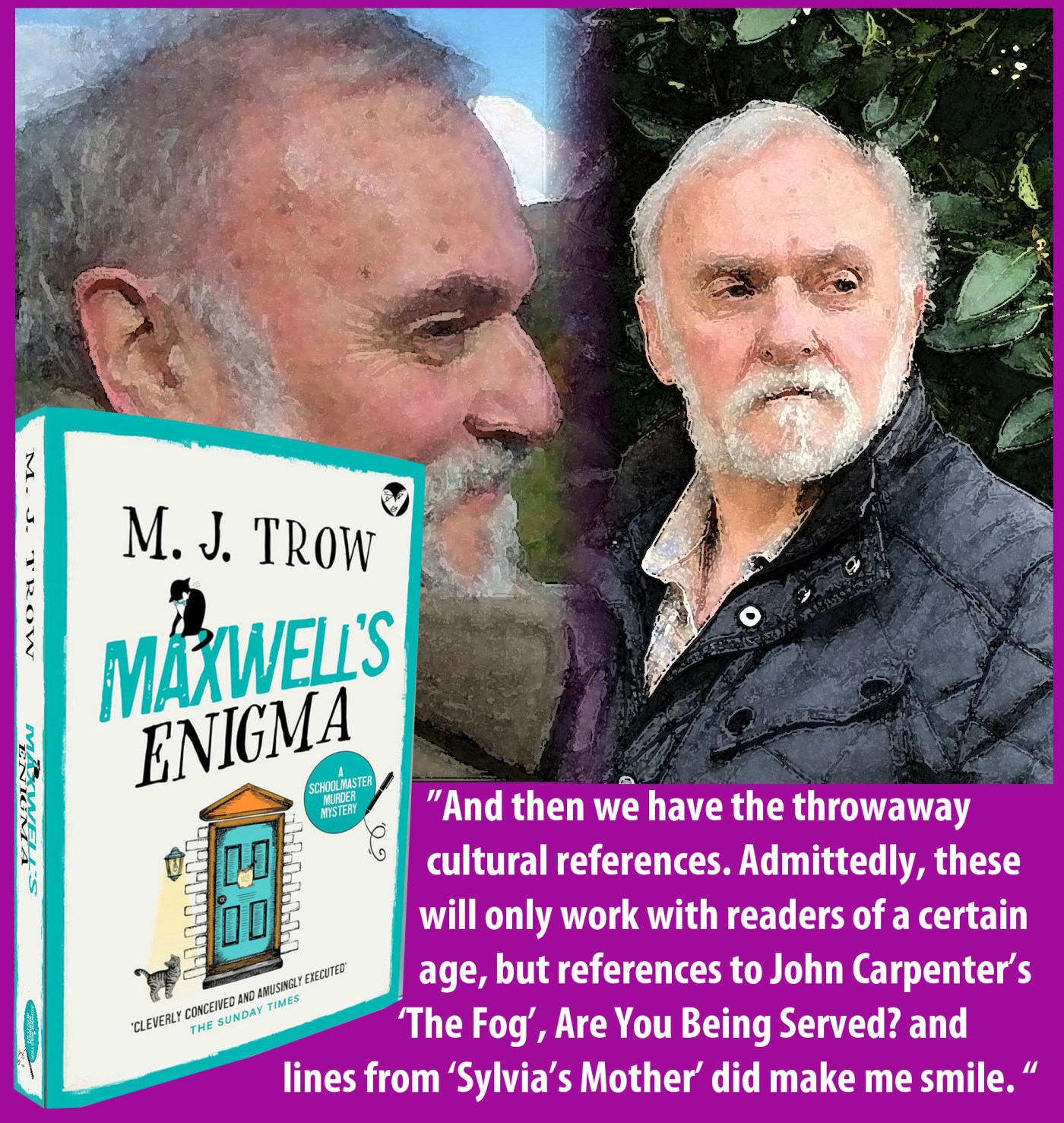
Meiron Trow (left) and I attended the same school in Warwick, but he was a few years behind me, so it would be a lie to say we were school chums. We both went on to spend our working lives as teachers, and I share his endless cynicism about school leadership – and his boundless optimism about the decency of most of the youngsters who we taught.
Peter Maxwell, a history teacher on the south coast of England, is something of a Trow self portrait. The series began in 1994 with Maxwell’s House and now, ‘Mad’ Max returns. I am not a huge fan of modern so-called ‘cosy’ crime. Murder is abhorrent and a blight on society. Surrounding it with the cotton wool of village gossips, eccentric squires, glowing Cotswold limestone villages and inquisitive old ladies might have worked in the 1930s but for me, at least, it doesn’t work now.
What lifts the Mad Max novels is Trow’s deep sense of actual English history – and the humour. His pushbike is nicknamed White Surrey after Richard III’s charger; his son is Nolan, named after the ill-fated officer at The Charge of The Light Brigade. And then we have the throwaway cultural references. Admittedly, these will only work with readers of a certain age, but references to John Carpenter’s ‘The Fog’, Are You Being Served? and lines from ‘Sylvia’s Mother’ did make me smile.
After giving what he thought was an uncontroversial talk to a local history group, Maxwell is told that he has been reported to the local police and accused of a hate crime. New readers will soon be aware that Maxwell’s wife is a police officer. His first wife died in a car accident and he has married Jacquie relatively late in (his) life.
The hate crime accusations seems just the work of a crank, but then there is an explosion in a house in town, and a body is found in the wreckage. The connection? The destroyed house was No. 38 – the same as Maxwell’s home in another part of town. Thanks to that bosom friend of both police officers and crime novelists, deoxyribonucleic acid, the charred corpse from No. 38 gets a name or, to be more accurate, several names. David Vaughan, Drake Parker, Donald Parker, Drake Parkour, take your pick, was, as they say, known to the police. He was also known to a young woman called Meriel, the teaching assistant in the Science Department at Maxwell’s school. They had been together in the audience at Maxwell’s history talk.
Unusually for the series, it is not Maxwell’s detective brain that solves the crime here, but more a mixture of happenstance and downright stupidity on behalf of the criminals. Readers who want to read more by this very prolific author might like to check out his other series, such as his Margaret Murray mysteries, or the Grand & Batchelor thrillers. He has also written non-fiction books about infamous crimes such as the Whitechapel murders and the Meon Hill murder of 1947.
Maxwell’s Enigma is witty, deftly written and thoroughly English. It is published by Joffe Books and is available now.
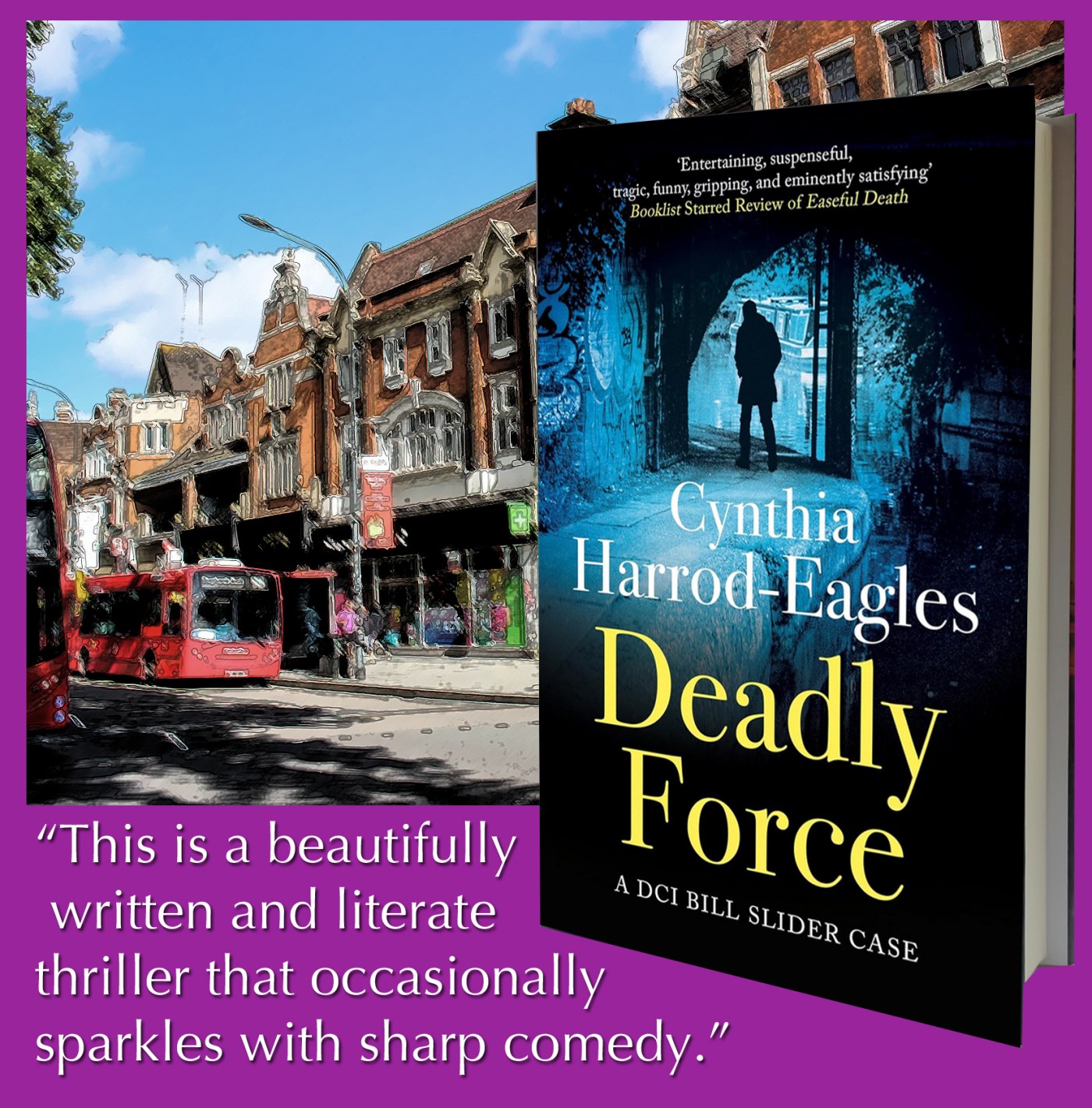
Being ‘late to the party’ in terms of long running crime fiction series is an occupational hazard for amateur reviewers. Yes, we try to cover the ‘big ones’ by such authors as Val McDermid (Tony Hill/Karen Pirie) Peter James (Roy Grace), Mark Billingham (Tom Thorne), John Connolly (Charlie Parker) or David Mark (Aector McAvoy) but there are only so many hours in the day, and sometimes we miss things. The Bill Slider books by Cynthia Harrod-Eagles are, judging by this book, one such, and a series that I regret not discovering years ago. If I may, I will write briefly about the economics of publishing, as it is relevant here. Some crime writers are, relatively speaking, household names, and their books are found on the shelves of TESCO and ASDA. This will be a little while after launch date, and the price will be less than the Amazon tab. In another universe altogether, let us look at libraries. Usually run by County Councils outside of the big cities, these amazing institutions loan books, free of charge to members. Although we are talking pennies, authors receive royalties when their books are borrowed. Severn House is a publisher that specialises in crime books to be sold to libraries. Their Amazon prices reflect this. After all, who would pay £21.98 for Deadly Force, as good as it is? The answer is – buyers for libraries. I am not sure if that is what they actually pay, but that is what Amazon tells us. Of course your ‘free’ library book has already been paid for – by you – through your council tax. Nowadays, local libraries have had to become more ‘inclusive’ by providing computer and internet access to increase footfall, which is all the bean counters at County Hall understand. Incidentally, Severn House has now been taken over by Joffe Books, a very different kind of publisher. Digression over, so back to the book. DI Bill Slider is an astute and amenable Met Police copper working out of Shepherd’s Bush. For out of towners , this is an area of west London, seedy but expensive in terms of housing, well served by London Transport. A body is found in a silted up canal. The corpse is quickly identified as that of Peter Bentley, an unremarkable policeman, working out of Notting Hill. He has been battered to death by someone who was probably, wielding a tire iron. Slider’s enquiries are painstaking, but some facts emerge. Bentley is estranged from his wife, has a zero social media presence and, in his private life, wore an expensive diamond ear stud – which is missing from his corpse.Just about half way through the book, the story takes a delicious twist. The diamond earring is found and, long story short, it was a gift to Bentley from his lover, a wealthy 50-something former actress. Unfortunately for Slider and his team, this new information solves nothing, and only sends a middle-aged Polish couple into the court system for petty theft. Then, from what seems like a complete dead-end, Slider’s persistence finds a thread of evidence and, when he tugs it, the fabric protecting the killer of Peter Bentley rapidly unravels and the killer – uncomfortably close to home – is brought to justice. This is a beautifully written and literate thriller that occasionally sparkles with sharp comedy. Deadly Force will be published by Severn House on 5th May.