Search

fullybooked2017

Tag

London

#TAKEN . . . Between the covers

Taken Header

OK, so Liam Neeson and Luc Besson got their anti-Albanian-gangster campaign in first, but Tony Parsons’ version has a hashtag, and only two citizens of the Adriatic republic bite the dust during DC Max Wolfe’s latest investigation. So, what do we have? Fans of the previous Max Wolfe novels The Murder Bag (2014) The Slaughterman (2015) The Hanging Club (2017) Die Last (2017) Girl On Fire (2018) can look away for a moment during a quick bio of DC Wolfe. He lives in a flat overlooking Smithfield Market. He is a single parent to daughter Scout (as in To Kill A Mockingbird), and has a dog called Stan, to whom he is devoted. Wife Anne is vaguely in the background, but is more concerned with her looks, career and latest boyfriend than she is about her daughter. The Wolfe household is run by a benevolent Irishwoman called Mrs Murphy.

Taken#Taken kicks off, appropriately enough, when a young ballet dancer, Jessica Lyle, is snatched from her borrowed car just yards from the gated luxury home she shares with another girl. From here, Wolfe and his alcoholic boss DCI Pat Whitestone face a veritable University Challenge of questions. Their starter-for-ten is to decide if Jessica was actually the intended victim. Although her father is a retired copper who may have run up an impressive list of enemies, isn’t it more likely that Jessica was mistaken for her flatmate, Snezia? After all, Snezia is not only a dancer of a different kind from Jessica (think ‘gentlemen’s’ clubs, tiny thong and shiny pole) but she is the mistress of fabled former gang boss Harry Flowers. Jessica was driving Snezia’s car when she was taken. Isn’t this just another example of the stupidity of hired thugs?

As if Wolfe doesn’t have enough on his plate, he is forced to cover for his boss when she gets herself into a whole world of trouble. He is far from being a stupid man, but makes assumptions about the Lyle abduction which lead him down a succession of dark alleys, with Whitestone’s obsession with nailing Harry Flowers adding more heat than light as he gropes for the truth.

Parsons takes us on a white knuckle ride through London’s gangland, a place where unpredictable violence à la Ronnie Kray is a marketable commodity, and luxury homes on the Essex fringes are paid for by dark deeds committed in the shadows cast by mountains of wrecked cars in scrap dealers’ yards. Lovers of London will be entranced by some of the locations, including a ghostly disused underground station and the spectacular mortuary extravagance of Highgate West cemetery.

tp003

Amid all the thuggery, armed police raids and visits to some of London’s least-visited curiosities, Parsons (above) finds space and time to deal with Wolfe’s tortuous relationship with his estranged wife. The writing here is full of emotional intelligence, sensitivity, perception, and not without pain. Wolfe’s devotion to his daughter, Scout, could not be more of a stark contrast with Anne’s insouciance, and yet there is still a sense that, to paraphrase Bobby McGee’s un-named companion, he would trade all his tomorrows for a single yesterday. Those who are familiar with Parsons’ best-seller Man and Boy will know that he is writing from the heart.

#Taken is published by Cornerstone/Century and will be out as a Kindle on 1st March, and in April as a hardback. If you click on the image below it will take you to a video of Tony Parsons talking about the book, and reading the first chapter.

Reading

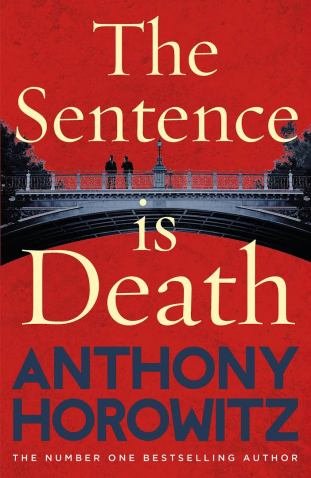
THE SENTENCE IS DEATH . . . Between the covers


TSID coverFor those of you who are unfamiliar with the first book in this series
, The Word Is Murder (and you can read my review here) you need to know that Anthony Horowitz has created a quite delightful literary conceit, and it is this: the story is narrated by Anthony Horowitz, as himself, and along the way we get to meet other real people in his life, such as his wife, his literary agent, and even some of the actors in his Foyle’s War series. The principal fictional character is an ex Met Police officer called Daniel Hawthorne, who was drummed out of the service for misconduct, but now operates as a private investigator, paid by the day by his former employers to work on difficult cases. Hawthorne has persuaded Horowitz to be Boswell to his Johnson and to write up the investigations as crime fiction.

Hawthorne is an intriguing character. He is probably somewhere on the autistic spectrum, lives alone, and has few social graces, His powers of deduction and observation are, however, remarkably sound. He immediately sees through the statement one witness has just given:

“The MG was right in front of us. Hawthorn pointed with the hand holding the cigarette.

‘There’s no way that’s just driven down from Essex of Suffolk, or anywhere near the coast.’
‘How do you know?’
‘The house he showed us in that photograph didn’t have a garage and there’s no way this car has been sitting by the seaside for three days. There’s no seagull shit. And there’s no dead insects on the windscreen either. Your telling me he’s driven a hundred miles down the A12 and he hasn’t hit a single midge or fly?’”

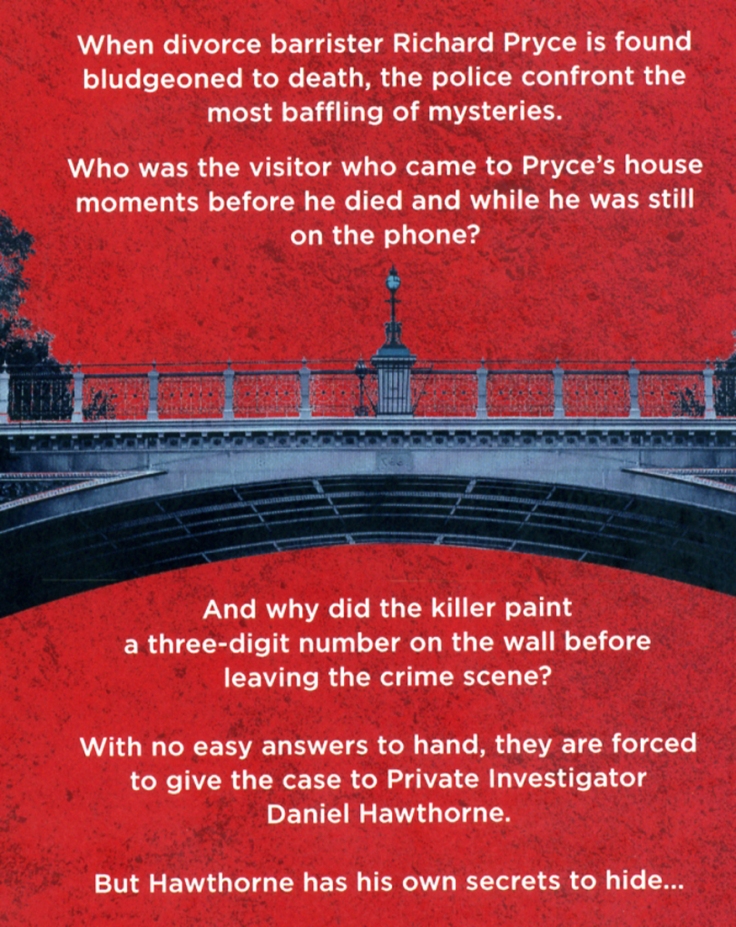
The case which has forced the police to seek Hawthorne’s help concerns a rich divorce lawyer who has been found battered to death in his luxurious house on the edge of London’s Hampstead Heath. For a decade or more Richard Pryce has been the go-to man for wealthy people who have had enough of their wives or husbands and want a divorce, but more particularly a divorce which will leave Pryce’s clients with as much of the family loot as possible. So, it is inevitable that while Pryce is adored by some, he is bitterly hated by others, and thus there are one or two obvious initial suspects. First among these is a rather aloof literary author whose determination to conflate America’s 1940s nuclear strategy with gender politics has won her many admirers of a certain sort. Her expensively produced collection of pretentiously profound haikus (is there any other kind?) has also made her much in demand at soirées in upmarket bookshops.

Then there is Pryce’s art dealer husband who, Hawthorne soon discovers, has been ‘playing away’ with the svelte young Iranian man who is front-of-house in his so, so discreet gallery. Has his affair been rumbled? Was Pryce about to cut him out of his will? The most unlikely connection, however, relates to Pryce’s younger self when he and two university buddies were enthusiastic cavers. Did a tragedy years earlier, 80 metres beneath the Yorkshire Dales, set in train a slow but remorseless search for revenge?

AHThe abundance of questions will give away the fact that this is a tremendous whodunnit. Horowitz (right) tugs his forelock in the direction of the great masters of the genre and, while we don’t quite have the denouement in the library, we have a bewildering trail of red herrings before the dazzling final exposition. But there is more. Much, much more. Horowitz’s portrayal of himself is beautifully done. I have only once brushed shoulders with the gentleman at a publisher’s bash, so I don’t know if the self-effacing tone is accurate, but it is warm and convincing. More than once he finds himself the earnest but dull Watson to Hawthorne’s ridiculously clever Holmes.

Horowitz is, I suspect, too polite to be cruel to fellow writers, but he cannot resist a dig at earnest feminist authors who treat every moment of history as if it were a glaring example of man’s inhumanity to women. Trash fiction does not escape, either, and when his fictional self reads a page from the latest sub-Game of Thrones swords and sorcery shocker, it is horribly accurate. Above all, though, this is a classic 24 hour novel. You start reading, you dart off to do something like pick up the kids, or turn on the oven. Back you come to the book, and before you know it, you are 200 pages in. Time flies by, and then bang! It’s finished. You know who the killer is, but you just wish you could start the book all over again. It really is that good. Published by Century, The Sentence Is Death is out on 1st November.

Long Lee031

PRIZE DRAW . . . Win Hugh Fraser’s Stealth!

Stealth comp header

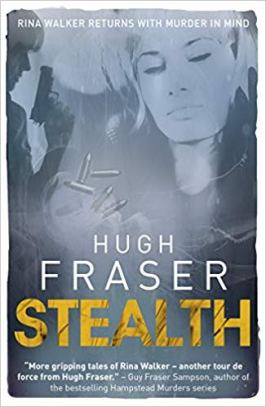
THIS IS PRETTY MUCH THE STANDARD REACTION from those in the know when some foolish functionary in a 1960s London gang decides that Rina Walker is a fragile female who can be taken out of circulation. Rina is a born killer, with fists, firearms, blades – or anything that happens to be handy.

NOW SHE IS BACK in the fourth novel of Hugh Fraser’s popular series. If you would like to win a copy of Stealth (published by Urbane on 8th October) you have three ways to enter the prize draw.

Email

Simply email me at fullybooked2016@yahoo.com, and put ‘Stealth’ as the subject

Twitter

Retweet or like one of the posts about Stealth on the Fully Booked Twitter feed (image link below). These regular posts will link directly to the review of the novel.

twitter-logo-final

Facebook

Just click the ‘like’ option on the Fully Booked Facebook page, (image link below)

FB

Competition closes at 10.00pm GMT on Sunday 7th October. The winner will be notified via social media.

Stealth header

STEALTH … Between The Covers

Stealth header

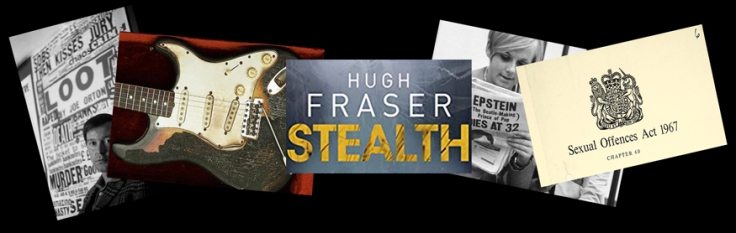
StealthLondon in 1967 seems to have been an exciting place to live. A play by a budding writer called Alan Aykbourne received its West End premier, Jimi Hendrix was setting fire to perfectly serviceable Fender Strats, The House of Commons passed the Sexual Offences Act decriminalising male homosexuality and Joe Orton and Kenneth Halliwell featured in a murder-suicide in their Islington flat. This is the backdrop as Hugh Fraser’s violent anti-heroine Rina Walker returns to her murderous ways in Stealth, the fourth novel of a successful series.
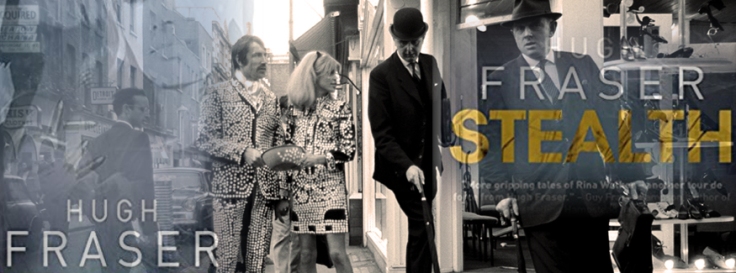
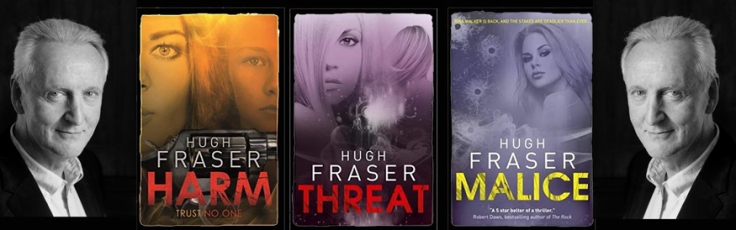
I am new to Ms Walker’s world, but soon learned that a brutal childhood deep in poverty, where attack was frequently the best form of defence, and a later upbringing embedded in the world of London gangsters, has shaped her view of life. Although parliament had decreed that chaps could sleep with chaps, provided both were willing, there was little public approval for chapesses having the same latitude, and so Rina’s love affair with girlfriend Lizzie is accepted but not flaunted.

Lizzie has been set up by Rina as proprietor of a Soho club, more or less legit, but with a multitude of blind eyes which fail to focus on minor breaches of the moral code. When a young tart is found in a club back room, battered to death with a hammer, Rina not only takes offence but wreaks summary revenge. The killer, a bare-knuckle fighter called Dave Priest, is not only thumped by his latest opponent on the cobblestoned back yard of a dingy pub, but becomes the latest victim of what might be called Rina’s Law when she kills him and artfully arranges his corpse to look as if he had slipped on the stairs.

Rina is locked into a world where she is forever repaying favours, or earning them and taking rain checks for a later day. One of her debts is to a grim and sordid gang boss who, in turn, owes a favour to a homicidal maniac currently a patient in Broadmoor. This particular penance involves her bumping off a perfectly innocent builder who has had the temerity to offer the maniac’s wife a new life in the dreamy suburbs of Romford. Rina is not totally without moral scruples, although if you blink you will miss them as they whizz past your eye line at the speed of light. She tries to scam her employer by staging the death of the honest builder, but she is found out in a complex sting involving shadowy operatives of military intelligence.

Stealth middle

Is Rina fazed by the step-up in class from bumping off Essex builders to the complex world of international intrigue, Cold War deception and men in expensive suits who never, ever are who they say they are? No, not for one moment. Whether downing large whiskies in backstreet pubs, or sipping chateau-bottled claret in expensive hotel suites, our Rina is equal to the task, be it on home turf or in the romantically sleazy cafes and bars of Istanbul.

The list of fine actors who have turned their hand to crime fiction is extremely short, not to say minuscule. Even more invisible, except via an electron microscope, is the catalogue of crime writing actors who play languid toffs. I yield to no-one in my admiration for Hugh Fraser in his roles as Captain Hastings and – my absolute favourite – his insouciant Duke of Wellington in Sharpe. The difference between Fraser’s screen persona and the world of Rina Walker could not be more extreme.

To cut to the chase, does Stealth work? It does, and triumphantly so. Fraser might be just a tad too young to have experienced the Soho of the mid 1960s, but if the scene setting isn’t from personal recollection, he has certainly done his homework. My only slight criticism is that I found that the constant mood/time/product placement via contemporary pop song titles began to grate after a while. There is a touch of “with one bound she was free” about Rina Walker, and you  would certainly think twice about taking her home to meet mummy and daddy in Virginia Water, but under the capable direction of Hugh Fraser her adventures provide an enjoyably violent and escapist crime read. Stealth is out on 8th October and is brought to us by Urbane Publications.

Stealth Banner

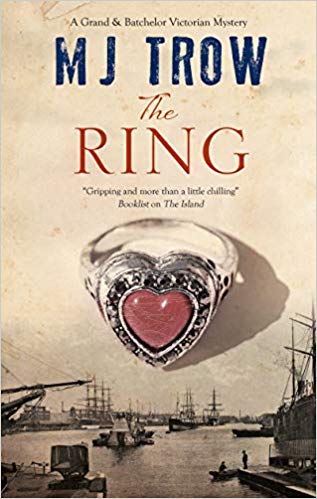
THE RING . . . Between the covers

Ring header

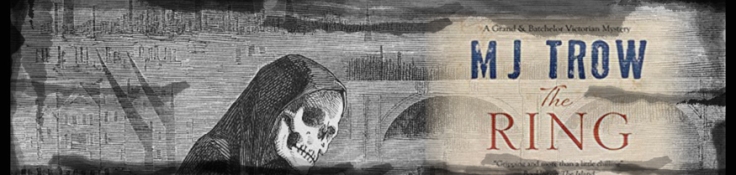
London. 1873. It would be another fourteen years before a gentleman calling himself a Consulting Detective would make his first appearance in Beeton’s Christmas Annual, but Matthew Grand and James Batchelor are just that – people consult them, and they try to detect things. That is pretty much where any resemblance to the residents of 221B Baker Street ends. Neither Grand nor Batchelor is nice but dim, nor is either given to bashing out a melancholy bit of Mendelssohn on a Stradivarius. Matthew Grand, though, has seen military service; rather than battling the followers of Sher Ali Khan in Afghanistan, he has had the chastening experience of fighting his fellow Americans during the War Between The States a decade earlier. While James Batchelor is an impecunious former member of The Fourth Estate, his colleague comes from wealthy New Hampshire stock.

The RingThe River Thames plays a central part in The Ring. Although Joseph Bazalgette’s efforts to clean it up with his sewerage works were almost complete, the river was still a bubbling and noxious body of dirty brown effluent, not helped by the frequent appearance of human bodies bobbing along on its tides. In this case, however, we must say that the bodies come in instalments, as someone has been chopping them to bits. PC Crossland makes the first grisly discovery:
“… he knew exactly what the white thing was. It was the left side of what had once been a human being, sliced neatly at the hip and below the breast. There was no arm. No head. No legs.”

 Trow gives us a Gilbertian cast of comedy coppers, in this case the River Police, led by the elephantine Inspector Bliss. While Bliss and his minions are trying to put together a case – and also the various limbs and organs of an unfortunate woman – Grand and Batchelor are visited by Selwyn Byng, an unseemly and ramshackle character, who believes his wife has been abducted, and has the ransom note to prove it. Byng may look cartoonish, and lack moral fibre; “Where’s your stiff upper lip?” “Underneath this loose flabby chin!” (quoted with due reverence to Tony Hancock and Kenneth Williams) but he has a bob or two, and so our detectives take on the search for the missing Emilia Byng.

It occurs to me that in dismissing any resemblance between H&W and G&B I am missing out one very important personage, and that is the housekeeper. The much revered Mrs Hudson is felt, rather than seen or heard, but Mrs Rackstraw is another matter entirely. The formidable woman dominates the apartment supposedly ruled over by the two young gentlemen:

“Mrs Rackstraw had been brought up in a God-fearing household and didn’t really hold with young gentlemen of their calibre not going to church. Had they been asked, both Grand and Batchelor would have preferred the constant nagging; her frozen silence and the way the boiled eggs bounced in their cups as she slammed them down on the table was infinitely worse.”

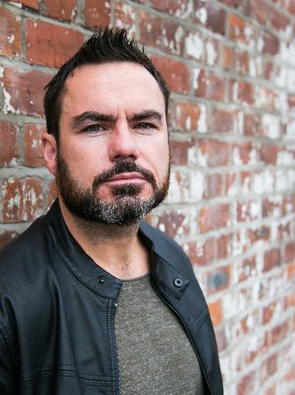
MJMJ Trow (right) has been entertaining us for over thirty years with such series at the Inspector Lestrade novels and the adventures of the semi-autobiographical school master detective Peter Maxwell. Long-time readers will know that jokes are never far away, even when the pages are littered with sudden death, violence and a profusion of body parts. Grand and Batchelor eventually solve the mystery of what happened to Emilia Byng, both helped and hindered by the ponderous ‘Daddy’ Bliss and a random lunatic, recently escaped from Broadmoor. Trow writes with panache and a love of language equalled by few other British writers. His grasp of history is unrivalled, but he wears his learning lightly. The Ring is a bona fide crime mystery, but the gags are what lifts the narrative from the ordinary to the sublime:
“They adjusted their chairs and faced the wall. Mr and Mrs Gladstone stared back at them from their sepia photographs, jaws of granite and eyes of steel. Since he was the famous politician and she was merely loaded and fond of ice-cold baths, he sat in the chair and she stood at his shoulder, restraining him, if the rumours were true, from hurtling out of Number Ten in search of fallen women.”

The Fully Booked review of The Island, the previous Grand and Batchelor mystery, is here. The Ring is published by Severn House, and will be out on 28th September.

Trow footer

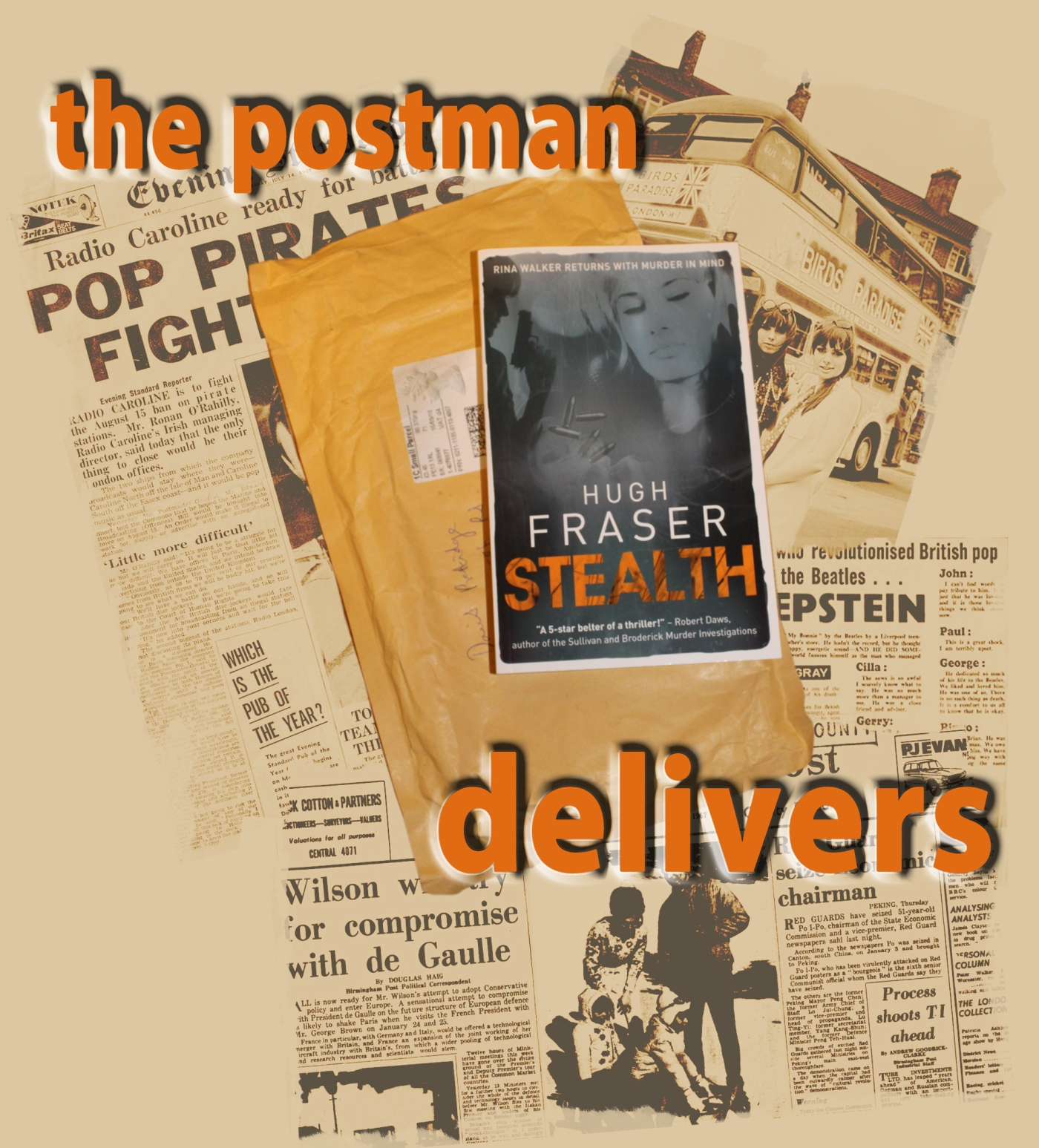
THE POSTMAN DELIVERS … Hugh Fraser

Stealth header

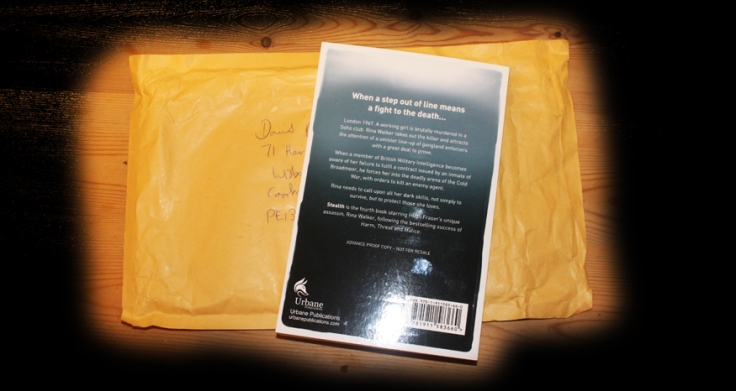
There aren’t too many female assassins out there in crime fiction, and even fewer English ones, so Hugh Fraser’s Rina Walker is a person of interest. For fans of the series – this is the fourth – Ms Walker will need no introduction, but for newbies, she had a childhood which shaped her future. Notting Hill, London, in the 1950s was not the chic neighbourhood it is today. 15 year-old Rina is a thief and a scavenger, of necessity. She avenges an attack on her younger sister, by killing the perpetrator – a local gangster. From here on it is either downhill – or uphill, depending on your view – all the way.

Stealth sees the fearsome lady back on the revenge trail. This time it is 1967 and the victim is a London ‘working girl’; Rina’s actions, however bring her face to face not only with the usual gangland suspects, but the faceless power brokers of British Military Intelligence, and Cold War spooks.

Stealth Banner

Stealth will be available from 8th October in paperback, and is brought to us by Urbane Publications. Watch for alerts on Twitter and Facebook pointing you in the direction of the full review. Meanwhile, you can follow the author on Twitter at @realhughfraser and he is, incidentally, a great fan of the East Anglian county of Suffolk.

urbane footer


WHAT FALLS BETWEEN THE CRACKS … Between the covers

WFBTC header

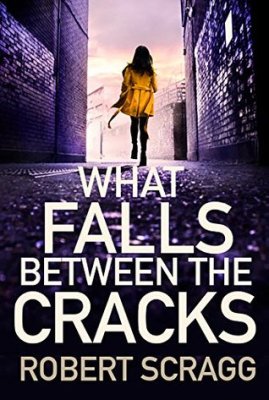
A maintenance man is called to a nondescript block of London flats. Water is dripping through a ceiling. Up he goes to the flat above. Problem solved. It’s a broken down fridge-freezer. He opens the door of the offending item of kitchen furniture. No problem? Big problem. Among the usual items – past-sell-by yoghurts, limp lettuce, yellowing chunks of Cheddar and a couple of shriveled courgettes – is something that really, seriously, does not belong. I mean, who would put a severed hand (minus a finger) in a domestic freezer?

ScraggWith that grim discovery acting as a starting pistol, debut author Robert Scragg (left) starts a middle-distance race to discover who murdered Natasha Barclay. For she is the person, identified by simply reading the opened mail strewn around the tomb-like flat, and checking rental records, whose hand lies in the freezer drawer.
Detective Inspector Jake Porter and Sergeant Nick Styles face enough questions to serve a whole series of University Challenge. Why did Natasha Barclay simply disappear from the radar in 1983? Is she dead? If so, where is the rest of her body? Why have those in her extended family – a stepmother and her second husband – remained silent about her disappearance. Why did her blood father shoot himself all those years ago?

Porter and Styles certainly have the required chemistry to succeed as fictional cop duos. Porter is the senior: he tries not to be trapped in a mindset dominated by the senseless death of his wife Holly, mown down by a hit-and-run driver. Porter seems to be the thinker, while Styles is the doer.

“Styles had his weakness for all things Hugo Boss, his image neat and orderly, close cropped hair, number two all over. A few had referred to him as the Met’s answer to Thierry Henry, until they saw him play five-a-side football. Porter was from Irish stock, his wardrobe more high street fashion and his appearance, while not unkempt, had a more lived-in feel to it; hair so dark it bordered on black, refusing to be fully tamed by gel, but with a sense of messy style to it.”

Porter and Styles scrape away like archaeologists. First one layer of deception is removed, then another, until they uncover substantial foundations hidden beneath decades of criminality, terrible violence and – most shocking of all – police corruption on a devastating and appalling scale. A thrilling shoot-out as a team of officers raid the HQ of the villains involved seems to bring the novel to an end, but Scragg has a couple more twists yet to apply to what is already a very complex and riveting story.

WFBTC coverIf ever there were an single implausible plot device, it might be the premise that a suburban London flat, complete with a severed hand sitting quietly in a freezer compartment, could remain untouched, unvisited and unnoticed for over thirty years. It is, however, a tribute to Robert Scragg’s skill as a storyteller that this oddity was so easily forgotten. The dialogue, the twists and turns of the plot, and the absolute credibility of the characters swept me along on the ride. Porter and Styles have made an impressive debut, and the author may well have elbowed them into that crowded room full of other fictional police partners. They are all out there; Bryant & May, Zigic & Ferrera, Rizzoli & Isles, Wolfe & Goodwin, Morse & Lewis, Jordan & Hill, Kiszka and Kershaw – watch out, you have company!

What Falls Between The Cracks is published by Allison & Busby and is available on 20th September.

A&B

PAST TIMES – OLD CRIMES … Skin Deep by Peter Dickinson

old paper or parchment

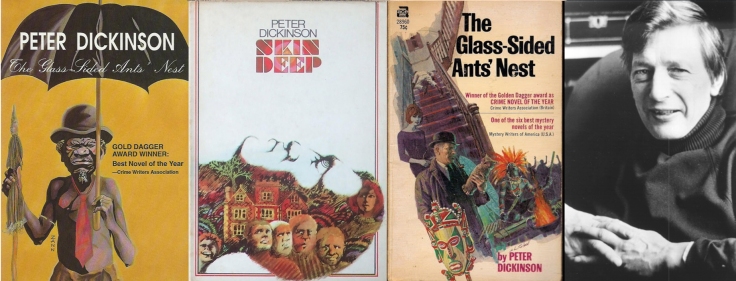
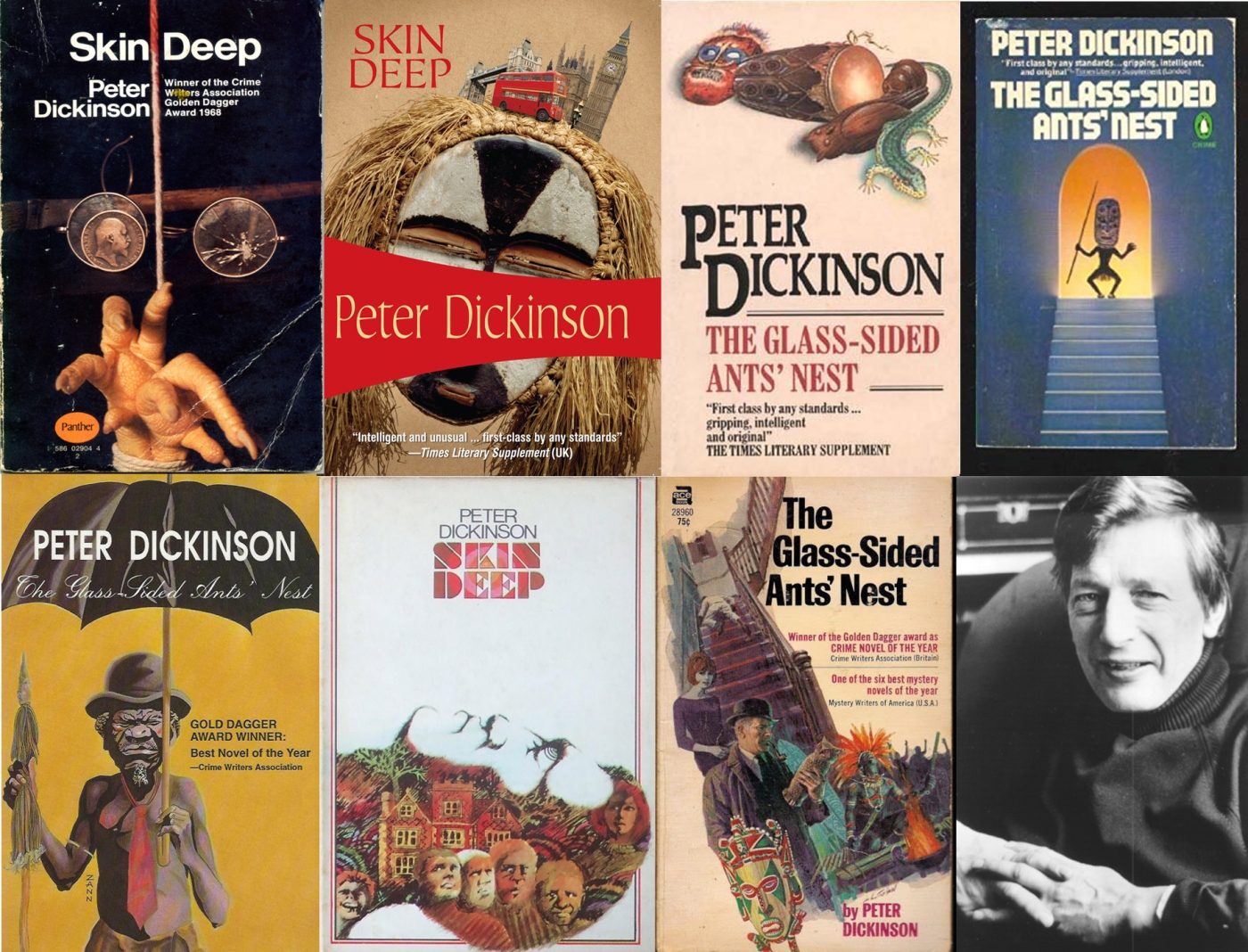
In June 1968 USA publishers Harper & Row released a book titled The Glass Sided Ants’ Nest. The novel, by Peter Malcolm de Brissac Dickinson, aka Peter Dickinson, was simultaneously published in Britain by Hodder & Stoughton as Skin Deep and won a CWA Gold Dagger in that year. Both titles are still available

dickinson_3529483kIncidentally, I don’t think there are many Old Etonian authors around these days, but Dickinson (left) was there from 1941 to 1946, and it is tempting to wonder if he ever rubbed shoulders in those years with another Eton scholar by the name of Robert William Arthur Cook, better known to us as the Godfather of English Noir Derek Raymond, who was there from 1944 until 1948.
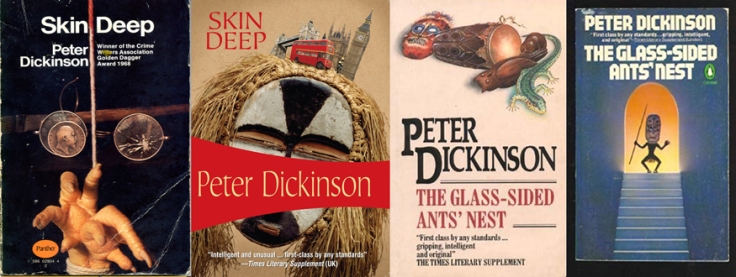
Skin Deep introduces us to London copper, Superintendent Jimmy Pibble, who was to feature in several subsequent mysteries. Already, Dickinson sets out his stall. Writers more ready to twang the purse strings of the book buying public might name their hero something more suggestive of intrigue and danger, like Jack Powers, Max Stead, Dan Ruger, Will Stark or Tom Caine. But Jimmy Pibble? He sounds more like a walk-on player in a Carry On film. But this, we soon learn, is Dickinson’s little joke, perhaps at the expense of lesser writers or less demanding readers. Pibble is highly intelligent, sensitive, but no-one’s pushover and, despite several bitterly ironic turns of events, nothing in the story is played for laughs.

The stage set of Skin Deep is brilliantly bizarre. Even the modern maestro of wonderfully eccentric plots, the Right Honorable Member for King’s Cross, Mr Christopher Fowler, might have baulked at this one. In a sturdily-built but nondescript London suburb, Flagg Terrace, live the exiled sole survivors of an ancient New Guinean tribe, the Kus. They survived a massacre by Japanese invaders in 1943 and have relocated to London. These folk, some crippled by genetic ailments, have transformed their home into a strange replica of their home village. The men lead separate lives from the women, and they practice a religion which is a perplexing blend of missionary Christianity and their native beliefs. Flagg Terrace has not been gentrifird:

“The tide of money had washed around it. The hordes of conquering young executives, sweeping down like Visigoths from the east and driving the cowering and sullen aboriginals into the remoter slums of Acton, had left it alone. Neither taste nor wealth could assail its inherent dreadfulness.”

When Aaron, the leader of the Ku folk, is found dead, battered to death with a carved wooden owl, Pibble is given the task of discovering the killer. He is clearly regarded by his more conventional superiors as a good copper, but something of an oddball, and someone to be kept as away as possible from high profile cases.

banner 1

To say that the Kus are an odd lot is an understatement. Among the residents are Dr Eve Ku, a distinguished anthropologist. She is married to Paul Ku, but she can only be referred to as ‘he’ due to her countryfolk’s distinctive take on gender politics. Robin Ku is, on the one hand a rather clever teenager who has an alter-ego as a Ku drummer, beating the traditional slit drums as an accompaniment to sexually charged tribal rituals. Add into the mix Bob Caine, a neighbour of the Ku’s. He is what John Betjeman called “a thumping great crook”, but he is a sinister fraudster who was not only implicated in the Japanese destruction of the Ku people, but has serious connections to organised crime in the here-and-now.

quote

Skin Deep is a wonderful example of literary crime fiction in which the author doesn’t write down to his audience, but skillfully uses language to evoke mood, ambience and atmosphere. Dickinson’s ear for dialogue is attuned to the slightest inflection so that we instantly know how is talking, without the need for clumsy prompts. Jimmy Pibble is a delightful character with a gentle streak of misanthropy in his soul. His idea of a good pub is:

“…a back street nook kept by a silent old man who lived for the quality of his draught beer. It would be empty when Pibble used it, save for two genial dotards playing dominoes.”

Pibble’s view of the policeman’s lot is similarly sanguine:

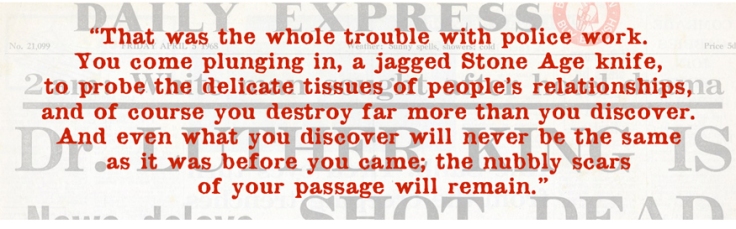
“That was the whole trouble with police work. You come plunging in, a jagged Stone Age knife, to probe the delicate tissues of people’s relationships, and of course you destroy far more than you discover. And even what you discover will never be the same as it was before you came; the nubbly scars of your passage will remain.”

Don’t be misled into thinking that there is anything remotely Golden Age or cosy about this book. It is often darkly reflective, and Aaron’s killer is both unmasked and punished in one tragic moment of unfortunate misjudgment by Jimmy Pibble. There were to be five more novels featuring the distinctive detective:

A Pride of Heroes (1969); US: The Old English Peep-Show
The Seals
(1970); US: The Sinful Stones
Sleep and His Brother
(1971)
The Lizard in the Cup (1972)
One Foot in the Grave (1979)

Peter Dickinson was also a successful and widely admired author of children’s books. He died in 2015 at the age of 88. Click the link to read an obituary.

banner 2

PAST TIMES – OLD CRIMES … The Burden of Proof by James Barlow

old paper or parchment

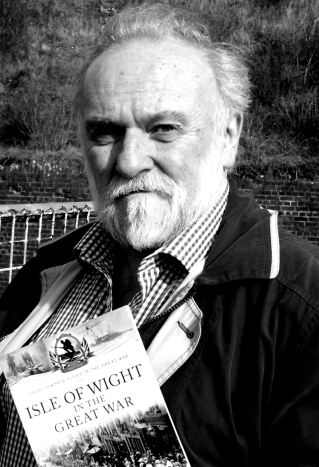
James BarlowJames Barlow was a Birmingham-born novelist who served as an air gunner with the RAF in WWII. Invalided out of service when he contracted tuberculosis, he faced a long convalescence. He began writing at this time, and after he worked in his native city as, of all things, a water rates inspector, he made the decision to write for a living. His first novel, The Protagonists, was published in 1956, but made little impact. It wasn’t until Term of Trial (1961) that he began to make a decent living from writing, and then more because film director Peter Glenville saw the cinematic potential in the story of an alcoholic school teacher whose career is threatened when he is accused of improper behaviour with a female pupil. The subsequent film had a star-studded cast including Sir Laurence Olivier, Simone Signoret, Sarah Miles, Terence Stamp, Hugh Griffith, Dudley Foster, Thora Hird and Alan Cuthbertson.

TERMOFTRIALTerm of Trial was a powerful and controversial film, but clearly had nothing to do with crime fiction. Barlow’s 1968 novel The Burden of Proof was another matter. By the time it was published, the Kray twins’ days as despotic rulers of London’s gangland were numbered. They were arrested on 8th May in that year and the rest, as they say, is history. The Burden of Proof is centred on a Ronnie Kray-style gangster, Vic Dakin. Dakin is psychotic homosexual, devoted equally to his dear old mum and a succession of pliant boyfriends, while finding time to be at the hub of a violent criminal network.

The cast of the subsequent film version of The Burden of Proof was similarly stellar to that of Term of Trial. Villain (1971) starred none other than Richard Burton, Ian McShane, Nigel Davenport, Joss Ackland, Donald Sinden and T.P, McKenna.

TBOF banner

Barlow seems to have been a fairly misanthropic fellow who raged at what he believed was a gathering darkness afflicting an England that he once loved. A year after The Burden of Proof was published he decided he’d had enough, and decided to relocate to a place to which many Englishmen of a previous generation were sent as a punishment – Van Diemen’s Land, latterly rebranded as Tasmania. Barlow’s departure was accompanied by a fanfare of his own devising, a rancorous demolition job on what he saw as a corrupted and increasingly shallow country – Goodbye England (1969)

Much of Barlow’s intense disgust at what was happening around him spills out onto the pages of The Burden of Proof. The crime plot centres on Dakin’s plan to pull off a lucrative wages heist, but this almost becomes secondary to Barlow’s polemic about his homeland being reduced to what he saw as an obscene freak show where morality and integrity were turned on their heads in favour of a mindless and debased popular culture. Re-reading the novel exactly half a century after it was published, I am astonished by how contemporary his words sound. They could be put in the mouths of many modern alt-right commentators. Given access to today’s social media he would rage like an Old Testament prophet and, just like his modern counterparts, he would enrage and delight in equal measure.

Barlow on Speakers’ Corner and the how the statuary of London acts as a metaphor:

“The small indifferent crowds hung around the rostrums on Sundays, laughing at the remnants of free speech. The pigeons excreted as they stood on the heads of statues of forgotten men of a time despised now by the liberals who knew better …”

1960s London is portrayed in the bleakest of descriptions:

“London was tired, seedy, cunning, ugly, here and there beautiful. In 1914 it had been at its most powerful; in 1940 at its most heroic. Now, in the 1960s, it was impotent and had the principles and self-importance of an old queer.”

As I read Barlow’s cri de cœur about what he clearly saw as the triumph of the metropolitan elite, I might have been something by Rod Liddle in one of his recent rants in The Spectator or The Sunday Times;

“Nobody could do anything now without being accountable to the scorn of the liberal intellectuals in print or on television. England was too articulate at the top. Nobody, even in a Socialist liberal permissive society, had the slightest notion of the wishes of the people, out there beyond the great conversational shop of London.”

8317246In the city which is portrayed as little more than a moral sewer, we have the vile Dakin and his criminal associates; we have an earnest and incorruptible copper, Bob Matthews who Barlow sets up – along with Bob’s mild-mannered and decent wife Mary – as the apotheosis of what England used to be before the plague took hold. We have Gerald Draycott, a dishonest and manipulative MP who flirts with the dangerous world of gambling clubs, casinos, girls-for-hire and drugs-for-sale, but still dreams of becoming a cabinet minister.

Back to the crime story. Dakin’s attempted wage-snatch, described in terrifying detail, does not go according to plan, but such is the depth, ferocity and intensity of the man’s evil, that there are casualties a-plenty beforte he gets his come-uppance. There is also a terrible incident, unconnected and not criminal by intent but more a result of negligence, which is described in horrific detail and left me dry-mouthed with a mixture of pity and shock. Of the people, volunteers, who help with the consequences of the disaster, Barlow says;

“They came when England and London needed them, and sank back into obscurity afterwards while the more important people postured before cameras with their guitars or explained the need to hate Rhodesians, or Arabs, or Israelis, or Americans…”

Nothing else I have read by Barlow comes close to The Burden of Proof in terms of its rage, its disgust and the sheer firepower of words when used by someone who believes he is on a mission. You may be appalled, you may be left thanking whoever you believe in that we live in more ‘enlightened’ times, but if you read this bitter and brilliant novel and don’t experience an emotional jolt then you may well be in a permanent vegetative state.

For a more recent slant on the real life connection between Ronnie Kray and powerful political figures in the 1960s, take a look at Simon Michael’s novel Corrupted.

Screen Shot 2018-09-01 at 15.18.48

Blog at WordPress.com.

Up ↑