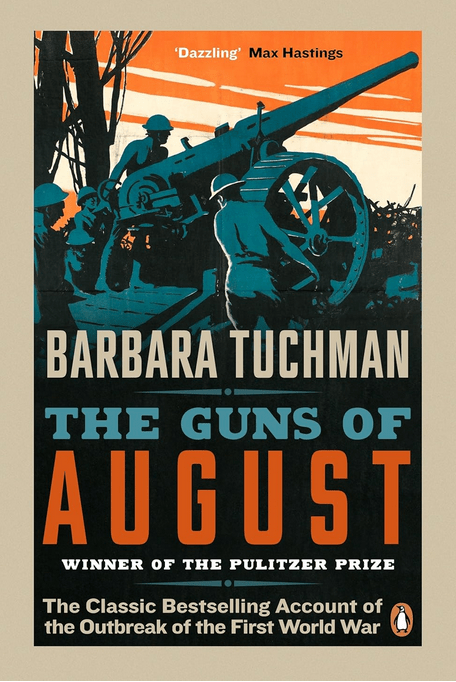

Barbara Tuchman’s The Guns of August was published in 1962. I was then 15 years old, and any reading I did was probably set texts for the looming ’O’ Level examinations, so I hope I can be forgiven for not reading her account of the events of 1914 earlier than 1973, when I was gifted a copy by a fellow teacher in Melbourne. Then, I read it at every opportunity, including the tram journeys to and from work along St Kilda Road. Her narrative drive, grasp of detail, and her ability to bring to life the petty and petulant relationships between senior military commanders and the sheer starving, parched and blood – shod lives of the poor bloody infantry, gripped me then, and I was determined to re-read it from the view of a widely-read and cynical near-octogenarian.
First, some publishing context. Between the wars there were many personal memoirs of the Great War, some of which were well written and historically accurate, but others less so. In what we now call the Cold War period, writers began to revisit the various hells of The Great War. Below is a very limited chronology of those 1960s publications.
1958 In Flanders Fields, Leon Wolff
1961 The Donkeys, Alan Clark
1961 Covenant With Death, John Harris*
1962 The Guns of August, Barbara Tuchman
1963 Haig, the Educated Soldier, John Terraine
1964 The Somme, Anthony Farrar Hockley
*This is a novel, albeit a very good one, based on the experiences of a Pals’ Battalion on !st July 1916.
Barbara Tuchman (nee Wurtheim) 1912 – 1989, won the Pulitzer Prize twice, once for this book and also for her account of a rather obscure (for Britons) episode in American history, the story of General Joseph Stilwell and his deeds in the Far East during WW2. One oddity is that in Tuchman’s account of the events leading up to the outbreak of WW1, and the chaotic eight weeks that followed, there is apparently little to interest her American readership, apart from the occasional reference to President Wilson, whose fervent desire for neutrality was never tested during this time. It is, admittedly, just one indicator, but when I logged in to Abebooks (other sellers are available) to check for second-hand copies, most of those on offer were in America. Incidentally, a mint first edition would set you back £ 918.72 plus £ 40.88 shipping. Even within the sometimes fantastical pricing world of second hand book dealers, one has to confess that, as good a book as it is, it is not that good.
Sadly, in my recently acquired version of the book, the maps were poor, but Tuchman’s vivid narrative and her awareness of the geography were sufficient to let me see the ‘lie of the land’. Her account is not comprehensive. The Russian victories over Austria Hungary in Galicia are only mentioned in passing but, taking the long view, they were to have no lasting impact on the war. For a description of how the conflict flared up in other parts of the world, I must send you in the direction of Ring of Fire, by Alex Churchill and Nicolai Eberholst (link to my review here). Tuchman focuses on three main battle zones, the clash between Russia and Germany in East Prussia, the fighting on France’s eastern border with Germany in Alsace Lorraine and, crucially, the Schlieffen Plan, involving Germany’s thrust through Belgium and down into northern France.
As much as Tuchman shows an astonishing grasp of geography, strategy and tactics, at the core of the book is her vivid portrayal of the key political and military figures who strutted their brief hour on this most bloody of stages. Strutting around on the edge of the German war effort is, of course, the Kaiser, but Tuchman wastes little time on this vainglorious man, neither does she use up much of her word count on Tsar Nicholas who was, despite his grandeur, only remotely connected to the events at the Front. Bestriding the narrative like Shakespeare’s Colossus is Joseph Joffre, the French commander in chief. His main quality was his stoic imperturbability. His world was based around three meals a day, a deceptively placid and ruminative character, and what modern writers might call ‘the long view’.
On the German side, Von Moltke was, nominally the puppet master, but under his command were such men as the mercurial Von Kluck, in charge of Schlieffen’s dictum that ‘the last man on the right should have The Channel at his back.’ On the Russian front, despite the enormous manpower superiority of the Tsar’s army, chaotic and disorganised supply lines resulted in the catastrophic defeat at Tannenburg, after which the Russian general, Samsonov, shot himself in a nearby forest.
So how does Tuchman portray British involvement in these tumultuous and violent weeks? Dispassionately, I would say. At the centre is Sir John French, one of the few British WW1 commanders not as yet successfully ‘rehabilitated’ by modern historians. She gives us a nervous and fractious little man, on his right hand the fragile Sir Archibald Murray, while on his left the eternal schemer, the suave Francophile Sir Henry Wilson. All British Great War buffs have been brought up on the story of Mons, and the murderous rifle fire of the BEF’s Lee Enfield rifles. The subsequent retreat is no less factual, nor is Horace Smith Dorrien’s calculated rearguard action at Le Cateau ( in direct contravention of French’s directive) In the end, French – belatedly and with reluctance – committed the BEF on the Marne.
It would be comforting to think that French’s custodianship of the BEF was a presage of the 300,000 men who lived to fight another day 26 years later at Dunkirk, but French then went on to preside over Ist Ypres, 2nd Ypres, Neuve Chapelle, Aubers Ridge and Loos, by which time most of the old BEF were just names on grave markers. Sir John’s own account of the events, 1914 (published in 1919) differs hugely from Tuchman’s account. French’s book (and I have read the relevant chapters) does, as one might expect from a man who was a brilliant cavalry leader in earlier war, exaggerated the role played the mounted troops. In his own lifetime, French’s book was vigorously criticised by none other than Sir John Fortescue, the official historian of the British Army. It is easy to criticise French, as he was ill-equipped for his role, but unlike General McLellan and his massive Army of The Potomac in the early stages of the American Civil War, he did not overestimate the strength of the enemy. The BEF’s six infantry divisions were dwarfed by the strength of both the Germans and the French.
Tuchman has a special place in her narrative for the military governor of Paris, Joseph Galieni. Wisely, she plays down the frequently exaggerated role played by the Paris taxis in the prelude to The Battle of The Marne, but she is unstinting in her praise for Galieni’s strategic awareness.
The social trope that involves the Germans employing impeccable strategy to secure sun beds in Mediterranean hotels, or their ability to devise cunning formations in football midfields must have had its birth somewhere, but it certainly wasn’t in the high summer of 1914. Yes, their precise railway timetables worked well up to a point, but became useless when it was realised that German engines and rolling stock wouldn’t work in Belgium or France because of different gauges. The relentless planned advance of Von Kluck’s divisions was all very well on paper, but when the field kitchens could not keep pace with the leading infantry units, and when men marched in wrecked boots filled with blood, the reality was very different. Tuchman paints a vivid picture of Germany’s armies, hundreds of miles from home, bloodshod and exhausted, sleepless and half – starved, facing a powerful French force and a largely intact BEF in what came to be known as the First Battle of The Marne.
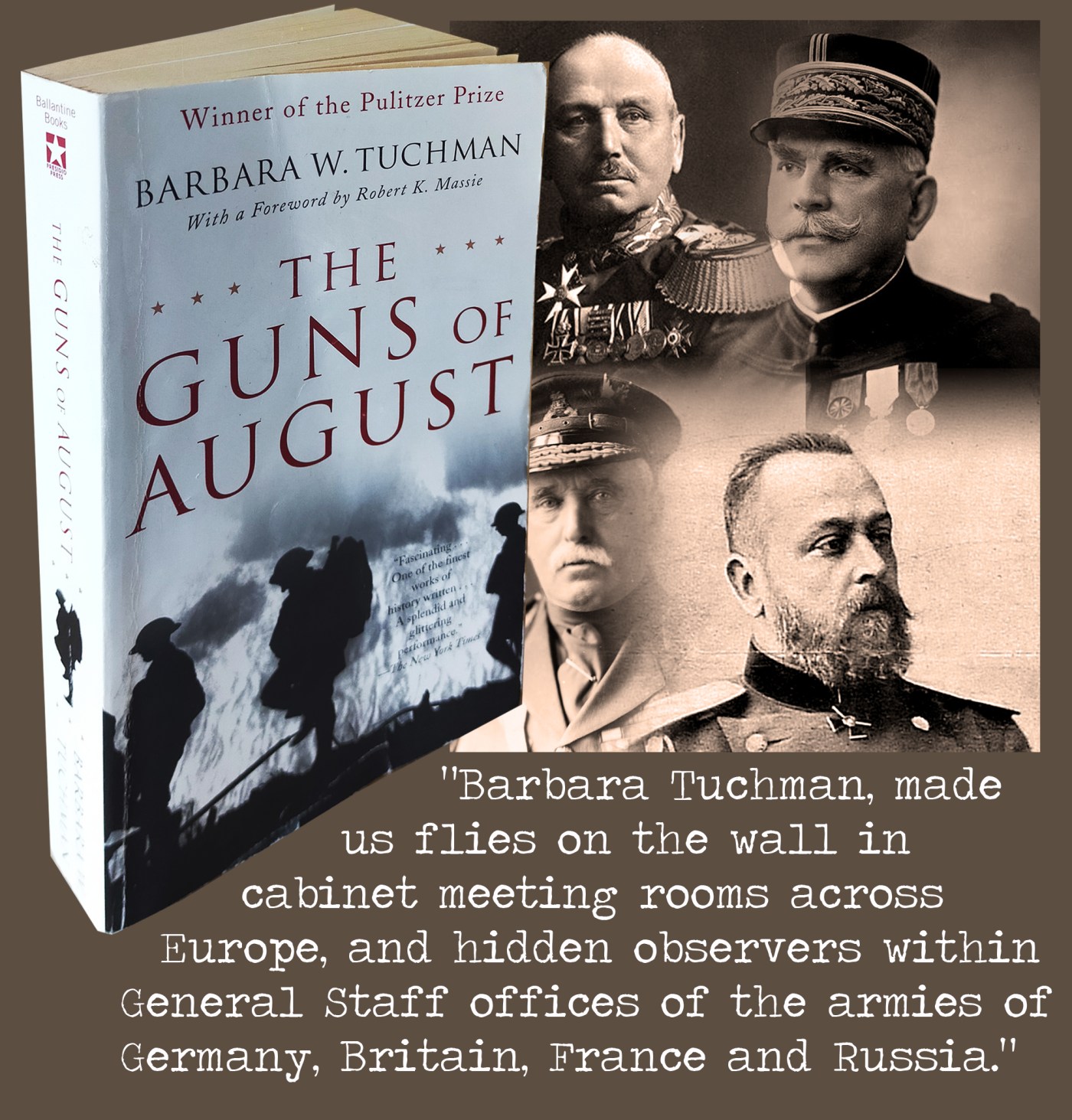
She leaves us after the events of early September 1914, but the First Battle of The Aisne and The Race To The Sea are both well covered elsewhere. Her book remains a masterpiece of narrative history. To conclude, Barbara Tuchman makes us flies on the wall in cabinet meeting rooms across Europe, and hidden observers within General Staff offices of the armies of Germany, Britain, France and Russia. The edition pictured below was published in 2014.