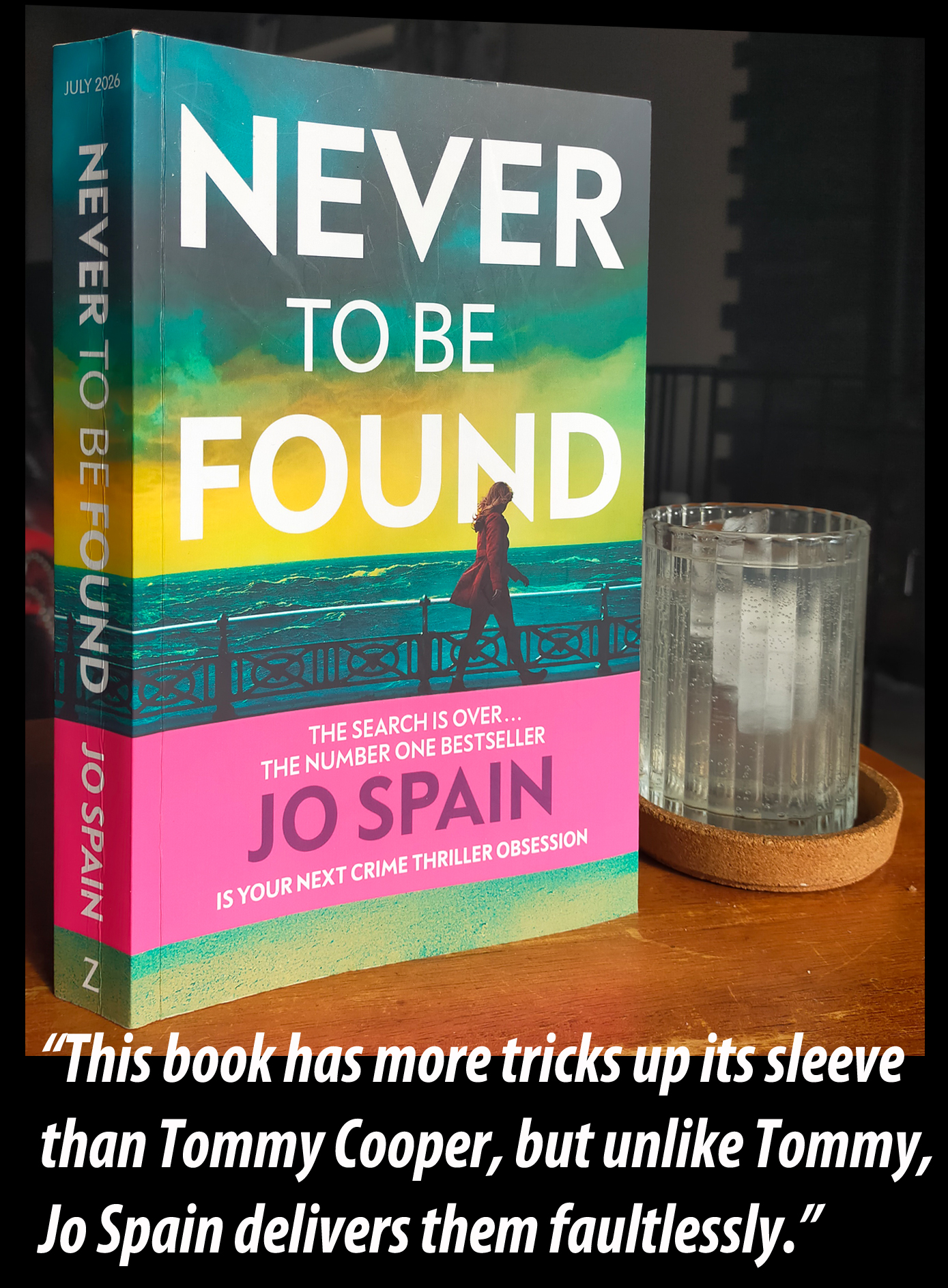

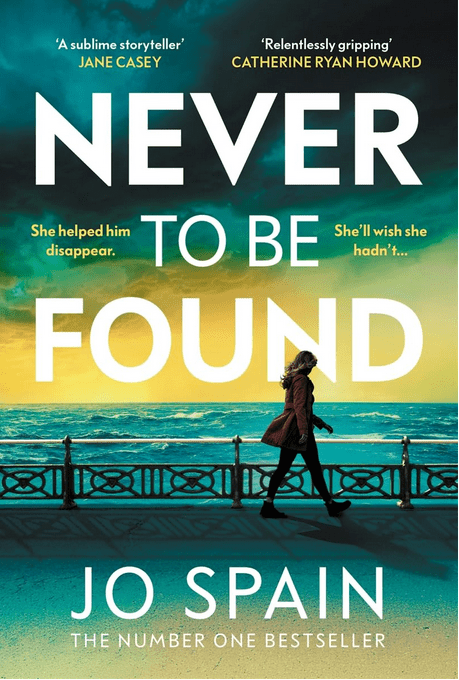
A new Jo Spain novel is always to be welcomed. I still believe that her Tom Reynolds police procedurals (link to reviews here) were the best of that genre I have ever read. Now, however, she is making a name for herself (and, I imagine, much more money) as a screenwriter and, indeed, this new book has already gone into development as a major network TV series.
The premise of Never To Be Found is both original and very clever. Veronica Page has a skill-set which was highly valued in Japan, the art of johatsu – the ability to make people disappear. People who have buckled under pressure, people with futures they are unwilling to contemplate, people who are burdened with some sense of shame or failure. Page isn’t a killer. Quite the reverse. She sees herself as a restorer of lives. She erases the old identity, and gives her customers the chance to reinvent themselves somewhere else, as someone altogether different. Now, she has an English client. A young man called Ben. He is due to inherit a huge fortune somewhere down the line, but now is trapped in the relationship between his feckless alcoholic mother and a bullying stepfather. Ben, however, isn’t the problem.
A man called Mark Drake most definitely is. Fifteen months earlier Veronica helped him disappear and, according to chapter three, he killed his wife. I use the words ‘according to’ advisedly. Problem is, with Jo Spain plots, you never quite know if she is telling you the full story. She has this sublime skill of encouraging the reader to make assumptions, which can lead to all manner of surprises. Anyway, it seems that Mark Drake has fled a murder scene, leaving behind two bodies. One is that of his wife, Amy. But there is another, and there, as WS once said “lies the rub”.
Veronica is approached by suspended police office named Seb who is determined to find Mark Drake and, by a mixture of persuasion and coercion, Veronica agrees to help him. She and Seb get a clue, and head to York, which was where Drake was headed. We know that Mark is in town, because he gets a couple of brief chapters to himself. It is at this point that seasoned Jo Spain readers may begin to suspect that there is s definitely something she is not telling us, at least explicitly. Veronica is nearly run down by a motorcyclist, and then she learns that one of the experts in her chain of identity changers, the man who produces fake IDs, had been found dead. And the police are very keen to speak to her.
Almost exactly half way through the book we learn more about Veronica’s backstory. Her father worked in the restaurant industry, and his main job was sourcing seafood – and in particular, tuna – from Japan. This meant frequent absences from home, but there was one final trip from which he never returned. The 18 year-old Veronica and her mentally fragile mother travel to Japan to find him. They are faced with the chilling truth that Veronica’s father’s rented Lexus was pulled from the water of the Seto Inland Sea. His wallet was there. His passport was there. His phone was there. But he wasn’t. Local contacts suggest that he may have wanted to disappear, and this is Veronica’s introduction to johatsu.
I mentioned WS earlier, but what happens in the later part of the book reminds me of Macbeth, rather than Hamlet. In the Scottish Play, there is a recurring theme of reversal, paradox, of black becoming white, of good becoming evil: the celebrated quote is:
“Fair is foul and foul is fair,
Hover through the fog and filthy air.”
This book has more tricks up its sleeve than Tommy Cooper, but unlike Tommy, Jo Spain delivers them faultlessly. The narrative is taut and the dialogue is convincing. Compared to the Tom Reynolds novels I mentioned earlier, this story has TV mini-series stamped all over it, and is clearly designed for international consumption. It is none the worse for that, however, and I can heartily recommend it. It will be published by Zaffre on 2nd July.



 fullybooked2017