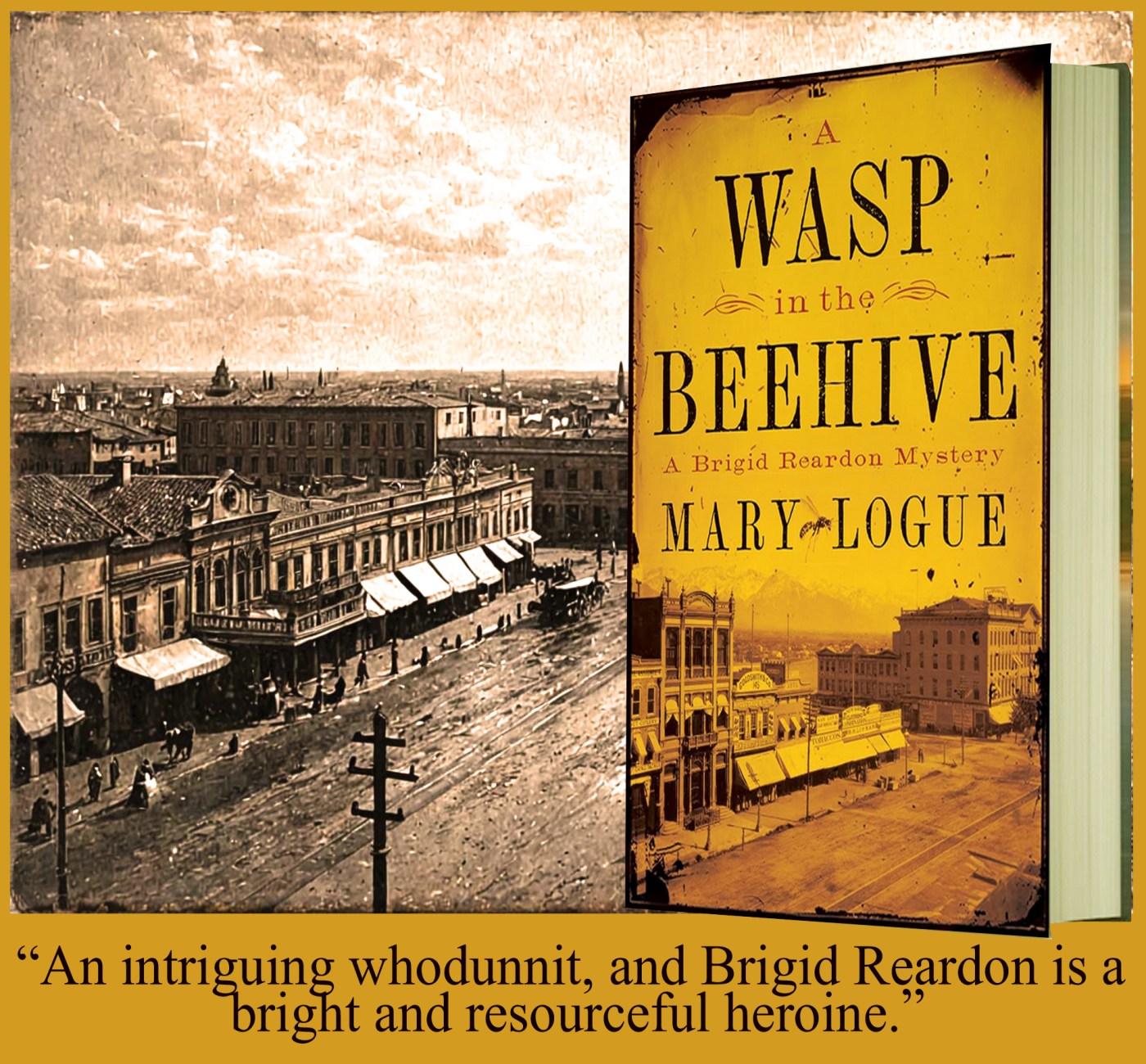
The Brigid Reardon Mysteries by Mary Logue are historical mysteries centered on an Irish immigrant navigating the American West in the 1880s. Starting with The Streel (2020) and followed by The Big Sugar (2023), the series features a determined, independent protagonist who solves murders in places like Deadwood and Cheyenne while seeking a better life. This is the third in the series, and begins in Salt Lake City where the eighteen year-old Brigid is applying for a job in a bookstore owned by a Mr Cutter.
We know from a brief preface that this gentleman has five wives, but this is, after all, Mormon central. Mr Cutter is something of a nasty piece of work. Not content with his five wives, he has his eyes on a sixth, Amelia. Normal terms for relatives become a problem in pluralistic marriages, but I think Amelia is his step daughter, as she is the daughter (by a previous marriage) of his second wife, Sarah. Unfortunately for Cutter’s equilibrium, sixteen year-old Amelia has fallen in love with Brandon, Cutter’s son by his first wife, Eliza.
When Mr Cutter is found dead in the sewing room of their house – a room he never has reason to visit – Brigid is reacquainted with Dr Kohler, a man she met in the bookstore. Doctor K has little to do with live patients – he is the city coroner. Cutter’s demise ushers in a delightful (for us readers) whodunnit, as a longish list of suspects is instantly available. Was it one of the wives, driven by jealousy? Brandon – or even Amelia – angered by his refusal to countenance their affection for each other? Or is it someone outside the family with a grudge against Cutter due to some slight or grievance borne out of the complex local religious politics? Whoever, the relationship between Kohler and Brigid is a CriFi match made in heaven.
At 200 pages, this is more of a novella, but none the worse for that. Spoiler alert – we are introduced to the murder weapon early in the piece, but as to who wielded it, that is rather more nuanced. There is one trivial, but unfortunate, research error. Dr Kohler refers to the methods of Sherlock Holmes. This is 1881, and it would be another six years before the character would appear, in A Study In Scarlet.
Written in the first person, the narrative of A Wasp In The Beehive ensures that we know plenty about Brigid. She is a bright, resourceful and courageous heroine. Categories are subjective, I suppose, but they are useful for tags, so I class this as Cosy Crime. Not my chosen genre, for sure, but I enjoyed this tale. It is published by The University of Minnesota Press and is available now.


Leave a Reply