 he dramatic events of The Rooks Die Screaming take place in the spring of 1921 in the Cornish market town of Bodmin. The bare bones of the story are that Detective Inspector Cyril Edwards of Scotland Yard has come to Bodmin to investigate murder and treachery involving a group of spies known as The Four Rooks. This book is a sequel to The Woman With The Red Hair, and to say there is a back-story is something of an understatement. The eponymous young woman is called Morag and, amongst other things, is Edwards’ sister-in-law. Elisha Edwards was one of the millions of unfortunates taken by an agent even deadlier than high explosives and machine gun bullets – Spanish Influenza.
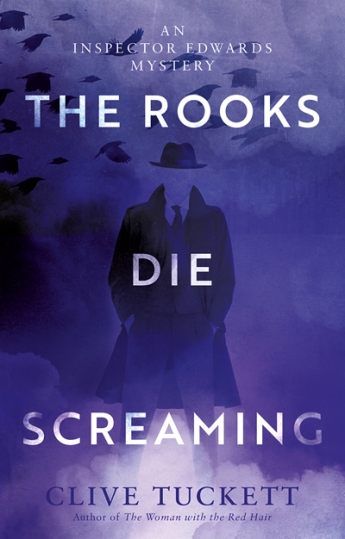 Morag is now Lady Frobisher. Her husband Harry, heir to The Fobisher Estate on the outskirts of Bodmin, is blind, victim of a grenade in the Flanders trenches. In the previous novel, Frobisher Hall was the scene of great torment for Morag, as she fell into the clutches of Morgan Treaves, an insane asylum keeper and his evil nurse. Treaves has disappeared after being disfigured with a broken bottle, wielded my Morag in a life or death struggle.
If you are picking up a sense that this novel has something of a Gothick tinge (note the ‘k’) you will not be far wrong. It is high melodrama for much of the way; secret tunnels; a sinister woman in the woods who, guarded by a lumbering giant mute forever silenced by the horrors he witnessed in the war, mixes deadly potions; a cottage where a sensitive soul can still hear the ghostly creaking of the former occupant’s body swinging from her suicide beam; a woman who, in falling prey to her own desires, has two terrible deaths forever on her conscience.
 That said, The Rooks Die Screaming is inspired escapist reading. It would be unfair to say that Tuckett (right) writes in an anachronistic style. This is much, much better than pastiche, even though there are elements of Conan Doyle, the Golden Age, John Buchan and even touches of Sapper and MR James. So, eventually, to the plot, but we need to know a little more about Cyril Edwards. Like many a fictional detective inspector he is his own man. In another nice cultural reference Tuckett adds a touch of Charters and Caldicott as Edwards explains to the bumptious Standish, a mysterious officer from Military Intelligence;
“‘I love cricket …. When I’m not turning down invitations to join dubious organisations, and thumping arrogant members of the royal family, I love nothing more than to relax at Lord’s and watch a game of cricket.’
Edwards stretched and picked up his Fedora hat, thinking of getting up and walking out of the room.
” I’m hoping to see the Second Test at Lord’s next month against Australia.”‘
 tandish orders Edwards to investigate the possibility that Harry Frobisher is one of the Rooks, but one who has betrayed his country. Arriving in Bodmin his first task is to explain to the local police how a corpse found on a train is that of a notorious London contract killer. Tuckett’s Bodmin is full of stock characters, including a stolid police sergeant, an apparently tremulous clergyman and a punctilious but respected solicitor who is privy to all the secrets of the local gentry, but is oh, so discreet. To add to the fun, Frobisher Hall also has its requisite roll call of faithful retainers.
The secret of The Four Rooks is eventually revealed, but not before the author throws a few red herrings onto the table. I could probably have done without the finer details of Lady Morag’s marriage bed, and some tighter proof-reading coupled with a more enticing cover would have done wonders for the book. That said, I enjoyed every page and I hope Clive Tuckett has another Inspector Edwards case up his sleeve, especially if it involves the redoubtable Morag Frobisher.
The Rooks Die Screaming is published by The Book Guild and is available now.

 On a tiny island off the Dorset coast of southern England, a little girl lives a dream childhood. Loving parents, the beauty of the sea and the sky, and the cloudless blue optimism of the young. But then, one terrible night, Stella Harvey’s idyll is shattered. On a September evening, with a violent storm lashing the tiny harbour of Evergreen Island, David Harvey ushers his family on board the ferry he runs for a living, and takes them away to the mainland. For ever.
 ears have flown by. Stella is now a consulting psychotherapist. Sister Bonnie is married with children. Their mother, Maria, is long dead, killed in a road accident. Father David, having left Maria for another woman, is now in the throes of dementia.
 nevitably, as night follows day, Stella’s arrival on Evergreen is not a joyful homecoming, and several skeletons come dancing and rattling their bones out of the cupboard to which time has consigned them. Firstly, Stella learns the tragic reason why her best friend and sworn blood-sister never replied to any of the letters she sent when the Harvey family began their new life on the mainland. Then, with the cruel perceptiveness of adulthood stripping away the illusions of youth, Stella looks on with horror as, first, the grisly remains are identified and personalised and then, second, questions from the past, smothered by time for so long, leap out into the present and demand answers.
 When Stella’s long-since-estranged brother, Danny, is drawn into what has become a murder investigation, the novel takes a seriously dark turn as it examines the nature of truth, loyalty, memory and love itself. Heidi Perks (right) has written a novel which will entrance readers who like a good psychological thriller, and she leaves us with a sense of sadness, certainly, but also an affirmation that, in the words of St Paul:

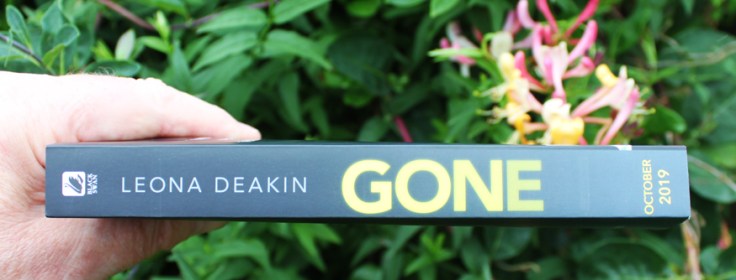

 he creative folk at Penguin Random House are certainly pushing the boat out in support of Gone, a new psychological thriller and the debut novel by former police psychologist Leona Deakin.





 Together with his grotesque partner and immediate boss, DI Peter Sutcliffe, Waits always gets the shitty end of the stick. ‘Sutty’ Sutcliffe is, you might say, a good old fashioned copper. Waits goes to meet him in a dingy rock-and-roll boozer:
 hy is Aidan Waits such a tortured character? Well, how long have you got? His childhood was loveless and chaotic, and spent largely in institutions where he rubbed shoulders with trainee failures, malcontents and killers. Echoing Nietzsche’s chilling remarks about the moral abyss, Waits has, more recently, gazed too long into a chasm inhabited by a repellent Manchester crime lord called Zane Carver. Carver has fed Waits’s drug habit, and the two have fought over women. Carver has a particular talent with women:
 s distinctive as Knox is as a stylist, and as much as he is a master of the inky black metaphor, he has a tale to tell and a plot to spin. The sepulchral calm of Martin Wick’s closely guarded hospital room is shattered by a savage attack which Waits survives, but puts him at the head of the queue as the police and the gutter press search for scapegoats. With Carver having decided to exact revenge on Waits by donning his black cap and pronounced the death sentence, Waits is on the run both from the gangster and, no less implacably, his politically motivated senior officers, but he keeps them at bay. He discovers faint-but-fatal fault lines in the original case against Martin Wicks, and finds that both Kevin Blake, the detective who brought Wicks to justice, and Frank Moore, the father of the murdered children, still have songs to sing.
 Joseph Knox writes like an angel. Possibly an Angel of Death, but he grasps the spluttering torch of English Noir once carried by such writers as Derek Raymond, and runs with such vigour that the flame burns brightly once again. He is not without humour, and there are many – if unrepeatable – gags exchanged between the cynical cops and their low-life prey. The politically correct nature of modern policing doesn’t escape his attention, either:
 nox has his grim fun with a Manchester police force that is barely honest, city down-and-outs who have lost most of the trappings of humanity, and an infestation of tattooed, Spice-addicted thugs straight from Central Casting – with Hieronymus Bosch as the agency’s head of HR. He also leaves us with a delightfully enigmatic final few pages. The Sleepwalker is published by Doubleday and will be
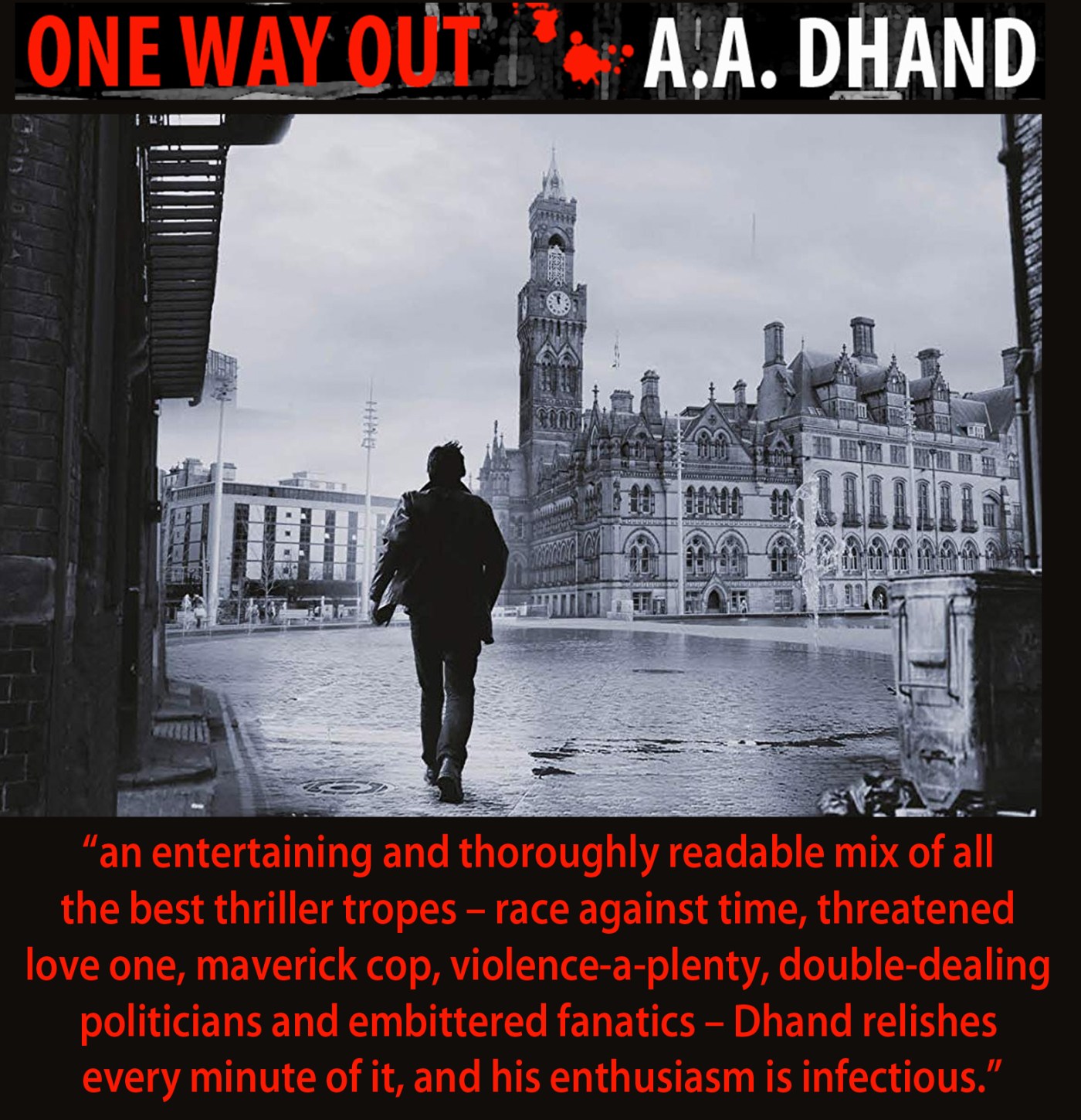

 The latest novel from AA Dhand is a gripping thriller which goes well beyond the constraints of the conventional police procedural. One Way Out begins with a huge bomb going off in the centre of Bradford. Although there has been sufficient warning to minimise civilian casualties, the perpetrators – an extreme right wing group known as The Patriots – have a further trick up their sleeve. It is a Friday, and with all 105 mosques in the Yorkshire city being full of worshippers, the terrorists announce that they have planted a bomb in one of the mosques, and it will be detonated unless the police track down and hand over the members of a notorious Islamic militant group called Almukhtaroon. The Patriots have pre-empted the obvious evacuation of the mosques by stating that if one single worshipper attempts to leave, the bomb will be detonated.
 hat we then have is an entertaining and thoroughly readable mix of all the best thriller tropes – race against time, threatened love one, maverick cop, violence-a-plenty, double-dealing politicians and embittered fanatics – Dhand relishes every minute of it, and his enthusiasm is infectious.
 Dhand is a Bradford man, born and bred, and he paints a vivid – if occasionally depressing – picture of the results of racial and religious bigotry. While he is justifiably harsh on right-wing extremism, he doesn’t spare the blushes of the Asian community, whether they are warring Muslim factions or Sikhs with more angry pride in their hearts than compassion. I’m not sure I totally bought into the relationship between Virdee and Tariq Islam, but no matter what the plot, suspension of disbelief is what we fiction readers are good at, otherwise we would spend our days reading history books or browsing the Argos catalogue.


 In the absence of a name, what do we know of her? She is a writer who, like so many others in real life, has been published but needs a day job to stay afloat. She is married to a rather dull but worthy London schoolteacher. They have a young son, Sammy and, in an effort to re-establish her identity she makes a successful application for a lecturing job at a university in the north of England. Husband Mark is unwilling to leave his post, and so they agree to live separately but meet up at weekends. At the very beginning of the novel the woman is assaulted by a stranger while she is out jogging: the attack is not physically serious but leaves deep mental scars.
 All the familiar tropes of modern British domestic noir kick in, to good effect. We have a stalker, marital infidelity, a woman alone in a remote cottage, the debilitating after effects of recreational drug use, a murder disguised as a suicide and, tellingly, a very scary confrontation on a Wuthering Heights-style moor.

 On a lonely and ancient hill in south western England, a group of amiable but earnest hippy cranks prepare to celebrate a pagan festival. What their leader finds when he climbs the hill to consummate the ritual sends him reeling and retching to his knees. There, strung up from the trees is a grisly collection of local wildlife, butchered and bloody. That is bad enough, but the centrepiece of this obscene display is – or was – human.
 ore corpses – both ancient and modern – are discovered, while Clare Hills is run ragged by a combination of unsettling discoveries about her late husband’s business affairs, and a bizarre conspiracy centred on the site, involving the dark and devious word of online antiquity sales.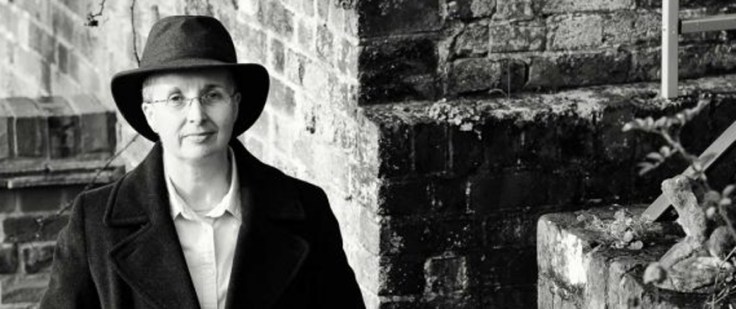

 London copper DI Tom Thorne has been entertaining us since his debut in Sleepyhead (2001). His creator, Mark Billingham, (left) has developed an enviably reliable repertory company of other players who share the stage with the main man. There is his best mate Phil Hendricks, a pathologist who, despite being gay, supporting Arsenal against Thorne’s beloved Spurs and having piercings in places where most folk don’t even have places, is the voice of sanity in Thorne’s often chaotic world. Thorne’s love interest (from whom he is currently living apart) is Helen, another police officer, but one who works in the traumatic world of child protection. Nicola Tanner is Thorne’s professional partner and they have history, but not one that either reflects on with much pleasure. Tanner’s partner Susan was brutally killed in a previous episode, and her death hangs over the pair like a pall.
 In an ostensibly unconnected narrative thread, Billingham introduces us to a Sarah, a vulnerable single mum who is anxious to gain the approval of other mums with whom she waits at the primary school gate twice each day. They seem confident, successful and financially comfortable. Sarah tries to join in with their daily sojourn at a pretentious ‘artisan’ coffee shop after the morning school run, but she still feels like the outsider. Her world is just herself and her son Jamie, and she struggles to compete with the gossip and banter that fly like sparks between Karen, Caroline, Savita and Heather. Until. Until the day when, sitting apart at her own table in HazBeanz, Sarah is chatted up by distinctly fanciable slightly older fellow. Almost instantly, Sarah finds the others anxious to swap phone numbers in return for daily updates about the new romance.

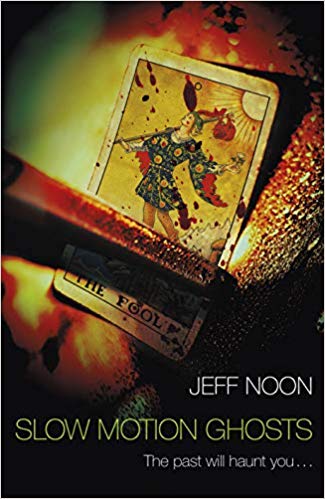 Later that year, with Brixton quieter, despite other English towns and cities erupting in copycat anger, Hobbes has become embroiled in a bitter internal dispute. A fellow copper, Charlie Jenkes (who rescued Hobbs from the mob on that fateful April night) after being indicted for savagely beating a black suspect, has taken his own life. And the officer who testified to Jenkes’s violence? Henry Hobbes, who, with that single act of honesty, is branded as a Judas by his own colleagues.