 SM Hardy, aka Sue Tingey, has put together a thoroughly enjoyable and, at times, genuinely scary ghost story. The Evil Within tells the tale of Jim Hawkes, a young London banker who has an attack of conscience about the bloodthirsty nature of his trade, and tells his boss to go forth and multiply. This rush of blood to the head is not entirely unconnected to the fact that he is still grieving for his dead sweetheart, who drowned herself after breaking off their engagement in a calamitous row. Jim decides that a physical exit from London is essential, and so he takes out a short term lease on a cottage in England’s West Country.
When he arrives in Devon he finds that the cottage – and its immediate surroundings – have, shall we say, history. The back story involves a dead girl, who was found hanged from the banisters. While exploring the adjacent churchyard, Jim meets the vicar, and is invited in to the rectory for a welcoming chat and a nice cup of tea. All good so far, but when he meets two of the long term residents, widowed Emma and Jed, the local handyman, fixer of lawnmowers and general village sage and factotum, his equilibrium is seriously disturbed when they tell him that the rectory is not only unoccupied, but the reverend gentleman has been dead for some time.
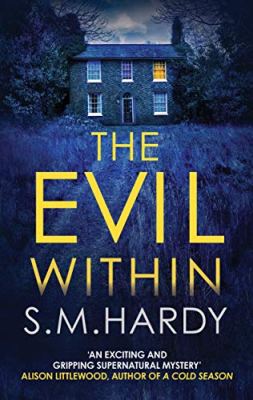 By now, of course, we have to suspend disbelief, because this is going to be a book where weird things are going to happen. There is one key question, as it ever was in ghost stories. Are the strange events actually happening independent from the main character’s perception or, as the title hints at, are they in his mind? SM Hardy certainly gives Jim Hawkes plenty to cope with. We have a Don’t Look Now style figure in a red coat who not only flits in and out of Jim’s peripheral vision, but occasionally holds his hand in her dead, cold fingers. Again with a nod to Daphne du Maurier’s wonderful short story, there are also two sisters, who may possible be sinister as well as spinster. We mustn’t forget a mysterious and hulking man in grey who clearly wishes Jim harm and may – or may not – be an astral projection of a malevolent criminal who lies in a vegetative state at a mysterious local mental hospital.
Clichés only become clichés when they are wearisome, and there is nothing remotely wearisome about The Evil Within. Yes, SM Hardy mines deep into the seam of supernatural fiction and comes up with many recognisable elements, but she welds them together to make a compelling novel. Best of all, even though she deal in familiar tropes – the haunted cottage, the startling face in the window, the conversations with the dead and the events that no-one in the village pub will talk about – we genuinely care about Jim Hawkes and what happens to him. The possibility that Jim’s apparitions may be just the product of his own mental fragility in the wake of his fiancée’s tragic death doesn’t diminish our concern for him, nor prevent us from fearing the worst when events take a disturbing turn.
I have never written a novel, nor could I, but I have read many and I know from experience that if the author doesn’t forge that link between reader and character, the book may as well be cast aside and sent to the charity shop. SM Hardy ticks this box – and many other important ones – and ensures that The Evil Within is both entertaining, credible and enthralling – with a sharp sting in the very tip of its tail. It is published by Allison & Busby and is available now.
Click on the image below for a short but spooky video


 The two women have little in common
 The structure of the book is intriguing;
 In Night Raids we see some of the story through the eyes of a crew of a German Heinkel bomber. Their mission is to destroy an essential bridge over the river; the bridge, crucially, carries the railway taking vital men and munitions to the east coast, where invasion is a daily expectation.The bombers come over at night, and have so far failed to destroy the bridge. What they have done, however, is unload some of their bombs on residential areas of the town, and inside one of the terraced houses wrecked by the raid, Brooke finds the body of an elderly woman. Her death is clearly attributable to Hermann Goering’s Luftwaffe, but the fact that her left ring finger and middle finger have been removed with a hacksaw cannot, sadly be laid at the door of the Reichsmarschall.

 aomi is a feature writer of some sort, while Charlie is an entrepreneur designer in the tech industry. While a succession of sharp-intake-of-breath builders and carpenters transform the neglected house into a Sunday supplement paradise, Naomi is desperate to conceive a second child. Naturally, both she and Charlie have smartphone apps which track her fertility cycle and give the couple vital windows when hurried coupling should produce little Prue’s sibling. Sadly, none of the digital wizardry seems to work. Charlie is all-too-often not up-to-snuff, and Naomi’s obsessive quest is becoming counter productive.
 While on her daily run there and back to Prue’s nursery school, Naomi meets a stunningly attractive alpha male called Sean, and his bluff insouciance is such a contrast with Charlie’s needy self-absorption that she is smitten. One thing leads to another – the ‘another’ being hurried stand-up sex in the shower cubicle at a local leisure centre – and guess what? Sean’s urgent thirty seconds has done the job, and Naomi is, at last, pregnant, but possibly by the wrong man.
 acDonald doesn’t set out to make us laugh with obvious satire, but he has fun casting a jaundiced eye on Naomi’s preoccupations. She is at a rather pretentious playgroup called ‘Sing, Sign and Movement.’
 Any sense of lifestyle mockery, gentle or otherwise, dissipates once we reach the final quarter of the book. Naomi discovers that whoever Sean really is, his plans for her and her family involve much than a few moments of lust. I certainly didn’t see the plot twist coming, and MacDonald (right) springs one surprise after another, right up to the final paragraphs. If you can’t make sense of the brief chapter interludes which consist of MSN messages (remember them?) between some bitchy schoolgirls, don’t fret – you will.
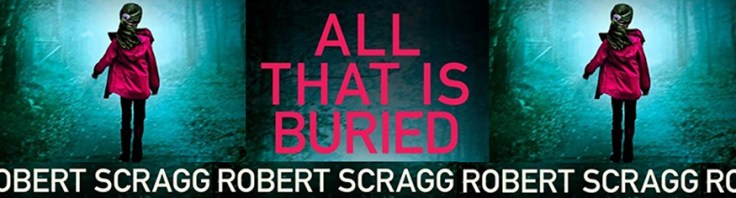
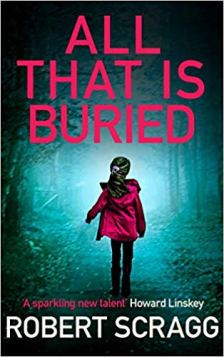 All the fun of the fair? They are strange throwbacks to an earlier, perhaps more innocent time, these funfairs that travel the country setting up in this or that town for a few days of loud music, strings of multicoloured light bulbs swinging in the wind, the shrieks of excited children and the unique smell of candyfloss and toffee apples. All That Is Buried, the latest case for Robert Scragg’s coppers Jake Porter and Nick Styles begins with an abduction in one such fair, pitched on a field in a London suburb. We see some of the story through the eyes of the killer. Our man – if he is indeed the culprit – describes the fair:


 or newcomers to the sublime world of Arthur Bryant and John May, the new collection of short stories written by their biographer, Christopher Fowler, contains a handy pull-out-and-keep guide to the personnel doings of London’s Peculiar Crimes Unit. OK, I lie – don’t try and pull it out because it will wreck a beautiful book, but the other bits are true.
 Leaving aside the pen pictures, introductions and postscripts, there are twelve stories. They are, for the most part, enjoyably formulaic in a Sherlockian way in that something inexplicable happens, May furrows his brow and Arthur comes up with a dazzling solution. Think of a dozen elegant variations of The Red Headed League, but with one or two being much darker in tone. Bryant & May and the Antichrist, for example, is a sombre tale of an elderly woman driven to suicide by the greed of a religious charlatan, while Bryant & May and the Invisible Woman reflects on the devastating effects of clinical depression. The stories are, of course set in London, apart from the delightfully improbable one where Arthur and John solve a murder within the blood-soaked walls of Bran Castle, once the des-res of Vlad Dracul III. Bryant & May and the Consul’s Son revisits Fowler’s fascination with the lost rivers of London, while Janice Longbright and the Best of Friends lets the redoubtable Ms L take centre stage.
 he gags are as good as ever. While investigating a crime in a tattoo parlour, Arthur is mistaken for a customer and asked if he has a design in mind:
 don’t know Christopher Fowler personally, but I infer from his social media presence that he is a thoroughly modern and cosmopolitan chap and, with his spending his time between homes in Barcelona and King’s Cross, he could never be described as a Little Englander. How wonderful, then, that he is the most quintessentially English writer of our time. His Bryant & May stories draw in magical threads from English culture. There is the humour, which recalls George and Weedon Grossmith, WS Gilbert, and the various ‘Beachcombers’ down the years, particularly DB Wyndham Lewis and JB Morton. Fowler’s eagle eye for the evocative power of mundane domestic ephemera mirrors that of John Betjeman, while his fascination with the magnetic pull of the layers of history beneath London’s streets channels Peter Ackroyd and Iain Sinclair.


 immy Mullen has been round the block. In the Falklands War his ship takes a direct hit from an Argentine fighter bomber and he watches his mates consumed by the ensuing fireball. Back home recuperating, with a pittance of a pension, he stacks supermarket shelves, battles with his nightmares and presides over the slow erosion of his marriage as drink becomes his only solace. Walking home one night from the boozer, he intervenes to prevent a girl being slapped around by her boyfriend. All very gallant, but the result is the boyfriend (an off-duty copper) lying insensible on the pavement in an expanding pool of blood.
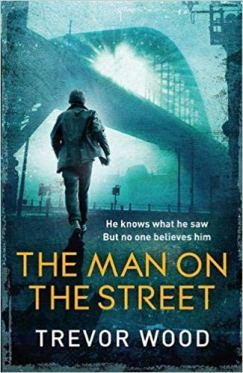 After the inevitable prison sentence Jimmy is now out on early release, but homeless, his ex-wife now remarried, and his daughter a complete stranger to him. Home is anywhere he can kip out of the rain. His social circle? A few fellow vagrants, raddled by drink, mental instability, drugs – or a toxic combination of all three. Their home-from-home is a charity called The Pit Stop where volunteers provide, food, showers and clothing.
 ome time later Jimmy sees a newspaper article featuring a young woman appealing for news about her missing father. The picture she is holding is of a man Jimmy thinks he recognises. It is the smaller man from the argumentative pair who disturbed his sleep a few weeks since. Or is it? With the help of a couple of his more social-media-savvy pals from The Pit Stop, Jimmy contacts the woman – Carrie Carpenter – and they are drawn into a mystery involving police (both complacent and corrupt), environmental activists, crooked businessmen and – as we learn near the end of the book – grim sexual deviancy.
 uthor Trevor Wood (right) has lived in Newcastle for 25 years and considers himself an adopted Geordie, though he says that he still can’t speak the language. Despite this, his phonetic version of the unique Geordie accent is good. Normally, I shy away from books where writers try too hard to convey accents in dialogue, but I think Trevor Wood does rather well here. Perhaps this is a result of my addiction to my box set of When The Boat Comes In.


 nora Andresson is a distinguished English actress. Perhaps slightly past her youthful allure, she remains a beauty who can pick and choose her projects, and her films are highly thought of. She has three problems clouding her horizon. The first is, as they say, a bastard. She has a brain tumour. It has been treated but she is only too aware that she may have won a battle, but not the war. Problems two and three are related – literally. She is separated from her Swedish husband, but they have a son – a young man called Malo – who is something of a wrong ‘un. The third problem relates to the words “they have a son”. Fact is, she does – her husband doesn’t. Malo’s father is actually a millionaire businessman named Hayden Prentice, and Malo was conceived during a drunken one-nighter just before Enora’s wedding. So why is Harold a problem? Although he is now an honest man, with legitimate investments and business interests, he made his initial fortune as a drug baron.
 he main plot of Sight Unseen hinges around the kidnapping of Malo’s Colombian girlfriend Clemmie. When a ransom demand of a million dollars is received her father, who, like many rich men from that benighted republic, has kidnap insurance, simply hands the case over to the experts. H, however, has other ideas, and decides to do things his way.
 Hayden Prentice is a brilliant creation and is, in many ways, at the centre of the book, as he was when we first met Enora in