

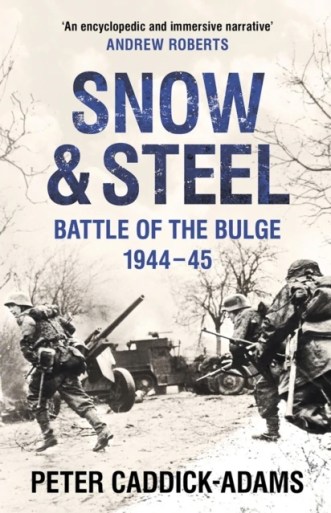
I thought it was high time I included some non-fiction reviews. I am a keen (amateur) military historian, so I am happy to start this little adventure into the unknown by reviewing a superb history, written by Peter Caddick-Adams, of one of the bloodiest battles of WW2. I was going to use the word ‘decisive’, but that would be inappropriate as it suggests that the outcome of the Battle of The Bulge, which began in December 1944. was a pivotal point in the war. It wasn’t. Hitler’s war was already lost, mainly thanks his disastrous attempt to invade Russia.
 By the autumn of 1944, German forces had been pushed out of France and were being systematically overwhelmed by the Red Army in the east. The allies had control of the Channel coast, but the Germans had effectively wrecked the French ports. Antwerp, however, had been taken more or less intact, and when the Germans had been removed from their strong-points controlling the estuary of the River Scheldt, the Belgian port became a massive conduit for the arrival of men, machines and supplies for the Allies.
Hitler believed that if he could reach Antwerp and choke the Allies’ massive superiority in materiel, he could somehow wrench victory from the jaws of defeat. Caddick-Adams tells a tale as tense and addictive as any murder mystery. Let’s look at the three main ingredients of such tales:
Motive; in the east, the Russians were just too many, too implacable, and too powerful, so Hitler needed a win – somewhere, anywhere.
Opportunity; the largely American forces in the Ardennes area were a mixture of battle-hardened veterans who has stormed the Normandy beaches on 6th June, and more callow units. Some had been battered and bloodied by the savage fighting in the Hurtgen Forest earlier that year. For a first hand account of that battle seen through the eyes of JD Salinger, click this link. None of these American units were expecting anything other than a steady but remorseless slog eastwards until they crossed the Rhine, until they were able to beard the Fuhrer in his den.
Means? Aye, there’s the rub. Caddick-Adams explains that the cream of the German army had already been wiped out on the undulating fields of Normandy and bleaker killing grounds of East Prussia. The Werhmacht – comprising its three branches of land, sea and air forces – was on its uppers. To boost the forces attempting to storm their way across Belgium and recapture Antwerp, navy men from the Kriegsmarine and ground-crew from the Luftwaffe were given a helmet and a gun, and pitched against American forces.
 It is one of the great paradoxes of WW2 that on the ground, at least, the Germans had the best guns, the best artillery and the best tanks. The problem was that although the formidable Panzers were easily able to overcome the relatively underpowered Sherman tanks used by the allies, the German vehicles were high maintenance and, some would say, over-engineered. The ubiquitous Shermans were rolling off the production lines in their thousands, while the formidable Tigers and Panthers – when they developed a fault – were fiendishly difficult to repair or cannibalise. Caddick-Adams (right) also reminds us how well-fed and supplied the American GIs were compared with their German foes. In one particularly eloquent passage, he tells us of the utter joy felt by a unit of Volksgrenadiers when they seized a supply of American rations. When their own kitchen unit eventually reached their position, the cooks and their containers of watery stew were given very short shrift.
Snow and Steel covers ground familiar to many amateur historians – the Malmedy Massacre, the heroic defence of Bastogne, and Hitler’s manic distrust of his generals, amplified by the Stauffenberg plot. The eventual outcome of this battle is a matter of history so, although his narrative is as good as any found in contemporary thrillers of mysteries, Caddick-Adams knows we expect no surprises. What he gives us, however, is what used to be called (in the age of vinyl) a double A-side. We have a brilliant, methodical and comprehensive account of a battle where we get to see both the strategic and tactical implications of a military campaign. Flip the metaphorical record over, and we have a vivid account of a battle as seen by men who were there, told in their own words, and thus made even more chilling through its immediacy. Snow and Steel is published by Arrow and is available here.


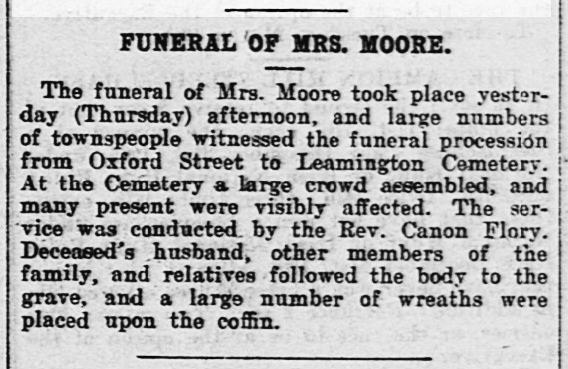


 Number 13 Oxford Street is a narrow three-story terraced house used these days, I believe, for student accommodation. It was advertised recently as a six bedroom let, a snip (!) at £3,360 pcm. The Bank of England inflation calculator tells me that in 1891, Edward Moore and his family would have been paying just under £26 a month. He had a large family comprising his wife Fanny Adelaide (36) and children Edwin James Moore (16), Fanny A Moore (14), William A Moore (13), Joseph C Moore (11), Rose Hannah Moore (10), Percy E Moore (8), Leonard J Moore (7) and Ernest F Moore (4).




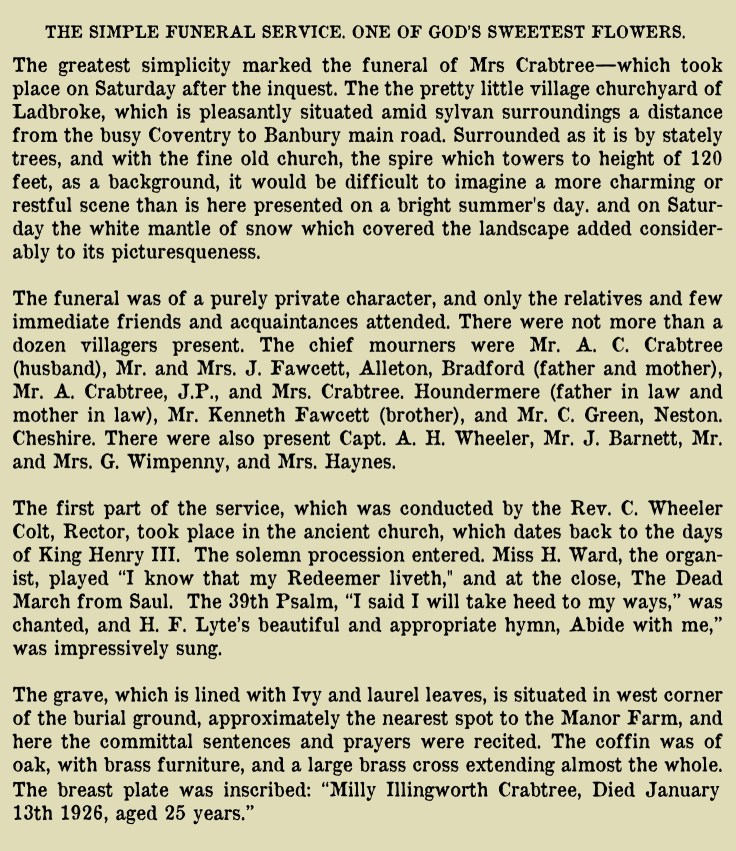
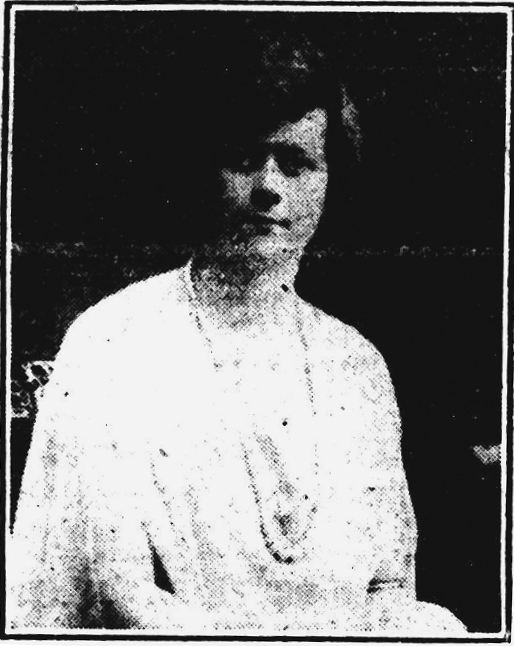
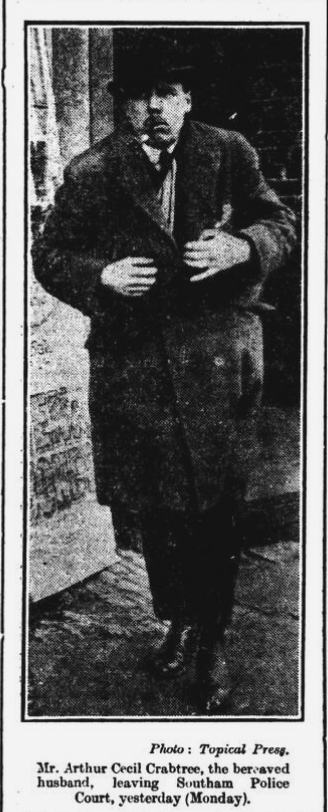 SO FAR – On January 13th 1926, Milly Crabtree, 25 year-old wife of Cecl Crabtree, is found battered to death at their home, Manor Farm in Ladbroke. 19 year-old George Sharpes is arrested for her murder. As is the way with these, things, the wheels of justice turn very slowly, and it was February before Sharpes came to face magistrates in Southam. The courtroom, normally used as a cinema (pictured above), was packed, and the onlookers were spellbound as a confession from George Sharpes was read to the court.
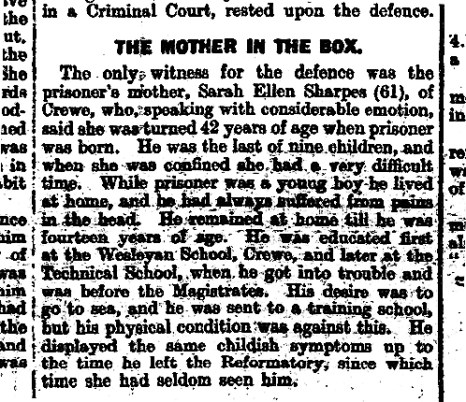 The magistrates wasted little time in stating that George Sharpes had a serious case to answer, and the case was moved on to be examined at the March Assizes in Warwick. The case was presided over by Mr Justice Shearman. The only possible line for the defence to take was that Sharpes was insane at the time at the time he committed the murder, and Sharpes’s mother was produced to state that her son had suffered an unfortunate childhood. Her pleas fell on deaf ears, however. Rejecting the claims that George Sharpes was insane, the judge donned the black cap and sentenced him to death. The execution was fixed for April and, as was almost always the case, a petition was set up to ask for clemency. The case was taken to appeal, in front of Lord Chief Justice Avory, who was perhaps not the most welcome choice for Sharpes’s defence team. Avory, a notorious “hanging judge”, had been memorably described:






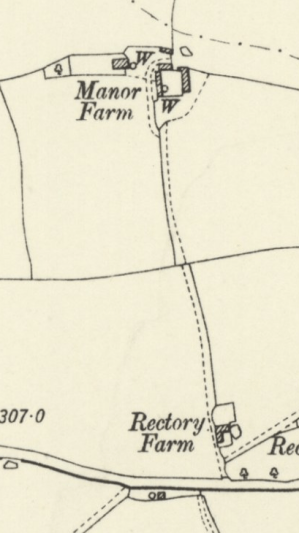 Manor Farm in Ladbroke dates back, according to the data on British Listed Buildings, to the mid 18th century. For architectural historians, it adds:

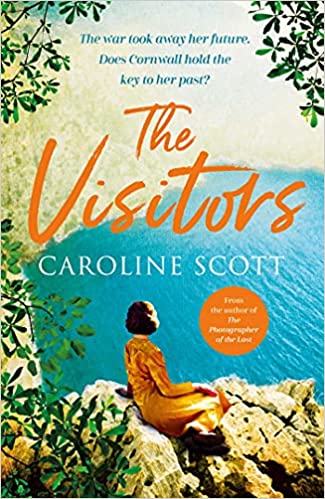 England, 1923. Like thousands upon thousands of other young women, Esme Nicholls is a widow. Husband Alec lies in a functional grave in a military cemetery in Flanders. His face remains in a few photographs, and in her memories. Left penniless, she ekes out a living by writing a nature-notes feature for a northern provincial newspaper, and serving as a personal assistant to an older widow, Mrs Pickering. Mrs P has the advantage of being able to visit her husband’s grave whenever she wants, as he was not a victim of the war.
 Caroline Scott (right) treats us to a high summer in Cornwall, where every flower, rustle of leaves in the breeze and flit of insect is described with almost intoxicating detail. Readers who remember her previous novel When I Come Home Again will be unsurprised by this detail. In the novel, she references that greatest of all poet of England’s nature, John Clare, but I also sense something of Matthew Arnold’s poems The Scholar Gypsy and Thyrsis, so memorably set to music by Ralph Vaughan Williams.

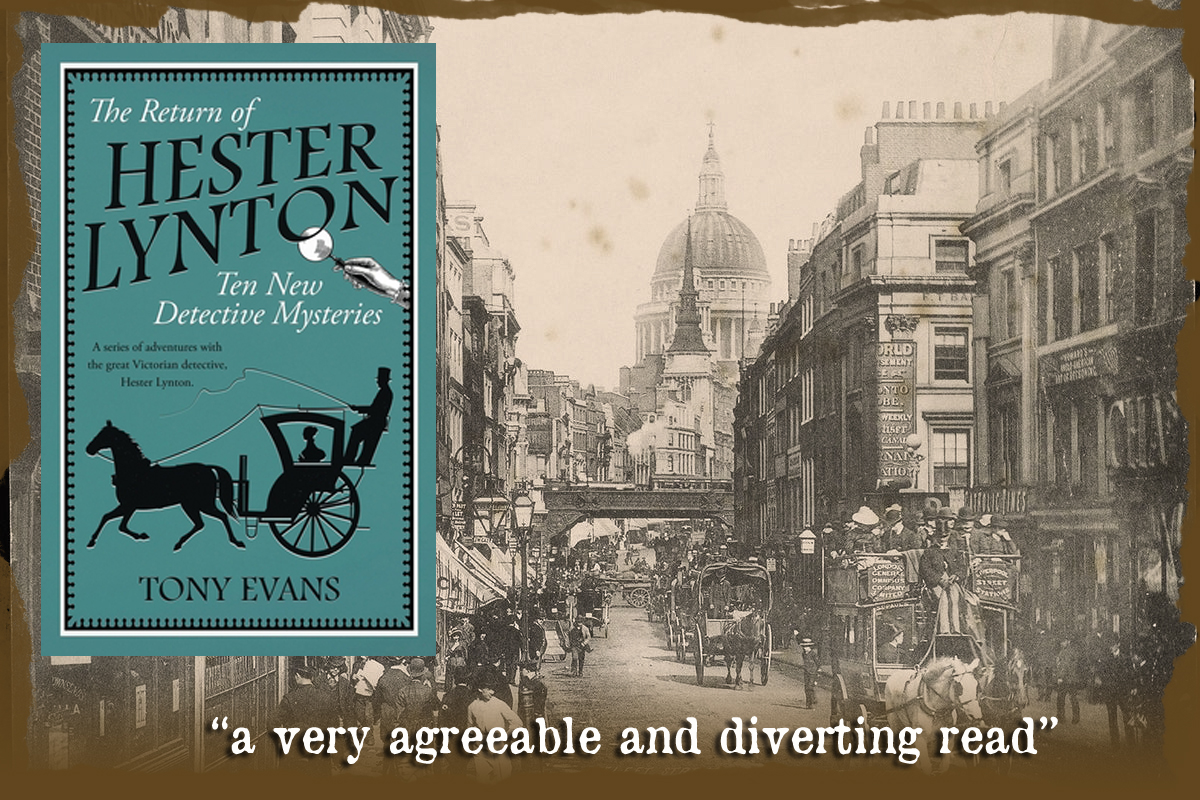

 A rich widower, a self made industrialist, dies and leaves his fortune to be divided between his two nephews. One is a down-at-heel schoolmaster, the other a disreputable roué. The lucky man has to solve a cypher set by their late uncle. The good guy brings the cypher to Hester and Ivy. They solve the conundrum with by way of a knowledge of 18th century first editions, a journey to explore an ancient English church, and by breaking in to a family mausoleum.
 Here, Tony Evans (right) indulges in the first of two shameless – but entertaining – instances of name-dropping. Our two sleuths, weary after a succession of difficult investigations, are enjoying some well-earned R & R in the resort of Whitby. So who do they meet? Think Irish writer and man of the theatre, blood, fangs …..? Gotcha! They are engaged by a fellow holidaymaker, a certain Mr B. Stoker to investigate the disappearance of a housemaid. She has been induced to leave her present employment to go and work for a rather dodgy doctor. Much skullduggery ensues, the housemaid is saved, and Mr Stoker says, “Hmm – this gives me an idea for a story.”


