

Fans of period police procedurals are in for a treat at the end of the month when RN Morris’s distinctive London copper, Chief Superintendent Silas Quinn makes a welcome return. It’s December 1914, and the war that was meant to be over by Christmas is showing only signs of intensifying. DORA – the Defence of The Realm Act – has been enforced, and among the many strictures it imposes on the populace are imprisonment without trial, a ban on publishing any description of war or any news that is likely to cause any conflict between the public and military authorities and, bizarrely, an interdiction on buying rounds in pubs.
 But Christmas is coming, and a rather upper-crust choir, The Hampstead Voices, is rehearsing for its seasonal concert, with all proceeds going to Belgian refugees, forced from their homes by the brutal Hun invaders. Directed by Sir Adrian Fonthill, the concert will include not only much-loved carols such as O Little Town of Bethlehem and Adeste Fideles, but choral works by Bizet and Handel. Special guest artistes will include dancers from Ballets Modernes and the distinguished violinist Emile Boland, but the evening will conclude with a performance of Sir Edward Elgar’s A Christmas Greeting, in the presence of the composer himself. It is also believed that Winston Churchill, First Lord of The Admiralty, will be in the audience at University College School on the evening of 24th December.
Silas Quinn may have many qualities, but a musical ear is not one of them, so how does he come to be involved in the doings of The Hampstead Voices? Rehearsals for the concert may not be going too well, perhaps due to the many tenors and basses who have answered the call to arms, but preparations take a distinct downturn when the Director of Music is found dead, slumped at his grand piano, with the sharpened handle of a tuning fork stuck into his ear. As boss of Scotland Yard’s Special Crimes Unit, Quinn is summoned to the scene of this musical murder.
It seems that the late Sir Adrian, despite his musical sensitivities, was not a paragon of virtue. He has a roving eye – and hands – for young sopranos and altos, and has a weakness for gambling which has left him in debt to some very dangerous people. But who stands to benefit from his death? Not those to whom he owes money,surely? A resentful husband, perhaps, who has been cuckolded?
 As Quinn tries to penetrate the wall of silence thrown up by Fonthill’s widow, his attention is drawn to a mysterious music box sent to Sir Adrian just before his death. When it is wound up and played, however, the resulting tune simply seems – even to Quinn’s tin ear – a haphazard sequence of random notes. But help is at hand. One of the Special Constables from Hampstead Police Station could be said to have an ear for music. He is none other than Sir Edward Elgar, celebrated composer of Salut d’Amour, Variations on an Original Theme and The Dream of Gerontius. Elgar takes the discordant melody and uncovers a message which rveals that Sir Adrian’s death is not to be the last associated with the ill-fated Christmas concert.
RN Morris (above right) gives us an inventive and delightfully improbable conclusion to this very readable novel. If you want something to lose yourself in for a few hours and a diversion to push to one side the misery and discomfort of the lock-down, then you will find nothing better than The Music Box Enigma. It is published by Severn House and will be out in hardback on 30th April.
For a review of an earlier Silas Quinn novel, The White Feather Killer, click here


 arker is given an apology, and asked to help with the hunt for Donna Lee Kernigan’s killer. He soon learns that the Jurel Cade, a special investigator for Burden County, has been involved in the investigations – or lack thereof – into the earlier deaths. The Cade family are rich, influential and undoubtedly corrupt. They have also managed to entice Kovas, a massive defence procurement company, to build a plant in the vicinity, a deal which will put food on tables, dollars in wallets and hope in hearts for the long neglected locals. A few murdered black girls mustn’t be allowed to embarrass the PR machine that deals with the Kovas public image.
 onnolly writes like an angel, and there is never a dead sentence, nor a misplaced word. Occasionally, within the carnage, there is a wisecrack, or a sharp line which sticks in the memory:











 He is no James Bond figure, however. His dark arts are practised in corners, and with as little overt violence as possible. Hammer To Fall begins with a flashback scene,establishing Joe’s credentials as someone who would have felt at home in the company of Harry Lime, but we move then to the 1960s, and Joe is in a spot of bother. He is thought to have mishandled one of those classic prisoner exchanges which are the staple of spy thrillers, and he is sent by his bosses to weather the storm as a cultural attaché in Finland. His ‘mission’ is to promote British culture by traveling around the frozen north promoting visiting artists, or showing British films. His accommodation is spartan, to say the least. In his apartment:
 So far, so funny – and Lawton (right) is in full-on Evelyn Waugh mode as he sends up pretty much everything and anyone. The final act of farce in Finland is when Joe earns his keep by sending back to London, via the diplomatic bag, several plane loads of …. well, state secrets, as one of Joe’s Russian contacts explains:

 We first met Leeds policeman Tom Harper in Gods of Gold (2014) when he was a young CID officer, and the land was still ruled by Queen Victoria. Now, in The Molten City, Harper is a Superintendent and the Queen is seven years dead. ‘Bertie’ – Edward VII – is King, and England is a different place. Leeds, though, is still a thriving hub of heavy industry, pulsing with the throb of heavy machinery. And it remains grimy, soot blackened and with pockets of degradation and poverty largely ignored by the wealthy middle classes. But there are motor cars on the street, and the police have telephones. Other things are stirring, too. Not all women are content to remain second class citizens, and pressure is being put on politicians to consider giving women the vote. Sometimes this is a peaceful attempt to change things, but other women are prepared to go to greater lengths.



 SM Hardy, aka Sue Tingey, has put together a thoroughly enjoyable and, at times, genuinely scary ghost story. The Evil Within tells the tale of Jim Hawkes, a young London banker who has an attack of conscience about the bloodthirsty nature of his trade, and tells his boss to go forth and multiply. This rush of blood to the head is not entirely unconnected to the fact that he is still grieving for his dead sweetheart, who drowned herself after breaking off their engagement in a calamitous row. Jim decides that a physical exit from London is essential, and so he takes out a short term lease on a cottage in England’s West Country.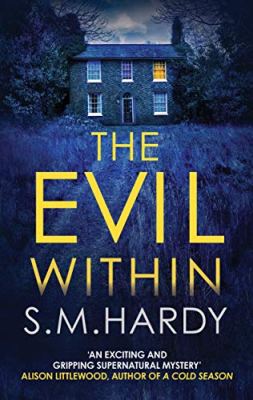







 The two women have little in common
 The structure of the book is intriguing;


