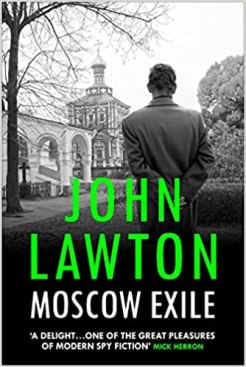
 Some writers who have authored different series occasionally allow the main characters to meet each other, provided that they are contemporaries, of course. I’m pretty sure that Michael Connolly has allowed Micky Haller to bump into Harry Bosch, while Sunny Randall and Jesse Stone certainly knew each other in their respective series by Robert J Parker. Did Spenser ever join them in a (chaste) threesome? I don’t remember. John Lawton’s magnificent Fred Troy series ended with Friends and Traitors (2017), and since then he has been writing the Joe Wilderness books, of which this is the fourth. I can report, with some delight, that in the first few pages we not only meet Fred, but also Meret Voytek, the tragic heroine of A Lily of the Field, and her saviour – Fred’s sometime lover and former wife, Larissa Tosca. As an aside, for me A Lily of the Field is not only the best book John Lawton has ever written, but the most harrowing and heartbreaking account of Auschwitz ever penned. Click the link below to read more.
The notional central character in this novel is Joe Wilderness, although he does not appear until the half way point of the book. For readers new to Joe, a bit of background. First, his real surname is Holderness – his nickname rather cleverly reflects a character who is beyond the pale of conventional loyalty and morality. His WW2 service career was marked by insubordination and bootlegging, and his eye for the main chance found him operating various scams in post war Berlin, where his deviousness brought him to the attention of the British intelligence agencies. Since then, he has been involved in various covert operations on behalf the government – and himself.
The background action in Moscow Exile begins with the activities and subsequent shock-waves caused by the scandal of The Cambridge Five – Burgess, Maclean, Philby, Cairncross and Blunt – pillars of the British establishment who were actively working for Moscow in the 1950s, but the novel has a wide timespan – from the late 1940s to 1969. Charlie Leigh-Hunt, a British toff with a distinguished WW2 record carries the story for a while, as he is sent to be chief spook in Washington after the hurried departure of Harold Adrian Russell “Kim” Philby. Charlie has an affair with Charlotte ‘Coky’ Shumaker a British socialiter, whose husband is Senator Bob Redmaine – a thinly disguised version of Joe McCarthy, he of the notorious anti communist witch hunts. Ironically, Coky is in the pay of Russia, as is Charlie, who eventually ends up as a Moscow resident.
Joe Wilderness has also, since a disastrous attempted prisoner exchange on a Berlin bridge between the East and West sectors, been a guest of the KGB, and Lawton sets up a delicious plot twist when Fred Troy – now a Lord, and a British diplomat – is persuaded to be ‘Our Man In Moscow.’ Again, readers new to Lawton’s books might welcome some background on Fred (see below)
The plotting, by this stage, in terms of bluff and double-bluff, makes John le Carré look like Enid Blyton but, to cut to the chase, HM government decides that it is too dangerous to allow Joe to remain in Moscow, and so he has to be ‘extracted’. It doesn’t hurt that Joe’s father in law, Colonel Burne-Jones is a senior figure in MI5, and his boss – Roderick Troy – is both Home Secretary and Fred’s brother. Normally, spies are only released in exchange for other spies, but the woman handling the Russian end of things, General Volga Vasilievna Zolotukhina is just as big a crook as Joe, and she wants money – £25,000 in the proverbial used notes.
Publicists and other book people who make lists might dub this the fourth Joe Wilderness novel but, for me, it’s the latest saga in Fred Troy’s career – and all the better for it. It is a dazzling and erudite journey down the complex back roads of Cold War diplomacy and skullduggery. Lawton is one of our finest writers, and every page he writes is pure pleasure. Moscow Exile is published by Grove Press and will be available on 4th May.


 Without giving the game away, it is in Brother Dominic’s previous life where the clues are to be found, but answers don’t come easy for Cross and Ottey. Although there was a very clever plot twist involving the identity of the killer, I was far more involved with George Cross as a person than wondering who murdered Brother Dominic.The relationship between Cross and his father, the discombobulating effect of the re-emergence of his mother – lost to him since she left the family home when he was five – and his attraction to the unambiguous world of order, silence and simplicity of Dominic’s fellow monks, all contribute to the power of this compelling read.













 This is the fourth book in a series featuring Norfolk copper DCI Greg Geldard, but author Heather Peck (left) wastes no time in providing all the back-story we need. Geldard is divorced from his former wife, Isabelle, who is a professional singer. She has now remarried a celebrated orchestral conductor, with whom she has a child, while Geldard is in a relationship with one of his colleagues, DS Chris Mathews. When he gets an early morning ‘phone call from Isabelle saying she and her son have been threatened by a foreign criminal connected to one of Geldard’s previous cases, he is forced to stay at arm’s length, but is disturbed to hear from a colleague that Isabelle may be making the story up.