We first met Leeds policeman Tom Harper in Gods of Gold (2014) when he was a young CID officer, and the land was still ruled by Queen Victoria. Now, in The Molten City, Harper is a Superintendent and the Queen is seven years dead. ‘Bertie’ – Edward VII – is King, and England is a different place. Leeds, though, is still a thriving hub of heavy industry, pulsing with the throb of heavy machinery. And it remains grimy, soot blackened and with pockets of degradation and poverty largely ignored by the wealthy middle classes. But there are motor cars on the street, and the police have telephones. Other things are stirring, too. Not all women are content to remain second class citizens, and pressure is being put on politicians to consider giving women the vote. Sometimes this is a peaceful attempt to change things, but other women are prepared to go to greater lengths.
This small but increasingly vocal movement provides one of two plot threads in what is, to my mind, Chris Nickson’s finest novel yet. Prime Minister HH Asquith and his Home Secretary Herbert Gladstone are due to visit Leeds, and it will be Harper’s task to make sure that the visit passes off peacefully. He knows there is likely to be a protest from unemployed men whipped up by anarchist Alf Kitson, but his greatest fear is that a demonstration led by suffragette Jennie Baines will provoke more intense publicity. At this point, it is essential to point out the difference between suffragettes and suffragists. The latter have the same aims as the former, but they are avowedly peaceful in their methods. Harper’s wife Annabelle is a suffragist. She has worked for women’s rights for many years, and has passed on her zeal to their teenage daughter Mary.
The parallel thread in The Molten City begins when Harper receives an anonymous letter:

As he uses his local knowledge and that of his older officers, Harper begins to piece together a jigsaw. As the picture begins to take shape, it is clear that it is one that contains elements of tragedy, greed, desperation – and downright criminality, and that solving the puzzle will bring joy to no-one. As the past players in this old drama start to realise that the past is catching up with them, anxiety leads to violence,and violence leads to murder.
There are so many dazzlingly good elements to this novel. Nickson, like many of his readers is someone of the twentieth century, and he has a keen eye and ear for little social mannerisms that certainly struck a chord with me. As Annabelle imagines her husband in a Chief Constable’s uniform, she says:
“You’d look a right bobby-dazzler.”
Only those of us who were brought up having their tea made in a pot will remember this gesture:
“She felt the side of the teapot and poured herself another cup.”
Teenagers were as hungry in 1908 as they are today, but few sit down with their parents at a set table and have their meal:
“She’d already cleaned her plate right down to the pattern and was working her way through the suet pudding.”
Tom Harper is still fit, active, and able to handle himself in a scrap, but like Tennyson’s Ulysses who laments “tho we are not now that strength which in old days moved earth and heaven, that which we are, we are;” he is all too aware of the passage of time:
“And it was a detective’s job to follow every possibility. That was what his old boss, Superintendent Kendall, had instilled in him when he was starting out in CID. Another one who was dead now; Harper had filled his shoes at Millgarth. Billy, Kendall, so many others …very soon the dead in his life would outnumber the living.”
Nickson orchestrates the dramatic disorder – based on real events – of the Prime Minister’s visit with panache and the skills of a born storyteller. We know – as does Harper himself – that finding the truth about the child stealing will benefit no-one alive or dead, but he is a policeman who must do his duty while being all too well aware that the truth is frequently uncomfortable.
The Molten City is published by Severn House and is out now. If you want to find out more about Chris Nickson and his books, then click the image below.


SM Hardy, aka Sue Tingey, has put together a thoroughly enjoyable and, at times, genuinely scary ghost story. The Evil Within tells the tale of Jim Hawkes, a young London banker who has an attack of conscience about the bloodthirsty nature of his trade, and tells his boss to go forth and multiply. This rush of blood to the head is not entirely unconnected to the fact that he is still grieving for his dead sweetheart, who drowned herself after breaking off their engagement in a calamitous row. Jim decides that a physical exit from London is essential, and so he takes out a short term lease on a cottage in England’s West Country.


There are three narrative viewpoints;
Her estranged sister, Sadie,

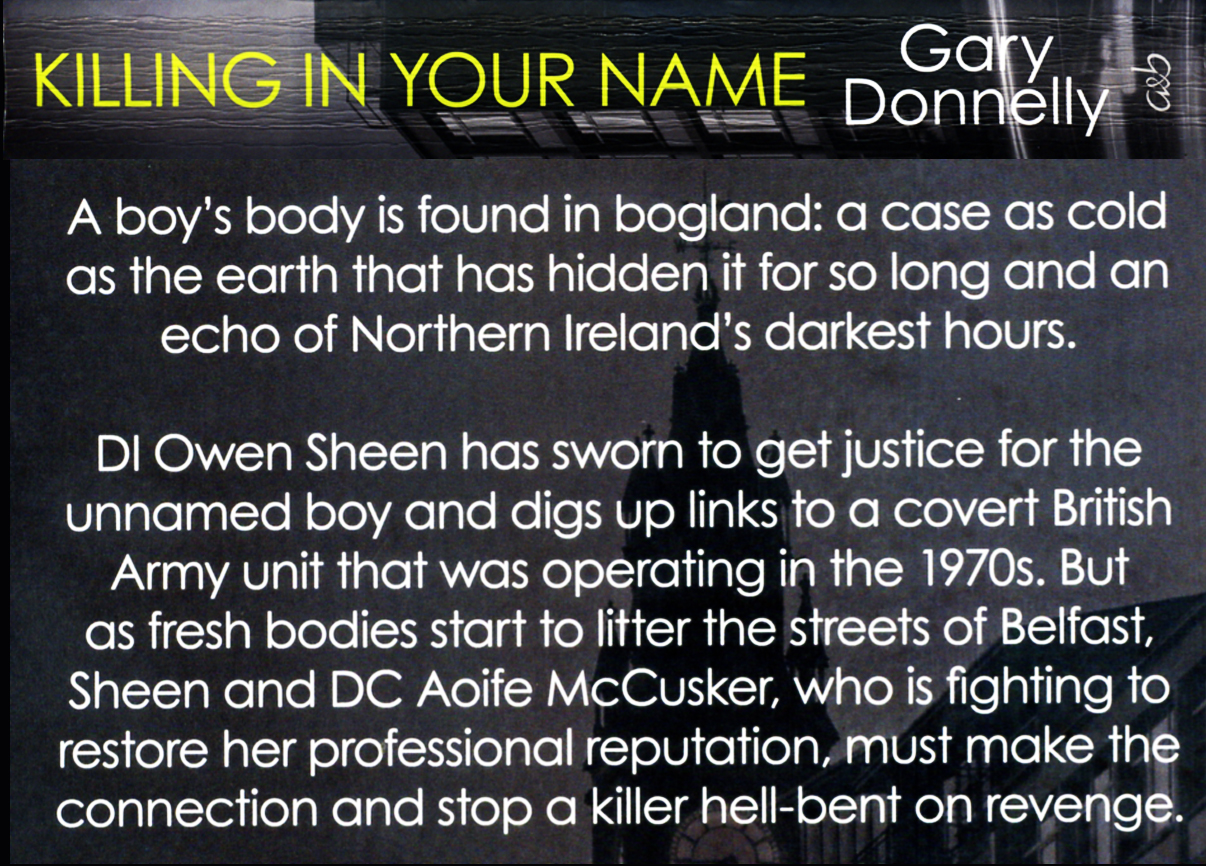
Belfast and its grim sectarian past is the epitome of noir. But, sadly, it is a non-fiction noir, as real events over the past fifty years or so would have been dismissed as preposterous had they been penned by a novelist. Such novelists would have to be writing historical fiction, though – wouldn’t they? Surely the momentous events of the spring of 1998 signaled a slow but irrevocable process of healing across the province? Gary Donnelly (left) has written a blistering debut novel Blood Will Be Born which says otherwise.
is Belfast minder is to be DC Aoifa McCusker, an ambitious and headstrong young officer widely distrusted by her male colleagues. Even before Sheen and McCusker have the chance to discover how they each like their coffee, author Donnelly introduces us to two of the spectacularly grotesque villains of the story. First up is John Fryer, a brutal republican hitman with too many deaths to his name. Too many? Fryer’s murderous career has been haunted by a grisly mythical beast known as The Moley, who rises up from the primeval bog and is only placated by the shedding of fresh blood. Fryer is contained – for now – in a secure mental hospital.
ryer and Moore, for their own reasons, are determined to set Belfast on fire. Not the triumphalist – but literal and containable – fire of The Loyalist bonfires on the eve of 12th July, but a fire which will lay waste to the fragile peace enjoyed in the divided city. Sheen and McCuskey, with different motives, are desperate to bring down Fryer and Moore.

Peter Laws introduced us to Matt Hunter in Purged (2017) and we learned that he is a former priest whose total loss of faith coincided with tragic personal events. Now, he lectures in the sociology of religion and belief systems, and has a reputation (one which does not sit lightly with him) for being the go-to guy when the police have a case which is ‘not dream’t of in our philosophy’.
unter discovers that Riley is a devotee of a local church, one which, depending on your view might be termed either ‘charismatic’ or ‘a bunch of eyeball-rollers’. Things take a dramatic turn for the worse when Riley’s wife is discovered, horribly mutilated, in one of the customer chairs of her home hairdressing salon.
hat happens next is violent, bloody, improbable – but totally gripping. Of course, Matt Hunter survives to return to his delightful wife and children, but not before he is forced to question his firmly-held disbelief in ‘ghoulies and ghosties, and long-leggedy beasties, and things that go bump in the night.’
Laws (right) doesn’t exactly play it for laughs, but amid the knockabout spookery and Hunter’s own predilection for making wisecracks, there is serious stuff going on. It is worth comparing Matt Hunter with another fictional investigator of strange things – Phil Rickman’s Merrily Watkins. Like the real life Peter Laws, Merrily Watkins is a priest. Like Matt Hunter, merrily doesn’t necessarily believe in the supernatural, but she is totally convinced that some folk do.

ames Oswald’s Edinburgh copper Tony McLean is something of a fixture in the crime fiction firmament these days, and Bury Them Deep is the tenth in the series. For those readers picking up one of his cases for the first time, a little of his back story might be helpful. He is based in Edinburgh and now, of course, works for Police Scotland. He was (unhappily) educated in English independent schools thanks to his wealthy family, some of whose riches he has inherited, thus making him ‘a man of means’. He lives in an old and impossibly roomy house, left to him by his grandmother. He has a fragile relationship with partner Emma, and it is fair to say that their life together has been punctuated by both drama and tragedy. McLean drives a very plush Alfa Romeo, enjoys an occasional glass of cask-strength single malt whisky and, aside from his instinct for police work, has been known to be susceptible to stimuli and influences that are not, as Hamlet remarked, “dreamt of in your philosophy.” After many successful cases, he is now Detective Chief Inspector McLean, but if his superiors imagine he will settle for a life behind a desk, they are very much mistaken.
Anya Renfrew is a rather dowdy and dull police civilian worker who seems devoted to her job, which is mastering the many databases which keep investigations fed with information. She has never had a day off in her life, and so when she goes missing it is considered rather unusual. Her mother is a former – and legendary – police superintendent, but Grace Ramsay is now old and infirm, living in a care home. Police are never more active than when investigating actual or possible harm to one of their own, and when McLean searches Anya’s house, what he finds hidden in her wardrobe indicates that Ms Renfrew’s private life was more exotic – and dangerous – than colleagues might have imagined.
cLean’s professional life already has one big complication. A five-times serial killer called Norman Bale is in a secure mental hospital, thanks to McLean’s diligence and bravery. Now, he asks to speak to McLean, and what he has to say is both shocking and improbable. Are his words just the ramblings of a psychological disturbed killer, or does his suggestion – that Anya Renfrew’s disappearance and the moorland bone-pit are linked to a sinister piece of folklore – have any substance?
t takes a bloody good writer to mix crime investigation with touches of the supernatural. John Connolly, with his Charlie Parker books is one such, but James Oswald (right) makes it work equally as well. The finale of this novel is as deeply frightening as anything I have read for a long time. Despite the drama, Oswald can use a lighter touch on occasions. There is dark humour in the way McLean sometimes needs to ingratiate himself with Edinburgh’s smart set. At an art gallery opening night he listens politely as two guests discuss one of the objets d’art:

ack in the day, before authors and their publishers trusted me with reviewing novels, I did what the vast majority of the reading public did – I either bought books when I could afford them or I went to the local library. I had a list of authors whose latest works I would grab eagerly, or take my place in the queue of library members who had reserved copies. In no particular order, anything by John Connolly, Jim Kelly, Phil Rickman, Frank Tallis, Philip Kerr, Mark Billingham, Christopher Fowler and Nick Oldham would be like gold dust.
Oldham’s Henry Christie was a particular favourite, as his adventures mixed excellent police procedure – thanks to Oldham’s career as a copper – a vulnerable and likeable hero, and an unflinching look at the mean and vicious streets of the Blackpool area in England’s north-west. Wildfire is the latest outing for Henry Christie, who has retired from the police and now runs a pleasant village pub set in the Lancashire hills.
ventually, the wildfires of both kinds are extinguished, at least temporarily, but not before Henry Christie is forced, yet again, to take a long hard look at himself in the mirror, and question if it was all worth the effort.
his brutal journey into the darkside of modern Britain ends with Christie summing up his motivation for continuing to fight on, his back to the wall:

artre insisted that the celebrated line from his 1944 play Huis Clos (No Exit), “L’enfer, c’est les autres.” was forever misinterpreted, but the idea that hell is other people has stuck, despite the protestations of the Great Existentialist. Some, like Jo Spain in her latest novel Six Wicked Reasons, would suggest – to mix and match poets – that Dante’s Nine Circles of Hell could be condensed into an overpowering tenth – Family.
The Lattimer family, patriarch Frazer, sons James, Adam and Ryan, daughters Ellen, Kate and Clíodhna – Clio – have assembled at the family home in south east Ireland overlooking the waters of Spanish Cove in the Irish Sea, so called because of its earliest recorded casualties – sailors from a Spanish galleon blown adrift from the Armada and then shattered on the hidden rocks.
eaders new to Jo Spain’s novels will welcome the apparently straightforward back-stories of Frazer Lattimer’s children, and their motives for wanting him dead. Those who know that the author is The Mistress of Misdirection will suspect, correctly, that this is only the start. But, for the record, I give you the Lattimer children. James is a big media name, with TV screenwriting and production credits on his CV. Lives in Dublin, of course with ex-model wife and step daughter. Adam – now there’s a tale. He now lives abroad, making money for fun, but he disappeared ten years earlier, broke the heart of his late mother Kathleen, and has now re-appeared, equally mysteriously, and it is his return ‘from the dead’ which has prompted the reunion. Ryan, alas poor Ryan. Drug addicted as a teenager, he has somehow survived industrial intakes of pharmaceuticals, and now lives in Italy, just about getting by as an odd-job man.
llen Lattimer is the female equivalent of the Prodigal Son’s brother. Remember, the bloke who stayed at home while his brother was out on the town, giving it all away? Ellen has stayed at home, cleaning, cooking, dusting – and paying for the upkeep of the house. She is prim, joyless, and what Private Eye used to call “tight-lipped and ashen-faced.” Kate, on the other hand, has spread her wings and learned to fly. Having overcome a teenage weight problem which caused her to be known locally as King Kong, she is now svelte, lean and lovely. Also, married to a filthy rich Chinese businessman with a chain of luxury hotels. Clio, though has been in the wars. Summoned from a dingy bedsit in downtown New York to attend the family gathering, she is the most volatile of the children, the antithesis of the line from the old hymn which described Our Lord as “slow to chide and swift to bless.”
s an amateur wordsmith I can only guess at Jo Spain’s writing technique; her prose is so assured, so fluent and has that sense of flair that cannot, surely, be the result only of endless hours of editing. No matter how long you spend polishing a piece of coal, you will never transform it into a gem stone. Six Wicked Reasons is a diamond, multi-faceted and reflecting both the light and the darkness of the human soul. It is 

s she gazes up at her bedroom ceiling, Lily Bell daydreams of becoming an actress. She is, to be sure, beautiful enough, with her long almost-white blond hair and her flawless complexion, but for the stepdaughter of a struggling artist in the London of 1851, her dreams of becoming Ophelia, Juliet or Desdemona are just foolish fantasies. Until the day her penniless stepfather receives a visit from one of his creditors, a mysterious self-styled Professor – Erasmus Salt. Salt is actually a theatrical showman, with a macabre interest in that overwhelming Victorian obsession, communicating with the dead. He offers Alfred Bell respite from the debt in return for Lily accompanying Salt and his spinster sister Faye to become the star of a new production, in which he will convince audiences that he has raised the dead.
Despite her misgivings, Lily is intrigued by what appears to be a chance to achieve her ambition. After all, Salt’s theatrical illusion may be faintly sinister, but who knows what career doors it might unlock? Bell, despite the tears and misgivings of his wife, cannot get Lily out of the door fast enough, and soon the girl is on her way south, to the seaside town of Ramsgate, where Salt’s production is due to be presented at The New Tivoli theatre.