We are in the fictional Derbyshire town of Bainbridge. Recently divorced Ruth Prendergast has finished work for the day, done her shopping, and is keen to be inside her new house in Hollywell Close, warm, snug and out of the icy winter rain. She fancies a night in, with a pizza and a glass or two of wine. What she gets, however, is a ghastly shock. Turning on the bedroom light she finds a man apparently asleep under her duvet. When she plucks up the courage to wake him, she finds she cannot. Because he is dead. Stone dead, with a knife embedded in his body.
 The team investigating the murder is led by Detective Inspector Isabel Blood, her Sergeant and a brace of DCs. They soon learn that the dead man is Kevin Spriggs, a middle-aged car mechanic, with a failed marriage behind him, an estranged son – and an argumentative temperament often fueled by drink. The murder raises many questions for Blood and her people. How did Spriggs and the person who killed him gain access to a locked house? Who hated Spriggs – admittedly not one of life’s natural charmers – enough to kill him? After all, he was something of a nobody, tolerated rather than loved by most people who knew him, but why this brutal – and mysterious – death?
The investigation – code named Operation Jackdaw – has achieved precisely three-fifths of five-eighths of diddly-squat, when it is rocked by the discovery that Ruth Prendergast, who discovered the corpse of the unfortunate Spriggs has herself disappeared. She was due to go on a walking trip with a lady friend, but she failed to make the rendezvous and, to borrow from The Bard, she has “melted into air, into thin air ….. leaving not a rack behind.“
There are enough fictional Detective Inspectors out there in the world of crime fiction to run a large county police force, so what makes Isabel Blood – to steal a sporting cliché – achieve a podium finish? Refreshingly, she is middle-aged, comfortable in her skin and appears to have no hidden demons. She is happily married with two teenage daughters, and the only kink in this domestic bliss is that her father was apparently bigamously involved with Isabel’s mother, and now lives in France where he has two grown up sons with his legal wife. Now, Isabel’s father and her half-brother have arrived in Bainbridge for a visit at precisely the time that the unfortunate Kevin Spriggs is discovered in Ruth Prendergast’s bed. Eventually, the team discover how – and why – the man was murdered, and the solution is complex, but it very neatly echoes Isabel’s own difficulties with her double family and half-siblings.
Without A Trace is a well plotted and nuance police procedural with credible coppers and equally convincing villains. It is published by HQ Digital, and will be out in Kindle on 29th October. A paperback edition will be available in January.


 The answer to that conundrum forms the central premise of the book. Porter’s niece Scarlett has been drawn into the orbit of a feminist organisation called Artemis led by a charismatic woman called Paula Kunis. Porter will only answer police questions about his activities if Bloom undertakes to track down Scarlett and extract her from the clutches of Artemis. Bloom is smart enough to realise that Porter is up to something, but cannot work out why he is so worried about his niece, when every other aspect of his behaviour suggests that he is a cold and devious man, with psychopathological elements to his character.
 century Professor Moriarty, who has crossed swords with Bloom and Jameson before. Thirdly, Gerald Porter has inexplicably disappeared from police custody and, almost immediately, a huge social media campaign vilifying Paula Kunis and Artemis has been launched, with the result that scores of husbands and fathers of women “poached” by Artemis have headed to the Scottish retreat and are angrily congregating at its gates.




 Nikki Hardcastle








 Intermission is, I am sure, the only novel I have read so far that has, as its spine, the Covid-19 pandemic. The action begins in that fateful early spring of 2020, and Hayden Prentice learns that one of his old friends, a former bent copper known as Fat Dave has been laid low with the virus and is in the local ICU, and not expected to live. Visiting is, of course, completely off limits, but the sight – via a video link – of his friend expiring amidst a sea of tubes and monitors chills HP to the bone. He travels from his Dorset manor house and summons Enora down to Portsmouth, where they have been given the use of a shabby flat owned by HP’s solicitor.

 As the plot develops we learn that the dead woman, Becca O’Brien, was pretty much human wreckage, drug addicted and feckless. Interestingly, her daughter (who now lives in sheltered accommodation0, was involved in an act of criminality which happened twenty five years earlier (see first paragraph) at a moorland location called Gorse Farm, where human bones have recently been discovered. In an ostensibly separate plot thread, Calladine is being threatened by a criminal adversary (something of a stage eastern European gangster) called Lazarov. When Lazarov threatens to harm Calladine’s grand-daughter if he doesn’t facilitate the Bulgarian’s take-over of the Leesdon drug scene, the tension ratchets up several notches.




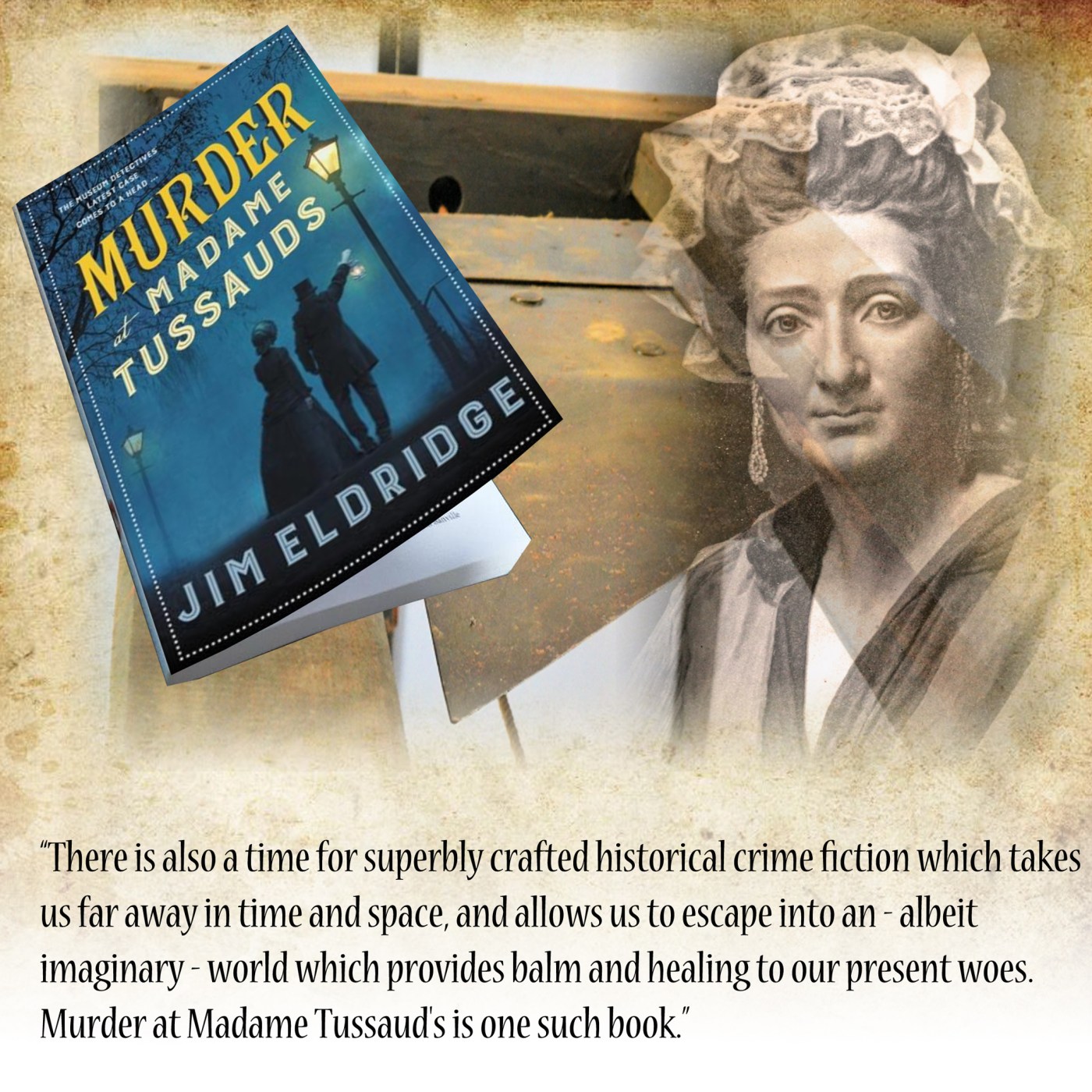
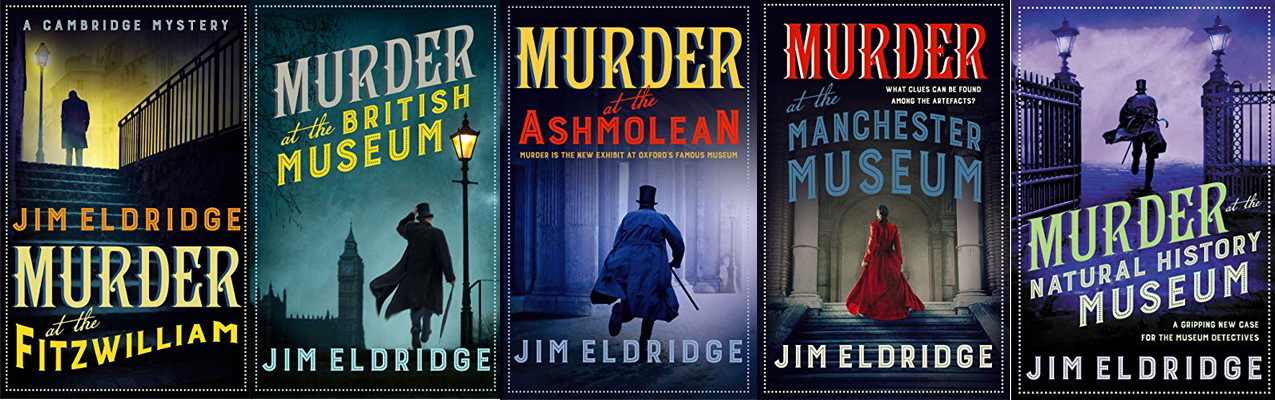
 This shouldn’t be dismissed as ‘comfort reading’. Yes, we know what we are going to get – the atmospheric late Victorian setting, the warm human chemistry between Daniel and Abigail, the absence of moral ambiguity and the certainty that good will prevail. Any genuine reader of fiction – and in particular, crime fiction – will know that, rather in the manner of Ecclesiastes chapter III , there is a time for everything; there is a time for the dark despair of Derek Raymond, there is a time for the intense psychological dramas of Lisa Jewell, and a time for workaday police procedurals by writers like Peter James and Mark Billingham. There is also a time for superbly crafted historical crime fiction which takes us far away in time and space, and allows us to escape into an – albeit imaginary – world which provides balm and healing to our present woes. Murder at Madame Tussaud’s is one such book. It is published by Allison & Busby and is