Search

fullybooked2017

Category

Uncategorized

THE TORMENTS . . . Between the covers

tt spine081 copy

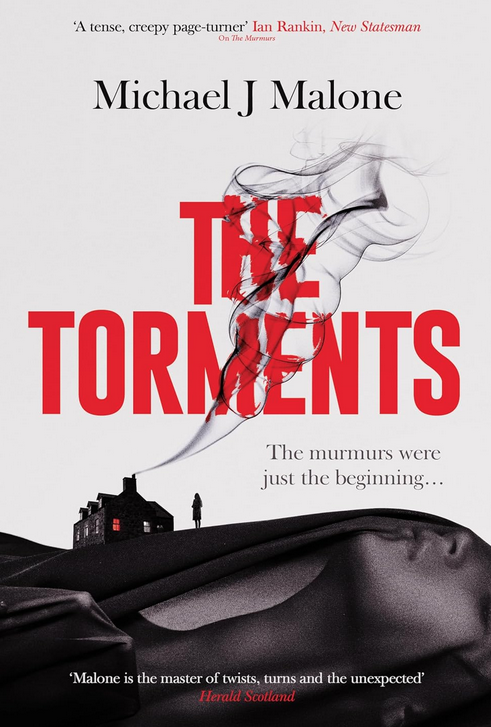
Annie Jackson, to whom we were introduced in The Murmurs (2023), has a frightening gift – she can foretell how people are going to die. She can also visualise the locations of dead bodies. One of the manifestations of her powers is also a curse. When she is inside her tiny cottage beside a Scottish locj, she hears constant murmuring voices. When she steps outside, however, these voices can be screams, or unintelligible chants. Annie has learned that this strange condition has affected women in her family going back generations.

Annie already has a certain amount of public exposure thanks to a recent case, but she is reluctantly accepted in the village near her cottage. She makes ends meet by waitressing in a cafe, and it is here, one afternoon, when the local lifeboat crew are in for their strong tea and bacon rolls that she has one of her moments of premonition. A junior member of the crew, a lad called  Lachlan, drives a car that is something of an ‘old banger’. Annie sees it wrapped round a tree, with the boy dead at the wheel. She says nothing direct by way of a warning, and when her vision turns into horrific reality, she becomes a pariah.

A member of Annie’s wider family turns to her for help. Her son Damien, a former footballer whose career was curtailed by injury, has gone missing, and she asks Annie to try to find him. Reluctantly, Annie agrees, and with the help of her twin brother Lewis, she takes on the case.

There is a parallel plot which begins in the mid 1960s, but we know it will converge with Annie’s present day travails. Two youngsters, Sylvia and Ben, are pupils at a prestigious boarding school, and they fall under the malign influence of Phineas Dance, a sadistic teacher who is also an acoylite of Satanism. Also lurking in the present day background is a sinister spectre known as the Baobhan Sith*.

*The Baobhan Sith is a female fairy in the folklore of the Scottish Highlands, though they also share certain characteristics in common with the succubus. They appear as beautiful women who seduce their victims before attacking them and killing them

As Annie and Lewis chip away at the mystery surrounding Damien’s disappearance their path crosses that of Craig Oldfield, the son of a wealthy and well-connected solicitor. Craig was a one-time friend of Damien, but is his claim that he has no idea of his former friend’s whereabouts to be trusted? We meet a a local police officer, Clare Corrigan who is initially sceptical of Annie’s special powers, and a retired academic called Dr Thomasina Hetherington, who most certainly is not. When Annie goes missing, the story heads for a dramatic conclusion in a cliff-side cave, rumoured to have once been the haunt of the legendary cannibal Sawney Bean. By now, the present day identities of Sylvia and Ben have become clear. The finale put me in mind of the glory days of my youth, reading the the sadly long forgotten novels of Dennis Wheatley  such as The Devil Rides Out (1934) in which the Duke de Richleau and his friends Simon Aron, Richard Eaton and Rex Van Ryn battled Satanic forces.

Novels that mix the paranormal with the more familiar tropes of crime fiction are more common than you might think. In the Aector McAvoy novels by David Mark it is McAvoy’s wife who has the sixth sense, and James Oswald’s DI Tony McLean often has worrying premonitions and glimpses into the ‘other world’. I once asked Phil Rickman if his wonderful diocesan exorcist Rev. Merrily Watkins always believes the people with troubled souls who reach out to her for help. His reply was along the lines of. “Not necessarily, but she believes that they believe.”

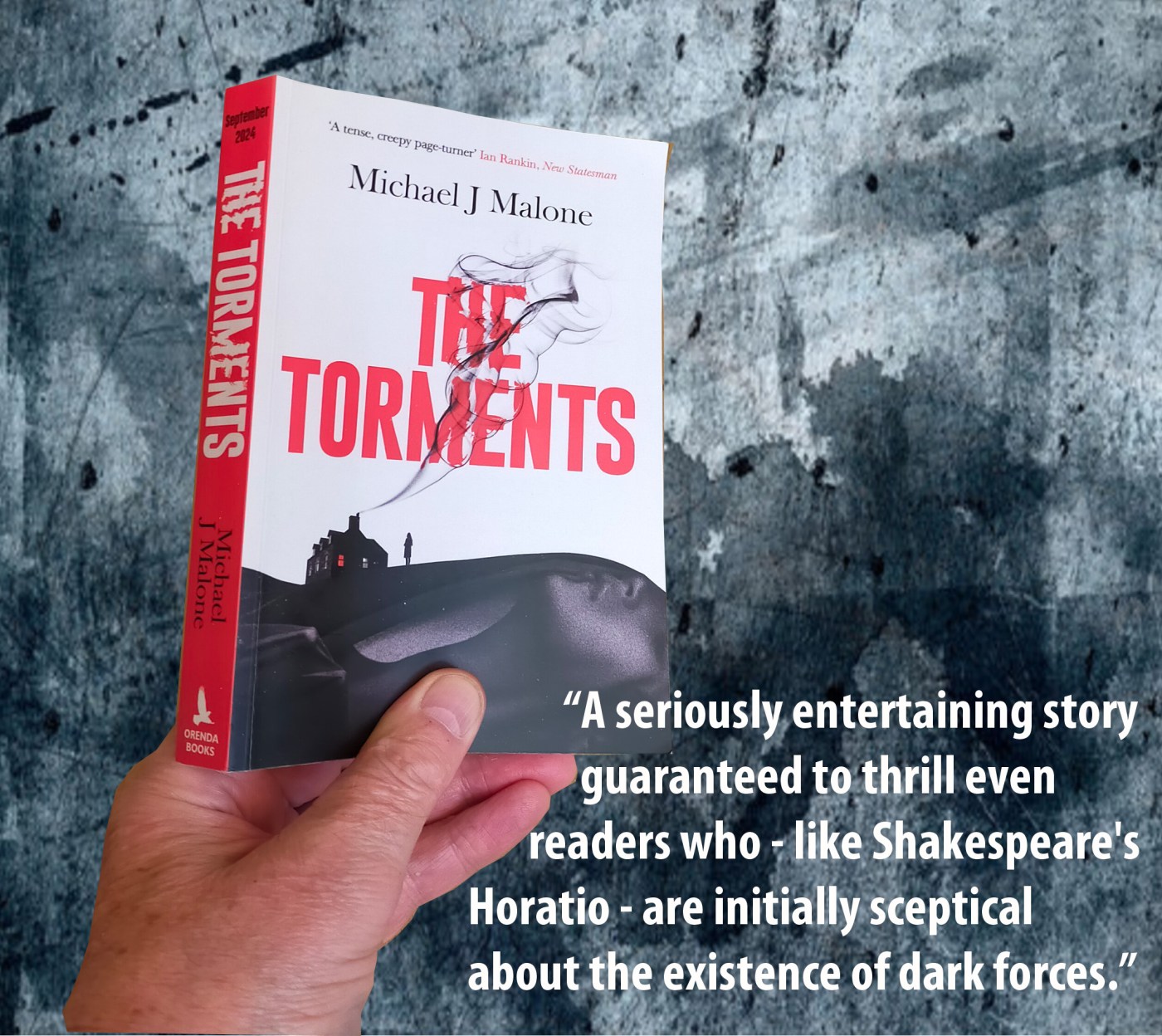
The Torments is a seriously entertaining story guaranteed to thrill even readers who – like Shakespeare’s Horatio – are initially sceptical about the existence of dark forces. It is published by Orenda Books and is available now.
Screen Shot 2024-09-11 at 20.32.54

I DIED AT FALLOW HALL . . . Between the covers

IDAFH spine074

Although set in a beautiful village near Cirencester, with glowing limestone cottages, a jolly white-haired vicar, and the squire’s mansion up on its hill, this is as far away from a ‘Midsomer’ type Cosy Crime as you can get. Instead it is a beautifully written tale, full of poetry, some very dark corners and people who, if not severely damaged, are fighting their own demons. Anna Deerin, a former ballerina who had to quit through ligament damage has moved to the village of Upper Magna. She lives in a grace and favour cottage in the grounds of Fallow Hall. She lives rent free because she has undertaken to work and restore what was once the Hall’s extensive kitchen garden. She keeps chickens and earns a slender living by baking cakes and selling them – and her fruit and vegetables – at the weekly farmers’ market on the village green.

She lives in a kind of self-imposed exile, with no mobile phone and no current close friends. This all changes when, while attacking a long neglected part of the garden with a pick-axe, she finds human remains. Into her life comes Detective Inspector Hitesh Mistry, another London exile. He heads up the search for the identity of the skeleton – subsequently proved to be that of a woman. Like Anna, he is a complex individual. He is deeply immersed, emotionally, in a well of sadness caused by the recent death of his mother. While he respects his elderly father, the way that his mother was treated rankles with him. Although it seems nothing unusual in Indian families, he resents the fact that his mother was just seen as a cook, child-bearer and housemaid, while her obvious intellectual and emotional talents (she was a part-time hospital administrator) seemed to count for nothing in the family home. He has little left of her now, except the fragrance of her skin and cooking – and a treasured red cardigan which he describes, chillingly, as ‘empty’.

Screen Shot 2024-08-20 at 12.36.36

Bonnie Burke-Patel (left) intersperses contemporary events with brief but telling episodes from 1967. We meet a young woman, living locally (almost certainly in Fallow Hall) She has a younger brother, away at university. Her mother is rather inadequate, particularly at household skills, and her father is a domineering and demanding WW2 veteran, hideously disfigured by a facial injury. One morning, she escapes into Cirencester (to buy the ingredients for her own birthday cake) and meets a young Canadian man. There is an instant attraction and, after very little courtship she, belatedly – in the time-honoured phrase – loses her virginity.

This sets up the puzzle to perfection, but the author plays her cards very close to her chest. Mid way through the book there are so many questions. Is the authoritarian father related to Lord Blackwaite, the current Lord of the Manor? Is the body in the garden his daughter? Who tried to batter their way in to Anna’s cottage a couple of nights after she uncovered the remains?

Reviewing crime novels is not particularly difficult when the books are thrillers, police procedurals or basic whodunnits. The reviewer has a few simple tasks: outline the plot, describe the characters and setting, and then describe how well the book works. I am neither a professional writer nor a journalist, and so I tend to read books that I know I will be happy with. Just occasionally, there comes a book which challenges my ability to do it justice. I Died at Fallow Hall is one such.

As I said earlier, despite the familiar rural tropes, this is something rather special. The startling violence near the end, and the emotional intensity with which Anna empathises with – and is determined to identify – the girl whose skull she cradled in her hands on that fateful autumn afternoon, sets this novel aside as something very special. Putting on my reviewer’s hat I can answer the potential readers’ question, “What do I get.” In no particular order you get a murder mystery, a grim account of the cruelties that family members can inflict on each other, a poignant study of loneliness and isolation, a gimlet-eyed look at English class structure and, above all, a testimony to the power of love. From Bedford Square Publishers, this is available now.

Screen Shot 2024-08-20 at 12.34.37

THE MAN THEY COULDN’T HANG . . . The murder of Sybil Hoy (part 2)

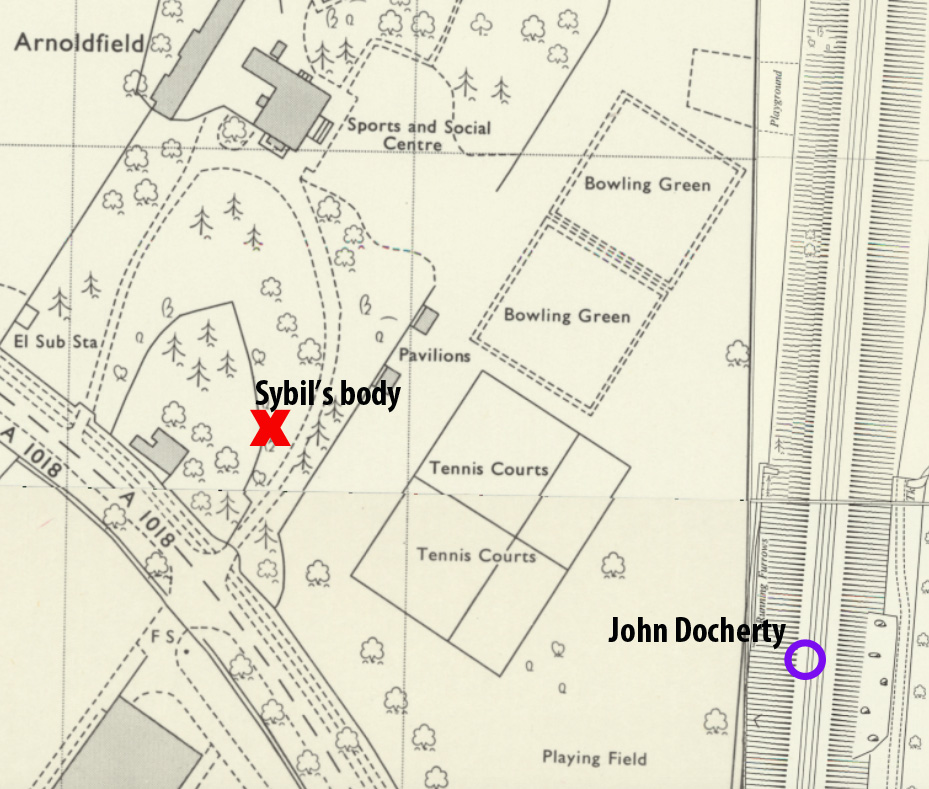
Sybil HeaderSO FAR: 10th August, 1954. Just after 11.00 am. In the drive leading up to the former mansion known as Arden Field just outside Grantham, the body of 24 year-old Sybil Hoy was found. She had been brutally murdered. Her body was taken away to the mortuary, and police began searching for the weapon. Just a few hundred yards away, across the Kings School playing fields, was the railway embankment that carried the London to Edinburgh main line. A railway lengthman (an employee responsible for walking a particular stretch of line checking for problems) had just climbed the embankments, and stood back as the London to Edinburgh service known as The Elizabethan Express thundered past.
Elizabethan

What he saw as the train clattered into the distance was utterly shocking. A man sat upright on the track, and just a few yards away, on the sleepers were the man’s severed legs. The man was conscious, and able to talk. An ambulance was summoned, and he was carried down the bank and rushed to hospital. The man was John Docherty, Sybil Hoy’s former fiancée.

Arnoldfiekd Map

Docherty, minus his legs, received further corrective surgery to the amputations delivered by the LNER locomotive, but was charged with murder, by a police office sitting at his bedside. He was conducted into a succession of magistrate hearings and eventually sent to be tried at Lincoln Assizes. It was the briefest of hearings, and he was sentenced to death.

FuneralAfter her body had been probed and prodded by investigators, it was eventually returned to her mother and father. God, or whoever controls the heavens, was not best pleased, because a violent storm rained down on the many mourners at the Victorian Christ Church in Felling


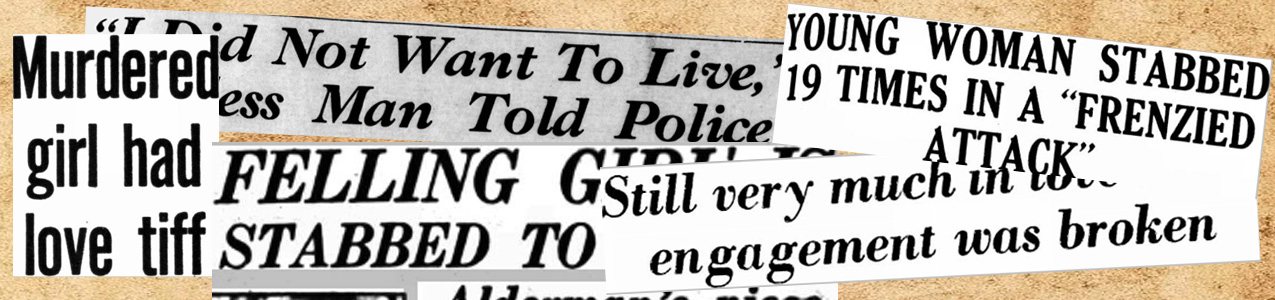
In the long history of newspapers reporting on murders and executions, there can seldom have been a bigger gift to headline writers. The five words ‘Legless Man Sentenced To Hang’ appeared over and over again in newspapers, both regional and national. For the Home Secretary, Gwilym Lloyd-George, himself an MP for Newcastle, the impending execution posed unique practical problems. Docherty literally could not walk to the execution chamber. He would have to be taken there in his wheelchair, and Henry Pierrepoint (or whichever executioner was appointed to the job) would have to oversee the grotesque scene of a man placed on the trapdoor, presumably sitting on his backside, hands pinioned (as was customary) and thus unable to maintain his balance. Almost inevitably, given the bizarre circumstances, the execution was called off. What became of the reprieved killer of Sybil Hoy is unclear. For citizen researchers, access to prison records via genealogy sites ends in 1951, so it is not beyond the bounds of possibility that Docherty, born in 1926, could have been released and reached old age.

Because Docherty pleaded guilty, his state of mind and mental health was never raised in court. These days, we have too many examples of mentally ill people being free in the community to murder and maim. The Nottingham triple killer, Valdo Calocane is just one example. In Docherty’s case, his mindset was so febrile that within the space of sixty minutes or so, he inflicted nineteen ferocious knife wounds on his former fiancée, and then ran a few hundred yards to the main railway line, climbed the embankment and put himself in the path of an express train. I use those two words advisedly. People who commit suicide by train usually put the matter beyond doubt by throwing themselves bodily in front of the oncoming train. Is it possible that Docherty calculated that by just putting his legs on the line he would avoid fatal injury? We have no way of knowing. If it was a gamble, it paid off, because he evaded a date with the hangman. I have to say that if his actions were calculated, then he was an extremely devious individual.

FIRE AND BONES . . . Between the covers

FAB SPINE066 copy

Screen Shot 2024-07-13 at 20.24.17To use a cricketing term, the Dr Temperance Brennan book series by Kathy Reichs (left) is 24 not out, and still looking good. The series featuring the forensic anthropologist began with Déjà Dead in 1997. For anyone new to the novels, I’ll just direct you here for background information. Tempe (her preferred nickname) is in her Charlotte NC autopsy room and has just finished one of her trademark investigations into long-dead human remains. She is planning a few days away with her long-time boyfriend, Quebec cop Andrew Ryan, but when she gets home, she has a series of ‘phone calls  which persuade her to drive to Washington DC to help with the investigation of a fatal fire in an old house in Foggy Bottom.

The Victorian property had been most recently used as a low rent boarding house, and amid the devastation, there are four dead bodies, all victims of the fire. When part of the ground floor gives way under the weight of one of the fire officers, a hidden cellar full of alcoves and passages is revealed, and it is in one of the chambers that Tempe discovers another corpse tied inside a burlap sack. While the charred remains of the four fire victims are quickly identified, the corpse in the burlap bag is more mysterious. The body is that of a woman, small and slender, but how long she had been in that bag, in that cellar is more problematic. Via one of those nerdish experts who specialise in arcane knowledge, Tempe learns that the sack in which the victim was confined probably dates from the late 1940s.

Screen Shot 2024-07-13 at 19.53.48

Tempe, with the help of a TV reporter called Ivy Doyle, learns that the reason for the fire may be connected to a group of hoodlums back in the prohibition era. The Foggy Bottom Gang. The ringleaders were Leo, Emmitt, and Charles “Rags” Warring, who had worked as laborers in their father’s barrel shop. When the (illegal) booze started flowing, all three quickly got caught up in the wild and sometimes violent underworld of Washington, D.C. But what is the connection between events decades ago and modern day Washington DC? Eventually, Tempe finds out the truth, and it reinforces the old adage about revenge being a dish best served cold and, in this case, slow.

The book rattles along at breakneck speed, and Tempe Brennan is her usual sassy, quick-thinking self, a persona that Kathy Reich’s millions of readers have come to know and love over the 27 years since Tempe first appeared. Thy narrative style is unmistakably and uniquely American – slick, witty, and sharp as a tack. It won’t appeal to readers who like gentle cosy crime mysteries set in idyllic British locations, but it is a testament to its style and commercial appeal that a TV series based on the books ran from September 13, 2005, concluding on March 28, 2017, airing for 246 episodes over 12 seasons. 

Fire and Bones is gripping and addictively readable, despite the fact that  – like books in other long-running American series by writers like Jonathan Kellerman, James Patterson and Harlan Coben – it is formulaic. The formula works, readers love it, so you will hear no complaints from me. It is published by Simon & Schuster, and is out today, 1st August.

Screen Shot 2024-07-13 at 20.20.13

THE POSTMAN DELIVERS . . . Lewis, Parry, Walls & Wilson

tpdheader

THE SILENT OATH by Michael J Lewis

The Silent Oath is the fourth in The Oath series that depicts life at Blackleigh Public School in the 1950s. Jonathan Simon, 17, is in his fourth year at Blackleigh, but he is self-conscious about his appointment as one of five Prefects in Trafalgar House. Jonathan knows:
(1) The school code of conduct mandates no snitching on anyone.
(2) The student Prefects have absolute power to discipline.
(3) Mr. Phillip Temple the new Headmaster is determined to revise the school admission policy to achieve a more even playing field in education.
The pressure mounts during a school trip to Paris as the school’s Board of Governors as they oppose the new Head. They will stop at nothing to get their way. In his effort to strive to support the Headmaster’s goals, Jonathan will have to overcome far more than an oath of silence executed by his enemies to prevail. This was published by The Book Guild on 7th June.

A CORRUPTION OF BLOOD by Ambrose Parry

Ambrose Parry is the pen name of husband and wife writing team Chris Brookmyre and Marisa Haetzman. Their series of historical crime novels set in 1850s Edinburgh featuring Dr Will Raven and Sarah Fisher began with The Art of Dying. Next came The Way of All Flesh, and this is the paperback version of the third in the series. A package containing human remains is washed up on the shores of Leith, and Raven is dragged into the darker reaches of the city’s underworld. Meanwhile, his former lover Sarah Fisher is trying to make her way in the world of medicine against the determined prejudice of the establishment. This is published by Canongate Books and will be available on 4th August. For a full review of the novel, click this link.

IGOR AND THE TWISTED TALES OF CASTLEMAINE  by Ian J Walls & Richard L Markworth

Not my usual fare, this, but here goes. Following decades of torture at the hands of his cruel master Victor Frankenstein, the once-downtrodden and pathetic Igor finally rises up and walks out on Victor, in the hope of finding a fulfilling life-less-ordinary elsewhere. Instead, something wicked his way came, and Igor finds his way to Castlemaine, an accursed village nestled deep in the Carpathian Mountains, where terrors stalk the waking world and ale is more expensive than in London. Published by Matador, this is available now.

FERAL by Glenis Wilson

When a storm causes a low-flying Cessna to crash in the woods on his sheep farm, it proves a catalyst for Kent Evans and his little daughter, Rachel. Their lives become entangled with three other people: Phillip Lemmingham, air traffic controller, Anan Isooba, the Cessna pilot and Mr Smith, owner of Wild Ark Zoo (and drug dealer). The pilot is trapped in the wreckage and one piece of cargo, a crate carrying an illegally imported black panther, smashes open. The panther escapes. Desperate to save his business, Mr Smith is determined to track down and recapture the panther while also recovering the second secret part of the cargo; a consignment of cocaine. Meanwhile the pilot, unable to move, remains an easy meal for a prowling hungry panther. From The Book Guild, this was published on 7th June.

MURDER COMES TO LADBROKE (2) . . . True crime from 1926

Ladbroke header

Cinema

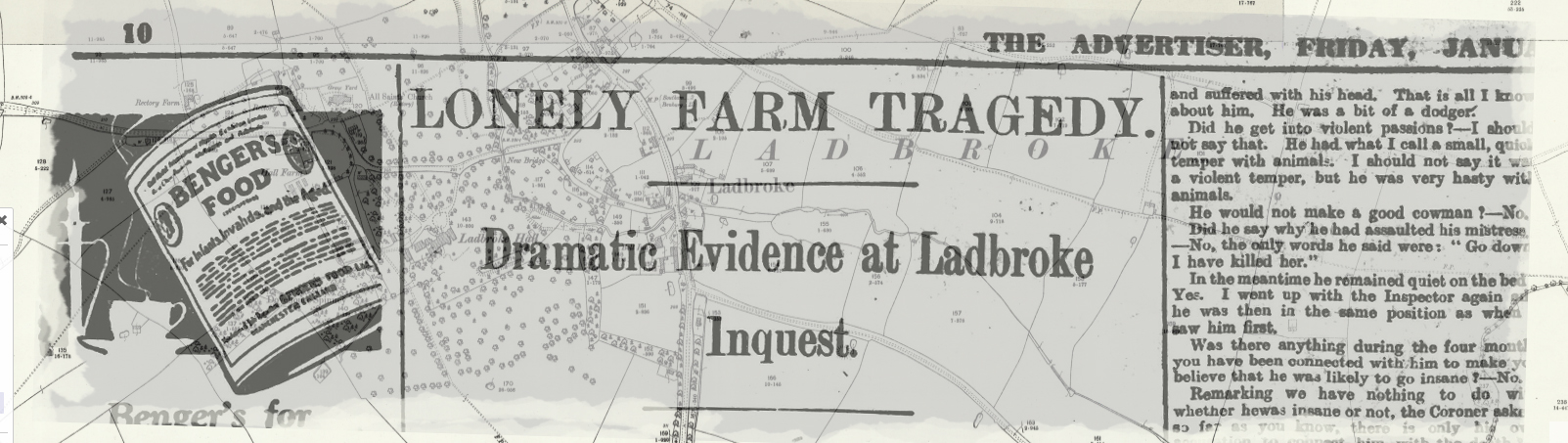
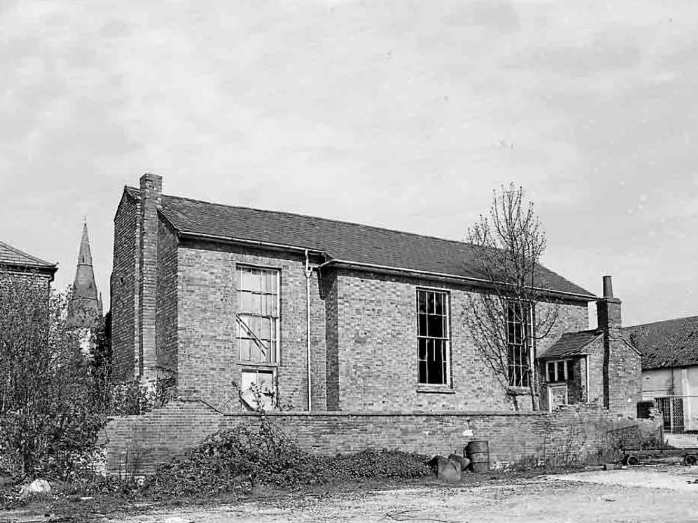
CecilSO FAR – On January 13th 1926, Milly Crabtree, 25 year-old wife of Cecl Crabtree, is found battered to death at their home, Manor Farm in Ladbroke. 19 year-old George Sharpes is arrested for her murder. As is the way with these, things, the wheels of justice turn very slowly, and it was February before Sharpes came to face magistrates in Southam. The courtroom, normally used as a cinema (pictured above), was packed, and the onlookers were spellbound as a confession from George Sharpes was read to the court.
I, George Sharpes, here wish to state how and why I murdered the deceased Mrs. Crabtree. On Wednesday morning, January 13th, the day I committed the crime, I went to work in the house about 9 a.m. The job I was doing was scraping paint off a skirting board. While I was sitting doing work, a thought entered my head to kill the deceased. Several ways entered my head, how to kill her, but in my mind I did not think these ways would have been successful So I let this thought keep on worrying me until dinner-time. When I went home it seemed to out of my mind all together.

When I came back in the afternoon the same thought came to me. This time I was working with a hammer, drawing nails out of the window. Then I came to a big nail just above the window and near to the door, the one which is opposite the front room door. Meanwhile the deceased had been past me on two occasions. The third time as she was coming past me I struck her on the side of the head and she fell down in the passage. Here I struck her again, and then I dragged her into the front room. When I came out I saw some blood on the floor, I took off my cap, cleaned up the mess, and threw my cap in the fire grate in the dining room. Then I went into the front room, and struck her again.

I seized pair of pyjamas and wrapped them round her head to stop her noise. The next thought that came to me was to do away with myself, so I went to look for a knife or a razor. As I was going through, the dining room, I passed the cowman’s daughter and she noticed that there was blood on hands. Then I went to Mr. Crabtree’s bench and there I found a knife. I then went upstairs and cut my throat. Even this did not kill me, so I tried again. Seeing this did not do it, I looked everywhere for a razor, but it was of no avail. As I was walking round I noticed a bottle labelled Camphorated Oil, Poison. I drank some of this, thinking it would bring me to a quick end. This made me feel faint, so I went back into Mr Crabtree’s bedroom. I knew that someone would find me, so I lay there.

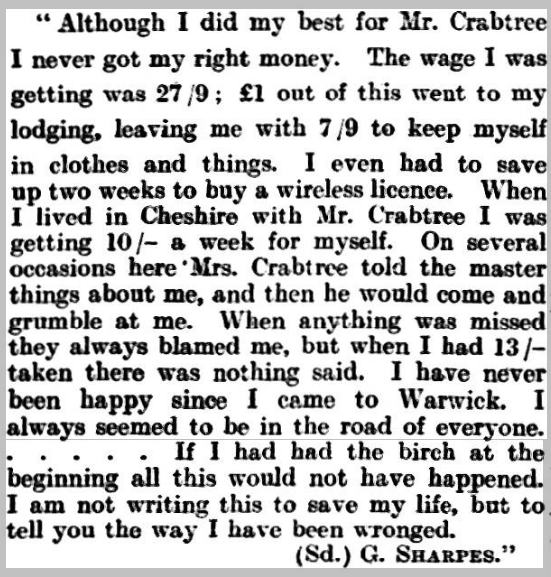
This bizarre statement continued with what appeared to be a motive for the attack:

Screen Shot 2021-12-13 at 10.22.52

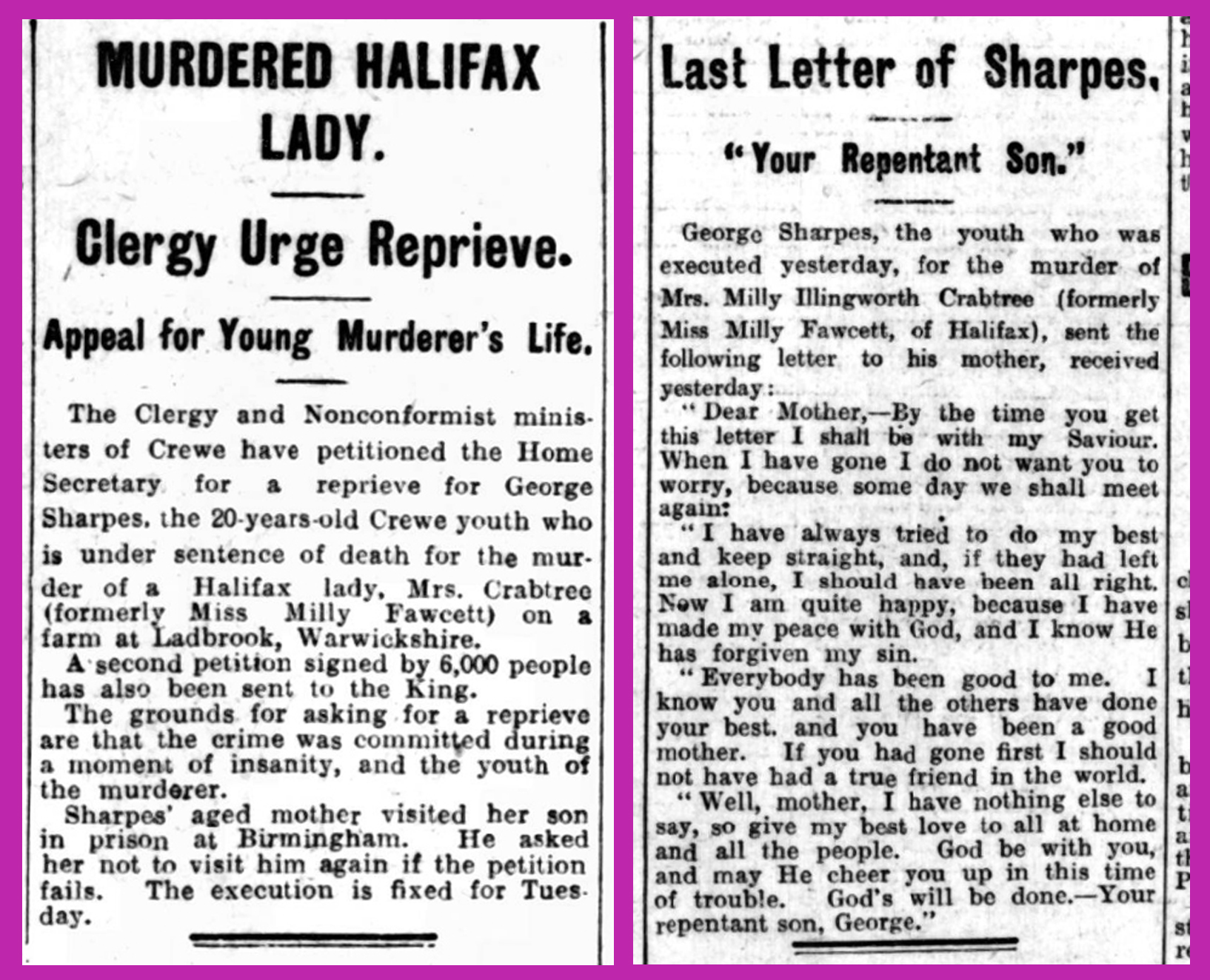
MotherThe magistrates wasted little time in stating that George Sharpes had a serious case to answer, and the case was moved on to be examined at the March Assizes in Warwick. The case was presided over by Mr Justice Shearman. The only possible line for the defence to take was that Sharpes was insane at the time at the time he committed the murder, and Sharpes’s mother was produced to state that her son had suffered an unfortunate childhood. Her pleas fell on deaf ears, however. Rejecting the claims that George Sharpes was insane, the judge donned the black cap and sentenced him to death. The execution was fixed for April and, as was almost always the case, a petition was set up to ask for clemency. The case was taken to appeal, in front of Lord Chief Justice Avory, who was perhaps not the most welcome choice for Sharpes’s defence team. Avory, a notorious “hanging judge”, had been memorably described:
“Thin-lipped, cold, utterly unemotional, silent, and humourless, and relentless towards lying witnesses and brutal criminals”.

Final words

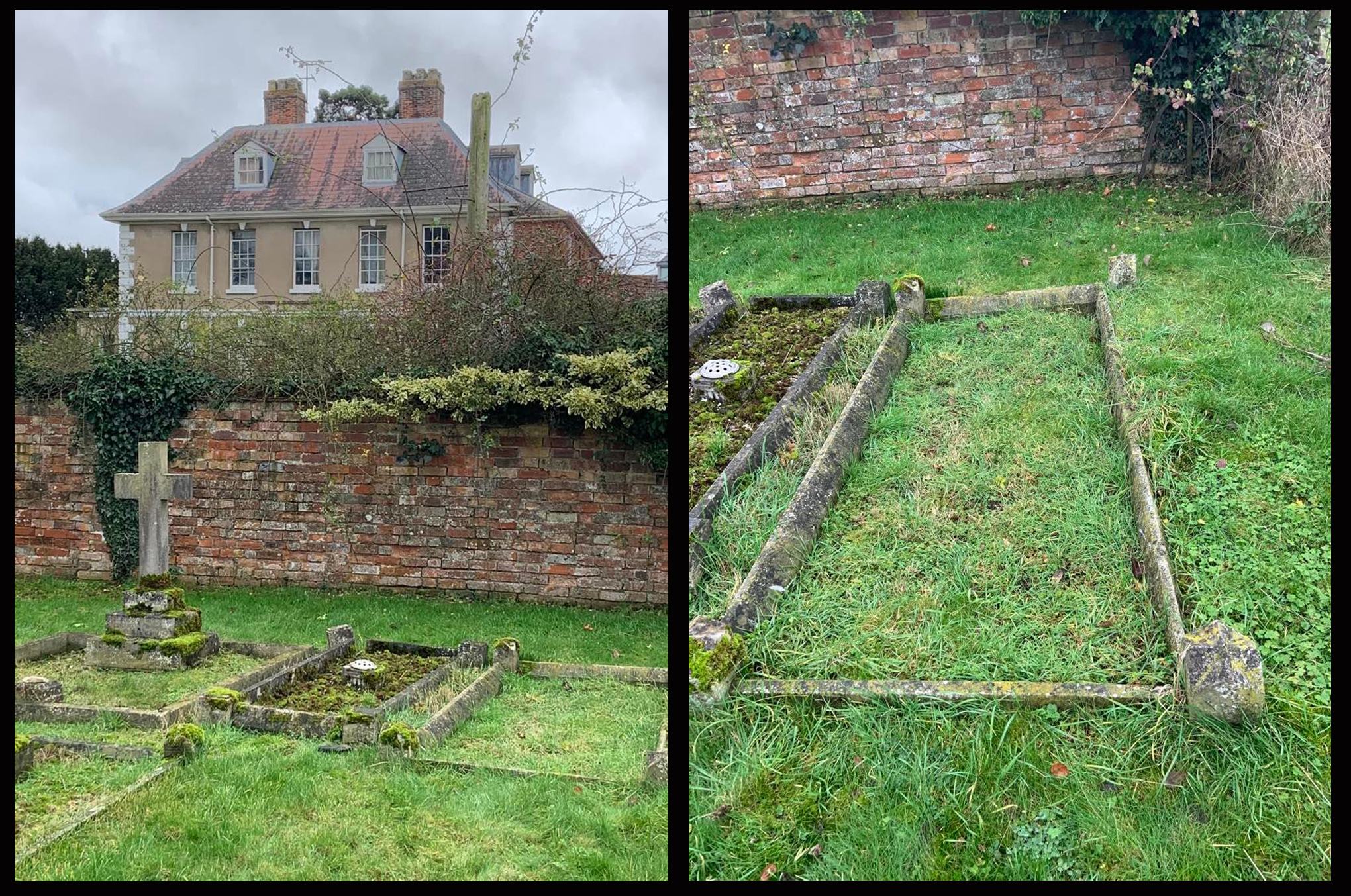
Avory dismissed the appeal, and George Sharpes, just turned 20 years od age, was hanged in Winson Green prison on 13th April 1926. The hangman was William Willis, assisted by Robert Baxter. As was customary, Sharpes was interred in the graveyard inside Winson Green prison. His burial plot was unmarked, but the location was recorded in prison records. As for his victim, she lies, one hopes at peace,  in a quiet corner of Ladbroke churchyard. Thanks to Maggy Smith for the photos.

Milly grave

MURDER COMES TO LADBROKE (1) . . . true crime from 1926

Ladbroke header

Screen Shot 2021-12-12 at 18.11.45Manor Farm in Ladbroke dates back, according to the data on British Listed Buildings, to the mid 18th century. For architectural historians, it adds:
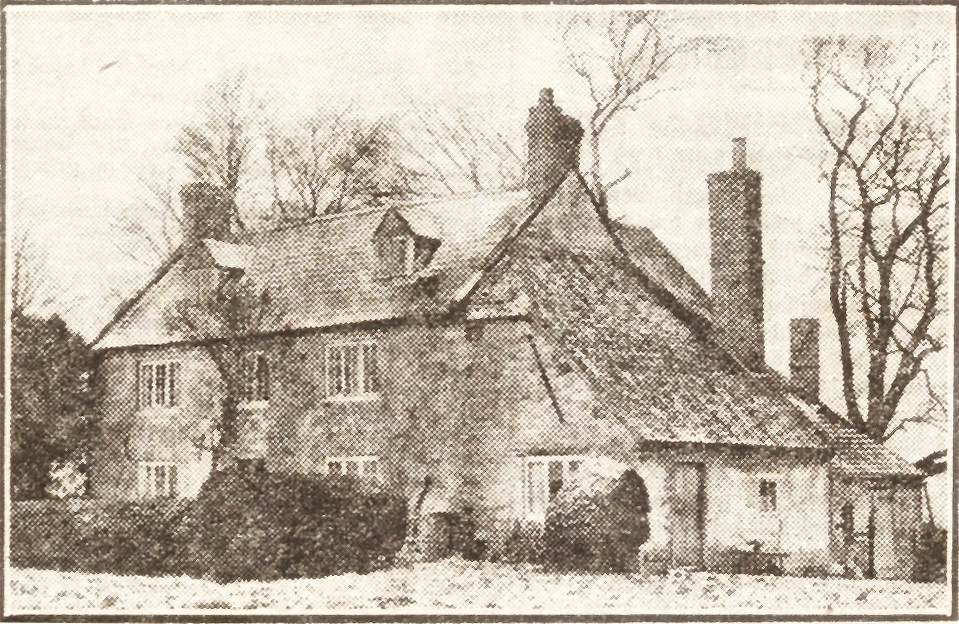
Squared coursed lias with quoins and coped gables. Slate roof with brick end stacks. L-shaped plan. 2 storeys plus attic; 3-window range of C20 three-light casements in original openings with stone flat arches to ground floor. C20 door with stone flat arch. 2 gabled dormers. C20 one-storey lean-to to left. Interior: noted as having stop-chamfered spine beams and large open fireplace, refaced C19. C18 central staircase with turned balusters.

In September 1925, the farm had been bought by Cecil Crabtree and his wife, Milly Illngworth Crabtree, (neé Fawcett). The couple had married in 1923 in Halifax, and had a son, Brian, aged eighteen months and a daughter, Betty, just six months old.

Crabtree was clearly a man with ambitions, and also had farming interests at Burton Farm, Neston, Cheshire. When the family moved down to Ladbroke, a young man called George Sharpes accompanied them as stockman. It appears that Cecil Crabtree had taken on Sharpes in a spirit of benevolence, as the the young man had, for four years, been an inmate of the Farm Training Colony, a reformatory for boys at Newton-le-Willows, and was considered to be “a wrong ‘un”. Sharpes’s parents lived in Crewe, where his father was a railway worker.

A young girl called Kathleen Coleman, aged 10, lived in one of the farm cottages with her mother and father – who worked for Mr Crabtree. Kathleen often helped out in the house, and on the afternoon of 13th January 1926, she made a chilling discovery. She went upstairs to Mrs Crabtree’s room, as one of the babies was crying. She told the inquest:

” I saw George lying on the bed with his throat all bleeding, and he told me to tell daddy to come. I ran and told father, who was in the cowshed.”

Her father, Sibert Pearson Coleman ran to the house, and saw George Sharpes, but was about to make another much more terrible discovery:

“His (George’s) throat was bleeding. I asked him what was the matter, and he said —’ Never mind me; go down to the missus. I have killed her.’ I ran down to the sitting-room, and found Mrs Crabtree lying dead in a pool of blood. She was bleeding from wounds in the face and the back of the head. I saw that she was past aid. One of the children was on the settee crying.”

Manor Farm

Inspector Cresswell, of Southam, was called to Manor Farm (above, as it was at the time) and when he arrived he found Mrs Crabtree lying on the floor of the sitting room, face downwards. There was a large quantity of blood near the head, and marks of blood on bureau, and also on the wall about five feet up. He found a hammer lying on the sofa, with blood and hair adhering to it. Seeing there was nothing he could do for Mrs Crabtree, the inspector returned to Sharpes, who was lying on the bed in Mrs Crabtree’s bedroom with a wound in his throat. There was a bloodstained shoemaker’s knife on the bed beside him. The wound was slight. There was towel and a suit of pyjamas wound round his head.

On seeing the Inspector, Sharpes muttered,“Let me die! Leave me alone, and let me die!”

The inspector called for a car and Sharpes was removed to the hospital in Leamington Spa, where he was detained. Cresswell said later that it seemed Mrs Crabtree’s skull was crushed in on the left side above and below the left ear.and probably done with one blow.

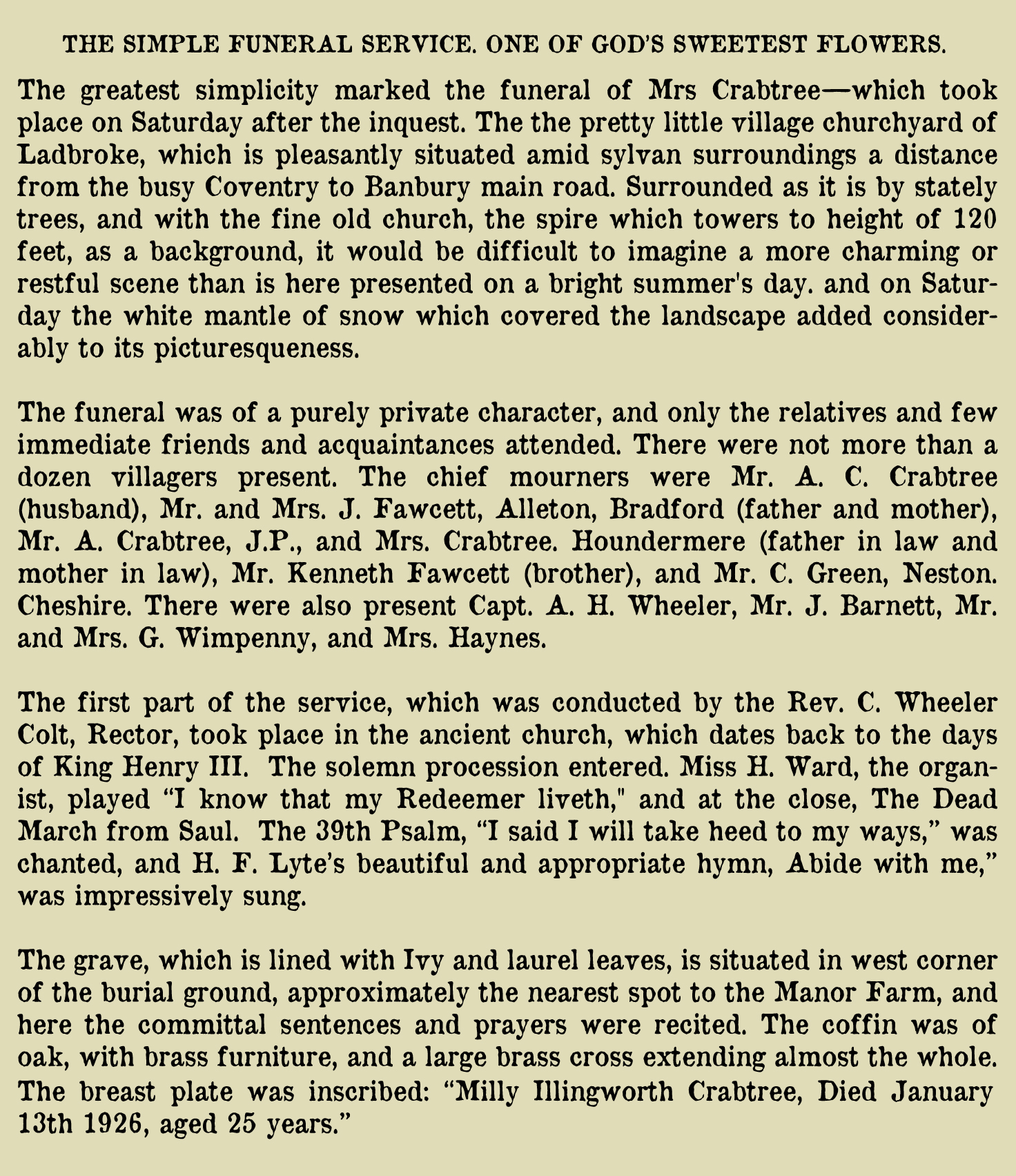
Cecil Crabtree was contacted and returned as fast as he could, in a state of understandable shock. There was little doubt who was responsible for his wife’s murder, and once the inquest had been comcluded, she was buried in Ladbroke churchyard on a snowy winter afternoon. The report in The Rugby Advertiser of Friday 22nd January was heartfelt:

Funeral report

Milly

IN PART TWO – Trial, motive – and justice

BLOWING MY OWN TRUMPET . . .

If I don’t do it, no-one else will! A little video – with sound – promoting my site. Click on the logo to play the video.

LOGO large

Some tags to search ….


FB HeaderCLICK ON ANY TAG AND THE CONTENT

WILL OPEN IN ANOTHER WINDOW

American crime fiction  Australian crime fiction.
Brian Stoddart  Chris Nickson  Christopher Fowler   Cosy Crime
Derek Raymond  
Dorothy L Sayers  
English crime fiction   English noir
Gary Donnelly   Harlan Coben     IR
ish crime fiction  
James Lee Burke   James Oswald   Jim Kelly  
Jo Spain   John Connolly   John Lawton  
Jonathan Kellerman   London   Mark Billingham
MJ Trow   Murder   Nick Oldham   Peter Bartram  
Peter Laws Peter Lovesey
Peter Temple   Phil Rickman   Philip Kerr  
Police Procedural   Psycholgical thriller
 
Rob Parker    Scottish crime fiction  Southern Noir  
Stacey Halls   Ted Lewis    True crime
Val Mcdermid    Victorian   WW1   WW2 

Featured post

Blog at WordPress.com.

Up ↑