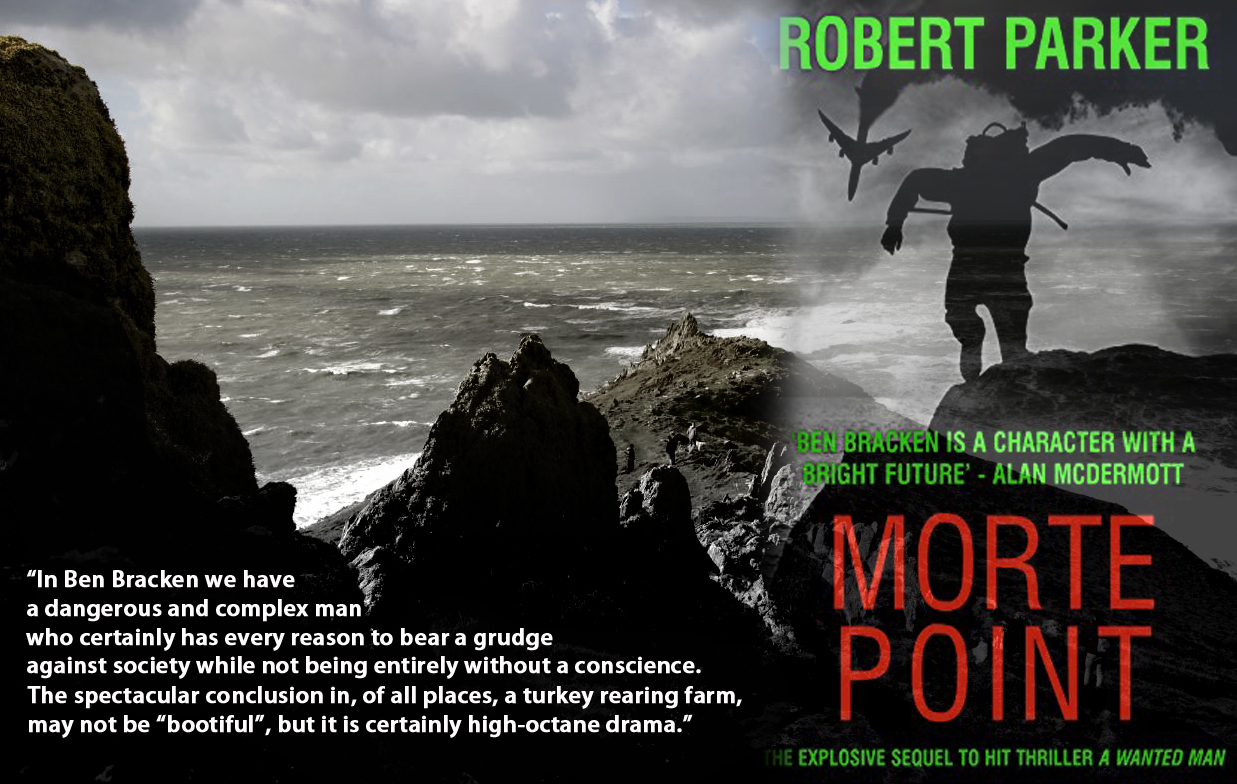
There is a hoary old cliché sometimes heard in football or rugby games, when the manager exhorts his team “to leave nothing in the changing room”. In plain English, he wants, to unearth another classic, “110% effort” from his lads. Robert Parker certainly leaves nothing behind on his keyboard, if I can extend the metaphor. As I noted in my review of his previous novel, Crook’s Hollow:
“If you are a fan of leisurely paced pastoral crime novels, complete with all the tropes – short-sighted vicars, inquisitive spinsters, toffs at the manor house with a dark secret – then maybe this book isn’t for you. If, on the other hand, you want 200 pages of non-stop action …..”
 Parker is on similar form here in Morte Point which, as Devonians know, is a rocky peninsula on the north west coast of that county. Rather than the bitterly feuding rural families in Crook’s Hollow, Mr P gives us a jailbird ex SAS soldier, a mysteriously beautiful Kosovan biochemist, a sunken plane wreck containing only the body of a woman (minus her head), a senior British government minister determined to engineer the biggest international shock since Hitler declared war and Stalin, a bloody shoot-out in London’s most prestigious hotel and – at the centre of the drama – a phial containing a synthesised botulism capable of killing millions.
Ben Bracken is the former SAS trooper who has fallen foul of The Regiment and ended up in jail. Escaping, but taking out an insurance policy by way of blackmail material on the governor, he is officially still “inside”. He is not far enough under the radar of a certain officer in the National Crime Agency, however, and Jeremiah Salix contacts Bracken with an offer he cannot (for various reasons) refuse.
An aircraft is due to land at a Devon Royal Marines airbase, but Salix tells Bracken that it will not reach its destination, but instead end up on the seabed. It will be carrying something of great interest to a certain group of individuals, but Bracken’s mission is to dive to the wreck and snatch that certain “something” before the bad guys arrive. Bracken does as he is bid, and despite being kept in the dark about the exact nature of what he was meant to retrieve, he is soon left in no doubt that the people who arrive just too late to prevent him from carrying out Salix’s orders are deadly serious.
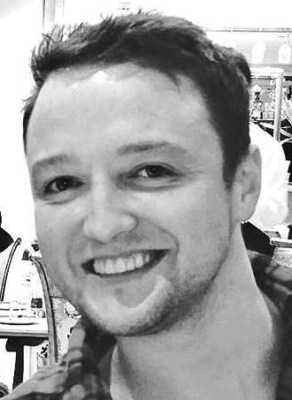 What follows is, to my mind, the best part of the book. Back in the day when the mysterious Andy McNab (and his ever-present black rectangle) was the media’s darling, survival skills, initiative in the wild and hiding in plain sight were familiar tropes in thrillers and on the screen, but Parker (right) has revitalised the idea. Bracken manages to stay half a step – but no more – ahead of his pursuers as he travels rough on his way north to meet up with Salix. You might scoff, and say that rural Devon is hardly the Iraqi desert, but Bracken realises that he is Britain’s most hunted man and, in these days of 24 hour news coverage on a bewildering range of devices, he knows that he has no friends, and no ally except his own resources and awareness of nature. He comes unstuck, however, after a chance encounter with vipera berus, and from this point the story takes a very different direction.
With the caveat stated at the beginning, this thriller will not tick every CriFi box. Midsomer Murders it ain’t, but in Ben Bracken we have a dangerous and complex man who certainly has every reason to bear a grudge against society while not being entirely without a conscience. The spectacular conclusion in, of all places, a turkey rearing farm, may not be “bootiful”, but it is certainly high-octane drama. Morte Point is published by Endeavour Quill and will be available on 27th July.
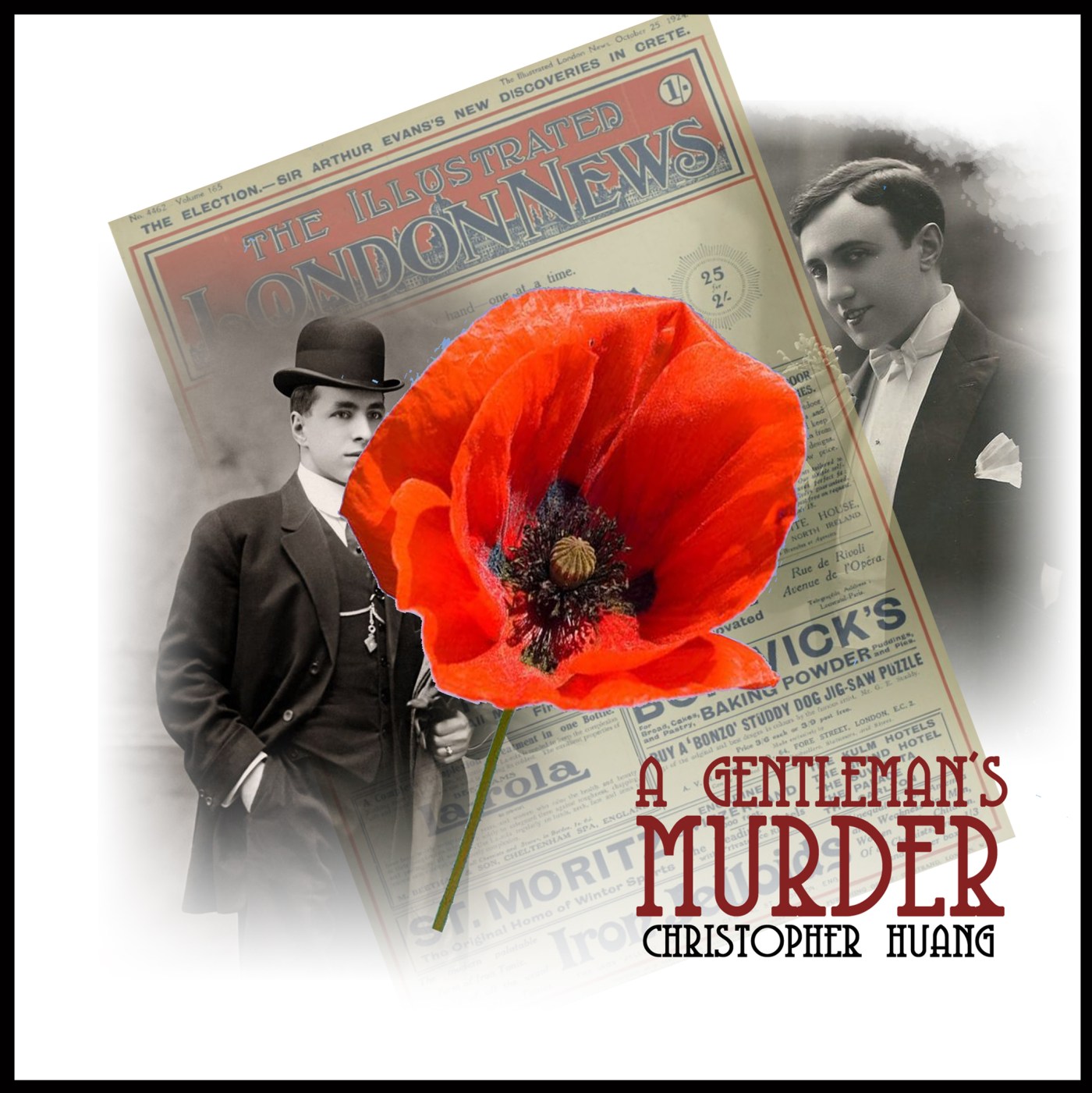
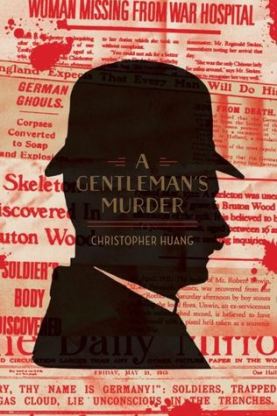 Eric Peterkin is one such and, although he carries his rank with pride, he is just a little different, and he is viewed with some disdain by certain fellow members and simply tolerated by others. Despite generations of military Peterkins looking down from their portraits in the club rooms, Eric is what is known, in the language of the time, a half-caste. His Chinese mother has bequeathed him more than enough of the characteristics of her race for the jibe, “I suppose you served in the Chinese Labour Corps?” to become commonplace.
 Christopher Huang (right) was born and raised in Singapore where he served his two years of National Service as an Army Signaller. He moved to Canada where he studied Architecture at McGill University in Montreal. Huang currently lives in Montreal.. Judging by this, his debut novel, he also knows how to tell a story. He gives us a fascinating cast of gentleman club members, each of them worked into the narrative as a murder suspect. We have Mortimer Wolfe – “sleek, dapper and elegant, hair slicked down and gleaming like mahogany”, club President Edward Aldershott, “Tall, prematurely grey and with a habit of standing perfectly still …like a bespectacled stone lion,” and poor, haunted Patrick “Patch” Norris with his constant, desperate gaiety.


 Watching You by Lisa Jewell takes us to the chic urban village of Melville Heights. Jack Mullen is a successful consultant in cardiology, while his wife Rebecca is “something in systems analysis.” A couple of doors down live the Fitzwilliam family. Tom is a charismatic and nationally renowned Head Teacher with an impressive record of turning round failing high schools. His adoring wife Nicola has no CV as such, unless you want to list an over-awareness of body image and a devotion to the latest fads in fashion and diet. Their teenage son, Freddie – an only child, naturally – is very keen on all things technical, particularly digital binoculars, spy software, and a fascination with the lives and movements of anyone he can see from his bedroom window.
 This is a clever, clever murder mystery. Lisa Jewell gives us the corpse right at the beginning – while keeping us guessing about whose it is – and then, by shrewd manipulation of the timeline we are introduced to the possible perpetrators of the violent death. By page 100, they have formed an orderly queue for our attention. Of course there’s beautiful, feckless Joey and her husband Alfie. Freddie Fitzwilliam is clearly at the sharp end of the Asperger spectrum, but what about his bird-like – and bird-brained mother? Schoolgirls Jenna and Bess are clearly fixated – for different reasons – on their headteacher, and as for Jenna’s mum, with her persecution complex and incipient madness, she is clearly on the brink of doing something destructive, either to herself or someone else. And who is the mysterious woman who flew into a rage with Tom ten years earlier while the Fitzwilliams were on a family holiday to the Lake District?
 Lisa Jewell peels away veil after veil, but like Salome in front of Herod, she tantalises us with exquisite cruelty. Just when we think we have understood the truth about the complex relationships between the characters, we are faced with another enigma and a further conundrum. There are flashes of absolute brilliance throughout this gripping novel. The relationship between Jenna and Bess is beautifully described and even though we suspect he may end up with blood on his hands, Freddie’s strange but exotic view of the world around him makes him completely appealing. In the end, of course,we learn the identity of the corpse and that of the murderer but, just like the Pinball Wizard, there has got to be a twist. Lisa Jewell (left) provides it with the last 39 words of this very special book, and it is not so much a twist as a breathtaking literary flourish.
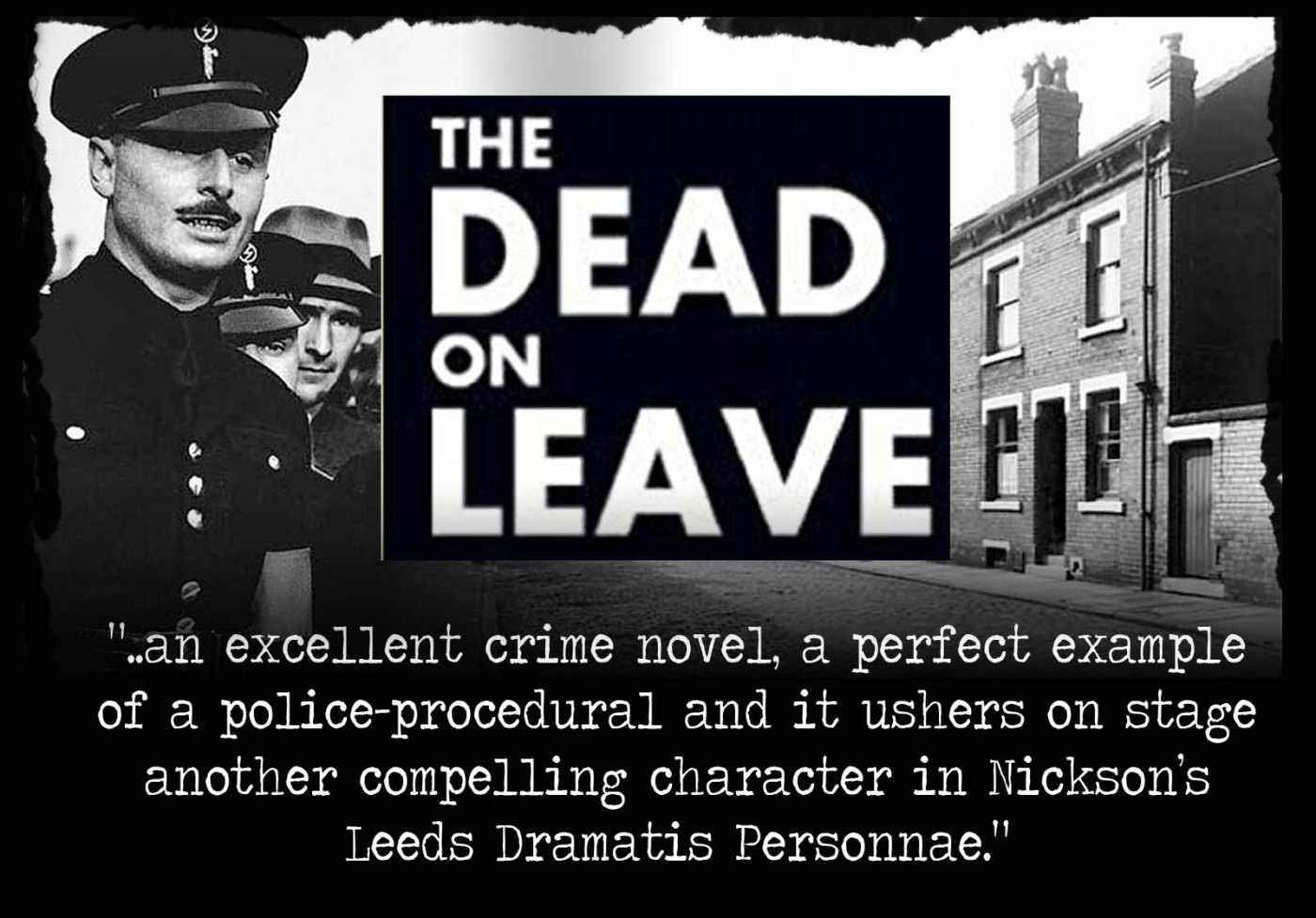

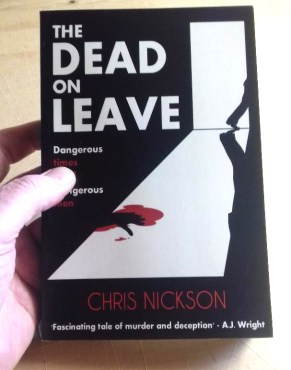 It appears the dead man is a would-be follower of Sir Oswald Mosley, charismatic leader of the British Union of Fascists and, after an appearance in Leeds by Mosley and his Blackshirts turns into a riot, it is tempting for the police to think that the murder is politically inspired. As Raven tries to make sense of the killing, he has his own demons to face. Like many other Yorkshiremen, Raven is a Great War veteran, even though his war was brief and horrific. Only able to see active service in the dog-days of the conflict, he was unlucky enough to be close to a fuel dump which was hit by a stray shell. There’s a line from a song about that war, which goes,
 The Dead On Leave is very bleak in places. Hope is in short supply among the working people in Leeds, and men have no qualms about building a wooden platform for Moseley to rant from, because a job is a job; consciences are a luxury way beyond the reach of folk whose families have empty bellies. Nickson (right) is a writer, with social justice at the front of his mind and he wears his heart on his sleeve. I doubt that he and I agree on much in today’s political world, but I can think of no modern British author who writes with such passion and fluency about historical social issues.
 Hal Westaway is no crook. She is not an opportunist. She has a conscience. She instinctively understands the difference between meum and teum. And yet. And yet. The gangster from whom she unwisely took out a desperation loan is angry and anxious for his 300%. Hal’s Brighton flat has already been turned over, and she knows that broken bones are next on the agenda. So, she accepts the invitation from the late Mrs Westaway’s solicitor to travel down to Cornwall to meet the family she never knew she had.
 Ruth Ware (right) is not the first writer – nor will she be the last – to explore the lurid charms of a decaying mansion, its ghosts both real and imagined, and the dusty terrors of death, but she makes a bloody good job of it in The Death of Mrs Westaway. Hal Westaway is a delightful character, and you would require a heart of the hardest granite not to sympathise with her and the exquisite dilemma she faces. The plot is a dazzling mix of twists, surprises, and just the right amount of improbability. The Death of Mrs Westaway is a thriller which makes you keep the bedroom light on, and long for the safety of daylight. It looks like being another bestseller for Ruth Ware, and you can judge for yourselves on June 28th, when the book will be published by


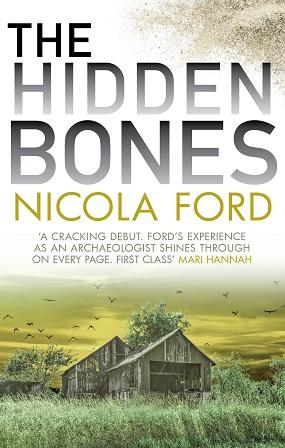 Clare Hills is an archaeologist who is struggling to hold her life together after the death of her husband. Her grief at his passing is tempered by the fact that he has left her virtually penniless. When she is invited by her former tutor, Dr David Barbrook, to help explore and archive the papers of Gerald Hart, she welcomes the chance to use her expertise. Hart was a gentleman archaeologist whose Palladian villa, Hungerbourne Manor, was the centre of his life’s work – investigating the Hungerbourne Barrows. The Bronze Age burial sites were Hart’s obsession, but whatever secrets they held, he seems to have taken them with him to his grave.
 I have many guilty pleasures, and one of them is being a sucker for a crime novel where the landscape plays a vital part in the plot. My two particular favourite writers in this regard are Phil Rickman and Jim Kelly, but with this excellent debut novel, Nicola Ford (right) has elbowed herself into their company.


 I was working in Australia when Peter Weir’s 1975 film Picnic At Hanging Rock premiered. I remember pub and dinner party talk for months after being dominated by interpretations and explanations about what might have happened to the ‘lost girls’. In the endpapers of Last Time I Lied American author Riley Sager, (left) acknowledges his debt to this film (and the short story on which it was based). Instead of a 1900 Melbourne, Sager beams us into up-country New York State in, more or less, our times.
 Emma’s summer idyll is destined to come to an abrupt and tragic end, however, when the three older girls in the cabin disappear one night, never to return. Despite the massive search and rescue operation, Vivian, Natalie and Allison remain missing, and Franny is forced to close the camp in disarray.


 Side by side with a pharmaceutically-addicted genius called Dante Torre she attempts to solve a grotesque mass murder. The express train from Milan to Rome arrives safely. Safe, that is, except for the passengers in the first class compartments who have all died in grotesque agony. Their bodies are discovered by an officer of the Railway Police and when he alerts his superiors,“la merda colpisce il ventilatore..” as they might (but probably don’t) say in Rome. Ironically, it is the fan from the air conditioning unit which has spread the deadly gas.
 Kill The Angel, translated from the Italian by Antony Shugaar (right), is ridiculously entertaining. The narrative constantly breaks the speed limit, and Colomba Caselli and Dante Torre are wonderfully imagined character. We can boo and hiss as Colomba is screwed – in all senses of the word – by sinister global forces, but she is a truly modern kick-arse (‘ass’ for US readers) heroine and she scorches her way across the pages of this gripping novel.

 The Thorne novels have a recurring cast list. As Salvatore Albert Lombino, aka Ed McBain said, quoting a 1917 popular song, “Hail, Hail, The Gang’s All Here!” Indeed they are. Its members include Helen, Tom Thorne’s long suffering partner plus little boy Alfie, and the bizarrely tattooed and pierced Mancunian pathologist Phil Hendricks. We have Nicola Tanner the police officer scarred by the murder of her alcoholic partner, Susan, and the perpetually cautious DCI Russell Brigstocke. Between them, they pursue two killers; one who murders losers-in-the-Game-of-Life on the periphery of a drugs gang, and another who seems to be targeting lonely women via a match-making service.
 Just when you think that he has provided all the answers to the complex plot, and the characters are, to quote the only bit of Milton I can remember from ‘A’ Level, “calm of mind and all passion spent,” Billingham (right) provides a breathtaking epilogue which, in addition to turning my preconception on its head, (feel free to add your own metaphor) bites you on the bum, punches you in the gut, hits you over the head with a piece of four by two, takes the wind out of your sails and grabs you by the short-and-curlies. Hopefully recovering from this multiple assault, you will be hard pushed to disagree with me that this is a brilliant crime thriller written by a master storyteller at the very top of his game.


