
London. 1873. It would be another fourteen years before a gentleman calling himself a Consulting Detective would make his first appearance in Beeton’s Christmas Annual, but Matthew Grand and James Batchelor are just that – people consult them, and they try to detect things. That is pretty much where any resemblance to the residents of 221B Baker Street ends. Neither Grand nor Batchelor is nice but dim, nor is either given to bashing out a melancholy bit of Mendelssohn on a Stradivarius. Matthew Grand, though, has seen military service; rather than battling the followers of Sher Ali Khan in Afghanistan, he has had the chastening experience of fighting his fellow Americans during the War Between The States a decade earlier. While James Batchelor is an impecunious former member of The Fourth Estate, his colleague comes from wealthy New Hampshire stock.
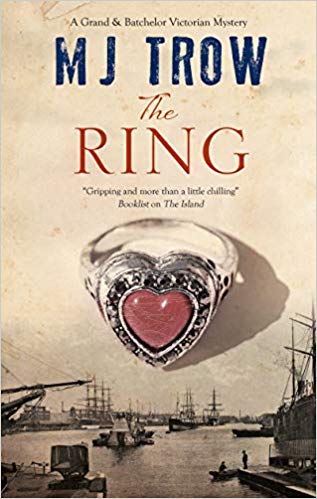 The River Thames plays a central part in The Ring. Although Joseph Bazalgette’s efforts to clean it up with his sewerage works were almost complete, the river was still a bubbling and noxious body of dirty brown effluent, not helped by the frequent appearance of human bodies bobbing along on its tides. In this case, however, we must say that the bodies come in instalments, as someone has been chopping them to bits. PC Crossland makes the first grisly discovery:
“… he knew exactly what the white thing was. It was the left side of what had once been a human being, sliced neatly at the hip and below the breast. There was no arm. No head. No legs.”
Trow gives us a Gilbertian cast of comedy coppers, in this case the River Police, led by the elephantine Inspector Bliss. While Bliss and his minions are trying to put together a case – and also the various limbs and organs of an unfortunate woman – Grand and Batchelor are visited by Selwyn Byng, an unseemly and ramshackle character, who believes his wife has been abducted, and has the ransom note to prove it. Byng may look cartoonish, and lack moral fibre; “Where’s your stiff upper lip?” “Underneath this loose flabby chin!” (quoted with due reverence to Tony Hancock and Kenneth Williams) but he has a bob or two, and so our detectives take on the search for the missing Emilia Byng.
It occurs to me that in dismissing any resemblance between H&W and G&B I am missing out one very important personage, and that is the housekeeper. The much revered Mrs Hudson is felt, rather than seen or heard, but Mrs Rackstraw is another matter entirely. The formidable woman dominates the apartment supposedly ruled over by the two young gentlemen:
“Mrs Rackstraw had been brought up in a God-fearing household and didn’t really hold with young gentlemen of their calibre not going to church. Had they been asked, both Grand and Batchelor would have preferred the constant nagging; her frozen silence and the way the boiled eggs bounced in their cups as she slammed them down on the table was infinitely worse.”
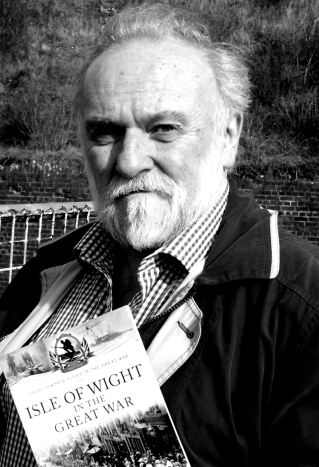 MJ Trow (right) has been entertaining us for over thirty years with such series at the Inspector Lestrade novels and the adventures of the semi-autobiographical school master detective Peter Maxwell. Long-time readers will know that jokes are never far away, even when the pages are littered with sudden death, violence and a profusion of body parts. Grand and Batchelor eventually solve the mystery of what happened to Emilia Byng, both helped and hindered by the ponderous ‘Daddy’ Bliss and a random lunatic, recently escaped from Broadmoor. Trow writes with panache and a love of language equalled by few other British writers. His grasp of history is unrivalled, but he wears his learning lightly. The Ring is a bona fide crime mystery, but the gags are what lifts the narrative from the ordinary to the sublime:
“They adjusted their chairs and faced the wall. Mr and Mrs Gladstone stared back at them from their sepia photographs, jaws of granite and eyes of steel. Since he was the famous politician and she was merely loaded and fond of ice-cold baths, he sat in the chair and she stood at his shoulder, restraining him, if the rumours were true, from hurtling out of Number Ten in search of fallen women.”
The Fully Booked review of The Island, the previous Grand and Batchelor mystery, is here. The Ring is published by Severn House, and will be out on 28th September.



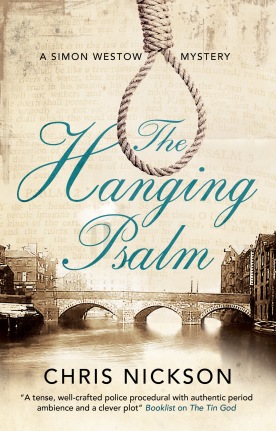 Nickson’s latest book introduces a new character, Simon Westow, who walks familiar streets – those of Leeds – but our man is living in Georgian times. England in 1820 was a kingdom of uncertainty. Poor, mad King George was dead, succeeded by his fat and feckless son, the fourth George. Veterans of the war against Napoleon, like many others in later years, found that their homeland was not a land fit for heroes. The Cato Street conspirators, having failed to assassinate the Cabinet, were executed.


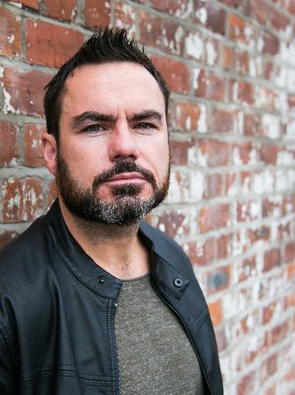 With that grim discovery acting as a starting pistol, debut author Robert Scragg (left) starts a middle-distance race to discover who murdered Natasha Barclay. For she is the person, identified by simply reading the opened mail strewn around the tomb-like flat, and checking rental records, whose hand lies in the freezer drawer.
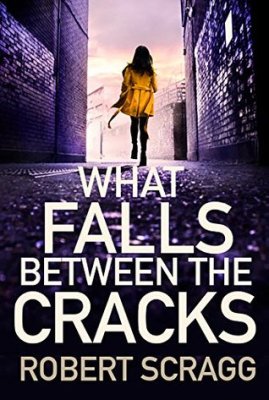 If ever there were an single implausible plot device, it might be the premise that a suburban London flat, complete with a severed hand sitting quietly in a freezer compartment, could remain untouched, unvisited and unnoticed for over thirty years. It is, however, a tribute to Robert Scragg’s skill as a storyteller that this oddity was so easily forgotten. The dialogue, the twists and turns of the plot, and the absolute credibility of the characters swept me along on the ride. Porter and Styles have made an impressive debut, and the author may well have elbowed them into that crowded room full of other fictional police partners. They are all out there; Bryant & May, Zigic & Ferrera, Rizzoli & Isles, Wolfe & Goodwin, Morse & Lewis, Jordan & Hill, Kiszka and Kershaw – watch out, you have company!

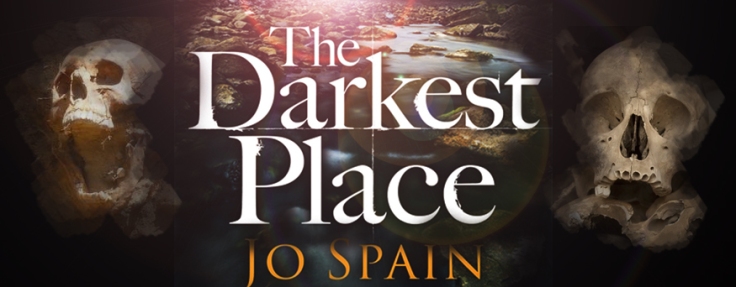
 Dublin copper DI Tom Reynolds is summoned from the dubious delights of his family Christmas to solve a murder. Readers of the previous three Tom Reynolds books might think there is little remarkable about that, but this time the corpse has been in the ground for rather longer than usual. Forty years, in fact. On the island of Oileán na Caillte, the pathologists have been disinterring corpses from a mass grave of the unfortunates who passed away as patients of the long-defunct psychiatric institution, St Christina’s. Those involved in the grim task discover nothing illegal, as all the residents of the burial pit were laid to rest in body bags, tagged and entered onto the hospital records. With one exception. That exception is the corpse of one of St Christina’s medical staff Dr Conrad Howe, who mysteriously disappeared forty Christmases ago. No body bag or tag for Dr Howe, but a rather surreptitious last resting place wedged between two other corpses.
 Other than that dark angel, the cast of suspects includes another former physician, now himself just days away from death, and others whose culpability in the inhuman treatment of St Christina’s patients has left psychological scars, some of which have become dangerously infected. Of course, this being, among other things, a brilliant whodunnit, Jo Spain (right) allows Tom Reynolds – and us readers – to make one major assumption. She then takes great pleasure, the deviously scheming soul that she is, in waiting until the final few pages before turning that assumption not so much on its head as making it do a bloody great cartwheel.

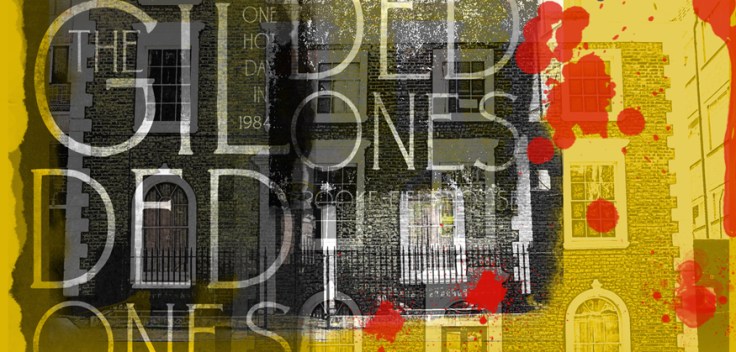
 This is a curious and quite unsettling book which does not fit comfortably into any crime fiction pigeon-hole. I don’t want to burden it with a flattering comparison with which other readers may disagree, but it did remind me of John Fowles’s intriguing and mystifying cult novel from the 1960s, The Magus. I am showing my age here and, OK, The Gilded Ones is about a quarter of the length of The Magus, it’s set in 1980s London rather than a Greek island and the needle on the Hanky Panky Meter barely flickers. However we do have a slightly ingenuous central character who serves a charismatic, powerful and magisterial master and there is a nagging sense that, as readers, we are having the wool pulled over our eyes. There is also an uneasy feeling of dislocated reality and powerful sensory squeezes, particularly of sound and smell. Author Brooke Fieldhouse (left) even gives us female twins who are not, sadly, as desirable as Lily and Rose de Seitas in the Fowles novel.
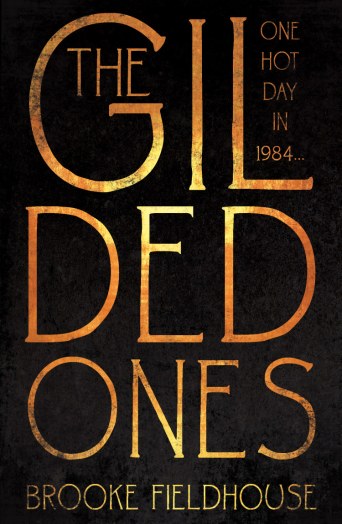 Lloyd Lewis is the Magus-like figure. He is so thumpingly male that you can almost smell him, and he rules those around him, with one exception, with an almost feral ferocity. So who are ‘those around him’? Ever present psychologically, but eternally absent physically, is his late wife Freia, the subject of Pulse’s dream. Martinique is Patrick’s girlfriend, and loitering in the background are his children, step-child and office gofer Lauren. Lauren, who has “thousand-year-old eyes”, is of the English nobility, but quite what she is doing in the Georgian townhouse we only learn at the end of the book. The one person to whom Patrick defers is his Sicilian friend Falco. Equalling the Englishman’s sense of menace, the sinister Falco appears briefly but is, nonetheless, memorable.


 Also Sprach, in no particular order (put the name to the quote for a bit of fun, but no prizes, sadly) Napoleon, Jack Nicholson, Hitler, Sartre, and Nietzsche. In this brilliant new novel by Simon Lelic we have, in theatrical terms, an intense two-hander between Susanna (a counsellor) and Adam (a troubled young man). Just a couple of problems here, though. First, neither person is exactly who they claim to be and, second, Adam has abducted Susanna’s daughter Emily and, for reasons which emerge as this extraordinary dialogue develops, wants her dead.
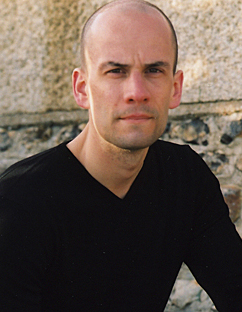 is a writer who views the human condition with what some might term a jaundiced eye, as witnessed in his previous novel,


 Lowery sets out his narrative stall with those four threads which will eventually weave together to powerful effect. Ibrahim, his puppet strings pulled from afar courtesy of the internet, plans a terrorist bomb attack which goes spectacularly wrong and he goes on the run. A revered and respected fighter, Karl, has to watch in frustration while his ISIL soldiers are outgunned and overwhelmed by coalition forces, and his position is undermined by over-promoted jobsworths in his own organisation. Faqir has finally had enough of living in the shell-torn morgue that Mosul has become, and gathers together his hard-earned savings and is determined to find a better life for his family. Battling German privacy laws which prevent him from publishing photos of his suspect, Kellerman presses on and is determined to bring his man to justice.
 This is a big, sprawling novel – nearly 450 pages – but it is grimly readable. I say ‘grimly’ because it goes behind bland newspaper headlines and ten-second TV news video clips, to reveal the whole Iraq – Syria situation as the ruinous, depressing and insoluble shambles it has become. It would be impossible to write a novel like this with it being political, but I don’t think Lowery (right) allows himself to become partisan. For sure, he pulls no punches in his scathing depiction of the social intolerance of many Muslim communities, and the genocidal fanaticism of ISIL which is as close to mental illness as makes no difference. He is, however, just as clear sighted in his scepticism about the real reasons why America and its allies – most pointedly Britain – became involved in Iraq in the first place.
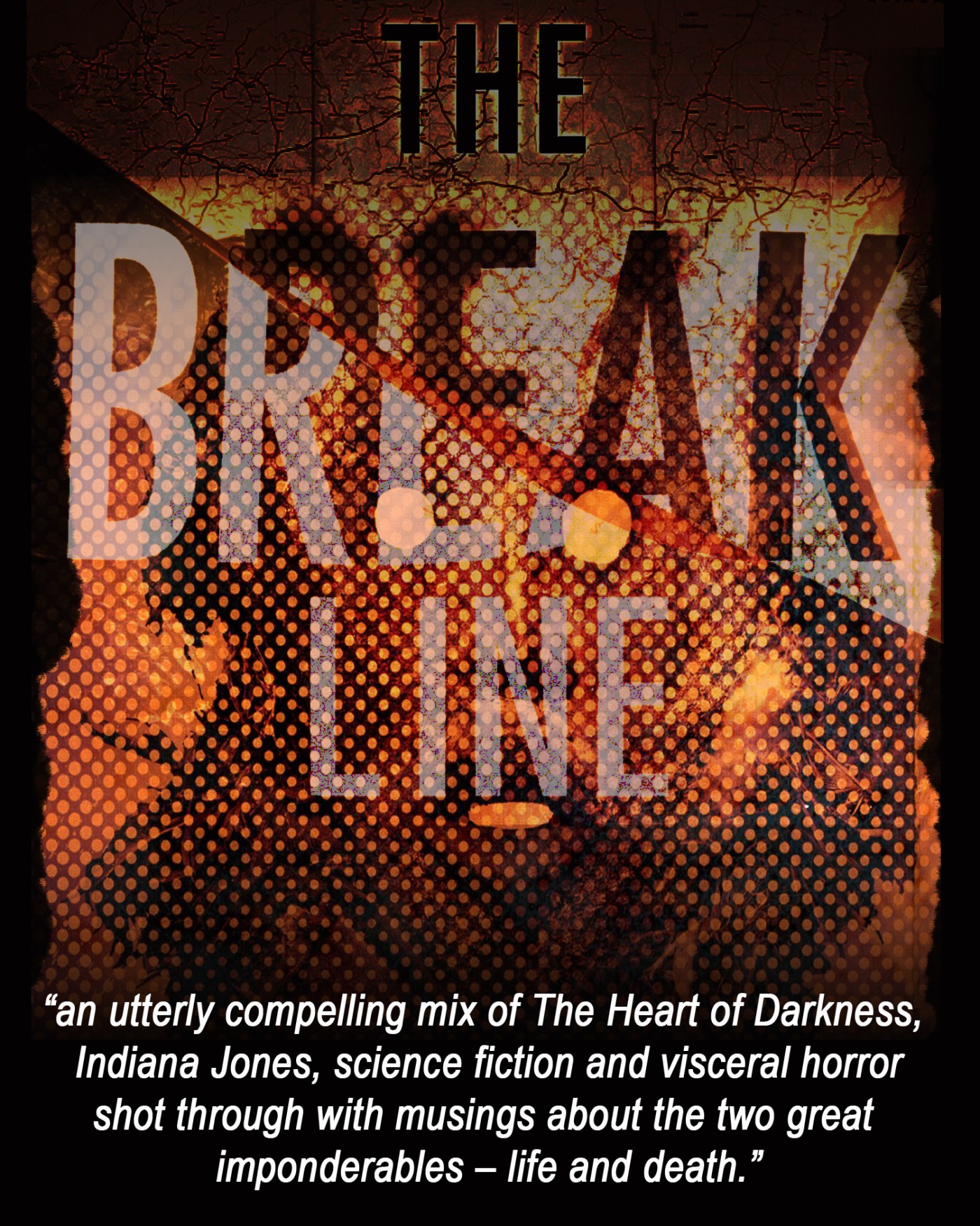
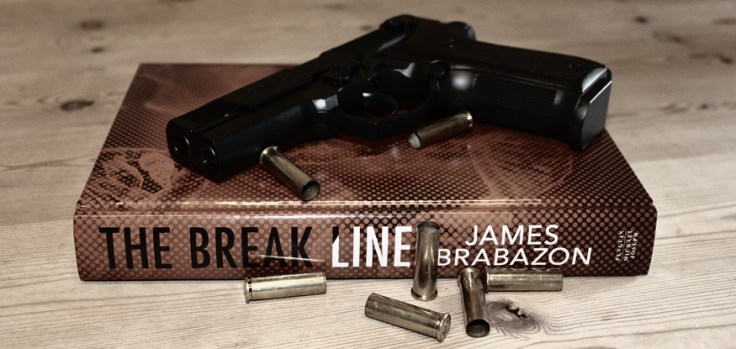
 One of my sons was, in his teens, an avid fan of the Andy McNab books and acquired several signed copies of the SAS man’s adventures, and even had a couple of autographed photos of the great man (complete with the obligatory black rectangle across his features, naturally). I have to confess that I didn’t share his enthusiasm, and military thrillers are not normally high on my TBR pile. When the publicists at Michael Joseph sent me a copy of The Break Line by James Brabazon two things aroused my interest. The first was the frankly terrifying background of the author, a documentary film maker and journalist who has been to some of the darkest and most dangerous spots in the world and lived to tell the tale. Second was my admiration for the team at Michael Joseph and my awareness that they don’t, in my experience, publish bad books. If The Break Line had convinced their editorial team, then maybe I should take a closer look?
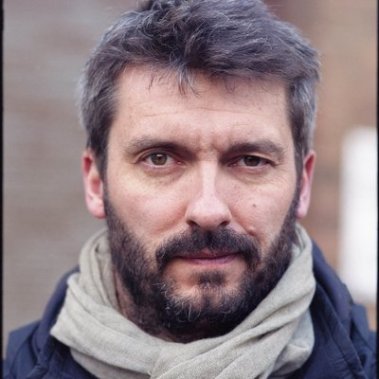 Exactly what it is that McLean faces will only be learned when you read the book. The instant you begin to read the first-person narrative, you will rightly assume that McLean survives his ordeal, as an action novel has yet to be written where the protagonist convincingly records his own death, but what happens between the first page and the last is a curious but utterly compelling mix of The Heart of Darkness, Indiana Jones, science fiction and visceral horror shot through with musings about the two great imponderables – life and death. Thriller fans will be able to fill their boots with the usual tropes; Le Carré style double and treble dealing at the highest level, fierce fire-fights, fascinating military detail, treacherous Russians and a cataclysmic body count. Brabazon (right) is not, however, simply ticking genre boxes. He shows an assured and convincing style of writing that puts him way above many of his contemporaries in the genre.
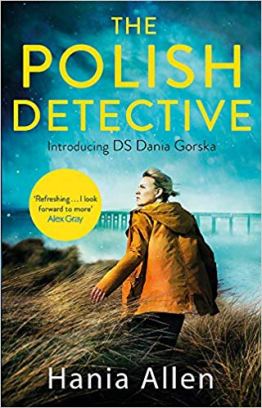 Dania Gorska has come to work in Dundee after starting her career in London with the Met. A divorce from husband Tony (watch out for the clever twist) has left her footloose and fancy free. Her exemplary record has meant she has enjoyed a swift and welcome transfer to Police Scotland. She lodges with her brother Marek, who is an investigative journalist.
 The Polish Detective is in some ways a standard police procedural which chugs along nicely on its accustomed rails. All the usual characters are present and correct; no such story would be complete without a dyspeptic senior officer, the obligatory post mortem scene with a sarcastic medical professor wielding the bone saw, the male junior detective who thinks he’s Jack – or perhaps Jock – the Lad, and the mind numbing tedium of the door knocking and CCTV scanning that sits behind every brilliant solution to a murder mystery. What lifts this book above the average is the character of Dania Gorska herself, and in particular her musical passion for, naturally, her great countryman Frédéric François Chopin and his sublime piano music. Hania Allen (right) describes herself as a pianist who makes up in enthusiasm what she lacks in talent, but under the fingers of DS Gorska, the great man’s preludes and nocturnes shimmer and sparkle throughout the pages, and the darker notes of the Polish soul are never far away.


