

Search

fullybooked2017

Category

REVIEWS

THE APPARITION PHASE . . . Between the covers

Screen Shot 2021-10-22 at 18.36.32

BorleyI don’t review too many non-crime novels on here, but this one really appealed to me. It begins in the 1970s in an unnamed English town. Tim and Abi are teenage twins and, like many such siblings, have an almost preternatural bond that often transcends the spoken word and visual communication. They also have what might be called an unhealthy fascination with ghosts and the paranormal. One of Tim’s hobbies is painting pictures of bygone execution methods, and their favourite book is a well worn copy of The End of Borley Rectory (1946) by Harry Price. Price was a well-known ‘ghost-hunter’ in the 1930s and 1940s and although he is widely regarded as a charlatan these days, he was a celebrated and popular author, particularly on the topic of Borley Rectory in Suffolk, once known as “the most haunted house in England”.

greenwich-ghost

The twins are also keen photographers, but bear in mind that this is the 1970s, and unless you had a home darkroom, photography for most people involved taking the roll of film from the camera and handing it over to Boots to be developed and printed. Tim and Abi are connoisseurs of paranormal photography and, even though they do not have the expertise to create elaborate fakes such as the celebrated ghost that haunted The Queen’s House Greenwich (right), they have imagination to spare. They have sole use of the attic in their house, and their well-meaning but rather ‘hands-off’ parents seldom venture up the ladder into Tim and Abi’s terrain.

TAP coverOn a blank wall, they draw a rather convincing image of a tormented woman, and take a whole roll of photographs of it. Harmless fun? Yes, it might have been, until they decide to take one of the more convincing images to school, and show it to a classmate, backed up with an elaborate story that Abi has seen the ghost of a former occupant of their house, a young woman who, shamed by her cheating fiancé, hanged herself in that very attic. The victim of their prank is Janice Tupp, a seemingly unremarkable girl who the twins despise because of her very ordinariness. Rather like those who tormented Carrie White, they have picked the wrong victim. Janice collapses at school after being shown the photograph, and when, some days later, the twins invite her round to their house in order to explain their deception (and to avoid getting into serious trouble) Janice shocks them by making a puzzling prediction which Tim and Abi can make no sense of. A few weeks later, however, something shocking happens which will change everything – for ever.

Further references by me to specifics of the plot will be, perforce, cautious, as I have no wish to diminish readers’ enjoyment – if that is the right word. I add that caveat, because Will Maclean takes us into  very dark territory. Suffice it to say that Tim becomes involved with two researchers and a group of people more or less his own age who have rented an old Suffolk manor house with the purpose of conducting experiments into the paranormal. At this point, cynical readers are entitled to use the cliché “And what could possibly go wrong…?” but Maclean skillfully avoids the more obvious pitfalls, and steers an intriguing course between Hamlet’s famous statement to Horatio, and our knowledge of the nature of reality and deception.

I wouldn’t say that I am a blasé reader, but any reviewer of mostly crime and thriller novels encounters fictional grief and trauma on a daily basis. The Apparition Phase genuinely had my anxiety levels tipping into the red zone – and staying there. Will Maclean references the unrivaled master of ghost stories – MR James – but in a sense, he goes one better. James wrote short stories, and therefore had only to keep the menace going for twenty pages or so, but to keep us engaged and anxious for four hundred is something else altogether.

This deeply unsettling novel, published by William Heinemann, came out in paperback earlier this month and will be available in Kindle and hardback on 29th October

WITHOUT A TRACE . . . Between the covers

WAT header

We are in the fictional Derbyshire town of Bainbridge. Recently divorced Ruth Prendergast has finished work for the day, done her shopping, and is keen to be inside her new house in Hollywell Close, warm, snug and out of the icy winter rain. She fancies a night in, with a pizza and a glass or two of wine. What she gets, however, is a ghastly shock. Turning on the bedroom light she finds a man apparently asleep under her duvet. When she plucks up the courage to wake him, she finds she cannot. Because he is dead. Stone dead, with a knife embedded in his body.

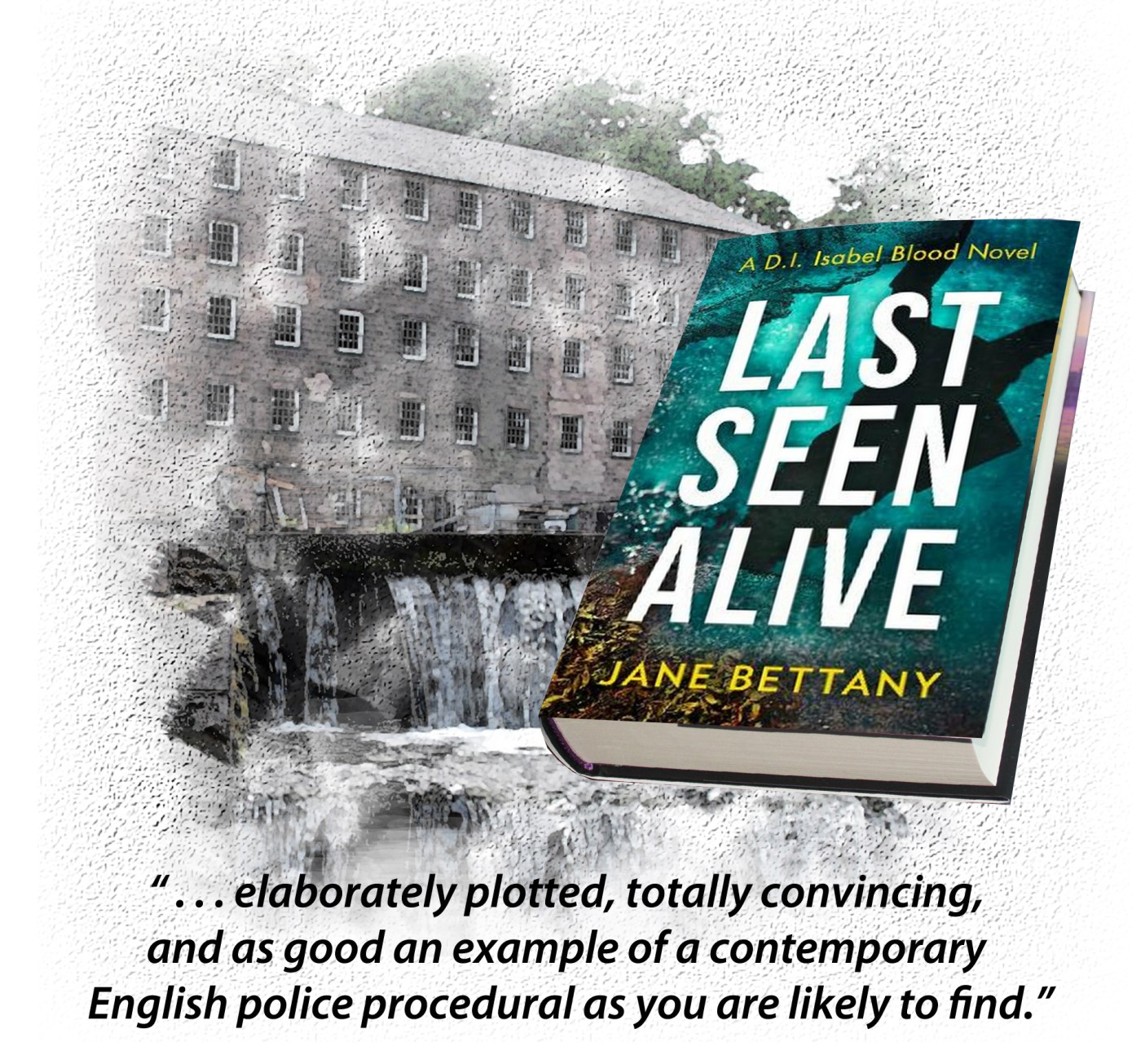
WAT coverThe team investigating the murder is led by Detective Inspector Isabel Blood, her Sergeant and a brace of DCs. They soon learn that the dead man is Kevin Spriggs, a middle-aged car mechanic, with a failed marriage behind him, an estranged son – and an argumentative temperament often fueled by drink. The murder raises many questions for Blood and her people. How did Spriggs and the person who killed him gain access to a locked house? Who hated Spriggs – admittedly not one of life’s natural charmers – enough to kill him? After all, he was something of a nobody, tolerated rather than loved by most people who knew him, but why this brutal – and mysterious – death?

The investigation – code named Operation Jackdaw – has achieved precisely three-fifths of five-eighths of diddly-squat, when it is rocked by the discovery that Ruth Prendergast, who discovered the corpse of the unfortunate Spriggs has herself disappeared. She was due to go on a walking trip with a lady friend, but she failed to make the rendezvous and, to borrow from The Bard, she has “melted into air, into thin air ….. leaving not a rack behind.

There are enough fictional Detective Inspectors out there in the world of crime fiction to run a large county police force, so what makes Isabel Blood – to steal a sporting cliché  – achieve a podium finish? Refreshingly, she is middle-aged, comfortable in her skin and appears to have no hidden demons. She is happily married with two teenage daughters, and the only kink in this domestic bliss is that her father was apparently bigamously involved with Isabel’s mother, and now lives in France where he has two grown up sons with his legal wife. Now, Isabel’s father and her half-brother have arrived in Bainbridge for a visit at precisely the time that the unfortunate Kevin Spriggs is discovered in Ruth Prendergast’s bed. Eventually, the team discover how – and why – the man was murdered, and the solution is complex, but it very neatly echoes Isabel’s own difficulties with her double family and half-siblings.

Without A Trace is a well plotted and nuance police procedural with credible coppers and equally convincing villains. It is published by HQ Digital, and will be out in Kindle on 29th October. A paperback edition will be available in January.

ORDERS TO KILL . . . Between the covers

OTK header

It’s always a pleasure to find a new (to me) historical police series, and especially one set during The Great War. I have read most of the Inspector Hardcastle series but, sadly, Graham Ison is no longer with us. RN Morris’s Silas Quinn books are great fun too, but most of those I have read recently are re-published editions of books written some years ago. Orders To Kill, by the accomplished and prolific historical novelist Edward Marston, is bang up to date, publishing wise, and it is the ninth in what is called the Home Front Detective series.

OTK cleanInvestigating duos are always a reliable way to spin a police novel, and in this case we have Inspector Harvey Marmion and Sergeant Joe Keedy of the Metropolitan Police. Marmion is married to Ellen, with a son and daughter. Son Paul has been mentally damaged by his time on the Western Front, and has now disappeared leaving no clue as to his whereabouts, while daughter Alice – also a service police officer – is engaged to Keedy.

It is December 1917 and Marmion and Keedy are investigating the brutal murder of a prominent surgeon, Dr Tindall, who has been working at a military hospital in London. He is found dead in his house, horribly mutilated by – according to the pathologist – a large bladed weapon, perhaps a bayonet. The dead man was highly thought of at his hospital, and widely admired by others who knew him, but when attempts are made to establish a possible motive, serious questions arise. Why, for example, can police find no trace of George Tindall’s parents at the Scottish address listed on his file? Why does the current owner of what was named as his Brighton home say that she has never heard of him?

He was clearly a wealthy man, and one who paid cash for his elegant Savile Row suits, but what motive could he possibly have had for fabricating a personal background? As the equanimity of the Marmion household is disrupted by alarming family news from Somerset, the women take a train to Shepton Mallett, while Marmion himself is confronted with fresh discoveries about the George Tindall many thought they knew well.

edward-marston-new-bestwbEdward Marston (real name Keith Miles, right) keeps us well tuned in to the news from abroad, as the Tindall case plays out against news of General Allenby’s triumphant entry into Jerusalem, and how the initial British success at Cambrai was tainted by a fierce German fight back. For Marmion and Keedy however, the Tindall case seems to be spiraling out of control as it seems his killers are two men taking their orders from a higher authority – and Tindall is not their first victim. The detectives travel to Brighton, Kent, Bristol and Staffordshire in their efforts to make the case make sense, but ultimately they must make one last – and infinitely more dangerous journey – before they reach a solution to this most intractable of mysteries.

Orders To Kill is highly readable, written by an author who clearly knows his history and is an accomplished storyteller. Published by Allison & Busby, it will be available on 21st October.

PAST LIFE . . . Between the covers

PAST LIFE HEADERE

I won’t repeat my spiel about coming late to an established series (which I seem to do all too often), so here’s a brief account of where we are in Past Life. Aector McAvoy is a Detective Sergeant working in Hull, on the north bank of the Humber Estuary. He is married to Roisin, who is of Irish Traveller heritage, and they have two children, Fin and Lilah. His boss is Detective Superintendent Trish Pharoah. McAvoy is a bear of a man, born to a Scottish crofter family. He is capable of great violence, but is fundamentally a gentle soul but perhaps too conciliatory and thoughtful for his own good. Author David Mark tells us:

“He is not a man at ease with the world or his place in it. He feels permanently displace; dislocated – endlessly cast as an outsider. He’s still the lumbering red-haired Scotsman who left the family croft at ten years old and has been looking for home ever since.”

Screen Shot 2021-10-10 at 20.06.34The story begins with a murder, graphically described and, at this point in the review, it is probably pertinent to warn squeamish readers to return to the world of painless and tidy murders in Cotswold manor houses and drawing rooms, because death in this book is ugly, ragged, slow and visceral. The victim is a middle-aged woman who makes a living out of reading Tarot cards, tea leaves, crystal balls and other trinkets of the clairvoyance trade. She lives in an isolated cottage on the bleak shore of the Humber and, one evening, with a cold wind scouring in off the river, she tells one fortune too many.

When McAvoy and Pharoah arrive at the scene they find the ravaged remains of Dymphna Lowell, and understand why one or two of the police officers first to respond to the 999 call have parted company with their last meal. Trish Pharoah has seen worse, but then she has been a regular onlooker at grisly tableaux that demonstrate the depths that humans can sometimes plumb. She is the wrong side of middle age, but not going gently into that good night. She has four daughters and nursed her husband – although he was an absolute bastard – day and night as he took a long time to die from an aneurism.

As McAvoy and Pharoah hunt the killer, the back-story is crucial and it needs to be explained. Roisin’s family have been engaged in a decades-long blood feud with another clan, and there has been copious amounts of blood shed along the way. Part of this history involved Roisin saving McAvoy from an infamous killer nicknamed ‘Cromwell’. Cromwell was then gruesomely punished by Roisin’s father, she and McAvoy fell in love and married, but the savage murder of Roisin’s aunt – another fortune teller – cloaks the narrative like a shroud. Roisin is a woman not at ease with the world or herself:

Screen Shot 2021-10-12 at 10.29.37“She has found herself some mornings with little horseshoe grooves dug into the soft flesh of her palms. Sometimes her wrists and elbows ache until lunchtime. She sleeps like a toppled pugilist: a Pompeian tragedy. She sees such terrible things in the few snatched moments of unconsciousness.”

When the satanic Cromwell strikes hard at McAvoy’s family, the big man goes off the radar and hunts down the killer. David Mark (right) gives us what we think is the climax as McAvoy and Cromwell go head to head in a terrifying and violent  battle in a disused WW1 sea fort, but just as we relax and think “job well done”, there is a plot twist that few will see coming, and we learn that there is a final trauma to be endured by the McAvoy family.

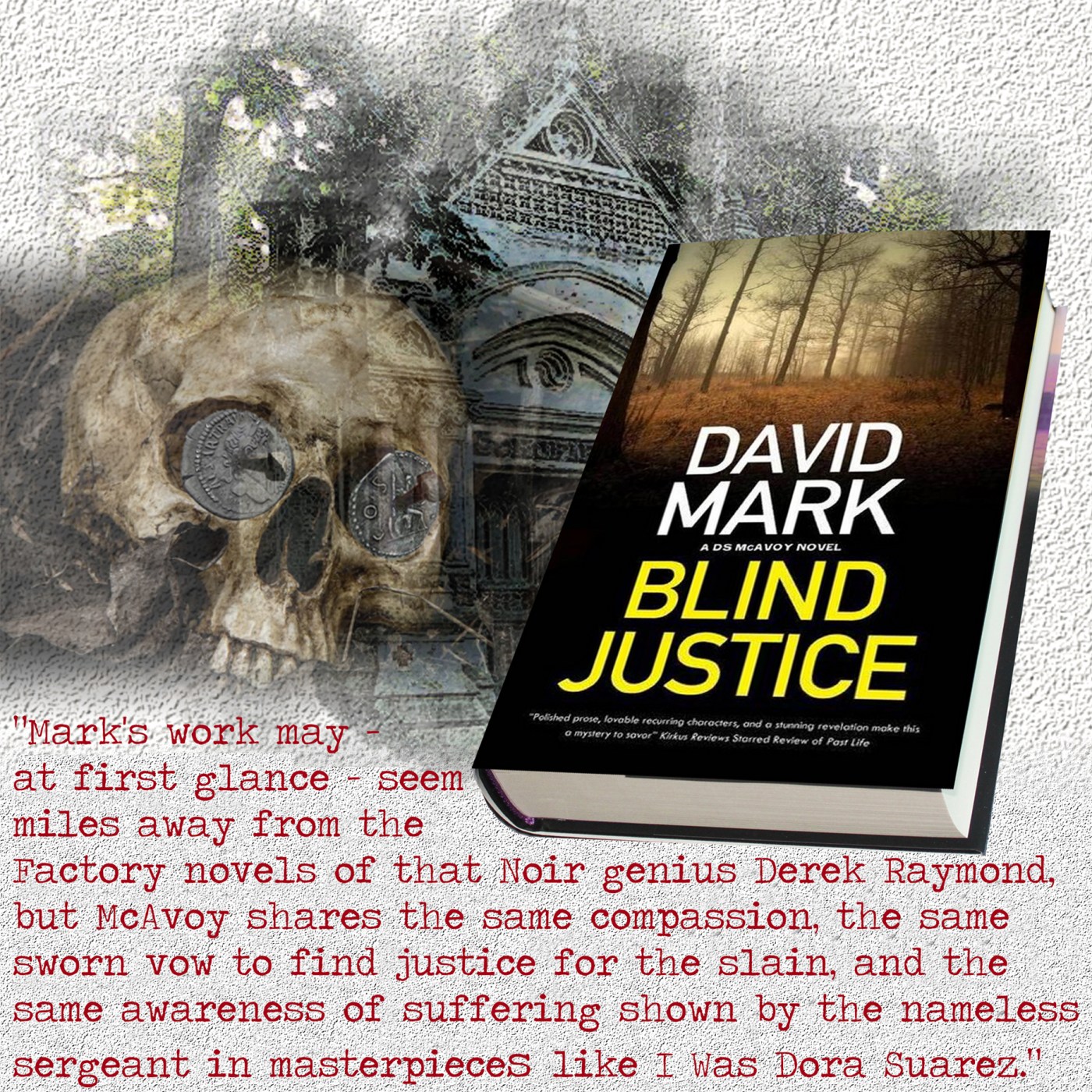
This is a dark, brooding novel, with more than a touch of Derek Raymond-esque nihilism and despair but, like his late, great Noir predecessor, David Mark also gives us searing honesty and compassion. Past Life is published by Severn House and is available now in hardback, and as a KIndle in November.

DEATH THREATS and other stories . . . Between the covers

GS header

Penguin have been quietly publishing new translations of all the Maigret novels and short stories for the last few years, and this is a recent collection of stories. What more is there to say about Georges Simenon? For me, the genius is in the economy. He never wastes a line, never provides an unnecessary description, and never uses twenty words when ten will do. He remains, quite simply, the master story-teller.

Monsieur Owen

Maigret is on holiday. He has taken the opportunity because Madame Maigret is away in Brittany tending to an ailing aunt. He is in one of the best hotels in Cannes. Rather out of his price range? Perhaps, but he has a friend in the trade, Monsieur Louis, an man who was once one of the top hoteliers in Paris, and a man who owes Maigret a favour or two. The detective “had eaten like a horse, drunk like a sailor and soaked up the sun through every pore like a bathing belle.” But his reverie is interrupted when M. Louis knocks on his door to say there has been a terrible murder. A mysterious guest called Monsieur Owen has taken rooms in the hotel along with his attractive young nurse. And now, a body has been found, naked and dead, in the bath of Monsieur Owen’s room – but it is not Monsieur Owen! In the pages that follow, Simenon weaves a delightfully complex mystery – and Maigret provides an equally intricate solution. This was first published as a magazine story in 1938.

Cafe New

This is slightly unusual, as it was also first published in 1938, just seven years after Simenon introduced Maigret in Pietr-le-Letton, and yet in this story Maigret has retired after a long career with the Paris police, and is living in Meung-sur-Loire. He is grumpy and bored, so Madame Maigret persuades him to join a nightly card school in a town café. The men play Manille, a variant of Whist. It is a game for four players, and one of the group – the town butcher, a family man – is reputed to have eyes for Angèle, the café waitress. When the butcher is found dead in his van, killed by a bullet from a wartime revolver, everyone – including the young police inspector investigating the death – expects Maigret to take charge of the case. He refuses, quite churlishly, and retires to his shed to fuss over his fishing tackle. It is only some time later, when Maigret and his wife attend the funeral of the café owner’s wife, that he reveals the reason for his silence and, once again, Simenon gives us a beautifully symmetrical solution.

Man On

This was first published under the title Le prisonnier de la rue in the Sept jours newspaper (15th and 22nd December 1940). It is worth noting at this point that Simenon remained in France during the  occupation but none of the Maigret stories set during the war references the German presence. Operating as a civilian policeman in wartime Paris would have been a very different experience from what we read here. What the papers are calling THE BAGATELLE MURDER because the body – of a handsome young Viennese doctor –  was found near La Porte der Bagatelle is puzzling Maigret and his  trusty team, Torrence, Lucas and Janvier. Eventually, they identify a suspect, and take it in turns to follow him through the streets of a wintry Paris. The man – identified as a Pole – becomes more haggard and hungry as his money runs out until, exhausted and desperate, he surrenders to Maigret. Simenon gleefully lets us know that the killing was un crime passionelle but then pulls the rug out from under our feet as he reveals who fired the fatal shot.

Candle Auction header

Maigret is working as the head of the Nantes Flying Squad, and he is summoned south to a God-forsaken village in a marshy area of the Vendée. Groux, A farmer down on his luck, has been forced to sell his property and has arranged a Candle Auction (click the link for an explanation) in the local inn, run by former criminal Frédéric, his slatternly wife Julia and barmaid Thérèse. During a lengthy card game on the evening preceding the auction, one of the prospective bidders – Bourchain – is found dead in his bed, his head ruined by blows from a hammer, and his wallet – containing the thousands of francs with which he intended to buy the farm – missing. Maigret creates his own version of the classic locked room mystery by re-assembling the participants in the card game, and painstakingly forces them to re-enact every card played, every break for drinks and every trip to the toilet until he discovers who wielded the coal hammer that shatters Bourchain’s head. Not for the first time, we play cherchez la femme. This was first published in serial form in 1942.

Death Threrats

A wealthy (to the tune of three million francs) rag and bone man, Emile Grosbois has requested a meeting with Maigret’s boss, and has produced a letter composed of words cut from a newspaper. It is a threatening prediction that Grosbois will be dead before before 6.00pm on the following Sunday. The Grosbois family – Emile, twin brother Oscar, their widowed sister Françoise and her two grown-up children Eliane and Henri – live on the premises of the scrap yard, but travel down to their riverside home outside Paris every weekend. Maigret is told he must join the family for the duration of the fateful weekend, and if the great man ever suffered a more miserable few days, Simenon never told us about it. The tensions between the disfunctional family simmer and burn until – just before the doom hour of 6.00pm – Maigret must intervene to save a man’s life and, in doing so, unmask the would-be murderer. This was first published, in serial form, as Menaces de Mort in 1942.

THIS COLLECTION WAS TRANSLATED BY ROS SCHWARZ,
PUBLISHED BY PENGUIN, AND IS AVAILABLE HERE

TO ALL THE LIVING . . . Between the covers

TAOTL

This is the latest in the series of excellent reprints from the Imperial War Museum. They have ‘rediscovered’ novels written about WW2, mostly by people who experienced the conflict either home or away. Previous books can be referenced by clicking this link.

MonicaAuthor Monica Felton (1906 – 1970) was certainly an unusual woman and, to borrow a modern phrase, somewhat to the left of Lenin. In 1951, she visited North Korea as part of the Women’s International Democratic Federation commission and outlined her impressions in the book That’s Why I Went (1954), adhering to an anti-war position. In the same year, she was awarded a dubious and deeply ironic honour – the International Stalin Prize “for peace between peoples”

We are, then, immediately into the dangerous territory of judging creative artists because of their politics, which never ends well, whether it involves the Nazis ‘cancelling’ Mahler because he was Jewish or more recent critics shying away from Wagner because he was anti-semitic and, allegedly, admired by senior figures in the Third Reich. The longer debate is for another time and another place, but it is an inescapable fact that many great creative people, if not downright bastards, were deeply unpleasant and misguided. To name but a few, I don’t think I would have wanted to list Caravaggio, Paul Gauguin, Evelyn Waugh, Eric Gill or Patricia Highsmith among my best friends, but I would be mortified not to be able to experience the art they made.
To All The Living
So, could Monica Felton write a good story, away from hymning the praises of KIm Il Sung and his murderous regime? To All The Living (1945) is a lengthy account of life in a British munitions factory during WW2, and is principally centred around Griselda Green, a well educated young woman who has decided to do her bit for the country. To quickly answer my own question, the answer is a simple, “Yes, she could.”

Another question could be, Does she preach? That, to my mind, is the unforgivable sin of any novelist with strong political convictions. Writers such as Dickens and Hardy had an agenda, certainly, but they subtly inserted this between the lines of great story-telling. Felton is no Dickens or Hardy, but she casts a wry glance at the preposterous bureaucracy that ran through the British war effort like the veins in blue cheese. She highlights the endless paperwork, the countless minions who supervised the completion of the bumf, and the men and women – usually elevated from being section heads in the equivalent of a provincial department store – who ruled over the whole thing in a ruthlessly delineated hierarchy.

Amid the satire and exaggerated portraits of provincial ‘jobsworths’ there are darker moments, such as the descriptions of rampant misogyny, genuine poverty among the working classes, and the very real chance that the women who filled shells and crafted munitions – day in, day out – were in danger of being poisoned by the substances they handled. The determination of the factory managers to keep these problems hidden is chillingly described. These were rotten times for many people in Britain, but if Monica Felton believed that things were being done differently in North Korea or the USSR, then I am afraid she was sadly deluded.

The social observation and political polemic is shot through with several touches or romance, some tragedy, and the mystery of who Griselda Green really is. What is a poised, educated and well-spoken young woman doing among the down-to-earth working class girls filling shells and priming fuzes?

My only major criticism of this book is that it’s perhaps 100 pages too long. The many acerbic, perceptive and quotable passages – mostly Felton’s views on the more nonsensical aspects of British society – tend to fizz around like shooting stars in an otherwise dull grey sky.

Is it worth reading? Yes, of course, but you must be prepared for many pages of Ms Felton being on communist party message interspersed with passages of genuinely fine writing. To All The Living is published by the Imperial War Museum, and is out now.

HUNT . . . Between the covers

hunt feature

Leona Deakin started her career as a psychologist with the West Yorkshire Police. She is now an occupational psychologist, so you can rest assured that her career has given her a valuable insight into how a fictional criminal psychologist would go about their work. Such knowledge, however, is worthless if the author can’t write. In Deakin’s hands the result is that we have a totally convincing character (Dr Augusta Bloom), an intricate plot with whiplash-inducing twists and turns, and a book that you just don’t want to end.

Screen Shot 2021-09-27 at 19.35.58Screen Shot 2021-09-27 at 19.36.16Hunt is the third episode in Augusta Bloom’s career, and you can read my reviews of the previous two stories by clicking the images. Bloom has an uneasy relationship with Marcus Jameson (a former military intelligence analyst), notionally her partner in their investigation agency. Rather than Ying and Yang, they are more chalk and cheese. The book begins with Bloom being summoned south from her Yorkshire Dales hideaway. Who demands her services? None other than the Foreign Secretary Gerald Porter. Where is he? In a London police cell, detained on suspicion of selling information to Britain’s enemies. But why does he need Dr Augusta Bloom?

Hunt coverThe answer to that conundrum forms the central premise of the book. Porter’s niece Scarlett has been drawn into the orbit of a feminist organisation called Artemis led by a charismatic woman called Paula Kunis. Porter will only answer police questions about his activities if Bloom undertakes to track down Scarlett and extract her from the clutches of Artemis. Bloom is smart enough to realise that Porter is up to something, but cannot work out why he is so worried about his niece, when every other aspect of his behaviour suggests that he is a cold and devious man, with psychopathological elements to his character.

On-line investigations by Bloom and Jameson get them only so far, and so Bloom decides to go to a seminar run by Artemis, to see what manner of creature it is. The women running the presentation are warm, friendly and convincing, but give little away, as Bloom tries to question them as subtly as possible. Having hardly scratched the surface of the veneer, Bloom signs up for a weekend retreat at the Artemis headquarters in an isolated village in the Scottish highlands. Jameson is dubious about this as he has a sixth sense that Artemis is not the benevolent campaigner for women’s rights that its glossy literature and media presence claim it to be. Bloom reassures him. After all, this the 21st century, the age of mobile phones and instant connectivity. What can possibly go wrong over a long weekend?

Bloom and a minibus full of other attendees arrive at the location, and are met by a flock of charming and smiling women who seem overjoyed to welcome potential recruits to the cause. It is all very fragrant, but a tiny alarm begins to ring in Bloom’s head as she sees all mobile phones and watches being handed over to the Artemis greeters. This tinkling bell becomes more clamorous when Bloom realises that the new arrivals are being subjected to sleep deprivation, time disorientation and one-to-one social monitoring by the Artemis devotees.

Back in the outside world, three things have happened. Firstly, Jameson has discovered that the Scottish retreat is entirely surrounded by high fences topped with barbed wire facing inwards, all the better to keep people in rather than to keep intruders out. Secondly – and much more worrying – is the appearance on the scene of Seraphine Walker, a sinister and clever criminal fixer, rather like a 21st LDcentury Professor Moriarty, who has crossed swords with Bloom and Jameson before. Thirdly, Gerald Porter has inexplicably disappeared from police custody and, almost immediately, a huge social media campaign vilifying Paula Kunis and Artemis has been launched, with the result that scores of husbands and fathers of women “poached” by Artemis have headed to the Scottish retreat and are angrily congregating at its gates.

Leona Deakin (right) has written an absolute cracker of a thriller, and her portrayal of how cults go about their business preying on innocent and needy people is chilling. The conclusion of Hunt is dramatic, violent and utterly gripping.

Hunt is out now, published by Black Swan/Penguin, and you can investigate buying choices by clicking the images below. Or, visit your local bookshop if you are lucky enough to have one.

amazon

Foyles_logo

Smith

BLACKOUT . . . Between the covers

blackout015

B0December 1939. Berlin. The snow lies deep and crisp and even, and Kriminalpolizei Inspector Horst Shenke is summoned to the Reich Security Main Office to meet Oberführer Heinrich Müller, a protege of Reinhardt Heydrich and recently appointed head of the Gestapo. Müller has a tricky problem in the shape of a former film star, Gerda Korzeny. Her husband is a lawyer and Nazi Party member who specialises in redrafting potentially awkward pieces of existing legislation in favour of the Party. And now Gerda is dead. Found by a railway track with awful head wounds. She had also been brutally raped. But what does this have to do with Heinrich Müller? His problem is that Gerda Korzeny was known to be having an affair with Oberst Karl Dorner, an officer in the Abwehr, Germany’s military intelligence organisation, and the Gestapo man wants the matter dealt with quickly and discreetly.

We learn that Schenke is a very good copper, but that his career has stalled because he has, thus far, refused to become a Party member. In his younger days, Schenke was a well-known racing driver, until a near-fatal accident forced him to quit the sport. His only legacy from those heady days is a permanently damaged knee. He is romantically involved with a woman called Karin Canaris, and if that surname rings a bell with WW2 history buffs, yes, she is the niece of the real-life head of the Abwehr, Admiral William Canaris.

Although he initially believes that the case will not bring him into direct conflict with local Nazi officials, Schenke’s discovery that Berlin has a serial killer on the loose is of little comfort, as everyone in the Party, from Goebbels down to the lowliest apartment block supervisor is anxious to preserve public confidence in these early months of the war.  Oberst Dorner takes a step or two down the ladder of Schenke’s suspects when the killer strikes again, but this time fails to finish the job. The victim survives with bruises and shock, but Schenke finds himself in a tight corner when, after investigating the young woman’s several false identities, he discovers that her real name is Ruth Frankel, and she is Jewish. In normal times, her racial profile shouldn’t matter, but these are not normal times, and Party officials take a dim view of wasting valuable resources on any case involving Jews.

Heinrich_MüllerOberführer Müller, (right) in an attempt to keep tracks on what Schenke is doing, sends a young Gestapo officer called Liebvitz to shadow the Kripo officer, and that allows us to meet a rather unusual fellow. These days, we would probably say he has Asperger’s Syndrome, as he takes everything literally, has no sense of humour and a formidable eye for detail. He is also a crack shot, and this skill serves both Schenke and the department well by the end of the book.

Simon Scarrow cleverly allows Schenke makes one or two mistakes, which makes for a very tense finale, but also establishes him as a human being like so many other fictional coppers before him – tired to the point of exhaustion, frustrated by officialdom and trouble by his conscience. Before the book ends, we also meet the deeply sinister – despite a superficial icy charm – Reinhardt Heydrich.

Comparisons between the worlds of Horst Schenke, Philip Kerr’s Bernie Gunther and David Downing’s John Russell are inevitable, but not in any way damaging. A good as they are, neither Kerr nor Downing have taken out a copyright on the world of WW2 Berlin. Simon Scarrow shines a new light on a city and a time that many of us think we know well. He creates vivid new characters – and revitalises our enduring fascination with some of the historical monsters that stalked the earth in the 1930s and 40s. I sincerely hope that this becomes a series. If so, it will run for a long time, and grip many thousands of readers. Blackout was first published in hardback in March this year, and this Headline paperback is available now.
Screen Shot 2021-09-14 at 19.18.48

THE BURNING . . . Between the covers

Burning027 copy

The Kellerman family – Jonathan, Faye and now Jesse – seem to be able to turn out highly readable thrillers at the flick of a switch. My personal favourites are the Alex Delaware novels, but this is the second Clay Edison book I’ve read, and it’s excellent. The Burning is billed as 4 of 4, so the series will come nowhere near the astonishing 36 books books of the Delaware series (with the 37th due next year) You can read my review of the 36th, Serpentine, by clicking the link. My review of the third Clay Edison book, Lost Souls is here.

Burning028But back to Clay Edison. He is a Deputy US Coroner in Berkeley, California, and The Burning begins, quite topically, with a destructive bush fire that has knocked out power supplies for everyone except those with their own generators. When Edison and his partner are summoned to retrieve a corpse from a mansion up in the hills, they find that Rory Vandervelde – a multi millionaire – has died from gunshot wounds. He was an avid collector. Rare baseball and basketball memorabilia, Swiss watches, antique knives – you name it, and Vandervelde had bought it. It is when Edison is inspecting the dead man’s astonishing collection of classic cars, stored in a huge garage, that he discovers something that sends a shiver down his spine, and not in a pleasant way.

“I’d missed the Camaro on my way in. So much to gawk at. Eyes not yet adjusted. I saw it now. It was, to be specific, a 1969 SS/Z28. V8 engine, concealed headlights, black racing stripes, custom leather upholstery.

A hell of a car. One that I recognised specifically. I had seen it before. Not once, but many times.

It was my brother’s.”

Edison muses that there has to be an innocent explanation why his brother’s prize possession – a car he had restored from near junk – is in the murdered man’s garage. He surely wouldn’t have sold it to him? Luke Edison is a reformed addict who has done jail time for killing two women in a drug fuelled car theft, but he has rebuilt not only the car, but his life. Simple solution – call Luke on his cell phone. No answer. Repeated calls just go to voice mail. Clay Edison has the black feeling that something is very, very wrong, but in an instinct for family protection, he tries to prevent any of his law enforcement colleagues from identifying the vehicle’s owner and linking him with the murder.

No-one – Luke’s neurotic hippy partner, his parents, his boss at a marijuana-based therapy start-up – has seen or heard of Luke for several days. Working off the record, explaining to no-one what he is doing, and sensing that his brother is a victim rather than a perpetrator, Clay Edison finally discovers that his brother is being used as bait by some seriously evil characters who – as payback for deaths in their family for which they hold him, Clay, responsible – are prepared to stop at nothing to exact their revenge.

I finished this book during a return train journey and a quick hour before bedtime. It is ridiculously readable. Yes, it’s slick, unmistakably American, and probably formulaic but, as the late, great British film reviewer Barry Norman used to say, “And why not?” Just shy of 300 pages, it is everything that is good about American thriller fiction – fast, exciting and  – like Luke Edison’s Camaro – a bumpy but exhilarating ride. I have no idea who wrote what in the Jonathan and Jesse Kellerman partnership, but who cares? Published by Century, The Burning is out on 21st September in Kindle and hardback, and will be available next year in paperback.

Camaro

Blog at WordPress.com.

Up ↑