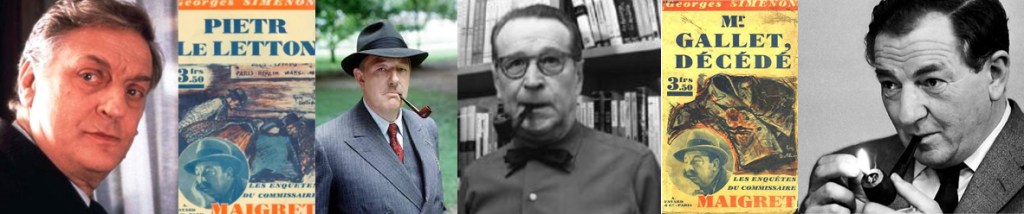
Maigret. The immortal creation of Georges Simenon. The Paris detective was the subject of 75 novels and a number of short stories. He was portrayed on TV by Rupert Davies, Bruno Cremer, Michael Gambon and Rowan Atkinson. What do we know of Jules Maigret? He was raised in the country, where his father was an estate worker. He enjoys his pipe (as did his creator). His wife, Louise, is usually Madame Maigret.
In real life, Simenon thrived on a diet of alcohol, tobacco and sex. Maigret is much more restrained. He is steady, thoughtful and insightful. If there were a crime fiction podium, then I suggest that the three finalists would be Simenon, Conan Doyle and Chandler. Who takes the gold is a matter of opinion.
Like thousands of other Britons of a certain age, my first experience of Maigret was through the 55 minutes TV dramas filmed by the BBC in the 1960s. Broadcast on Monday night, they were unmissable. Rupert Davies was middle aged, wavy haired and avuncular. Madame (Helen Shingler) was ever present, but always the tolerant and long-suffering supporter of her husband. At work there was the indefatigable Lucas (Ewen Solon), the keen new boy Lapointe (Neville Jason) and the slightly chaotic but intimidating Torrence (Victor Lucas). When he was killed in one of the episodes, Maigret lamented, ‘he was a lion’. For some reason, there was no Janvier, a copper who featured in the Bruno Cremer series.
The biggest problem for me is the fact that the Maigret novels, and I have read dozens of them, were written in French. I have schoolboy and tourist French, but nothing like the knowledge required to read the books in their original tongue. As an ‘A’ level task, I read a Simenon short story, Le Temoignage de l’enfant Choeur, but it was only recently, in a translation, that I finally understood what had happened. What stands between us and the original text is the translator.
These good people are linguists, but frequently neither poets not writers. I hope we are better served by translators these days than when Geoffrey Sainsbury translated the first *British editions of the novels. He became notorious for for taking significant liberties with the text, often renaming characters and altering titles. It wasn’t until 1952 that Simenon finally had enough of his English collaborator.and ended the partnership. It has been suggested that the translations were always handed over to Simenon for approval. This was somewhat disingenuous, as Simenon could neither speak or read English.
*The first translations in English began in 1932 and were the work of Anthony Abbott, and published in New York.
To illustrate the extent to which English readers are at the mercy of translators, the following graphic shows, side by side, three different opening paragraphs of Maigret at The Crossroads. Left is that by Anthony Abbott (1933). Centre is by Robert Baldick, thirty years later, while the one one the right is the work of Linda Coverdale in 2014. My thanks to colleague Stuart Radmore for providing these comparisons.
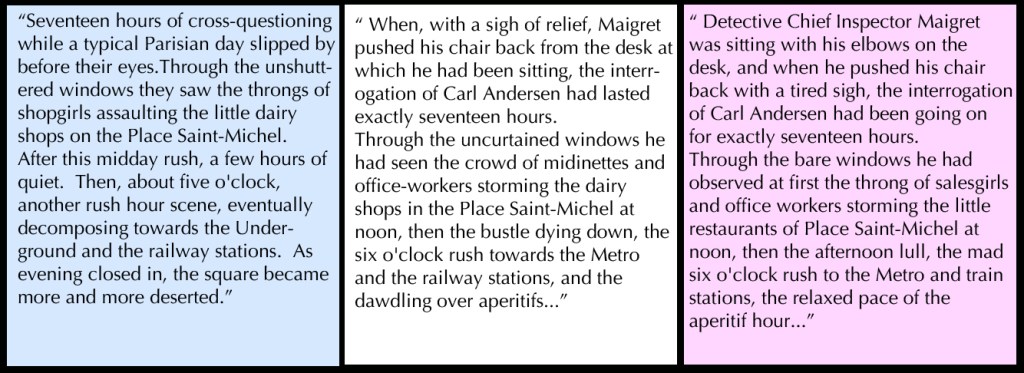
The egregious “train stations” in the 2014 account will tell you that this is an American translation but, that aside, apart from the fact that Maigret has been interviewing someone for a long time, and that two of the versions mentions his name, the styles are completely different. In part two, I will examine Maigret’s method, take a look at Maigret’s life, and draw some conclusions about where Simenon’s novels stand in the pantheon of 20th century fiction.


Leave a Reply