
Cambridge, in the early autumn of 1939, is like every other city and large town across Britain: war has been declared, the army is everywhere – as are rumours of German spies and infiltrators under every metaphorical bed. Observers scan the skies night and day vainly searching for enemy aircraft while in Belgium, the British Expeditionary Force sit waiting the German Army’s first move. In hindsight, of course, we know that this was the ‘phony’ war, and that Hitler’s forces had, for the moment at least, more pressing work further east.
 In this febrile atmosphere are many men and women who have memories of “the last lot”. One such is the latest creation from Jim Kelly, (left) Detective Inspector Eden Brooke. He saw service in The Great War, but were someone to wonder if his war had been ‘a good war’, they would soon discover that he had suffered dreadful privations and abuse as a prisoner of the Turks, and that the most physical legacy of his experiences is that his eyesight has been permanently damaged. He wears a selection of spectacles with lenses tinted to block out different kinds of light which cause him excruciating pain. For him, therefore, the nightly blackout is more of a blessing than a hindrance.
One of Brooke’s stranger habits is moonlight bathing in the River Cam. It is on one such visit to the river that he overhears a conversation. Because of blackout, he can see nothing, but it seems a group of ‘squaddie’ soldiers under the command of an NCO are digging pits to bury something – and it is not a pleasant job. Daylight, and an inspection by one of Brooke’s officers, provides no answer.
With the mysterious burials in St John’s Wilderness nagging away at him like a toothache, Brooke must divert his attention to violent deaths. With military minds convinced that barrage balloons will prove the answer to death being delivered from the skies by the Luftwaffe, the ‘blimps’ are tethered all over the city. To us, they have a slightly comedic aspects, but when one breaks free from its mooring and catches fire, the results leave no-one laughing. As the balloon careers across the Cambridge rooftops it trails a deadly mesh of netting and steel cable. A man, subsequently identified as American research student Ernst Lux, has been caught up in this obscene accidental fishing expedition and when his body eventually returns to the ground it looks as if it has been savaged by some dreadful predatory beast. The second death is just as brutal but mercifully quicker. The body of Chris Childe, a conscientious objector and an active member of the Communist Party, is found slumped over his parents’ grave in Mill Road Cemetery. He has been shot through the head at point blank range.
Brooke is pulled this way and that with the investigations, but then there is a further complication. Three lorries, running on false plates, are found parked up on Castle Hill, their drivers gone. When the investigation gathers speed it becomes clear that this is an operation in black market meat, controlled by criminal gangs in Sheffield. Brooke is convinced that there is a military connection between all these events, but in order to make any sense of them he needs to get straight answers from the top brass at regional army HQ out at Madingley Hall. The Inspector is, literally, an ‘old soldier’ and he knows precisely how the military mind works, so attempts by officers such as Colonel George Swift-Lane to ‘baffle him with bullshit’ are doomed to failure.

The relationship between the deaths, the digging and the dirty dealing are eventually laid bare by Brooke’s intelligence and persistence. Kelly’s writing has never been more atmospheric and haunting; he gives us one spectacular and horrific set-piece when a demonstration by the Auxiliary Fire Service goes terribly wrong, and he makes sure that the killer of Chris Childe dies a death more terrible than that of his victim. Above all, though, we have a brilliant and memorable new character in Eden Brooke. There is a little something of Christopher Foyle about him, although his wife Claire is very much alive, but Brooke’s son is also away doing his bit, with the BEF in Belgium, waiting for the push that would eventually. just seven months later, drive them into the sea.
Brooke’s portrait is subtle, nuanced and, while revealing up to a point, leaves us with the impression that this a man who we may never completely understand, and that he is someone whose actions, thoughts and decisions will always have the capacity to surprise us. I can only say to Jim Kelly, “Thank you, Mr K – this is as brilliant and evocative a piece of crime fiction as I will expect to read all year. You’ve gone and done it again!”
The Great Darkness is published by Allison & Busby and will be generally available on 15th February.
For a background to Jim Kelly’s work and his use of landscape, place and history in his novels, click the link below.
LANDSCAPE, MEMORY – and MURDER

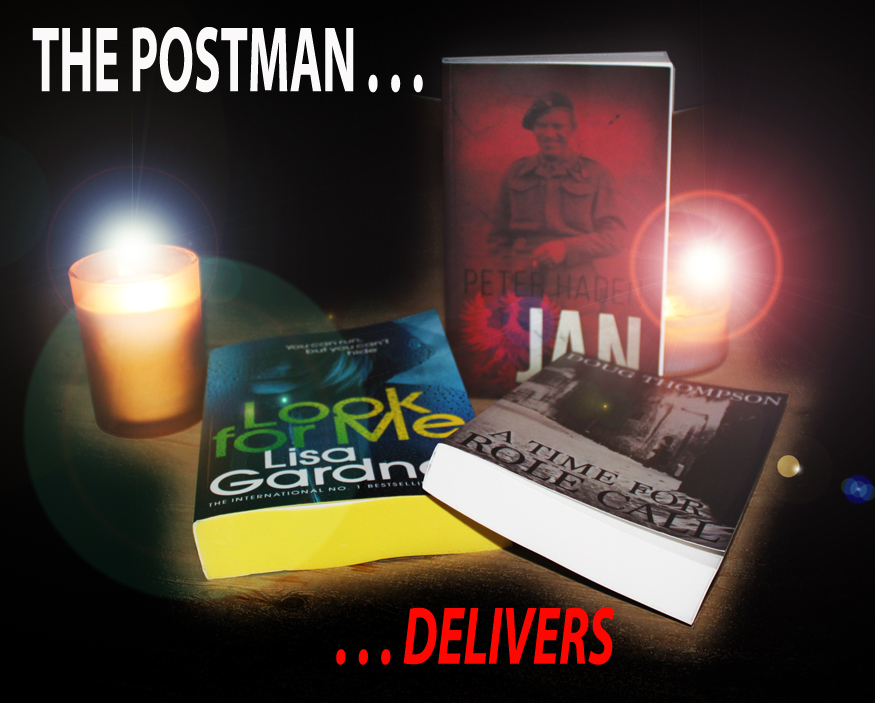

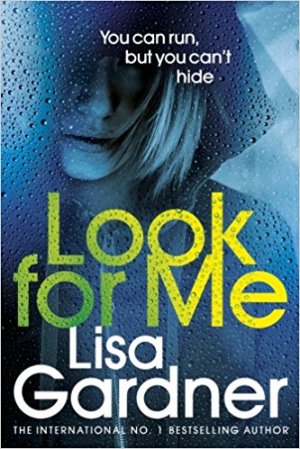 Look For Me is a return to active duty for Boston Detective D D Warren. In the twelfth book of an obviously popular series, Gardner brings back a character – Flora Dane – from an earlier book, Find Her, in which Dane was a resilient but haunted survivor of kidnap and abduction. Now, Dane’s thirst for vengeance on her tormentor is a mixed blessing for Warren who is faced with a murder scene of almost unimaginable violence. Four members of the same family lie slaughtered in the family home, a refuge transformed into a charnel house. But where is the fifth member of the family? Has the sixteen year-old girl escaped, or is her disappearance the prelude to an even greater evil? Look For Me is published by Century, part of the Penguin Random House group, and will be available in early February 2018. You can pre-order a copy
  Polish history in the twentieth century shows us a region constantly in the thick of conflict between rival military forces. It was the scene of many of the battles on the Eastern Front during WWI, and Poland suffered hugely at the hands of the Nazis during WWII. The very worst concentration camps set up by Hitler were on what is now Polish territory. Then, post-war, came what was, to all intents and purposes, a Russian occupation. Peter Haden’s novel Jan actually deals with a real person, his uncle, Jan Janicki and his exploits both before and during the Nazi occupation of his homeland. The novel tells of a flight from desperate domestic poverty, the humiliation of working for the ruthless German invaders, but then a determination to fight back, which sees Jan laying his life on the line to support the Polish resistance movement. Jan is published by Matador, and is available from
  From Poland to Italy, where much of A Time For Role Call by Doug Thompson (left) is set. Former Professor of Modern Italian language, history and literature, Doug Thompson draws on his intimate knowledge of Italy to write a lively novel with a feisty protagonist and colourful cast of supporting characters. Sally Jardine-Fell is recruited by the wartime Special Operations Executive to travel to Italy. Her mission? To insinuate herself into the life of none other than Count Galeazo Ciano, Foreign Minister to Il Duce – Benito Mussolini – himself. Inevitably, things do not go according to plan, and, despite both the war and Mussolini himself becoming consigned to history, events conspire against Sally, and she finds herself in a cell, charged with murder. A Time For Role Call is published by Matador, and is available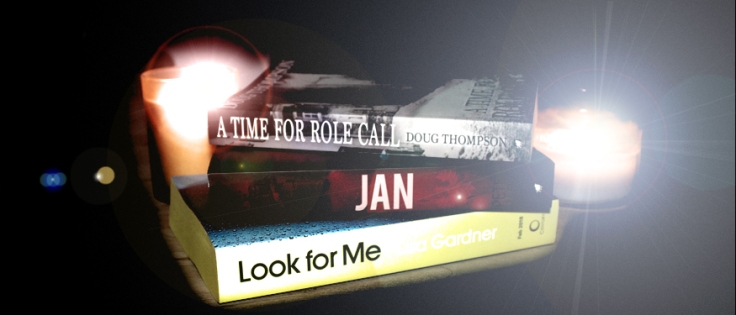


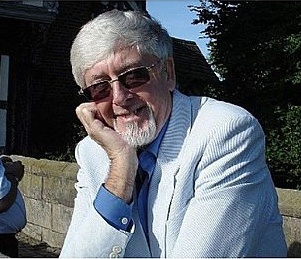
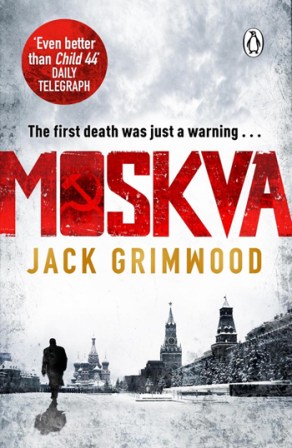 Jack Grimwood’s Moskva sets out to convince us that there is room for one more tale of conflicted lives in a modern Russia full of paradox and uncertainty. The book came out in hardback earlier this year, and is now available in paperback, from Penguin. Does Grimwood, who made his name writing science fiction and fantasy novels, hit the spot?
 The breadth of this novel in terms of time sometimes makes it hard to work out who has done what to whom. Patience – and a spot of back-tracking – will pay dividends, however, and the narrative provides a salutary reminder of the sheer magnitude of the numbers of Russian dead in WWII, and the resultant near-psychosis about The West. To top-and-tail this review and answer the earlier question as to whether Jack Grimwood (right) “hits the spot”, I can give a resounding “Yes!”. Yes, the plot is complex, and yes, you will need your wits about you, but yes, it’s a riveting read; yes, Tom Fox is a flawed but engaging central character, and yes, Grimwood has sharp-elbowed his way into the line-up of novelists who have written convincing crime novels set in the enigma that is Russia.
 Philip Kerr’s Bernie Gunther novels bestride the 20th century, from the rise of the Nazis in 1930s Germany to the post war period when many countries still sheltered mysterious German gentlemen whose collective past has been, of necessity, reinvented. Gunther is a smart talking, smart thinking policeman who has kept his sanity intact – but his conscience rather less so – by dealing with such elemental forces as Reinhardt Heydrich, Joseph Goebbels, Juan and Evita Peron, and Adolf Eichmann.
 A Man Without Breath (2013) sees Gunther is working for an organisation whose very existence may seem improbable, given the historical context, but Die Wehrmacht Untersuchungsstelle (Wehrmacht Bureau of War Crimes) was set up in 1939 and continued its work until 1945. In 1943, on a mission from the Minister for Propaganda, Joseph Goebbels, Gunther is sent to Smolensk and entrusted with proving that the thousands of corpses lying frozen beneath the trees of the nearby Katyn Forest are those of Polish army officers and intellectuals murdered by the Russian NKVD, and not those of Jews murdered by the SS.
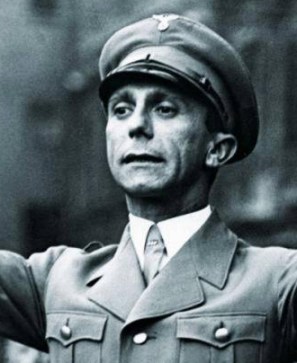 the German military that Hitler is a dangerous upstart who has already damaged the country beyond repair, and must be stopped. Adrift on a sea of violent corruption, Gunther constantly plays the role of the decent man, but in the end, he follows one theology, and one theology only. If he wakes up the next day with his head firmly attached to his shoulders, and has feeling in his extremities, then he has done the right thing. His conscience has not died, but it is far from well; it competes a whole chorale of competing voices in his head, each wishing to be heard. As he is left helpless by the world of spin and disinformation orchestrated by Dr Goebbels, (right) he must resort to his basic copper’s instincts to protect himself and uncover the truth.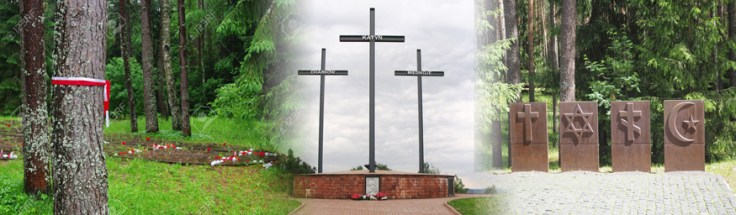
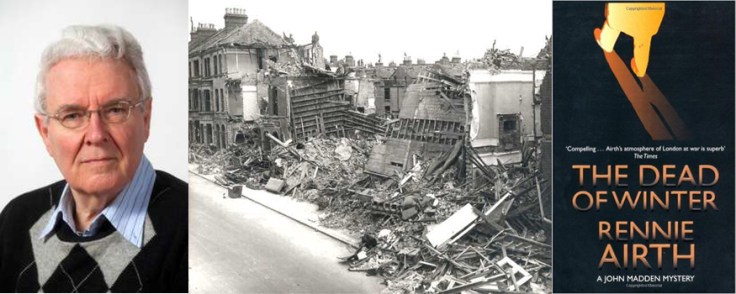
 We are in the weeks leading up to Christmas 1944, deep in what would prove to be the last winter of a war which, thanks to the Luftwaffe, had brought death and destruction to the doorsteps of ordinary people in towns and cities up and down the country. German aircraft no longer drone over the streets of London; instead, the Dorniers and Heinkels have been replaced by an even more demoralising menace – the seemingly random strikes by V1 and V2 rockets. Despite the fact that the rockets need no visible target to aim at, the ubiquitous blackout is still in force. An Air Raid Precaution Warden, whose job has become as redundant as that of those manning anti-aircraft batteries, makes a chilling discovery. He stumbles – literally – on the body of a young woman. Her neck has been broken by someone clearly well-versed in killing, and the only clue is a number of spent matches lying by the body.
 There is more than a touch of The Golden Age about this novel, but it is much more than a pastiche. Although the killing of Rosa Nowak is eventually solved, with a regulation dramatic climax in a snow-bound country house, Rennie Airth allows us to breathe, smell and taste the air of an England almost – but not quite – beaten down by the privations of war. Many of the characters have menfolk away at the war, including Madden himself and his wife Helen. Their son is in the Royal Navy, on the rough winter seas escorting convoys. The contrast between life in the city and in the country is etched deep. In the city, restaurant meals are frequently inedible, the black market thrives unchecked due to depleted police manpower, and even the newsprint bearing cheering propaganda from the government is subject to rationing. Travelling anywhere, unless you are fiddling your petrol coupons, is arduous and unpleasant.
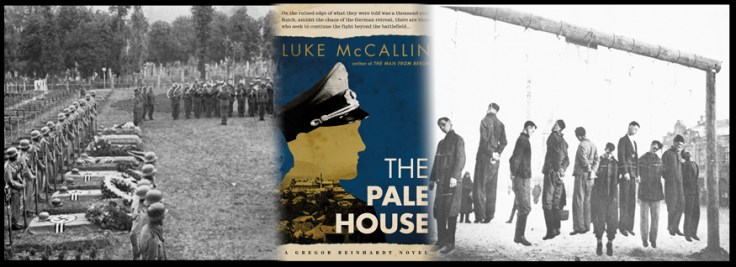
 finds employment as an officer in the Feldjaegerkorps. His creator, Luke McCallin, (right) introduced us to Hauptmann Reinhardt in
  A LILY OF THE FIELD by John Lawton


