

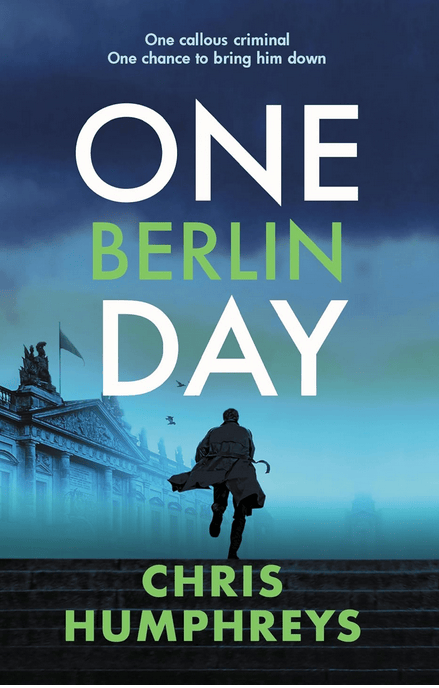
Chris Humphreys introduced us to his hitman anti-hero Mr Phipps in One London Day, which I reviewed earlier this year. In that story, the murderous Phipps was hired by The Shadows, a rogue group of financiers who were subverting justice and posing a threat to the national good. His mission was to kill their accountant. This he did, but not without causing collateral damage, one instance of which was brutally beating Stanley, a young London football thug. That act will come back to haunt him in this novel, where he is hired in joint enterprise by MI5 and MI6 to take out a target in Germany.
The target is Olsen, a former STASI officer who is now running a people smuggling operation using refrigerated lorries. MI6 want him dead, but MI5 and one of their top women, known as Ellerby, would rather go down the legal route using arrest and formal trial. Cleverly, perhaps to distract us from the moral shortcomings of Mr Phipps, Humphreys creates a genuine monster in Berndt Olsen. His titular father was an SS officer, but his blood father was a Red Army rapist. The acne that rendered him monstrous as a youngster has been tamed by the use of Royal Jelly from his beehives, but his mental scars are open and unhealed. He selects young girls from his potential passengers, and uses them terribly.
Humphreys sets the Berlin scene beautifully. The major players are all there, but we are yet to see how their worlds will collide. Phipps, posing as a football fan in town for an international match; Ellerby, dining with an old cop friend, hoping that she can persuade the BND (the German foreign intelligence service, the Bundesnachrichtendienst) to cooperate; Olsen, moving smoothly through the world of privacy and security his wealth has bought; Sadiq Khan, the only member of The Shadows to evade justice, being wined and dined by Olsen in an exclusive gentlemen’s gated complex; Stanley, ostensibly in town to watch a football match, but more interested in smuggling a huge payload of class A pharmaceuticals back to England. There is another person of interest – Wolfgang, Olsen’s formidable neo-Nazi chauffeur and bodyguard.
We are given something of an explanation into why Phipps is a borderline psychopath, and it is because of his harrowing time as a soldier in Afghanistan. Humphreys reminds us, not that it was strictly necessary, that Afghanistan is a bestial, bigoted and benighted hell-on-earth, and that people from The West have, for centuries, been fooling themselves that they can change the place, from the disastrous forays of the mid 19th century to the equally catastrophic interventions of more recent times.
When Ellerby receives the bum’s rush from her contact at the BND, she is left with with no option but to pull the metaphorical trigger on Olsen, by sending a text to Phipps which will set him loose to eliminate Olsen. I’m struggling to find the best metaphor for how the novel plays out, but it involves vehicles, be they trains or cars, converging on – not a crossroads, because that implies just four ways – a point of collision. Do the good guys win? Yes, of course, but in unexpected ways, Olsen’s end being particularly painful and inventive.
The author betrays some political bias during the narrative. He clearly thinks that the AfD is bad for both Germany and Europe. I might disagree with his stance, but this doesn’t dilute my admiration for a brilliant political thriller, which blends traditional Noir with the genre of the flawed-but-reluctantly-sympathetic hired killer. One Berlin Day will be published by Allison & Busby on 17th September.







 Lorimer has become bogged down in a partially – and only partially – successful investigation into murder, prostitution and people trafficking based in Aberdeen. In the Granite City some entrepreneurs, denied a living by the decline in the oil and gas industries, have taken to trading in other commodities – human lives. However, to borrow the memorable line from The Scottish Play, Lorimer’s team have “scotch’d the snake, not kill’d it.” The head of the gang responsible for taking young and innocent Romany women from impoverished Slovakian villages, and setting them to work in Scottish brothels is known only as “Max”. The very mention of his name is enough to silence witnesses, even those who have every reason to long for his downfall. But how – if at all – is Max connected to Peter Guilford, arrested for his wife’s murder, but now beaten within an inch of his life while on remand in Glasgow’s Barlinnie prison?
 The British police procedural – the Scottish police procedural, even – is a crowded field, and each author and their characters tries to bring something different to choosy readers. Where Alex Gray (right) makes her mark, time and time again, is that she is unafraid to show the better things of life, the timeless touches of nature in a summer garden, or the warmth of affection between characters, particularly, of course, the bond between William and Margaret Lorimer. Here is one such moment:


