
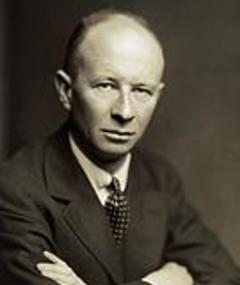
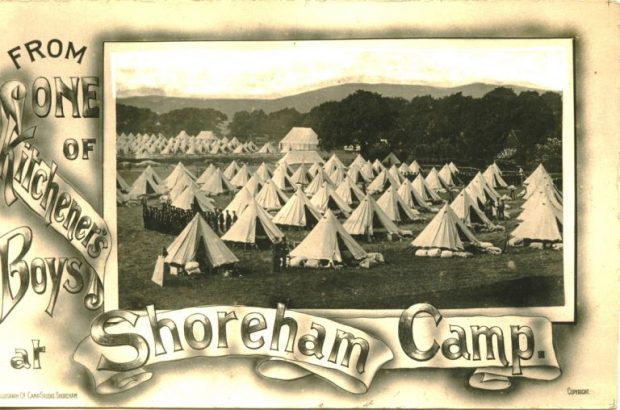
 Humphrey Cobb (left) was born on 5th September 1899, in Siena, Italy. His mother was a doctor, and his father was an artist. He was sent to England for his early schooling, but then received his secondary education in America. After being expelled from high school in 1916, he decided to join the Canadian Army and was sent to Europe to fight. Remember that America did not join the war until 1917. He kept a war diary, and October 1917 has him at Shoreham Camp, in Sussex, as part of the 23rd Canadian Reserve battalion. January of 1918 has him near Hill 70, in front of Loos. He describes the death of a friend from his platoon.
“What happened to Young, no-one ever knew for sure. Some thought a Fritz potato masher had landed on his respirator and that it had exploded just as he was brushing it off. Evidence: face blown in and right hand blown off. “
He saw the war out, and after being stationed in post-war Cologne for a spell, he finally arrived back in Montreal on 31st May 1919.
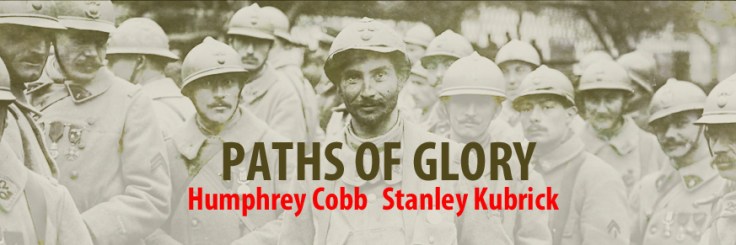
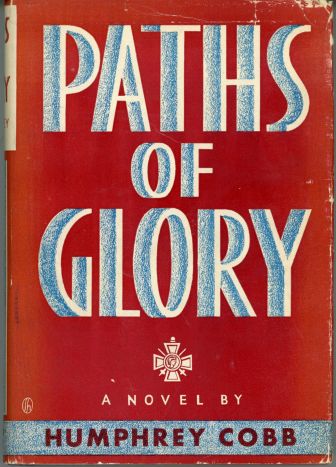 The years after The Great War saw Cobb involved in a variety of enterprises. He wrote Paths of Glory while working for Gallup, the advertising and polling company, and it was published in 1935 by The Viking Press. It is believed that Cobb took the core of his story from real events on the Marne front, where for Corporals from the 136th Regiment were executed after a failed attack on a German strong-point near Souain.
So how does the book stand when set alongside the film? Firstly, it has to be said that Cobb died in 1944, so any input from him was clearly impossible. Anecdote has it that Kubrick had read the book as a teenager, and had been deeply affected by it, but a chain of events led to the film screenplay differing in one essential element from the book. In the mid 1950s Kubrick was still an emerging talent as a director, and did not have the clout to persuade big studios to put up the money for an anti-war film, made in black and white. The crucial intervention came with the interest (and influence) of Kirk Douglas. The star clearly had to have a main part in the film, but who?
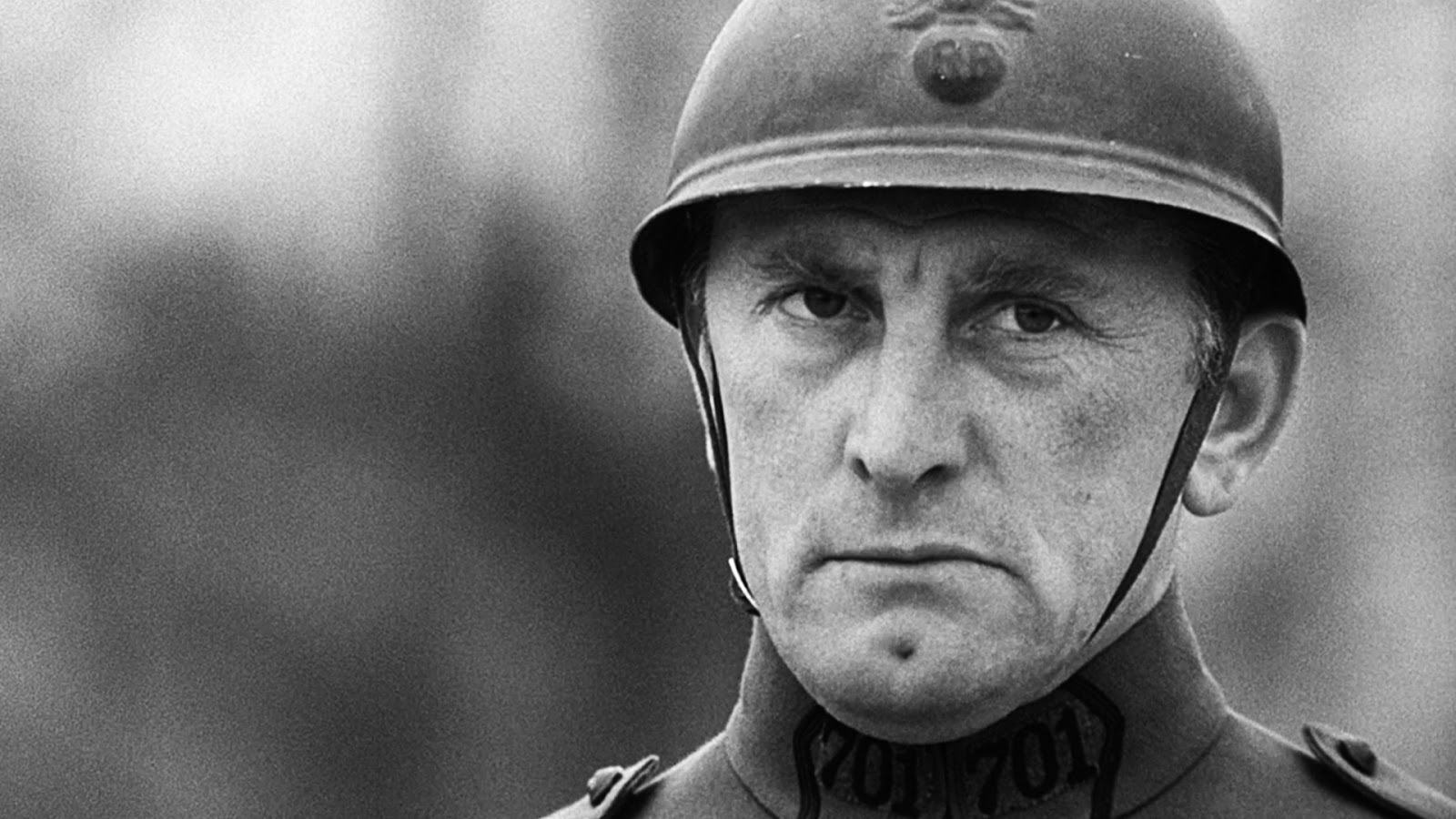
In the novel, Colonel Dax is a relatively peripheral figure who, reluctantly, goes along with the doomed plan to storm the German bastion which is, incidentally, called ‘The Pimple” in the novel. So, it was a bold stroke in one way for Kubrick to re-imagine Dax as the forthright and confrontational character whose personal bravery is never in doubt, and a man who just happens to have been a lawyer in civilian life. And who better to play Dax than the dimple-chinned Hollywood heart-throb Kirk Douglas?
Cobb focuses almost all of his attention in the novel on the three men who were executed, and on the various reasons why they came to be shot by their own comrades. The book has no pantomime villains, and certainly no one person who has the blood of the victims on his hands. The men die as a result of the inexorable grinding of the military machine and the numbing effect of battlefield casualty statistics. Men are reduced to numbers, compassion is subverted by casualty statistics, and procedure trumps initiative every time. As William Tecumseh Sherman may (or may not) have said, “I tell you, war is Hell!“
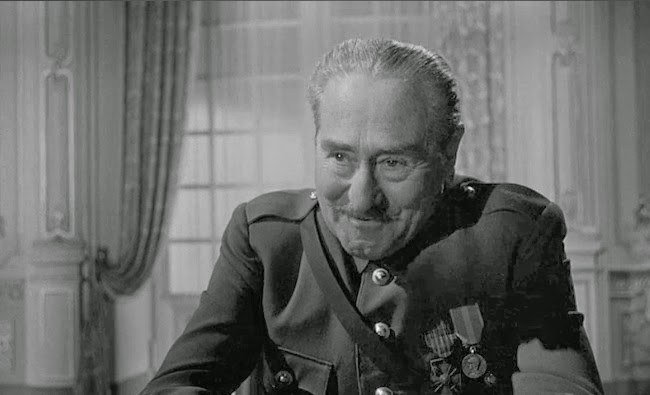
 There are places where Kubrick and his screenwriters – Calder Willingham and Jim Thompson – did stick close to the book. The first is with the three man patrol into No Man’s Land where the cowardly and drunken Lieutenant causes the death of one of the men, thus setting up the selection of the other to be one of the judicial victims. The film plays it pretty straight, too with the events immediately prior to the execution. The character of Private Ferol is played with characteristic bravura by Timothy Carey, (right) There is one crucial difference; in the book, Ferol is chosen because he he is anti-social and widely disliked for his unpleasant behaviour, and he continues to be sarcastic and foul-mouthed right up to the point where he is strapped to the execution post. In the film, however, the enormity of his fate finally overwhelms him, and he in the unforgettable procession from the chateau to the place of execution – a chilling via dolorosa – he is reduced to a weeping, stumbling figure, clutching the arm of the Padre.
The final confrontation between Dax and the general doesn’t happen in the book, neither does the powerful final scene where the soldiers in the estaminet boo and mock the captured German girl who is forced to sing to them, but then they are reduced first to silence, with some in tears, and then they join in with the simple old song she is singing. Outside, Dax has just been told that the regiment has been ordered to return to the Trenches, but he walks away, leaving his men to their brief hour of peace.
It is worth repeating that Cobb’s gaze is focused on the rigid mechanism of army life. It whirrs, ticks and chimes the hours with little regard for the human lives caught up in its cogs. He shapes this in many different ways, but never better than when he describes the efforts made to make sure the execution is done ‘properly’.
“Regimental Sergeant-Major Boulanger was there, busy, competent as regimental sergeant-majors always are, in the same way that head waiters are busy, competent, or seem to be so, if they are good head waiters.”
It is to Boulanger that Cobb gives the very last action, in the last paragraph of the book, where he is given the task of administering the coup de grace to the bodies slumped against their posts.
“It must be said of Boulanger that he had some instinct for the decency of things, for, when he came to Langlois, his first thought and act was to free him from the shocking and abject pose he was in before putting an end to any life that might be clinging to him. His first shot was, therefore, one that deftly cut the rope and let the body fall away from the post to the ground. The next shot went into a brain that was already dead.”
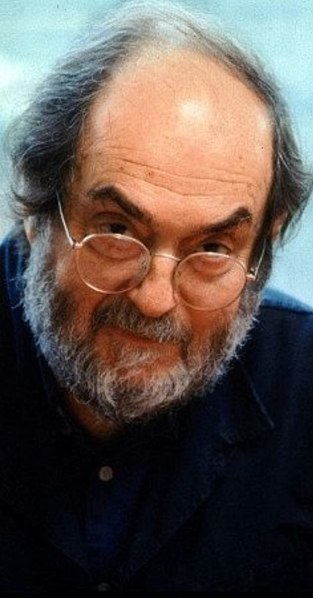
I think that Kubrick (below) takes the gist of the novel, and shaped it to his own ends, and in doing so created a magnificent piece of cinema. His anti-war message is different from Cobb’s, but was clearly something he felt very deeply. A decade or so later he was able to return to his theme in Dr Strangelove, but this time he used satire and the comedy of the absurd to make his point.



 The poet Vernon Scannell, himself a veteran of WW2 wrote a haunting poem he called The Great War. The closing lines are:
 In her 2014 novel Those Measureless Fields she began her own personal exploration of what happened to the men and families who had to pick up the pieces of their lives after the Armistice. She followed this in 2019 with what was, for, me one of the books of the year,
 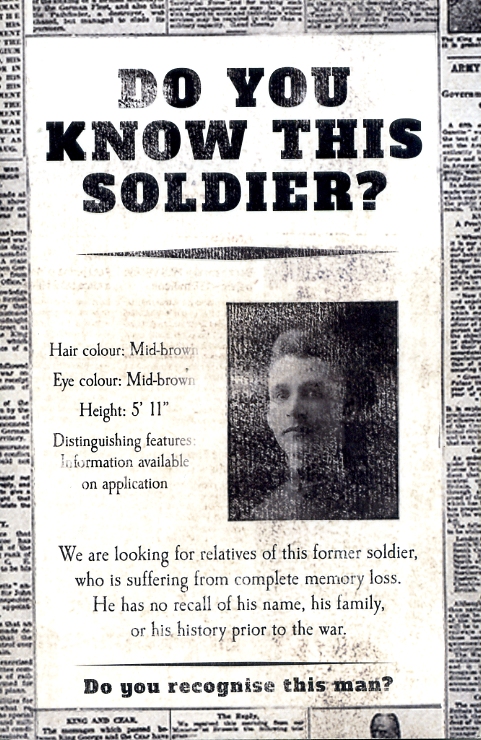 At a rehabilitation centre in the Lake District, Haworth tries to find the key that will unlock Adam’s memory. James and his boss, Alec Shepherd, take a bold decision. They release a photograph of Adam, and what little they know of him, to the national press. This triggers a wave of mothers, wives and sisters who yearn for the impossible – a virtual resurrection of their lost son, husband and brother. From the tragic queue of broken hearted souls, three women seem to be the most convincing. They are Celia Daker, who believes that Adam is her missing son, Robert, Anna Mason, a young wife who dares to dream that she is no longer a widow, and Lucy Vickers a sister who is now bringing up the children of her lost brother.
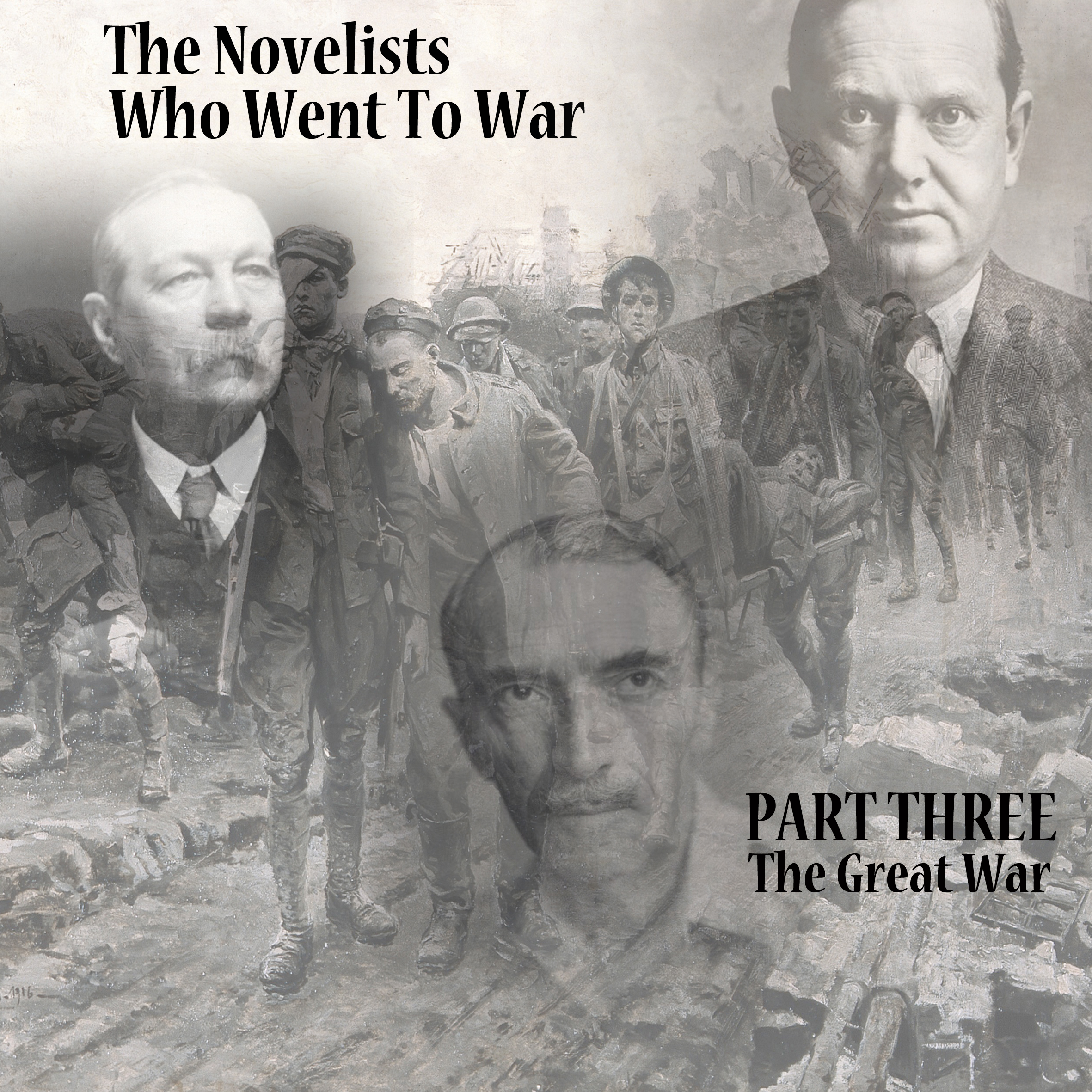

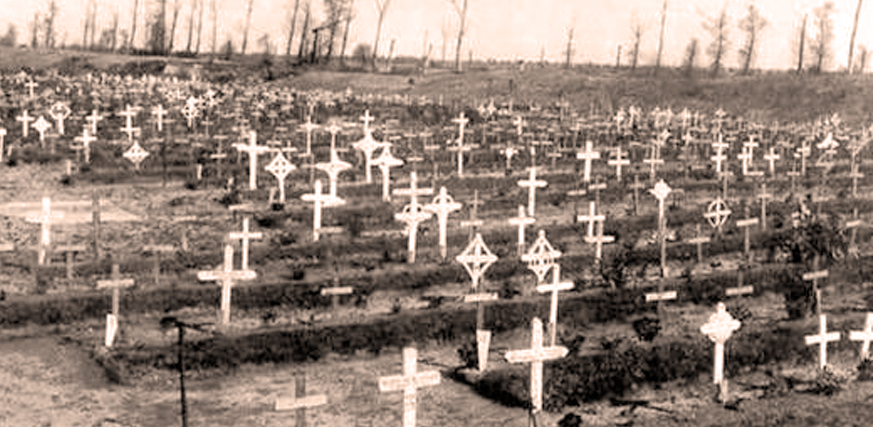
 It is 1921. In Britain, dignified war memorials, paid for by public subscription, are beginning to be dedicated. In France and Belgium most cities and towns within artillery range of the Old Front Line stand in ruins, while villages are usually reduced to random piles of shattered bricks. The dead are everywhere. In places where the living have yet to re-establish themselves there are crosses. Thousands upon thousands of simple wooden crosses, distinguished one from the other with a basic aluminium strip, letters stamped on it and pinned to the wood. A former officer, now a worker for what would become the Commonwealth War Graves Commission explains his mission:
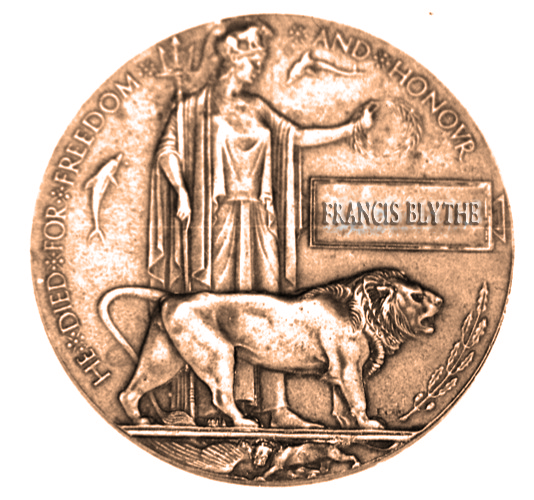
 arry Blythe makes his living meeting a macabre but necessary demand. He travels the shattered countryside, on commission from relatives, taking photographs of the crosses, or the places of which dead men spoke in their letters home. There were three Blythe brothers, Will, Harry and Francis. Only Harry has survived the conflict. As in other silent houses across the country, mothers did what mothers always do – adjust and try to get on with things:
 y 1921, pilgrimages to The Old Front Line have become big business. Visitors are everywhere, armed with commercially printed guide books; some search for graves, others visit their old haunts. Caroline Scott lets us shadow Harry and Edie on their heartbreaking journey from the Houthulst Forest and Ypres in the north, via Arras and down further south to the point where the French manned the front line trenches of a line that ran from the Belgian coast to Switzerland.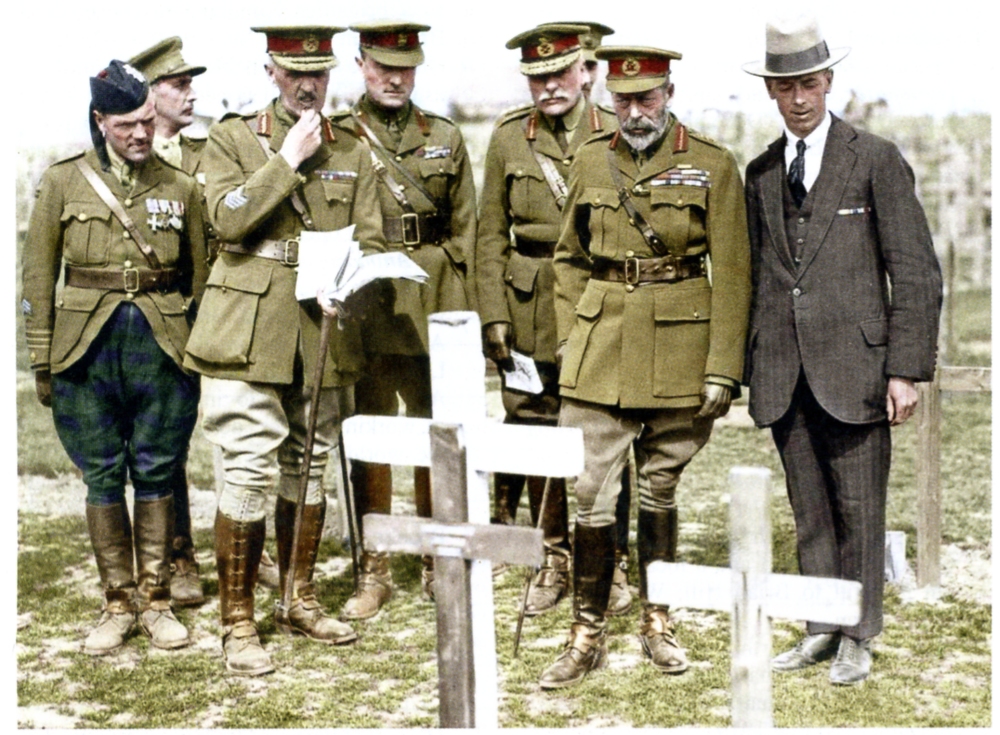
 ilfred Owen wrote, concerning his work, “The Poetry is in the pity.” Caroline Scott echoes this message. Such was the disconnect between life in the trenches and home that, for many men, returning on leave was not the joyous temporary reprieve from hell that we might imagine: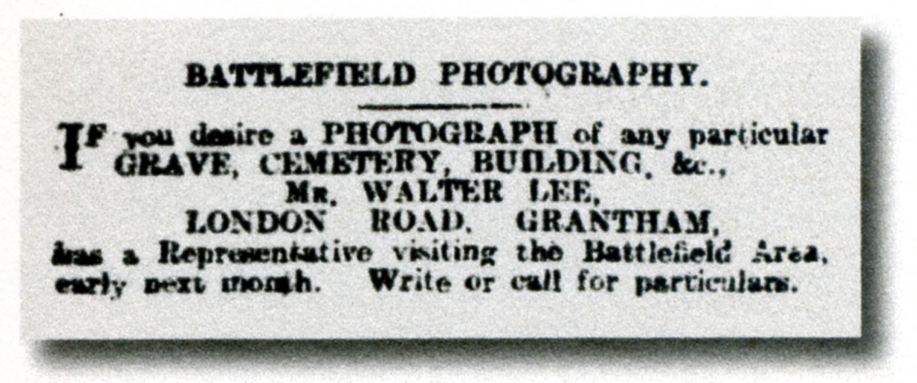


 he dramatic events of The Rooks Die Screaming take place in the spring of 1921 in the Cornish market town of Bodmin. The bare bones of the story are that Detective Inspector Cyril Edwards of Scotland Yard has come to Bodmin to investigate murder and treachery involving a group of spies known as The Four Rooks. This book is a sequel to The Woman With The Red Hair, and to say there is a back-story is something of an understatement. The eponymous young woman is called Morag and, amongst other things, is Edwards’ sister-in-law. Elisha Edwards was one of the millions of unfortunates taken by an agent even deadlier than high explosives and machine gun bullets – Spanish Influenza.
 Morag is now Lady Frobisher. Her husband Harry, heir to The Fobisher Estate on the outskirts of Bodmin, is blind, victim of a grenade in the Flanders trenches. In the previous novel, Frobisher Hall was the scene of great torment for Morag, as she fell into the clutches of Morgan Treaves, an insane asylum keeper and his evil nurse. Treaves has disappeared after being disfigured with a broken bottle, wielded my Morag in a life or death struggle.
 That said, The Rooks Die Screaming is inspired escapist reading. It would be unfair to say that Tuckett (right) writes in an anachronistic style. This is much, much better than pastiche, even though there are elements of Conan Doyle, the Golden Age, John Buchan and even touches of Sapper and MR James. So, eventually, to the plot, but we need to know a little more about Cyril Edwards. Like many a fictional detective inspector he is his own man. In another nice cultural reference Tuckett adds a touch of Charters and Caldicott as Edwards explains to the bumptious Standish, a mysterious officer from Military Intelligence;
 tandish orders Edwards to investigate the possibility that Harry Frobisher is one of the Rooks, but one who has betrayed his country. Arriving in Bodmin his first task is to explain to the local police how a corpse found on a train is that of a notorious London contract killer. Tuckett’s Bodmin is full of stock characters, including a stolid police sergeant, an apparently tremulous clergyman and a punctilious but respected solicitor who is privy to all the secrets of the local gentry, but is oh, so discreet. To add to the fun, Frobisher Hall also has its requisite roll call of faithful retainers.
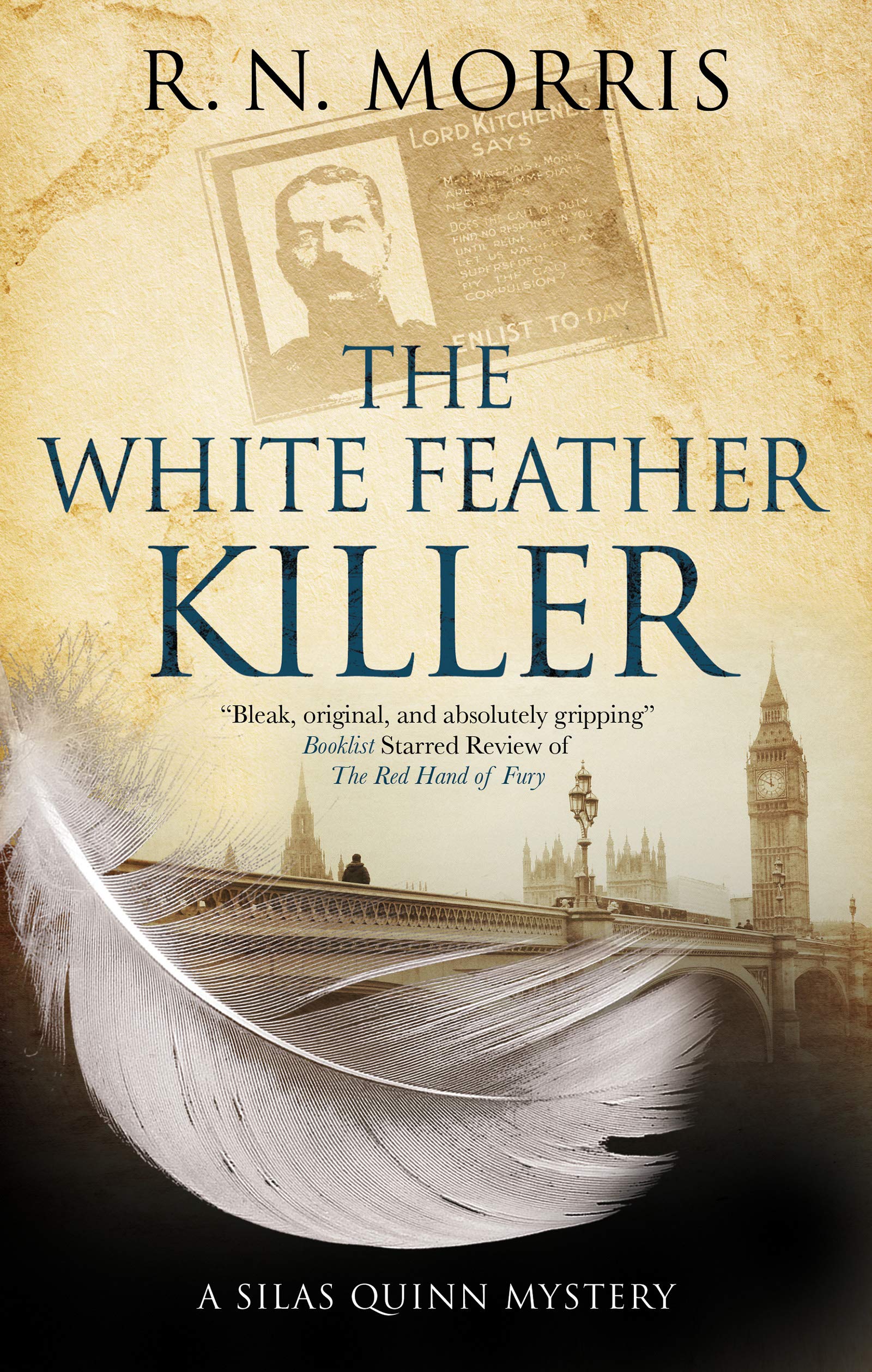 I’m a great fan of historical crime fiction, particularly if it is set in the 19th or 20th centuries, but I will be the first to admit that most such novels tend not to veer towards what I call The Dark Side. Perhaps it’s the necessary wealth of period detail which gets in the way, and while some writers revel in the more lurid aspects of poverty, punishment and general mortality, the genre is usually a long way from noir. That’s absolutely fine. Many noir enthusiasts (noiristes, perhaps?) avoid historical crime in the same way that lovers of a good period yarn aren’t drawn to existential world of shadows cast by flickering neon signs on wet pavements. The latest novel from RN Morris, The White Feather Killer is an exception to my sweeping generalisation, as it is as uncomfortable and haunting a tale as I have read for some time.
 f Morris were to have a specialised subject on Mastermind, it might well be London Crime In 1914, as the previous books in the DI Silas Quinn series, Summon Up The Blood (2012), Mannequin House (2013), Dark Palace (2014) and The Red Hand Of Fury (2018) are all set in that fateful year. Silas Quinn, like many of the best fictional coppers, is something of an oddball. While not completely misanthropic, he prefers his own company; his personal family life is tainted with tragedy; he favours the cerebral, evidence-based approach to solving crimes rather than the knuckle-duster world of forced confessions favoured by his Scotland Yard colleagues.
 orris takes his time before giving us a dead body, but his drama has some intriguing characters. We met Felix Simpkins, such a mother’s boy that, were he to be realised on the screen, we would have to resurrect Anthony Perkins for the job. His mother is not embalmed in the apple cellar, but an embittered and waspish German widow, a failed concert pianist, a failed wife, and a failed pretty much everything else except in the dubious skill of humiliating her hapless son. Central to the grim narrative is the Cardew family. Baptist Pastor Clement Cardew is the head of the family; his wife Esme knows her place, but his twin children Adam and Eve have a pivotal role in what unfolds. The trope of the hypocritical and venal clergyman is well-worn but still powerful; when we realise the depth of Cardew’s descent into darkness, it is truly chilling.
 Historical novels come and go, and all too many are over-reliant on competent research and authentic period detail, but Morris (right) plays his ace with his brilliant and evocative use of language. Here, Quinn watches, bemused, as a company of army cyclists spin past him:
 uinn has to pursue his enquiries in one of the quieter London suburbs, and makes this wry observation of the world of Mr Pooter – quaintly comic, but about to be shattered by events: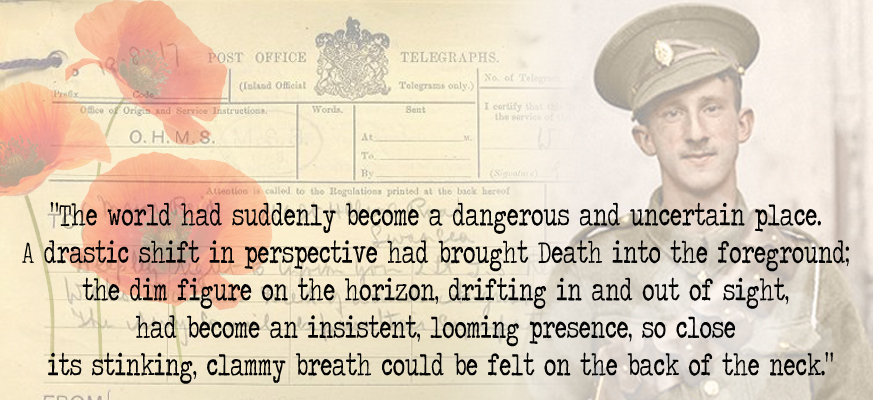


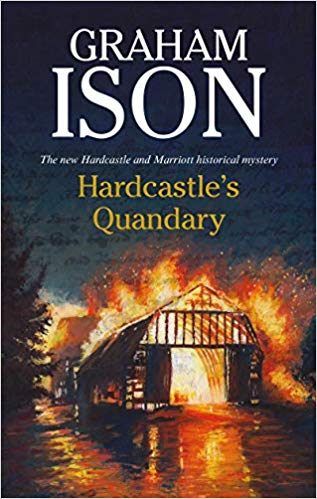 Forced to play cherchez-la-femme, the detectives stumble down one blind alley after another, but as they do so they learn a few home truths about the fate of the young men who went to fight in the war-to-end-all-wars, and returned home to find that their birthplace was not the ‘land fit for heroes’ glibly promised by politicians. There is a peacetime army with no place for young officers whose courage was welcome in the trenches, but whose humble upbringing is now seen as an embarrassment as the cigars are lit, and the port passed in the correct direction at mess dinners. Such young men, not all heroes, but men nevertheless, are forced to find civilian employment which is neither honest, decent nor lawful.
 Graham Ison is a master story-teller. The Hardcastle books contain no literary flourishes or stylistic tricks – just credible characters, excellent period detail and an engaging plot. Cosy? Perhaps, in the sense that we know how Hardcastle and his officers are going to react to any given situation, and their habits and small prejudices remain unchanged. Comfortable? Only because novels don’t always need to shock or challenge; neither do they always benefit from graphic descriptions of the damage humans can sometimes inflict on one another. Ison (right) credits his readers with having imaginations; he never gilded the lily of English life in the earlier Hardcastle cases which took place during The Great War, and he doesn’t start now, nearly a decade after the final shots were fired. The suffering and trauma of those four terrible years didn’t end at the eleventh hour on that eleventh day; they cast a long and sometimes baleful shadow which frames much of the action of this novel.

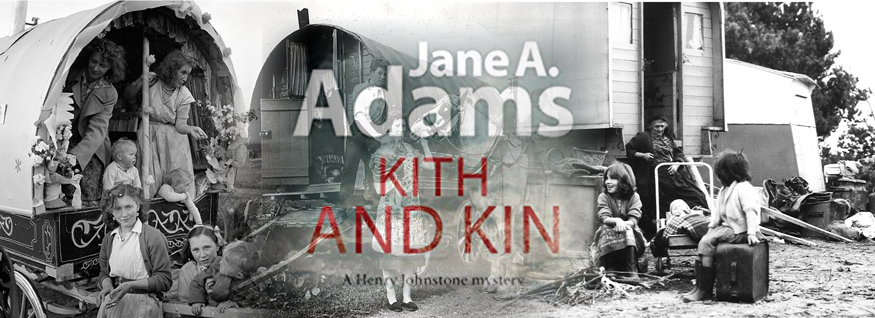
 Coming across a very, very good book by an author one has never encountered before and then realising that she has been around for a while is a shock to the system, and if the downside is that the experience further highlights one’s own ignorance, then the blessing is that as a reviewer and blogger, there is something new to shout about. Jane A Adams made her debut with The Greenway back in 1995, and has been writing crime fiction ever since, notably with four-well established mystery series featuring Mike Croft, Ray Flowers, Naomi Blake and Rina Martin. She began the saga of London coppers Henry Johnstone and Micky Hitchens in 2016, with The Murder Book. Their latest case is Kith and Kin.
 The period is set to perfection, and Adams (right) skilfully combines past, present and future. The past? There can scarcely have been a man, woman or child who escaped the malign effects of what politicians swore would be the war to end wars. The present? 1928 saw devastating flooding on the banks of the River Thames, a book called Decline And Fall was published, and in Beckenham, not a million miles away from where this novel plays out, Robert ‘Bob’ Monkhouse was born. The future? Johnstone’s sister, who has married into money, has a head on her shoulders, and senses that in the financial world, a dam is about to break – with devastating effects.


