

By my reckoning this is the fifteenth outing for Alex Gray’s veteran Glaswegian copper, William – now Detective Superintendent – Lorimer. A woman – who, if witnesses are to be believed, was a deeply unpleasant person – is found stabbed to death, her hands clutched around a top-of-the-range kitchen knife. Dorothy Guilford was widely disliked both within her own family and further afield while her husband, Peter – by contrast – has few detractors. Yet the working hypothesis of the police investigating Dorothy’s demise is that Peter Guilford did the deed.
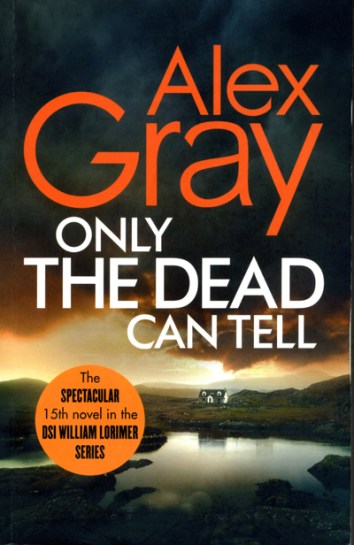 Lorimer has become bogged down in a partially – and only partially – successful investigation into murder, prostitution and people trafficking based in Aberdeen. In the Granite City some entrepreneurs, denied a living by the decline in the oil and gas industries, have taken to trading in other commodities – human lives. However, to borrow the memorable line from The Scottish Play, Lorimer’s team have “scotch’d the snake, not kill’d it.” The head of the gang responsible for taking young and innocent Romany women from impoverished Slovakian villages, and setting them to work in Scottish brothels is known only as “Max”. The very mention of his name is enough to silence witnesses, even those who have every reason to long for his downfall. But how – if at all – is Max connected to Peter Guilford, arrested for his wife’s murder, but now beaten within an inch of his life while on remand in Glasgow’s Barlinnie prison?
Alex Gray gives us an enthralling supporting cast. Ever present are the consultant psychologist, Dr Solomon Brightman and his wife Rosie, a pathologist who has the essential – but unenviable – task of literally eviscerating the human bodies which are the result of murder most foul. Young Detective Constable Kirsty Wilson goes above and beyond the call of duty to make sense of the confusing and contradictory ‘facts’ of the Dorothy Guilford case. All the while, though, she is facing a personal dilemma. Her boyfriend has just won the promotion of his dreams – a prominent position in his bank’s Chicago operation. But will Kirsty cast aside her own imminent promotion to Detective Sergeant, and follow James in his pursuit of The American Dream?
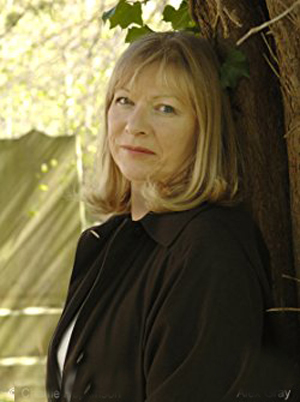 The British police procedural – the Scottish police procedural, even – is a crowded field, and each author and their characters tries to bring something different to choosy readers. Where Alex Gray (right) makes her mark, time and time again, is that she is unafraid to show the better things of life, the timeless touches of nature in a summer garden, or the warmth of affection between characters, particularly, of course, the bond between William and Margaret Lorimer. Here is one such moment:
“She smiled as he selected a bottle from the fridge. The dusk was settling over the treetops, a haze of apricot light melting into the burnished skies …….she pulled a cardigan across her shoulders as she settled down on the garden bench, eyes gazing upwards as a thrush trilled its liquid notes. Live in the moment, she thought, breathing in the sweetness that wafted from the night-scented stocks.”
This is not to say that Gray wears rose-tinted spectacles. This is far, far from the case, and her scenes depicting the violence – both emotional and physical – that we inflict on one another are powerful, visceral and compelling.
A particular mention needs to be made of the deft touches Gray uses when writing about Margaret Lorimer. Here is a woman much to be envied in many ways. She has a loving husband, a stable and prosperous home life, and a teaching career in which she touches the lives of so many young people in her school. And yet, and yet. A cloud hovers over Margaret, and it is one that can never be blown from the otherwise blue sky. The couple’s inability to have children sometimes weighs heavily, especially when friends and colleagues are gifted with children. But Gray never allows Margaret to become embittered, and if she envies Rosie and Solomon, for example, then she keeps it to herself.
Only The Dead Can Tell is, quite simply, superbly written and plotted. It sums up everything that is golden and enthralling about a good book. It is published by Sphere, and will be out as a hardback and a Kindle on 22nd March.





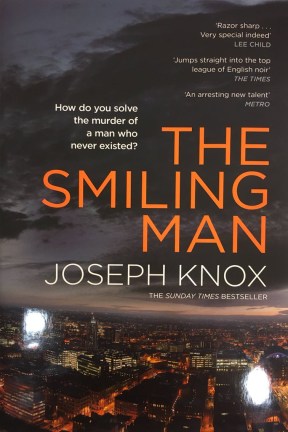 This is all too much like hard work for Sutcliffe, but despite warnings from his saturnine superior, Superintendent Parr, Waits digs deeper. He uncovers a labyrinthine series of connections between an absent solicitor doing his rich-white-man things among the bar girls of Thailand, an apparently gay businessman and his estranged wife, the corpse (now renamed The Smiling Man), and another hotel room, its floor saturated with pint after pint of human blood.
 This is little short of a modern masterpiece. You might imagine Joseph Knox (right) to be a weathered, life-weary cynical misanthrope, hunched in a corner of the pub, savouring a roll-up, rather like a latter day Derek Raymond, but anyone who has had the privilege of meeting Joseph will know that this is far from the case. He is well versed in the art of Noir, though, as he revealed when he spoke to us around the time that his first novel, Sirens, was published.
 But there is still a job to be done, and in Carol Jordan’s case this is to head up a new police unit, called ReMIT – Regional Major Investigations Team – and their first case is a shocker. In a windswept lay-by on a lonely moorland road, a car is discovered, blazing out of control. When the flames die back sufficiently for the emergency services to get close, the charred remains of a young woman are discovered in the driving seat. The post mortem reveals that she has been strangled, and the blaze started, of all things, by a large box of potato crisp packets. Another such death soon follows, and the ReMIT team discover that they are dealing with a supremely clever killer who befriends his victims at weddings. He ‘crashes’ the wedding with consummate ease, and then targets young women who have attended the wedding unaccompanied. Spinning a yarn that he is a widower still mourning his late wife’s death from cancer, he seems to be the perfect gentleman. Caring, considerate, sexually undemanding – to the unfortunate women he seems like all their Christmases have come at once.


 We are taken to an autumnal Boston. Initially, Warren has nothing more on her mind than the consequences of giving in to the demands of her young son that they should adopt a dog. Her domestic reverie is rudely and violently interrupted when she is called to a house in the Brighton district of the city, where she is confronted by a scene of carnage. Householder Charlie Boyd is sitting on his sofa, as dead as a doornail. His girlfriend Juanita Baez is in the kitchen, shot as she was taking something from the cupboard. In the bedroom, even worse horrors await. Lola and Manny Baez, two of Juanita’s children, are clasped in a protective embrace, but just as dead as the adults.


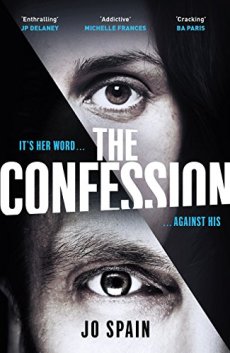 Jo Spain not only takes on the challenge, but she meets it head on and completes it with subsequent pages of The Confession which manage to be, as night follows day, bravura, intense, full of authentic and convincing dialogue, utterly mesmerising and, in places, literally breathtaking. A countryman of Spain’s began his most famous novel with “Stately, plump Buck Mulligan came from the stairhead, bearing a bowl of lather on which a mirror and a razor lay crossed.” She counters with:
 Of course, we get there in the end, and understand why JP Carney has exacted such an emphatic revenge on the handsome, charismatic and plausible Harry McNamara, but sometimes book reviews have to stop dead in their tracks, and say, “Trust me, this is a brilliant novel, but to tell you any more would be little short of criminal.” Yes, The Confession is a brilliant novel. Yes, I read it through in one sitting, deep into the early hours of a winter morning. Yes, I am a fan of Jo Spain (right). Yes, if you don’t get hold of your own copy of this, you will receive scant sympathy from me. The Confession is published by Quercus, and will be on sale as a Kindle from 11th January, and as a hardback from 25th January. Check online buying choices

 By 22nd March 2018, there should be catkins on the willow and hazel, daffodils should be getting into their stride and, even if it’s a little early to be looking for summer migrants like swallows and warblers, nothing will be more welcome to lovers of good crime fiction than the return of William Lorimer in another – the fifteenth, unbelievably – police procedural set in Scotland. Since Alex Gray (left) saw Never Somewhere Else published in 2002, she has made Lorimer and his world one of the go-to destinations for anyone who loves a well-crafted crime novel, with a sympathetically portrayed central character.

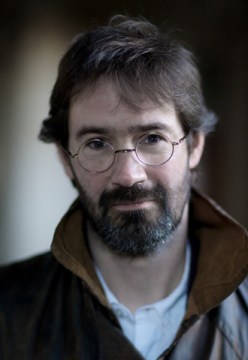 I should add, at this point, that James Oswald (left) is not your regulation writer of crime fiction novels. He has a rather demanding ‘day job’, which is running a 350 acre livestock farm in North East Fife, where he raises pedigree Highland Cattle and New Zealand Romney Sheep. His entertaining Twitter feed is, therefore, just as likely to contain details of ‘All Creatures Great and Small’ obstetrics as it is to reveal insights into the art of writing great books. But I digress. I don’t know James Oswald well enough to say whether or not he puts anything of himself into the character of Tony McLean, but the scenery and routine of McLean’s life is nothing like that of his creator.
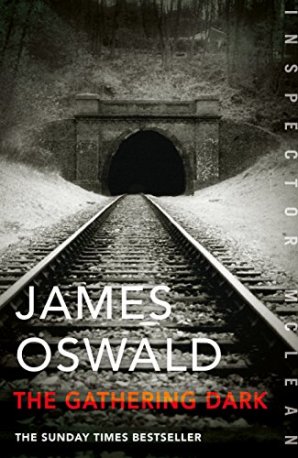 McLean is going about his daily business when he is witness to a tragedy. A tanker carrying slurry is diverted through central Edinburgh by traffic congestion on the bypass. The driver has a heart attack, and the lorry becomes a weapon of mass destruction as it ploughs into a crowded bus stop. McLean is the first police officer on the scene, and he is immediately aware that whatever the lorry was carrying, it certainly wasn’t harmless – albeit malodorous – sewage waste. People whose bodies have not been shattered by thirty tonnes of hurtling steel are overcome and burned by a terrible toxic sludge which floods from the shattered vehicle.




 fullybooked2017