

Fans of period police procedurals are in for a treat at the end of the month when RN Morris’s distinctive London copper, Chief Superintendent Silas Quinn makes a welcome return. It’s December 1914, and the war that was meant to be over by Christmas is showing only signs of intensifying. DORA – the Defence of The Realm Act – has been enforced, and among the many strictures it imposes on the populace are imprisonment without trial, a ban on publishing any description of war or any news that is likely to cause any conflict between the public and military authorities and, bizarrely, an interdiction on buying rounds in pubs.
 But Christmas is coming, and a rather upper-crust choir, The Hampstead Voices, is rehearsing for its seasonal concert, with all proceeds going to Belgian refugees, forced from their homes by the brutal Hun invaders. Directed by Sir Adrian Fonthill, the concert will include not only much-loved carols such as O Little Town of Bethlehem and Adeste Fideles, but choral works by Bizet and Handel. Special guest artistes will include dancers from Ballets Modernes and the distinguished violinist Emile Boland, but the evening will conclude with a performance of Sir Edward Elgar’s A Christmas Greeting, in the presence of the composer himself. It is also believed that Winston Churchill, First Lord of The Admiralty, will be in the audience at University College School on the evening of 24th December.
Silas Quinn may have many qualities, but a musical ear is not one of them, so how does he come to be involved in the doings of The Hampstead Voices? Rehearsals for the concert may not be going too well, perhaps due to the many tenors and basses who have answered the call to arms, but preparations take a distinct downturn when the Director of Music is found dead, slumped at his grand piano, with the sharpened handle of a tuning fork stuck into his ear. As boss of Scotland Yard’s Special Crimes Unit, Quinn is summoned to the scene of this musical murder.
It seems that the late Sir Adrian, despite his musical sensitivities, was not a paragon of virtue. He has a roving eye – and hands – for young sopranos and altos, and has a weakness for gambling which has left him in debt to some very dangerous people. But who stands to benefit from his death? Not those to whom he owes money,surely? A resentful husband, perhaps, who has been cuckolded?
 As Quinn tries to penetrate the wall of silence thrown up by Fonthill’s widow, his attention is drawn to a mysterious music box sent to Sir Adrian just before his death. When it is wound up and played, however, the resulting tune simply seems – even to Quinn’s tin ear – a haphazard sequence of random notes. But help is at hand. One of the Special Constables from Hampstead Police Station could be said to have an ear for music. He is none other than Sir Edward Elgar, celebrated composer of Salut d’Amour, Variations on an Original Theme and The Dream of Gerontius. Elgar takes the discordant melody and uncovers a message which rveals that Sir Adrian’s death is not to be the last associated with the ill-fated Christmas concert.
RN Morris (above right) gives us an inventive and delightfully improbable conclusion to this very readable novel. If you want something to lose yourself in for a few hours and a diversion to push to one side the misery and discomfort of the lock-down, then you will find nothing better than The Music Box Enigma. It is published by Severn House and will be out in hardback on 30th April.
For a review of an earlier Silas Quinn novel, The White Feather Killer, click here


 We first met Leeds policeman Tom Harper in Gods of Gold (2014) when he was a young CID officer, and the land was still ruled by Queen Victoria. Now, in The Molten City, Harper is a Superintendent and the Queen is seven years dead. ‘Bertie’ – Edward VII – is King, and England is a different place. Leeds, though, is still a thriving hub of heavy industry, pulsing with the throb of heavy machinery. And it remains grimy, soot blackened and with pockets of degradation and poverty largely ignored by the wealthy middle classes. But there are motor cars on the street, and the police have telephones. Other things are stirring, too. Not all women are content to remain second class citizens, and pressure is being put on politicians to consider giving women the vote. Sometimes this is a peaceful attempt to change things, but other women are prepared to go to greater lengths.



 ames Oswald’s Edinburgh copper Tony McLean is something of a fixture in the crime fiction firmament these days, and Bury Them Deep is the tenth in the series. For those readers picking up one of his cases for the first time, a little of his back story might be helpful. He is based in Edinburgh and now, of course, works for Police Scotland. He was (unhappily) educated in English independent schools thanks to his wealthy family, some of whose riches he has inherited, thus making him ‘a man of means’. He lives in an old and impossibly roomy house, left to him by his grandmother. He has a fragile relationship with partner Emma, and it is fair to say that their life together has been punctuated by both drama and tragedy. McLean drives a very plush Alfa Romeo, enjoys an occasional glass of cask-strength single malt whisky and, aside from his instinct for police work, has been known to be susceptible to stimuli and influences that are not, as Hamlet remarked, “dreamt of in your philosophy.” After many successful cases, he is now Detective Chief Inspector McLean, but if his superiors imagine he will settle for a life behind a desk, they are very much mistaken.
 Anya Renfrew is a rather dowdy and dull police civilian worker who seems devoted to her job, which is mastering the many databases which keep investigations fed with information. She has never had a day off in her life, and so when she goes missing it is considered rather unusual. Her mother is a former – and legendary – police superintendent, but Grace Ramsay is now old and infirm, living in a care home. Police are never more active than when investigating actual or possible harm to one of their own, and when McLean searches Anya’s house, what he finds hidden in her wardrobe indicates that Ms Renfrew’s private life was more exotic – and dangerous – than colleagues might have imagined.
 cLean’s professional life already has one big complication. A five-times serial killer called Norman Bale is in a secure mental hospital, thanks to McLean’s diligence and bravery. Now, he asks to speak to McLean, and what he has to say is both shocking and improbable. Are his words just the ramblings of a psychological disturbed killer, or does his suggestion – that Anya Renfrew’s disappearance and the moorland bone-pit are linked to a sinister piece of folklore – have any substance?
 t takes a bloody good writer to mix crime investigation with touches of the supernatural. John Connolly, with his Charlie Parker books is one such, but James Oswald (right) makes it work equally as well. The finale of this novel is as deeply frightening as anything I have read for a long time. Despite the drama, Oswald can use a lighter touch on occasions. There is dark humour in the way McLean sometimes needs to ingratiate himself with Edinburgh’s smart set. At an art gallery opening night he listens politely as two guests discuss one of the objets d’art:

 ack in the day, before authors and their publishers trusted me with reviewing novels, I did what the vast majority of the reading public did – I either bought books when I could afford them or I went to the local library. I had a list of authors whose latest works I would grab eagerly, or take my place in the queue of library members who had reserved copies. In no particular order, anything by John Connolly, Jim Kelly, Phil Rickman, Frank Tallis, Philip Kerr, Mark Billingham, Christopher Fowler and Nick Oldham would be like gold dust.
 Oldham’s Henry Christie was a particular favourite, as his adventures mixed excellent police procedure – thanks to Oldham’s career as a copper – a vulnerable and likeable hero, and an unflinching look at the mean and vicious streets of the Blackpool area in England’s north-west. Wildfire is the latest outing for Henry Christie, who has retired from the police and now runs a pleasant village pub set in the Lancashire hills.
 ventually, the wildfires of both kinds are extinguished, at least temporarily, but not before Henry Christie is forced, yet again, to take a long hard look at himself in the mirror, and question if it was all worth the effort.
 his brutal journey into the darkside of modern Britain ends with Christie summing up his motivation for continuing to fight on, his back to the wall:
 All the fun of the fair? They are strange throwbacks to an earlier, perhaps more innocent time, these funfairs that travel the country setting up in this or that town for a few days of loud music, strings of multicoloured light bulbs swinging in the wind, the shrieks of excited children and the unique smell of candyfloss and toffee apples. All That Is Buried, the latest case for Robert Scragg’s coppers Jake Porter and Nick Styles begins with an abduction in one such fair, pitched on a field in a London suburb. We see some of the story through the eyes of the killer. Our man – if he is indeed the culprit – describes the fair:

 Deborah Masson’s police procedural Hold Your Tongue is as gritty as the granite in the Aberdeen where it is set. Fictional Detective Inspectors tend to be brilliant, yet with fatal flaws; perceptive, but incapable of managing calm personal lives; honest and principled, but concealing their own dark secrets. Masson’s Eve Hunter ticks all the boxes, and adds a few of her own. She is returning to work after a catastrophic encounter with a notorious criminal family. After the son of the crime gang’s Capo sustains life changing injuries in a car chase, Johnny MacNeill has exacted brutal revenge resulting in Hunter’s partner DS Nicola Sanders being paralysed from the neck down, while Hunter herself has a permanently damaged leg and intense psychological scarring.
 As the killer works towards the Sabbath Day child, Hunter and her colleagues dash this way and that, always vital hours behind the murderer. Masson (right) contributes to the mayhem with some elegantly clever misdirection. Early in the piece she teases us with the suggestion that the series of murders has something to do with brothers and sisters, but even when we – and Eve Hunter – think we are close to the truth, there is one big surprise left. Hold Your Tongue is an assured and convincing debut, and I hope there will be more cases to come for Eve Hunter. The book is out now, and


 Alyssa Wyatt is pretty much your showcase American Mom. Not Middle American geographically, as she lives in New Mexico, but she ticks most of the other boxes; handsome successful husband, two teenage kids, nice house and a fulfilling career – as a cop. Like so many fictional law enforcement types, she has a dark past centred in childhood trauma, but what is done is done, and she lives for Holly, Isaac and husband Brock.
 harly Cox reveals to us the identity of the bad guy fairly early in the piece. Or, rather, she doesn’t. Over enigmatic? Quite probably, but to say more would ruin the fun. Alyssa and Cord chase their tails with more determination than success, while the sadist at the centre of the mayhem plans his next atrocity.
 on’t be misled, however, into thinking that All His Pretty Girls is Chick Lit. Yes, a female is the central character, but there’s no shortage of graphic violence and enough of the ‘mean streets’ to satisfy fans of hard-boiled crime.


 We first met London’s Detective Inspector Jake Porter and Sergeant Nick Styles in Robert Scragg’s debut novel What Falls Between The Cracks (
 orter is still haunted by the death of his wife in a hit-and-run accident and, like all good fictional DIs, he is viewed by his bosses – in particular the officious desk jockey Milburn – as mentally suspect. He is forced to go for a series of counselling sessions with the force’s tame psychologist, but after one hurried and fruitless encounter, he becomes totally immersed in a puzzling case which involves an old friend of his, Max Brennan. Brennan has arranged to meet his long-estranged father for the first time, but the older man fails to make the rendezvous. When Brennan’s girlfriend is abducted, he turns to Porter for help.
 his is a well written and entertaining police procedural with all the necessary tropes of the genre – maverick cop, desk-bound boss, chaotic personal lives, grimy city background and labyrinthine plot. Naturally, Porter finally gets to the bottom of the mystery of the missing businessmen, but this point was reached with a fair few pages left to go, so clearly something else is about to happen. Sure enough, it does, and it is clever plot twist which I certainly didn’t see coming. Robert Scragg may be a relative novice in the crime fiction stakes but, to mangle a metaphor, he casts his red herrings with the ease and accuracy of an expert.


 al McDermid was anxious that over-enthusiastic reviewers and fans might give away the ending of her previous Carol Jordan and Tony Hill novel,
 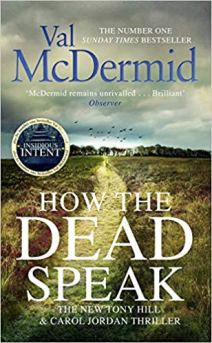 After the events of which we will not speak, Jordan’s Regional Major Incident Team has been disbanded while the woman who was its beating heart and soul keeps her fragile psyche from harm by continuing to renovate her home, a former barn on a heather covered northern hillside. Visitors are few and usually unwelcome, but none more so than Tony Hill’s vindictive and manipulative mother Vanessa who, after inflicting her abrasive personality on her son in a prison visit, coerces Jordan into using her investigative skills to track down a fraudster who has conned her out of a small fortune. Only slightly less welcome is Bronwen Scott, Tony Hill’s solicitor. She also has a job for Jordan, but this time it is to establish grounds for an appeal against a murder conviction handed down to a gay man who, the jury believes, has murdered a rent boy.
 nd there is a bonus. McDermid – who, as fans of her band will know, is no mean singer – might just be performing a cover version of one of my favourite songs Save The Best For Last (below). If any potential readers are sentimental old (or young) sods like me, you will be permitted a little sniffle and a dab at a moist eye when you read the final pages.


 fullybooked2017