Search

fullybooked2017

Tag

murder

#TAKEN . . . Between the covers

Taken Header

OK, so Liam Neeson and Luc Besson got their anti-Albanian-gangster campaign in first, but Tony Parsons’ version has a hashtag, and only two citizens of the Adriatic republic bite the dust during DC Max Wolfe’s latest investigation. So, what do we have? Fans of the previous Max Wolfe novels The Murder Bag (2014) The Slaughterman (2015) The Hanging Club (2017) Die Last (2017) Girl On Fire (2018) can look away for a moment during a quick bio of DC Wolfe. He lives in a flat overlooking Smithfield Market. He is a single parent to daughter Scout (as in To Kill A Mockingbird), and has a dog called Stan, to whom he is devoted. Wife Anne is vaguely in the background, but is more concerned with her looks, career and latest boyfriend than she is about her daughter. The Wolfe household is run by a benevolent Irishwoman called Mrs Murphy.

Taken#Taken kicks off, appropriately enough, when a young ballet dancer, Jessica Lyle, is snatched from her borrowed car just yards from the gated luxury home she shares with another girl. From here, Wolfe and his alcoholic boss DCI Pat Whitestone face a veritable University Challenge of questions. Their starter-for-ten is to decide if Jessica was actually the intended victim. Although her father is a retired copper who may have run up an impressive list of enemies, isn’t it more likely that Jessica was mistaken for her flatmate, Snezia? After all, Snezia is not only a dancer of a different kind from Jessica (think ‘gentlemen’s’ clubs, tiny thong and shiny pole) but she is the mistress of fabled former gang boss Harry Flowers. Jessica was driving Snezia’s car when she was taken. Isn’t this just another example of the stupidity of hired thugs?

As if Wolfe doesn’t have enough on his plate, he is forced to cover for his boss when she gets herself into a whole world of trouble. He is far from being a stupid man, but makes assumptions about the Lyle abduction which lead him down a succession of dark alleys, with Whitestone’s obsession with nailing Harry Flowers adding more heat than light as he gropes for the truth.

Parsons takes us on a white knuckle ride through London’s gangland, a place where unpredictable violence à la Ronnie Kray is a marketable commodity, and luxury homes on the Essex fringes are paid for by dark deeds committed in the shadows cast by mountains of wrecked cars in scrap dealers’ yards. Lovers of London will be entranced by some of the locations, including a ghostly disused underground station and the spectacular mortuary extravagance of Highgate West cemetery.

tp003

Amid all the thuggery, armed police raids and visits to some of London’s least-visited curiosities, Parsons (above) finds space and time to deal with Wolfe’s tortuous relationship with his estranged wife. The writing here is full of emotional intelligence, sensitivity, perception, and not without pain. Wolfe’s devotion to his daughter, Scout, could not be more of a stark contrast with Anne’s insouciance, and yet there is still a sense that, to paraphrase Bobby McGee’s un-named companion, he would trade all his tomorrows for a single yesterday. Those who are familiar with Parsons’ best-seller Man and Boy will know that he is writing from the heart.

#Taken is published by Cornerstone/Century and will be out as a Kindle on 1st March, and in April as a hardback. If you click on the image below it will take you to a video of Tony Parsons talking about the book, and reading the first chapter.

Reading

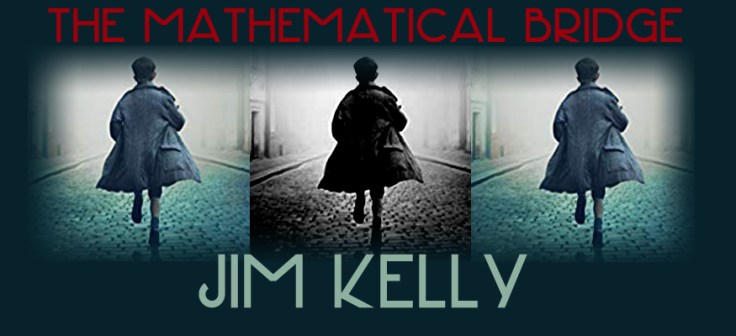
THE MATHEMATICAL BRIDGE . . . Between the covers

TMB HEADER

“Detective Inspector Eden Brooke trudged into Market Hill, the city’s great square, as snowflakes fell, thick and slow, each one a mathematical gem, seesawing down through the dead of night. Every sound was muffled, a clock striking the hour out of time, the rhythmic bark of a riverside dog, the distant rumble of a munitions train to the east, heading for the coastal ports. The blackout was complete, but the snow held its own light, an interior luminescence, revealing the low clouds above. Brooke stopped in his tracks, his last crisp footstep echoless, and wondered if he could hear the snow falling; an icy whisper in time with the sparkling of the crystals as they settled on the cobbles, composing themselves into a seamless white sheet.”

TMB“Begin as you mean to go on” says the old adage, and Jim Kelly sets himself a hard task with the brilliant and evocative first paragraph of The Mathematical Bridge. The beautiful use of language aside, Kelly’s first 126 words convey a wealth of information. A country at war. Midwinter. A city preparing for an attack from the air. A policeman out and about when honest men are abed.

Eden Brooke first appeared in The Great Darkness (2018) and you can read my review by clicking the blue link. A copper in the university city of Cambridge, he is a war veteran, not of the Western Front, but of the desert campaign, one of ‘Allenby’s Lads.’ We join him in that first winter of the Second World War, when German bombers have yet to inflict their terror on the houses and streets below them. Tragedy strikes when a boy, evacuated from his London home to the relative safety of a Roman Catholic community in Cambridge, is feared drowned in the fast-freezing River Cam. His body is eventually recovered, but not before Brooke has unearthed a plot to bring death and destruction to the streets of Cambridge.

The conspirators are not Germans but people from much nearer home who firmly believe that their enemy’s enemy is their friend. With two Irish republican conspirators sitting in a Birmingham jail, sentenced to death for a 1939 bomb atrocity in Coventry, Brooke realises that the next potential target for the IRA is Prince Henry, Duke of Gloucester, younger brother to the King. Henry is due to make a morale-boosting visit to Cambridge to boost the war effort, and Brooke is desperate to find the link between the dead boy in the river and the Irish community who worship at St Alban’s church.

Eden Brooke is an engaging character. Blighted by vision problems and chronic insomnia – both the result of his wartime treatment at the hands of brutal Turkish captors – he goes about his work with a steely intensity, much to the despair of his wife and daughter. Kelly’s portrait of provincial England in the first months of WW2 is mesmerising, more so given the added piquancy of our knowledge of what will happen, contrasted with the uncertainty of the characters in the novel.

Give Jim Kelly a landscape, a town, a city, an isolated village, and he will mobilise and send it off to war. Fans of his Philip Dryden novels will know the dramatic chiaroscuro he paints that shows how the comfortable middle-class cathedral city of Ely sits surrounded by dark and broken hard-scrabble villages out in the Fen. His Norfolk copper, Peter Shaw, knows only too well the contrast between the rough estates of King’s Lynn and the Chelsea-On-Sea second homes further up the Norfolk coastline. Eden Brooke’s Cambridge is a vivid and vital character in The Mathematical Bridge. Kelly makes it, despite the murders, an island of relative calm and rationality, for beyond it, out there in the flat darkness, lies The Fen.

doublesmallmathematicalbridgeThis is writing of the highest quality. Not just with the lame caveat ‘for a crime novel’ but writing with a touch of poetry and elegance gracing every line. Even when the crime is solved, the perpetrators are behind bars, and the delightfully complex contradictions of the plot have been explained, Kelly (right) still has the emotional energy to give us a last scene which manages to be poignant but, at the same time, life-affirming.

The Mathematical Bridge is published by Allison & Busby and is out on 21st February. For more about Jim Kelly and his writing click this link.


A&B

COLD AS THE GRAVE . . . Between the covers

CASTG header

This is a welcome return to the world of Edinburgh copper Tony McLean. He is now Chief Inspector, and to quote, appropriately enough, the Scottish Play, he feels he is dressed in ‘borrow’d robes’. On his desk are small mountains of files, reports, initiatives and consultation documents: beyond the door of the nick are thieves, rapists and murderers. McLean knows where his heart is leading him, and it is out away from his desk and onto the mean streets.

When McLean uses the excuse of a potential clash between rival demonstrators to desert his office, he discovers a corpse abandoned in a derelict cellar. As the technicians and medics swarm round the body it seems obvious that the remains – of a young girl – have been there for some considerable time. When, however, the pathologist is able to take a closer look under the spotlight above the mortuary slab, he comes to the astonishing conclusion that the girl has only been dead for a matter of days, despite her desiccated and leathery skin.

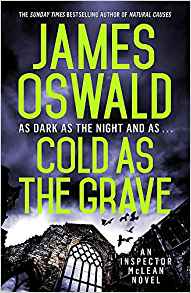
indexCold As The Grave is the ninth novel in the Tony McLean series, but fine writers – and Oswald is up there with the very best – make sure that it is never too late to come to the party. For anyone new to the series, McLean is something of an individual. Due to an inheritance, he is exceedingly wealthy, but has a modest lifestyle and chooses to remain a police officer. He has a long-standing ‘significant other’ in Emma Baird, but the previous novel, The Gathering Dark, (click to read the review) ended with her having a disastrous miscarriage. McLean is a fine detective, but he is blessed, or perhaps cursed, with an awareness of the supernatural. The two characters in the books who operate in this sphere are Madame Rose, a bizarre but benign transvestite clairvoyant, and the considerably more sinister Mrs Saifre. She is, on the surface, merely a very rich and influential owner of newspapers and media outlets, but McLean senses that there is something existentially evil and elemental behind her smooth corporate image.
Back in Cold As The Grave, more bodies are found, each apparently mummified in the same way as the poor child found in the tenement cellar. McLean makes an important connection between the deaths and the rising tide of people trafficking which has hit the city. Girls and young women from the war zones of the Middle East are being brought in and, at best, set to work for a pittance in local factories but, at worst, forced into prostitution.

With his bosses exasperated at the amount of time he is spending away from his paper shuffling duties, McLean’s investigation reaches a crucial fork in the road. To the left is the grim possibility that someone at the heart of the trafficking gang is using some kind of deadly serum, derived from snake venom, to carry out murders and threaten other victims: to the right, however improbable, is the presence of some kind of evil djinn reincarnated from Aramaic legend and folklore. McLean knows that following the road to the right will lead only to ridicule by both his superior officers and those who work for him, but he has learned to trust his instincts, even if they terrify him.

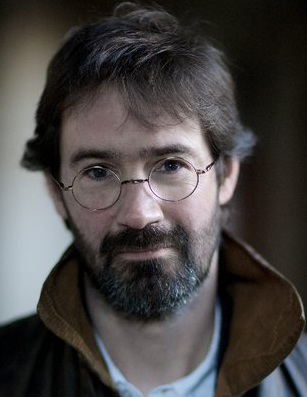
joDoes McLean follow his head or his heart? The road to the left or the right? Cold As The Grave is a brilliant police procedural, but there is more – so much more – to it. For those who love topographical atmosphere Oswald (right) recreates a wintry Edinburgh that makes you want to turn up the central heating by a couple of notches; for readers drawn by suggestions of the supernatural there is enough here to induce a shiver or three, while making sure the bedroom light remains on while you sleep. The sheer decency and common humanity of Tony McLean – and the finely detailed portraits of the people he works with – will satisfy the reader who demands authentic and credible characterisation. Cold As The Grave is published by Wildfire/Headline and will be out on 7th February.
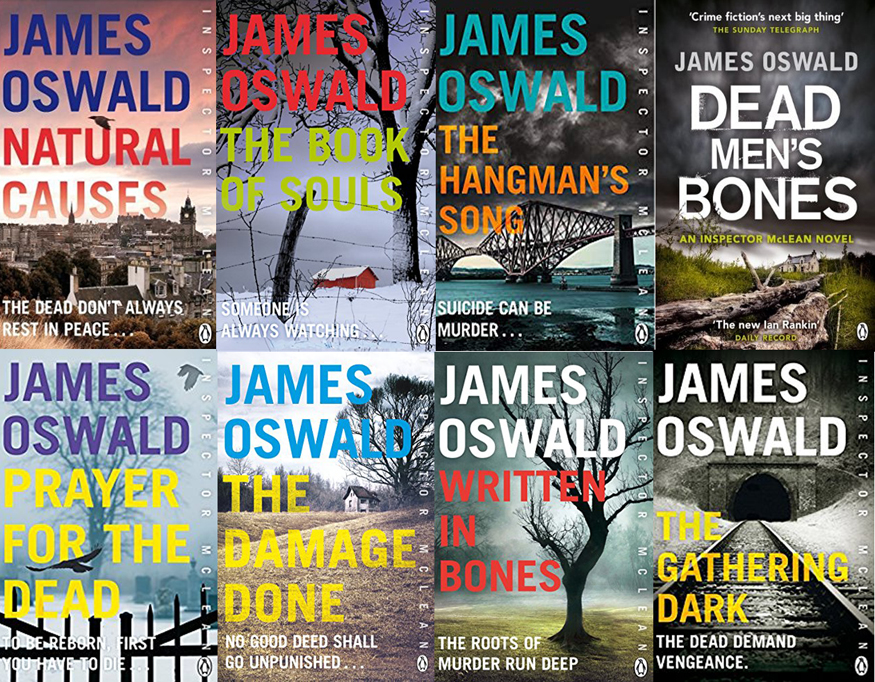
McLean books


DANGEROUS DECEITS . . . Between the covers

dd header

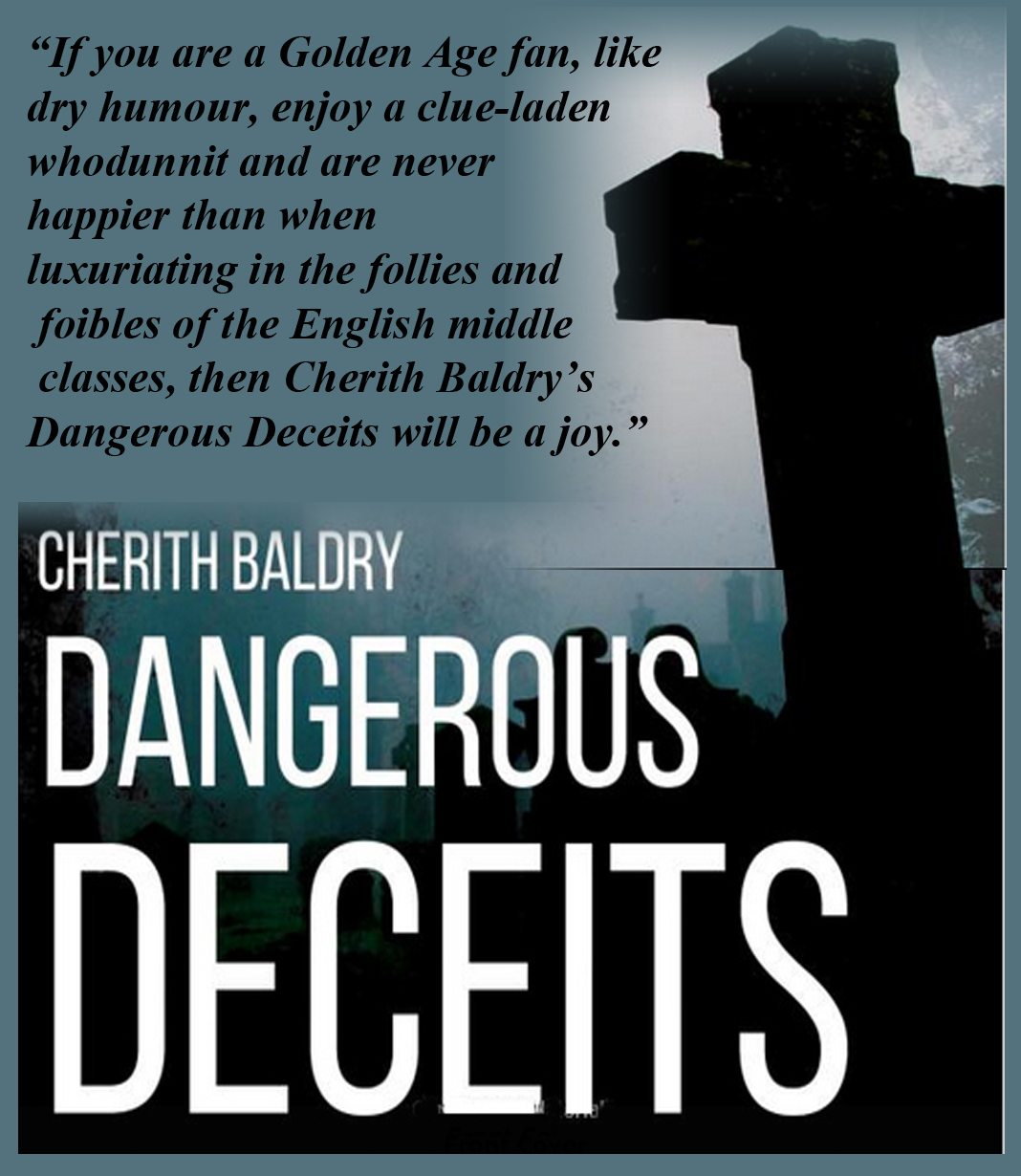
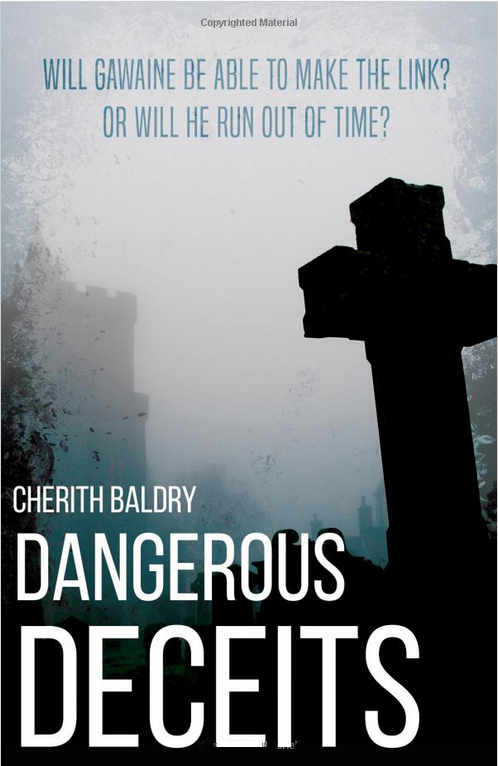
dd covrYou might guess that a crime novel featuring an amateur detective called Gawaine St Clair is not going to take you down many mean streets; furthermore, were one to Frenchify its chromatic tint, then it would probably be nearer beige than noir. This being said, if you are a Golden Age fan, like dry humour, enjoy a clue-laden whodunnit and are never happier than when luxuriating in the follies and foibles of the English middle classes, then Cherith Baldry’s Dangerous Deceits will be a joy.
Gawaine St Clair seems to be a man of independent means, not unlike his aristocratic predecessor Lord Peter Death Bredon Wimsey, and his affluence enables him to take up criminal investigations without having to make excuses to an employer for his absence from the workplace. In this case he is called upon by his aunt Christobel to solve the mysterious death of a vicar. Father Tom Coates disappeared into his vestry moments before the beginning of a service, and was not seen again until he was found some time later, all life extinct due to a fatal blow to his head with the time-honoured blunt object.

It needs to be said at this point that the novel is very, very ‘churchy’. I use the term to describe a way of life centred around the Anglican church, with attendant church wardens, vergers, flower ladies, Parochial Church Councils, the occasional Bishop, and heated disputes over liturgical practices. Anthony Trollope de nos jours? Possibly, but as an Anglican, albeit rather lapsed, I share Cherith Baldry’s obvious love of the sonorous prose of The Book of Common Prayer – the proper 1662 version, not some squeaky clean modern adaptation designed to appeal to ‘the younger generation’. She uses suitably resonant quotes as her chapter headings, none more appropriately than:

“Man that is born of a woman hath but a short time to live.”

St Clair is faced with a whole repertory company of likely suspects, all – or none – of whom may have had their reasons to bash Father Tom’s head in. In no particular order, we have a choleric prep school Headmaster straight out of Decline and Fall, a woman denied communion because of her marital woes, a glib local solicitor, the dead man’s brother and sister, with whom he owned valuable shares in a family business, and a dowdy local GP with a beautiful and sophisticated wife.

cbGawaine may be too arch and precious for some tastes but he fits perfectly into the Home Counties landscape with its manicured village greens and faux Tudor dwellings. I thoroughly enjoyed Dangerous Deceits and Father Tom’s killer is unmasked not amid the dusty shelves of a country house library, but in the altogether more fractious atmosphere of an extraordinary (in the procedural sense) meeting of the Ellingwood PCC. The solution, as in many a whodunnit, rests with everyone – including Gawaine, the local coppers and, in this particular case, me – making a seemingly obvious assumption early in the piece.
Cherith Baldry (right) is an acclaimed writer of children’s fiction and fantasy novels. The first in her Gawaine St Clair series was Brutal Terminations, which came out in February 2018. Dangerous Deceits is available now and is published by Matador.

THE SUSPECT . . . Between the covers

suspect035

Kate Waters was introduced to readers in Fiona Barton’s novel, The Widow (2016) and made her second appearance in The Child (2017). Now she returns in The Suspect and is very much “the story” rather than just a reporter investigating the dark things that happen to other people. Two teenage girls have celebrated the end of their ‘A’ Levels by heading off on the adventure of a lifetime – a back-packing trip to Thailand. When phone calls home and emails suddenly stop, the parents of Alex and Rosie are at first uneasy, but then disquiet turns into blind panic.

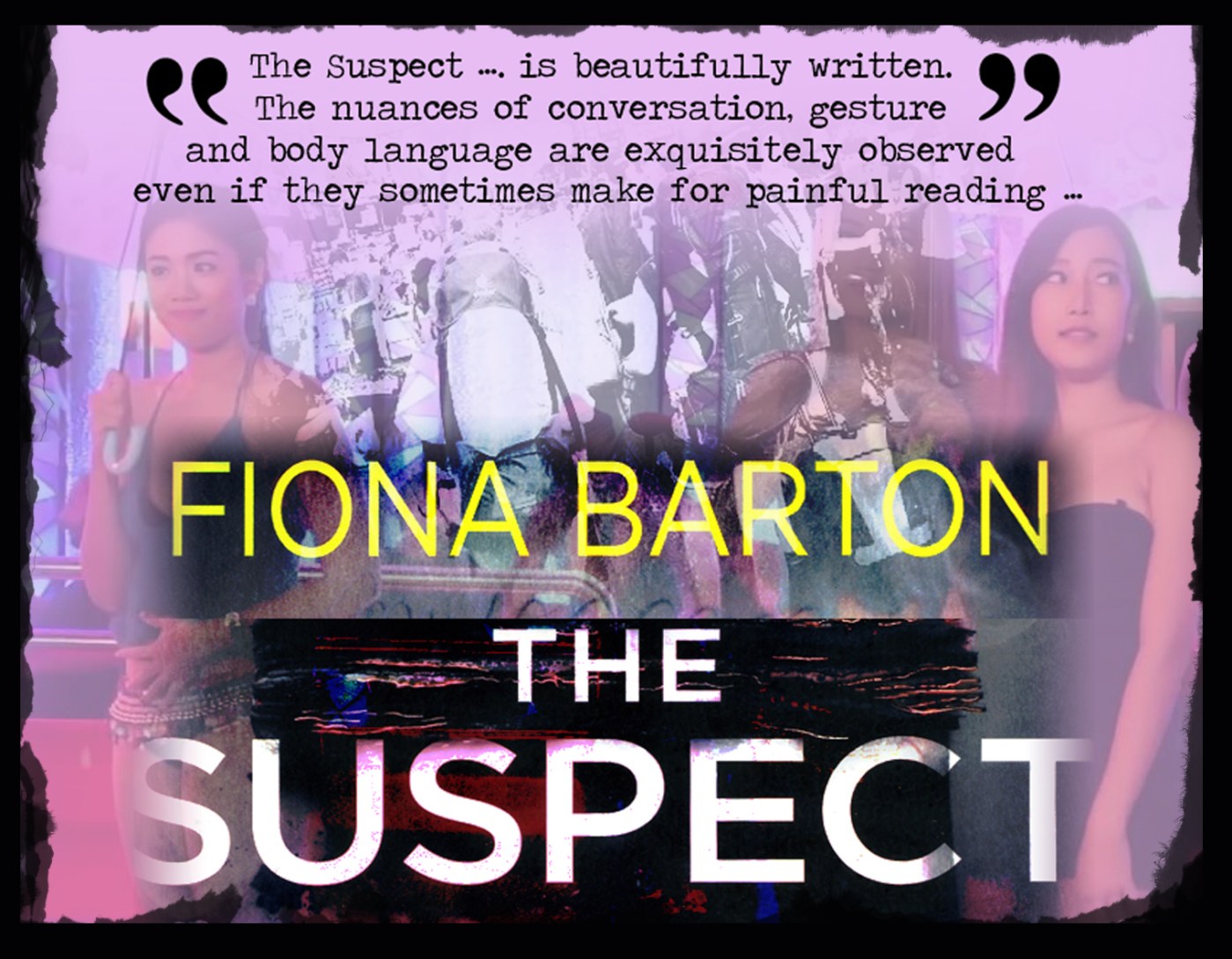
ts coverSensing a very productive headline story that will run and run, Kate Waters uses all her empathy and tricks-of-the-trade to get close to the girls’ families, and the story does indeed have the whole enchilda. Beautiful teenage girls, disappearance in a Bangkok drug den, frantic parents, the possibility of incompetence by foreign police – what could possibly go wrong? Jake Waters is what could possibly go wrong. Kate’s son has been away in Thailand “finding himself” after a failed spell at university, and her journalistic glee at the ramifications of the story is brutally brought up short when she finds that her errant boy might be at the very epicentre of the story she has claimed as her own.

The technique of telling a story from several different narratives is hardly new, but few can have handled it better in recent times than Fiona Barton. The events both here in England and further afield unfold through the eyes of Kate Walters herself, the distraught parents, and the local police team lead by DI Bob Sparkes and his DS, Zara Salmond. Inevitably, the perceptions of Kate Walters are more immediate because her narrative is first person. Barton has probably forgotten more about the world of journalism than most crime writers will ever know, and she makes good use of her experience when she describes the gears grinding as Kate switches from mother to reporter and then back to mother again. On her own website, Fiona Barton writes:

“I should say here that Kate Waters is not me. I’ve been where she goes but she is a composite of many Kates I have worked with. She is in her fifties, has juggled career and family, chafing at her hospital consultant husband’s dismissal of her job and the guilt of missing parent evenings and football matches. She is world-weary at times, terrified by the technology changing the media and insecure about her role. But she is still driven by the need to find the story. And she refuses to go until she has nailed it…”

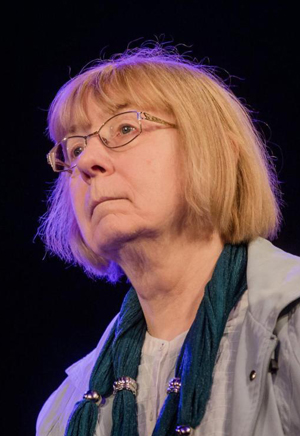
FionaIt must be said that this is a story long on personal misery and rather short on redemption, but it is beautifully written. The nuances of conversation, gesture and body language are exquisitely observed even if they sometimes make for painful reading, such as the bittersweet moments between Bob Sparkes and his dying wife. My own children are, thankfully, well past the age of “doing” Thailand, but my advice to those with gap-year offspring is, with all respect to Fiona Barton (right), don’t read this book! Once your teenagers have shouldered their backpacks and waved goodbye at the departure gate, your mind will hark back to The Suspect it will be nessun dorma for you!

The Suspect is a superior blend of psychological thriller and police procedural, and Fiona Barton keeps us guessing until the last page and a half. To be fair she does give us a fairly important clue much earlier in the novel, but – quite correctly in my case – she expects that we will forget about it in all the to-ing and fro-ing between Bangkok, Hampshire and London. The Suspect is published by Bantam Press and will be out on 24th January.

bantam

THE MAN WITH NO FACE . . . Between the covers


tmwnf header

The most sinister fictional hitmen usually only have a surname, and if that name is a harsh monosyllable, then all the better. Kale is one such, and Peter May introduces him to us in his latest novel, The Man With No Face. Kale, who learned his trade in the British Army, is sent to Brussels to carry out a double killing.

The central character is not the malevolent Kale, but a Scottish journalist, Neil Bannerman, who is sent to Brussels, partly to keep him out of the way of his paper’s thrusting new editor, but also to delve for sensational stories of immorality and incompetence among the myriad employees of what we now call the European Union.

tmwnf coverBannerman initially lodges with an embittered fellow journalist, Tim Slater, who shares his apartment with his autistic daughter Tania. The child is looked after by a young Englishwoman, Sally Robertson, with whom Bannerman strikes up a relationship.  Kale’s victims are Slater himself and a senior British politician but when he strikes he is unaware that Tania is watching from the next room. Mute, she is later unable to tell the police anything, but she draws a picture of what she has seen. The drawing is intensely detailed and very graphic with one exception. The killer has no face.

Peter May aficionados will probably recognise this book in its earlier manifestations; firstly as Hidden Faces, published by Piatkus in 1981 and again with its current title a year later, but this time under the imprint of St Martin’s Press.

mayHow has the book fared, nearly forty years on? Whatever revisions the author has made, he hasn’t pushed the time slot on by four decades, so we are still in the late 1970s, so in a sense the book has become historical crime fiction by default. I don’t know what Peter May (right) thinks about the vexed question of Brexit, but here he paints a picture of the EEC in its all-too-familiar guise as a fraud-riven monolithic haven for thousands of bureaucrats, men and women pushing paper around at huge expense to taxpayers across the continent, but achieving very little except the perpetuation of their own jobs.

The vexed question of Britain’s relationship with southern Africa in the 1970s is now little more than a footnote in the history of the 20th century, but May uses it to good effect here. The setting of The Man Without A Face is a wintry Brussels that, quite literally, chills us to the bone. The snow, sleet, bitter winds and the hazy winking of car tail lights as they battle with the frozen city streets will make you want to reach for an extra layer of warm clothing. In keeping with the weather, there is a distinct noir-ish feel about much of the book, and the existential musings of Kale as he goes about his bleak business reminded me very much of Derek Raymond. Bear in mind, though, that Raymond’s classic Factory novels post date this, making me think that perhaps Peter May was ahead of the game.

Back in 1981, the trope of the mute, blind or disabled witness to a crime had already been explored, most memorably in the Audrey Hepburn film Wait Until Dark (1967), but our current awareness of the complex issue of people with Autism was not mainstream in the 1980s. Leaving aside the socio-cultural background, The Man With No Face is a cracking thriller now, as it must have been then. It is published by riverrun, which is an imprint of Quercus. and it’s out on 10th January.

riverrun


THE BOY . . . Between the covers

I do love me a good,sweaty Southern Noir, preferably down in Louisiana, with ‘gators thrashing about in the bayou, a storm blowing in from the Gulf, insects the size of golf balls on Kamikaze missions against the fly screens, and folk pushed to the limits of their tolerance by the relentless humidity. Throw in a dash of Cajun music and Acadiana French cursing, and I am set for the night. Tami Hoag’s latest novel ticks all the required boxes.

Hoag, who hails from the relatively temperate zone of Iowa, has created a brilliant husband and wife police partnership in Nick Fourcade and Annie Broussard. The pair first emerged on the printed page as long ago as 1997 in A Thin Dark Line but, of course, crime fiction time isn’t the same as real time, and the two cops are still relatively young and beautiful in Hoag’s latest thriller, The Boy. They are called to a beaten up shack in the sticks beyond the somnolent settlement of Bayou Breaux, and they find a seven year-old boy hacked to death with a knife, while his mother has apparently fled the scene, barefoot and bearing wounds from the same blade that brutalised her son.

Genevieve Gauthier has a past, however. Before settling in Bayou Breaux with son KJ, she has been no stranger to law enforcement. Blessed – or cursed – with an ethereal and vulnerable  beauty designed to act as a magnet to predatory men, she has served jail time for suffocating her first-born child. Fourcade and Broussard are faced with a dazzling and perplexing star burst of inconsistencies as they try to find who killed KJ. Why was Genevieve allowed to escape with relatively minor injuries? Where is KJ’s teenage baby-sitter, Nora? Is her disappearance connected to KJ’s death?

Fourcade and Broussard have a bitter enemy in the shape of Kelvin Dutrow, their boss. As Sheriff, he likes to dress in tactical combat gear, his belt heavy with weapons he has no idea how to use. He likes nothing better than a press conference where he can strike a pose, talk tough and play to the camera. His animosity to the pair reaches fever pitch when they discover that not only does he have a sinister past, but it comes with some highly questionable connections to the bereaved young woman nursing her injuries in the local hospital.

The identity of KJ’s killer is cleverly concealed until the final pages, and there is a blood-soaked denouement which will satisfy even the most hardened Noir fan. The Boy is lurid, yes, and certainly melodramatic, but it is a gripping read which had me canceling other activities right left and centre so that I could get to the end.

The Boy is published by Trapeze and is out as a Kindle on 31stDecember 2018, and will be available in other formats in 2019.

https://www.amazon.co.uk/Boy-Broussard-Fourcade-Tami-Hoag-ebook/dp/B01MCZ5Y10/ref=sr_1_1?ie=UTF8&qid=1543917727&sr=8-1&keywords=The+Boy+Tami+Hoag

WE CAN SEE YOU … Between the covers

Whatever your view on lifestyle coaches, they certainly have a market, and perhaps nowhere more so than in the ever-so-socially-aware state of California. Brook Connor may not have cornered that market, but she has a best-selling ‘how to come out on top’ guide to her name, as well as wealthy clients and a regular spot on TV. She may not have absolutely everything – after all, her husband is a failed movie actor-cum-tennis coach with a roving eye, but her bank balance is healthy, her home is valued in the millions, and she has an adorable five year-old daughter.

 Correction. She did have an adorable five year-old daughter. She returns home after work one day to find both daughter Paige,and nanny Rosa gone,  and a chilling note explaining that they have been taken. A severed finger inside a prettily decorated gift box persuades Brook that these people are not fooling around.

 As ever in kidnap cases both real and fictional, the bad guys caution against any police involvement, and so Brook and husband Logan get the ransom money together and set off to make the exchange. Of course, the exchange doesn’t go to plan, and Brook is left concussed at the bottom of a gully out in the sticks, the money has gone, and there is the inconvenient matter of a body in the trunk of her SUV, lifeless mainly because of one of her own kitchen knives sticking out of his ribs.

 Brook goes on the run, confounded by her initial decision not to involve the police, and also the discovery of the body in the trunk of her car. There is nothing the media loves more than a celebrity criminal, and soon her face is plastered over every news channel. Armed only with her own automatic sidearm and a blazing desire to find her daughter, she leads the law enforcement agencies a merry dance until her race against time comes to an abrupt and bloody end in the personal gym of a notorious ‘businessman’ with links to the infamous cartels from south of the border, down Mexico way.

 Kernick very cleverly uses a split time narrative, with one showing Brook in custody facing multiple murder raps, and another detailing the events which have led to her arrest. He is not done with us, though; a seismic plot shift leads to a dramatic conclusion which even Nostradamus would not have seen coming.

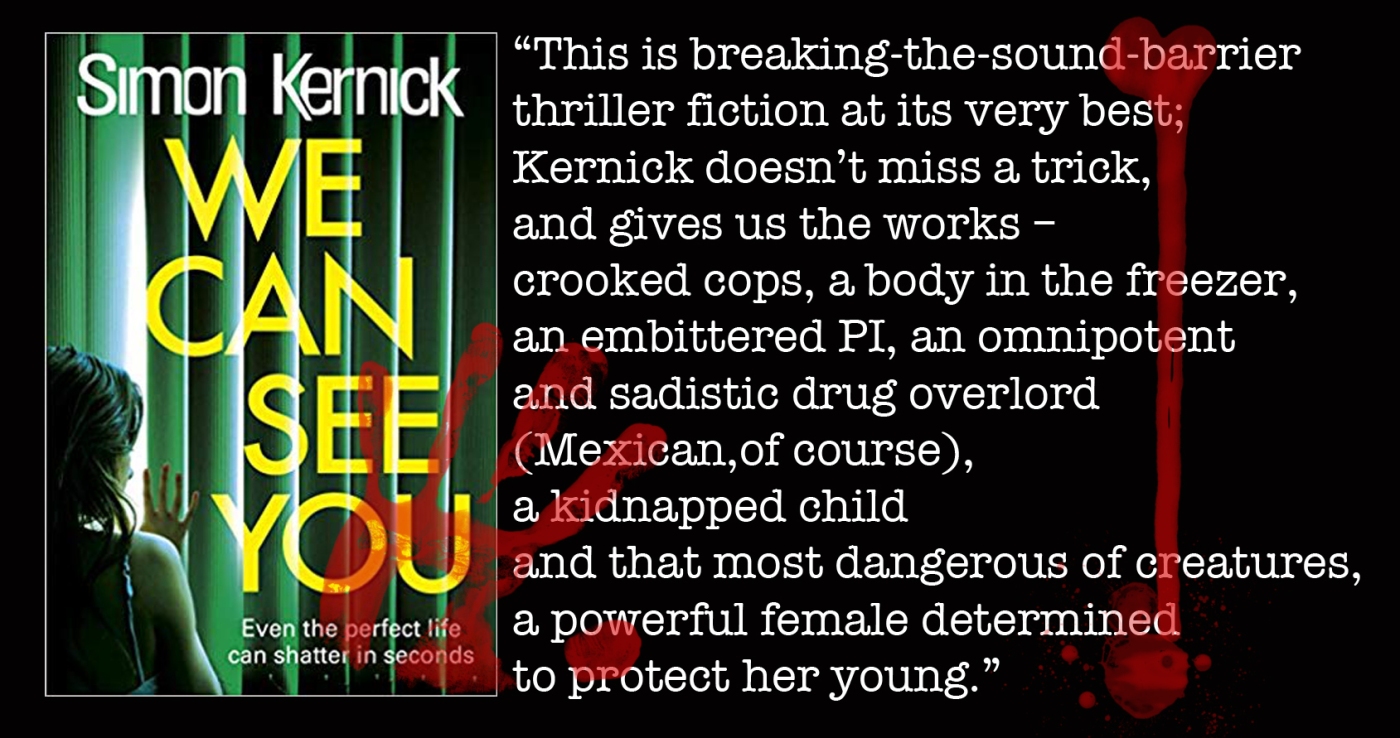
This is breaking-the-sound-barrier thriller fiction at its very best; Kernick doesn’t miss a trick, and gives us the works – crooked cops, a body in the freezer, an embittered PI, an omnipotent and sadistic drug overlord (Mexican,of course), a kidnapped child and that most dangerous of creatures, a powerful female determined to protect her young. We Can See You is published by Century and is out today, 29thNovember.


KINGDOM OF THE BLIND . . . Between the covers

I can almost hear the sneers now:

“Call yourself a crime fiction reviewer?”
“Pull your head out of the sand, mate”
“What next? You have heard of Sherlock Holmes, I take it..”

Actually, no.Crime fiction reviewers tend to be a fairly charitable lot, especially as most of us are not in it for the money, but for the love of reading (and a few ARCs, naturally) But I do have to confess a sense of embarrassment at reading a brilliant book and then realising that it is only the latest in a well established series of which I had been blissfully unaware.

Apology done and, I hope, dusted. Armand Gamache is a senior policeman with the Sûreté  in Quebec the francophile province in Canada. He is still under suspension following a controversial drugs case which resulted in one of his colleagues being badly shot up, and a potentially fatal consignment of the opioid fentanyl going missing.

Gamache is informed by a notary that he has been named as an executor of a will. He has, however, never met or even heard of the deceased woman. Intrigued, he goes to meet the notary and his fellow executors at a remote farmhouse. Arriving, in the teeth of a violent blizzard, he is bemused to discover that a friend from his home village of Three Pines, has received the same summons.

The mystery deepens when Gamache learns that the dead woman was a domestic cleaner, and she has bequeathed an estate apparently worth millions of dollars. She used to joke that she was of noble blood, but was her self-mockery founded in fact?

A murder at ‘Baroness’ Baumartner’s ramshackle farmhouse transforms the affair from peculiar to deadly, and Gamache is sucked into an investigation which can only end badly. In addition,  he has a two huge problems, massive elephants in the confined space of his professional room.  Firstly, Amelia Choqet, an unconventional young police woman who has been mentored by Gamache, has been kicked out for drug offences, and has now apparently reverted to her former lifestyle of street whore and drug abuser. Secondly he is tormented by the fear that if the missing batch of opioids gets onto the streets, there will carnage.

The murder of Anthony Baumgartner takes Gamache and his team into the murky world of investment finance and an environment where millions of dollars are flicked this way and that by financial ‘experts’.

Allegedly, native Canadians have fifty words for snow, and LouisePenny certainly makes us shiver, stamp our frozen feet, and clap our gloved hands together. The  weather becomes a baleful and powerful character in The Kingdom Of The Blind, and every step Gamache and his team take is in defiance of snowdrifts, abandoned vehicles and cold of such intensity that exposed skin is first brutalised and then destroyed.

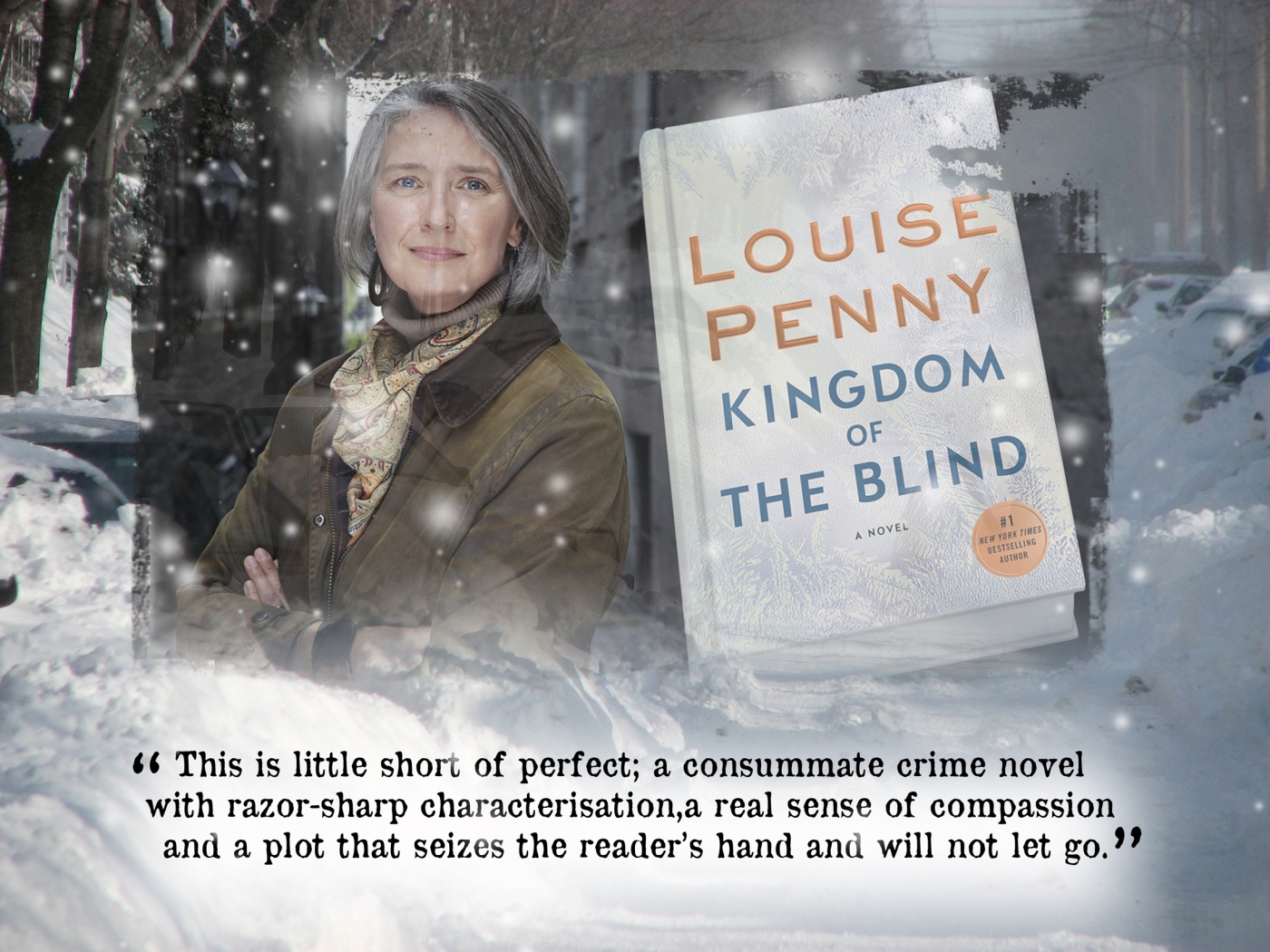
In addition to describing the search for a murderer, Louise Penny cleverly sets off two other plot-lines for us to chase, and she takes great delight in resolving both, but neither in the way we have been led to expect. Kingdom Of The Blind is little short of perfect; a consummate crime novel with razor-sharp characterisation, a real sense of compassion, convincing dialogue and a plot that seizes the reader’s hand and will not let go. Published by Sphere, the novel (the 14th in the series) is out on 27th November.


Blog at WordPress.com.

Up ↑