Search

fullybooked2017

Tag

murder

A LOUTH TRAGEDY . . . Part One

ALT header

Back in the 1950s and 60s I was a regular visitor to Louth. Mother was a Louth girl, and my grandmother, although born in Yorkshire, had lived in the area since before The Great War, first in a cottage in the grounds of Tathwell Hall, where her father was Head Groom, and then in the town itself. I used to stay with her in Tennyson Road during school holidays, and blissful days they were. I had made several friends in Louth, and we did what most lads did in those innocent days – played football and cricket and went fishing. The most intense of all our passions was, however, trainspotting.

RunaboutEach summer, we used to buy what was called a Runabout Ticket. It cost twelve shillings and sixpence and was a small rectangle of stiff blue cardboard. On it was printed a stylized map of the railway network in the area. It meant we could travel on any train, between any of the stations, as often as we wanted, for a week. Crucially, it gave us access to the East Coast main line between Peterborough and Grantham, with its magnificent Gresley Pacifics and all manner of spectacular engines. At other times, however, we had to make do with the trains that ran through Louth on the Grimsby to Boston line, and one of our favourite places to trainspot was the level crossing on Stewton Lane. Between trains.we could muck about by the nearby stream where it ran through a little gully, which was known as Seven Trees Island. Happily undreamed of in those days was the fact that we were enjoying ourselves on the site of one of the most gruesome and tragic murder cases of the early twentieth century.

MINNIEIn 1927, just by the railway, there stood a small wooden bungalow, the home of Bertram Horace Kirby, 46, and his wife Minnie. They were not originally Louth people, both having come from Boston, where they had married – possibly in St Botolph’s – in 1905. They had three sons. The two oldest had left home. Harry, 21, lodged with Mrs Took in nearby Church Street, while Ralph, 17, had emigrated to Canada. There was a much later addition to the family. Leslie Norman Kirby was just 8 years old. Minnie Eleanor Kirby (right) was described as follows in subsequent press reports:

“Mrs. Kirby was tall, and of striking appearance. She was most friendly woman, and was liked very much by her neighbours. Her hobby was gardening. She had studied her subject, and she was an expert gardener, and passionately fond of her flowers. She was extremely well-read, and was a thoroughly cultured woman, clever in many ways, and musical. She was a keen churchwoman.

Mrs. Kirby was also an enthusiastic member of the Women’s Unionist Association, and canvassed in Louth at the last election. She had been educated in Boston at Miss Stothert’s High School, and for about 10 years she was head clerk at Mr. A. Simpson’s furniture store, in the Market-place. She was very well-known in Boston. At school, she was a very apt pupil, and we are informed that Miss Stothert “thought a lot of her.” During her schooldays the took part in “The Mandarin”, and other plays. She was extremely fond of rowing, and frequently enjoyed her favourite exercise on the Witham.”

KIRBYBertram Horace Kirby (left) was a year younger than his wife. He also had musical talent, and while they lived in Boston he had been church organist in the town, and the village of Frampton. He had applied himself to various trades while living in the Boston area, but had worked for almost ten years for the London and North Eastern Railway. By 1927, however, he had given this job up, and had attempted to strike out on his own as a commercial dealer.

In the early evening of Sunday 10th July , Harry Kirby called at his parents’ home, and took his mother for a stroll. Although he had moved out of the bungalow because he and his father “couldn’t get along” he had noticed nothing untoward in the atmosphere between his mother and father. He was later to admit that his father “was prone to violent tempers when he had taken drink.”

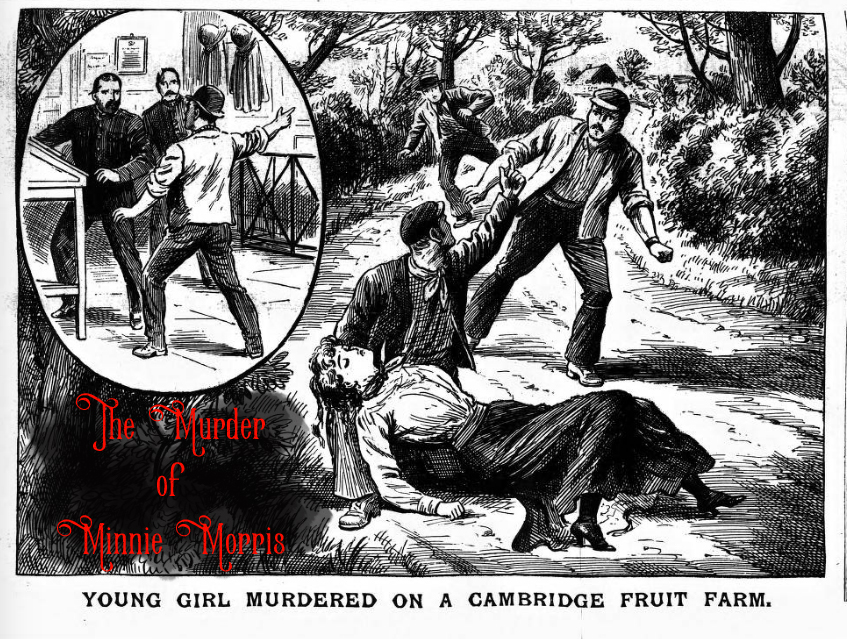
Despite all seeming well with his parents, Harry Kirby must have had a sixth sense that prompted him to visit the bungalow on Tuesday 12th July. He found the doors locked and the curtains drawn, and could make nobody hear. He walked into the town and asked for help from the police. He returned with Inspector Davies who must have also sensed something was wrong, and forced his way into the bungalow through a rear window. What he found confirmed Harry Kirby’s fears that a tragedy was about to unfold. Minnie Kirby was lying dead on the floor of the living room, on her stomach, with her head turned to one side. At the base of her skull was a savage wound which had almost separated her head from her body.

In Part Two
AN ARREST INTERRUPTS A GAME OF DOMINOES
ANGUISHED LETTERS

OUT FOR BLOOD . . . Between the covers

OFB 002

Aberdeen, Scotland.The Granite City. To say that Police Scotland’s DI Eve Hunter has baggage would be something of an understatement. Physically and mentally damaged by a ruinous encounter with a notorious crime family, she is only allowed back to work on the understanding that she undergoes tortuous (for her) therapy sessions with Dr Shetty, the police psychologist. We first met Hunter in Hold Your Tongue, and you can read that review by clicking the link.

OFB 001We start with two corpses. One is an unidentified young woman, strung up by her neck to a tree on a golf course. The other, a young man, is found in more comfortable surroundings – his flat – but he is equally dead. As Hunter’s team begin to investigate the cases it seems that they could not be further apart. The dead man is an old boy of one of the area’s most prestigious independent schools, and has a rich father. The girl, however, is an Eastern European prostitute. Links between the two deaths slowly turn from gossamer to steel. Was one using the other? Is it that simple? Why do the names of powerful local figures crop up over and over again on the peripheries of the case?

In some ways we are on familiar territory here. We have the classic police procedural trope of the tired and overworked detectives trying to keep their family lives on track, while still having to give everything to ‘the job’. We have some coppers who are, if not actually corrupt, downright idle, their only concern being how to protect their pension Somehow, these stresses and strains of police work come over as fresh and as harrowing as if it were the first time we had read them.

This is not the first novel in recent years to highlight the deeply unpleasant trade in human lives carried out by Eastern European criminals. I live in a town where it happens, and nothing Deborah Massen (below) has written here is in any way exaggerated or fanciful. She vividly portrays the brutality of the men – and women – who run the rackets, and the misery of the girls who become enslaved.

DM

Masson showed in her previous book that she has a talent for having her police characters (and with them, we readers) pursue one line of enquiry, convinced that solution can only lie in that single direction, only for events to take a startling turn in another direction altogether. In proving that we are all wrong, and making the plot twist plausible, she takes a great risk, but I have to say her gamble pays off, and she produces a startling conclusion with the true flourish of a literary magician. Out For Blood is available in Kindle from Transworld Digital now, and will be out in paperback under the Corgi imprint on 10th December.

RIVER OF SINS . . . Between the covers

River Header

A little while ago I reviewed a novel set in Worcestershire – it was the beginning of WW2, and it centred on the fictional village of Ambridge and, of course, featured The Archers. History of a very different kind now. River of Sins is the seventh in a series of historical mysteries written by Sarah Hawkswood set in and around the city of Worcester in the 12th century.

Filler 1
I am new to the series but I enjoyed the fact that we have that most dependable of crime fiction tropes – a pair of investigators. There is a slight variation a theme in this case, as they are aided by an intrepid young apprentice. The dynamic between the three works well. Hugh Bradecote is the Under Sheriff, and is of noble birth with a degree of hauteur, while Sergeant Catchpoll is Worcester through-and-through, rough and ready, but very street-wise. Walkelin – the apprentice – is something of a ‘gofer’, but is bright, perceptive, and not afraid to speak his mind.

Filler 2

The novel begins with a woman being brutally done to death on a small island in the River Severn on the northern outskirts of Worcester. We learn that the woman and her killer are acquainted, but just how, and what the significance is, only unfolds with the investigation.

The dead woman is Ricolde, known throughout the city as The Whore of Worcester. She was widely despised by the gentlewomen of the city, while being used by their husbands, but as Bradecote and Catchpoll discover, there was another dimension to Ricolde. Educated, and perfectly content to talk the night through with men who demanded nothing other than her company, she also gave money to the church to be used to ameliorate the misery of other women of the street who were less resilient than she.

The investigators struggle to find a motive for the murder. Moral disapproval doesn’t usually lead to someone being dismembered with a woodsman’s axe, but does the clue to Ricolde’s death lie deep in her past, and has it to do with the horrific scars on the soles of her feet, inflicted decades earlier?

Sarah Hawkswood’s Worcester is a place we can see, hear, feel, breathe – and smell – as the mystery unfolds. What is the River of the title? It is the River Severn, broad and deep, a source of fresh food, a vital artery of transport at a time when roads were just beaten dirt, but also a means of escape and concealment. With only the most rudimentary forensic skills available, Bradecote and Catchpoll must rely on the most basic and time-honoured methods of detection, means, motive and opportunity. This is an excellent detective story which also gives us an intriguing glimpse into a long-lost world.

River of Sins is published by Allison & Busby and will be out in paperback and as a Kindle on 19th November.

Hawkswood books

THE BEACH PARTY MYSTERY . . . Between the covers

TBPM header

41FEXmDAJYL._SX322_BO1,204,203,200_It’s the summer of 1966 and Brighton journalist Colin Crampton – he’s the crime reporter for the Evening Chronicle – gets a tip off from a friendly local copper that there has been a murder in Embassy Court, an upmarket block of flats on the seafront. Racing to the scene to try to out-scoop his rival from the Evening Argus, he ducks under the crime scene tape and learns that the dead man is Claude Winterbottom, a financial consultant.

Reporters are sometimes accused of muck-raking, and Crampton does literally that as he holds his nose and sifts through Winterbottom’s dustbin. He soon finds a motive for the man’s death. The so-called ‘financial consultant’ was actually a fraudster, selling get-rich-quick schemes to people with more money than sense. The list of people Winterbottom has scammed is quite impressive, and it even includes Crampton’s landlady, the redoubtable Mrs Gribble.

indexPeter Bartram (right) doubles up on the enjoyment by giving us a parallel plot (which eventually weaves in with the murder of Winterbottom) involving an off-shore pirate radio station, Radio Sea Breeze. Younger readers used to the communication free-for-all we have today may be puzzled by the concept. Back in the 1960s licences to transmit radio were not readily available in the UK and record companies had a tight grip on who played their music. Taking their cue from America, enterprising broadcasters exploited a loophole in the law by using ships anchored in international waters as their radio stations. The most famous was probably Radio Caroline which was on the air, using five different ships with three different owners, from 1964 to 1990. It still exists, but is now fully digital – and legal.

The Beach Party Mystery is a highly entertaining merry-go-round involving, in no particular order, The Rolling Stones, the FBI, the KGB, MI5, auditions for a James Bond movie, a Mary Whitehouse soundalike – and the world’s most insanitary pub. Unsurprisingly, for a man who has spent his life as a journalist, Peter Bartram has a nice turn of phrase, and a keen eye:

“It was one of those picture book places you find in the Sussex countryside. There were ancient houses with oak beams and sagging roofs. There were moss-encrusted flint walls. There was an old stone church and graveyard with weathered headstones. There was a village hall with a noticeboard. It carried news of scouts’ picnics’ Women’s Institute keep-fit sessions and parish council meetings.”

I make no apology for being a huge fan of the Colin Crampton novels. Yes, they may be light in tone, and they don’t set out to examine the darker recesses of the criminal mind, but I love them. The Beach Party Mystery is published by The Bartram Partnership and is out now, For reviews of the previous novels in the series, and also feature articles by Peter Bartram, click on the image below.

Screen Shot 2020-11-12 at 18.34.57

THE MUSEUM OF DESIRE . . . Between the covers

MOD coverThe strange-looking empty mansion in the dry hills above Los Angeles is rented out as a venue for everything from cancer charity fundraisers to wild parties. As the much put-upon guy from the agency wearily pushes his cart of cleaning materials up the hill, he is expecting the usual joyless cocktail of spilled food, used needles and condoms. What he actually finds causes him to part company with his breakfast burrito.

In a stretch limo parked in front of the house, he finds four people, each very, very dead, and with the floor of the car swimming in blood. Cue another case for LAPD Detective Milo Sturgis and psychologist Dr Alex Delaware. Veterans of the long-running series (this is book number 35 since When The Bough Breaks in 1985) will know the basic set-up. Delaware’s day job is in child psychology, while Sturgis is, in now particular order, gay, unkempt, a brilliant cop and eternally hungry.

The four corpses in the limo seem to have nothing at all in common aprt from being dead; a thirty-something professional bachelor with an insatiable – but perfectly legal – love life, and elderly chauffeur, a gentle and harmless man with mental problems who lives in sheltered accommodation, and a rather unprepossessing middle-aged woman who, it transpires, had drink and drug issues, and lived mostly on the streets. To add to the mystery, the forensic team analyses the blood on the floor of the car – and it is canine.

Delaware and Sturgis are convinced that the killings took place elsewhere, and the interior of the limo was an elaborate stage set. But who is the director of this hellish drama, what is the message of the play, and who was the intended audience?

jonathan-kellermanBit by bit, one slender thread at a time, the tangle of the mystery is unpicked. As per usual Kellerman (right) gives us a spectacularly complex solution to the quadruple murder. It’s almost as if we are passengers on a train journey, and some of the sights that flash by the window before we reach our destination include erotic Renaissance paintings, a chillingly damaged autistic teenager and a brief glimpse of Herman Göring’s fabled collection of looted art.

There will be, no doubt, some people who will look down their noses at this book – and others like it – while dismissing it as formulaic. Of course it is written on a certain template, but that’s what makes it readable. That’s why readers turn, again and again, to books that are part of long running series. We don’t want John Rebus to start behaving like Jack Reacher, any more than we will be happy for Carol Jordan to turn into Jane Marple. The Museum of Desire is slickly written, for sure, but I think a better word is ‘polished’. Both the dialogue and interaction between Delaware and Sturgis crackle with their usual intensity, and we are not short-changed in any respect in terms of plot twists and deeply unpleasant villains.

The Museum of Desire is published by Century/Arrow/Cornerstone Digital, came out in hardback  and Kindle earlier this year, but this paperback edition will be available from 12th November.

ONE WAY STREET . . . Between the covers

OWS feature

TrevorWood-600x600Trevor Wood (left) introduced us to Jimmy Mullen in The Man On The Street (click to read my review) in October last year. Mullen is a Royal Navy veteran who has fallen on hard times. Not the first man to struggle after a military career ends, he has served time for manslaughter, lost his wife and daughter, and lives in a Newcastle hostel for homeless men. His PTSD means that his dreams are often invaded by visions of the several hells he went through in his service career. In the previous book he gained a certain temporary celebrity as the ‘Homeless Private Eye’ when he tracked down a murderer, but now life has returned to its drab normality. He still lives in the hostel, dines at The Pit Stop, a drop-in centre that feeds the homeless, goes everywhere with his dog (called ‘Dog’) and has a precarious friendship with a man called Gadge who is also homeless, but is a regular user of the computers in the local library, and has a grasp of modern technology that is often useful to Mullen.

Into Mullen’s life comes a young man called Deano. Deano is a wreck of a boy with a stack of criminal convictions, addicted to whatever can ease the pain of the next couple of hours, traumatised by being pimped out as a male prostitute, and forever searching for his missing mother and brother. Deano’s brother Ash has turned up dead in nearby Sunderland, and Deano convinces Mullen to take a look at the case, as several other youngsters have turned up dead in a variety of unpleasant ways, apparently out of their heads on Spice – a cheap and potent chemical version of cannabis.

OWS coverThe search for answers takes Mullen not just into the grimy underworld of the Newcastle drug scene, but brings him face to face with a prominent local politician, a clergyman whose teenage daughter has been leading a double life and – more painfully – the wreckage of his relationship with his ex-wife and their daughter.

On the way to resolving the mystery of the murdered children, Mullen survives attempts on his life and struggles hard to subjugate his own violent and retaliatory instincts as he encounters some seriously depraved individuals.

As you may gather, this book is not a bundle of laughs. Mullen is convincing, likeable even, but his world is full of human shipwrecks. To extend the analogy, Mullen appears at low tide, but some of the other characters are many leagues down at the bottom of the human ocean. I cannot imagine what personal research has gone into this, but Trevor Wood has produced another addictive read. One Way Street is published in Kindle by Quercus, and will be available on October 29th. It will be out in hardback in March next year.


SMOKE CHASE . . . Between the covers

Jack Callan’s debut novel Smoke Chase introduces John Chase, a six foot, sixteen stone army veteran of colonial wars, now working with the embryonic Special Branch, a police department set up to combat the violent threat of Fenian revolutionaries in late 19th century London. It is the winter of 1885 and, as always, Chase is operating very much undercover, dressed as a working man.

smoke001After a long night shift, Chase is having his breakfast in a cafe when he is alerted to a bomb going off in the vicinity of nearby Tobacco Dock. When he arrives on the scene he finds a dead man – or, at least, what remains of him – but in what is clearly a set-up he is pounced on by a number of police officers, and hustled off in manacles to 26 Old Jewry, the HQ of The City of London Police.

Despite providing his warrant card, Chase – and a union official called Burns are taken to a rotting prison hulk moored in the Thames. Chase soon worked out that he and Burns are being targeted because they have come too close to a huge web of corruption involving a gang of bent import-export fraudsters aided and abetted by senior police officers.

Chase overpowers his guards and escapes to the shore where he begins to plot the downfall of Mordecai and Elisha Smithson, the gangsters who are in charge of the smuggling ring. We have pretty much everything served up from this point on including, in no particular order, rape, torture, Russian thugs, suicide, enough stabbings and shootings to fill a morgue, families being kidnapped and depraved assassins. Participants fall like flies, even unto the last paragraph of the last page

John Chase is rather like a modern-day Bulldog Drummond, and the novel, despite the gore, harks back to a more innocent time when characters like Dick Barton overcame even the most beastly assailant – “with one bound he was free!”

Jack Callan has certainly done his homework, however. The topographical background – London’s dockland when it was it was a rough and tumble working environment, the Lea Valley and the sordid nooks and crannies of East London – is enthusiastically painted,and we even have fleeting acquaintance with the music hall singer Bessie Bellwood and the women’s rights campaigners Annie Besant and Elizabeth Garrett Anderson.

women

To borrow a cliché beloved of football commentators, Jack Callan leaves nothing in the changing room. Smoke Chase has enough blood and thunder to satisfy the most demanding addict. Callan’s debut novel is published by Matador and is out now.

For more novels set in Victorian England,
just click on the image of Her Majesty.

editrs571723_2105800-lpr


BASED ON THE BOOK BY . . . Trent’s Last Case

TLC header

A journalist and author best remembered for inventing a form of four-line droll poetic biography that bears his middle name is an unlikely author, you might think, of one of the classic crime novels in English literature. Edmund Clerihew Bentley (1875-1956) wrote Trent’s Last Case, which was first published in 1913. It has been filmed three times, first as a silent film in 1920, again (directed by Howard Hawks) with both a silent and talkie version in 1929, and – the version I will refer to – in 1952, directed by Michael Wilcox.

The book’s title is misleading, as it was actually the first time the character of Philip Trent had appeared. The novel is regarded as a classic, and was widely admired by such fellow writers as Dorothy L Sayers, but it seems odd that Trent only featured in two more books and then only after a gap of many years.

Trent's Last Case.2-1Philip Trent is a successful painter, journalist – and amateur detective. He is summoned by his sometime employer, newspaper boss  Sir James Molloy, to investigate the shooting of American businessman Sigsbee Manderson, at his country house in the south west of England. Manderson was a ruthless plutocrat who had made many enemies in his pursuit of riches, but even discounting those, the house itself offers a hatful of suspects, including the butler, Mabel (Manderson’s wife) and two male secretaries who dealt, respectively, with his social and business affairs.

Check the date of publication. 1913. I am not sure if The Moonstone (Wilkie Collins, 1868) is exactly a Country House Mystery, but I can’t think of anything else that comes before Trent’s Last Case that includes elements we have come to regard as staples of the genre – the grand house, the butler, the maids, the examination of movements and motives among the house residents. Remember that it was to be another seven years before Agatha Christie’s The Mysterious Affair at Styles, and the subsequent flowering of such companion talents as Dorothy L Sayers and Margery Allingham. To put Bentley’s novel into sharper context, bear in mind that His Last Bow and The Casebook of Sherlock Holmes were still be published, in 1917 and 1927 respectively.

OrsonSo, to the book, the film and how they relate to each other. Readers of the book may have to keep pinching themselves so that they remember this takes place in 1913. We are still, despite ‘Bertie’ dying three years earlier, in Edwardian England. The ravages of The Great War were still to come. The film sets the action pretty much contemporary with the production, that is to say, post-war England. In the novel, we only see Sigsbee Manderson through Trent’s examination of his personal possessions, and the testimonies of the other inhabitants of White Gables. The box office potential of having Orson Welles play the odious businessman, however, was obviously too much for the producers to resist, and the big man (right, complete with strange prosthetic nose) puts in a characteristically bravura performance in a flashback cameo towards the end of the film.

The film is workmanlike and sticks fairly closely to the narrative of the book, including the eventual solution to Manderson’s death. Although the film ends with Margaret Lockwood (Mabel Manderson) and Michael Wilding (Trent) having a fairly chaste snog, the screenplay doesn’t come close to the intensity of Trent’s infatuation – although he behaves like a perfect gentleman – with Mabel. The film Trent is matinee-idol suave – as indeed Wilding was at this stage of his career – but is much tougher than Bentley’s Trent. Not that the Trent in the book is flabby. In between the initial investigation and the denouement, Trent goes away and acts as a war correspondent in a blood-soaked civil war somewhere in Central Europe. It is more that the literary detective is much more loquacious and passionate, and is given to quoting Shelley and Swinburne.

12728084854

Again, I say remember the date. 1913. Some critics have even suggested that Bentley had his tongue discreetly in his cheek when he wrote the novel, but by the time the film was made, almost forty years and two world wars later, huge swathes of the novel would never have got into the script, and the social and emotional nuances would have bemused 1950s cinema audiences.

To sum up, Trent investigates, gets it almost right, falls in love with the widow, sets out his solution on paper and then, unwilling to disclose his solution for fear of the hurt it will cause, goes off to a frightful war to seek oblivion. When he returns, he presents his version of events, only to find he was correct in all but the crucial detail of whose finger was on the trigger when Manderson was shot. The book is spirited, and full of entertainment as Bentley harmlessly shows off how clever he is. The film does an adequate job and is worth watching, if only for Orson Welles hamming it up for dear life, and a brief appearance by Kenneth Williams (even then as camp as a row of tents) as the gardener (below) who discovers the body.

Kenneth

PEOPLE OF ABANDONED CHARACTER . . . Between the covers

There can be no historical event – save, perhaps, the assassination of John F Kennedy – which has attracted more theories, speculation and books, both fiction and non-fiction, as the killings attributed to Jack The Ripper in the autumn of 1888. My feature JACK THE RIPPER . . . In fiction, from the early days of this website, looks at just a few novels which have retold the tale.

People001

Now, debut novelist Clare Whitfield has her moment on the stage with People Of Abandoned Character. Susannah Chapman is a rather unusual woman, in her early thirties, who has known at first hand the dreadful deprivation of that part of the east End of London known as The Nichol. The contemporary map of the area (below) grades streets with colours according to the level of poverty, with red indicating relatively comfortable residents through blue to black – the depths of squalor.

Poverty_map_old_nichol_18891

Susannah has no recollection of her father, and a memory of her mother so horrifying that she only turns to it in her nightmares. She is eventually rescued by her grandparents who take her to live with them in Reading. She chooses to become a nurse, and is accepted as a trainee at The London Hospital on Whitechapel Road, seen below in a 19thC photograph.

london-hospital-exterior

When Susannah attracts the attention of a young doctor, Thomas Lancaster and, after a whirlwind romance, she leaves The London as Mrs Lancaster to become the mistress of a delightful riverside home in Chelsea. Mistress? Not quite. The first sign that all may not be well is that Thomas Lancaster has a housekeeper named Mrs Wiggs, and the lady is a graduate of the Mrs Danvers school of domestic management. Yes, I know that’s an anachronism, but fans of Judith Anderson and Rebecca will know what I mean.

The early passion and harmony of the marriage soon dissipates, and Susannah begins to be disturbed both by her husband’s violent sexual demands and his frequent nocturnal absences, from which he returns feverish and dishevelled. Soon, the narrative of the novel begins to synchronise with what we know about the actual Ripper murders. Ripperologists can take the roll call of well-known characters safe in the knowledge that The Gang’s All Here. We meet the victims themselves, of course, but also the walk-on parts such as the actor Richard Mansfield, John Pizer, the Police Surgeon Dr Phillips and dear old Fred Abberline put in an appearance.

People Of Abandoned Character is a bravura piece of story-telling which gleefully rises above a tale of real-life horror which, by its very familiarity, has lost some of its sting. We eventually learn that Susannah is not quite the put-upon damsel in distress she might want us to believe in. The conclusion of the story is as astonishing and enterprising a solution to the eternal Ripper mystery as I have ever read, and fans of Gothick gore and melodrama will certainly not be disappointed. It is published by Head of Zeus and is out now.

Blog at WordPress.com.

Up ↑