

If you are new to the Bryant & May series, then I could be rude and say, “You’re a bit bloody late!” More charitably, I could direct you to some of my earlier reviews of books in this magnificent sequence. Take a look here.
After many false twilights and surviving more execution attempts that John ‘Babbacombe’ Lee, it looks as though the Peculiar Crimes Unit has finally succumbed to the bureaucrats who have been plotting its demise for decades. The vandals have moved in and pulled out all the computer terminals, cut off the electric, and the ineffectual and (rightly) much mocked nominal supremo of the PCU – Raymond Land – has given his valedictory address to the staff (rostered below)

But fate – in the shape of a deceased old lady – has one last trick to play. When Amelia Hoffman is found dead in her flat, the regular police are happy to file the death in the file marked “Elderly Widows, No Family, Neglected By Social Services, Death Of.” But all is not what it seems. Arthur Bryant finds that the dead woman was one of three women who, having worked at Bletchley Park, were then absorbed into the post war British intelligence service. Arthur grabs at this straw with grateful hands, declares it ‘specialized’ enough to warrant the attention of the PCU, and launches a murder investigation.
Unusually for a Bryant & May investigation, there is an international element, courtesy of a frightful chap called Larry Cranston. He holds a British passport, but is in the employ of the CIA and various dark branches of the American state. When he drunkenly runs down and kills a pedestrian, he looks for diplomatic immunity and it is dangled in front of his nose – but at a price. The price is that he hunts down and ‘neutralises’ three old ladies – one of whom is Mrs Hoffman – who hold the key to exposing a sensitive intelligence operation, code-name ‘London Bridge‘.
Arthur Bryant, to the exasperation of his colleagues, has the habit – when he finds the solution to a problem – of going into a kind of investigative purdah. He refuses to share his thinking or his evidence, mostly on the grounds that John May and the others will neither understand it nor believe it. Such is the case here, and Arthur knows that he is dealing with the kind of historical criminal crossword, the esoteric clues for which only he can explain. By the end of the novel, however, even Arthur realises that he has been played, and nothing about the case is what it seems.
As ever, Christopher Fowler’s writing is exquisite. His deep reverence for – and knowledge of – the dark and lonely pathways trodden by centuries of Londoners is compelling. As usual the dialogue sparkles and the jokes are laugh-out-loud, but there is a sense of endgame here. Arthur, it seems, is wearing his inner Ulysses like a suit of armour:
As the old joke goes, “Pretentious? Moi?” Quoting Tennyson in a crime fiction book review? I make absolutely no apologies. Christopher Fowler has, over the long sequence of Bryant & May novels, shown that he lives under the same roof as many great writers who understood ‘Englishness’. In my mind, he sits down happily with such names as John Betjeman, JB ‘Beachcomber’ Morton, George and Weedon Grossmith and – in terms of London – Peter Ackroyd.
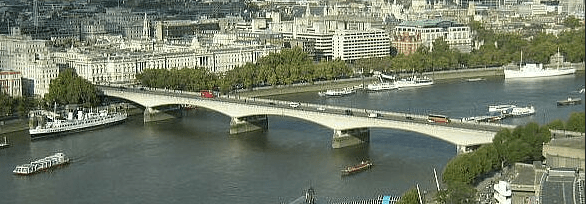
It was with great dismay that many B&M fans read on the author’s Twitter the other day that this would be the last novel in the series. After all, the two fellows are impossibly old, given all they have witnessed and been through together, so it was not unexpected. Sad times then, but the last few pages of the book are as poignant – and beautifully written – as anything you could ever wish to read. Think Julius Caesar, Act III, Sc2, line 148. And yes – I did. London Bridge Is Falling Down is published by Doubleday and is out now.





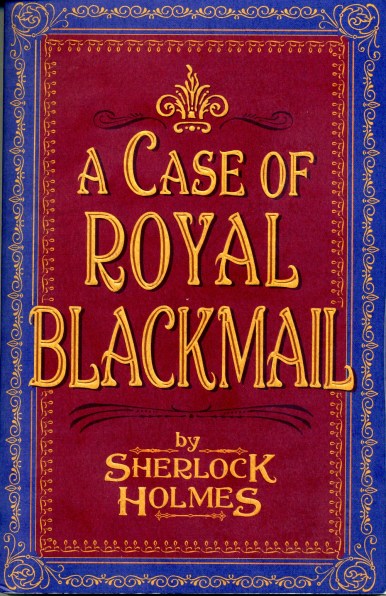 We are in London in the summer of 1879, and young Holmes has yet to meet the man who will write up his greatest cases. Holmes works for a guinea a day, and is striving to build his reputation. Within the first few pages, he has been hired to investigate two cases on behalf of a man who was already a celebrity, and another who would become infamous in his lifetime, but revered and admired after his death. The celebrity is Albert Edward, Prince of Wales, the future King Edward VII, a notorious Lothario whose battleground has been country houses and mansions the length and breadth of the country, the vanquished being a long list of cuckolded husbands. It seems that the heir to the throne has been in the habit of entering his sexual achievements in a diary – a kind of fornicator’s Bradshaw, if you will – but it has gone missing, and Holmes is charged with recovering it.
 One hundred pages in, and it is clear that the author is enjoying a glorious exercise in name-dropping. James McNeill Whistler, Lillie Langtry, Francis Knollys, Patsy Cornwallis-West, Frank Miles, Sarah Bernhardt, John Everett Millais and Rosa Corder (right) are just a few of the real life characters who make an appearance, and it is clear that ‘Sherlock Holmes’ moves in very elegant circles.


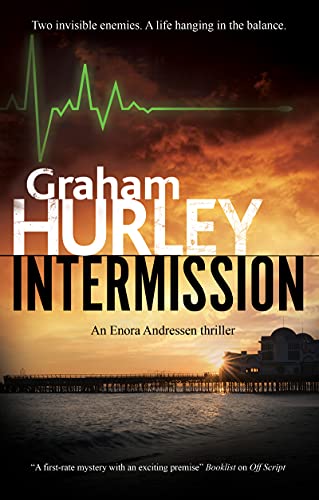 Intermission is, I am sure, the only novel I have read so far that has, as its spine, the Covid-19 pandemic. The action begins in that fateful early spring of 2020, and Hayden Prentice learns that one of his old friends, a former bent copper known as Fat Dave has been laid low with the virus and is in the local ICU, and not expected to live. Visiting is, of course, completely off limits, but the sight – via a video link – of his friend expiring amidst a sea of tubes and monitors chills HP to the bone. He travels from his Dorset manor house and summons Enora down to Portsmouth, where they have been given the use of a shabby flat owned by HP’s solicitor.
 The action skips thirty years, and Jim Mulcahy who was the rookie detective covering the girl’s disappearance is now Superintendent, and heading for retirement. When recreational scuba divers find the rusting remains of a car at the bottom of a local lough with a skeleton on the back seat – which turns out to be the headless remains of Frank Rudden – the case is reopened. It was Rudden who drove off in his VW Beetle that fateful night three decades earlier, with Hazel Devereaux as his passenger. We are now, of course, in the age of smartphones and internet search engines, and it doesn’t take the Irish coppers long to link this cold case to several similar murders in that Irish home-from-home, Boston Massachusetts. Detective Ray Logue is sent to liaise with the Boston PD, in particular Officers Sam Harper and Olivia Callaghan.
 As Logue, Callaghan and Harper close in on who they think is the killer, Kevin McManus bowls us a couple of googlies – or perhaps I should say, since we are in Boston, throws down some curve balls – and all is not what it seems to be.




 *
*

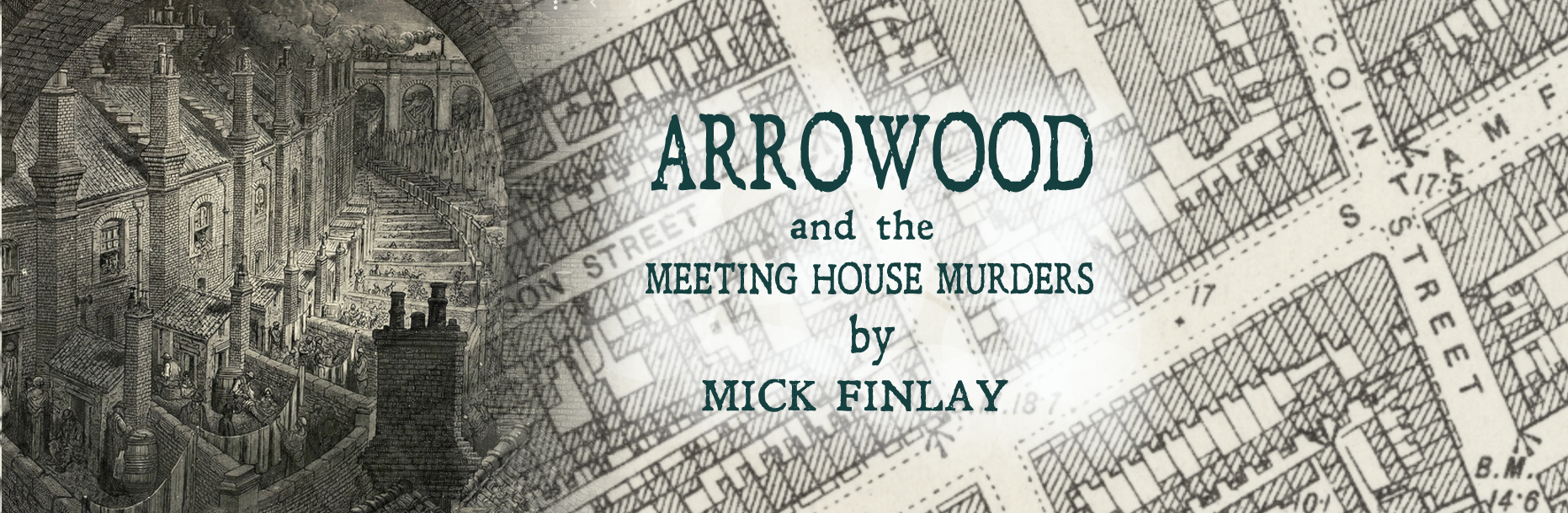
 The narrator is Norman Barnett, William Arrowood’s equally impoverished assistant. Neither man is a stranger to tragedy. Barnett’s wife, ‘Mrs B’ died some months previously, while Isabel Arrowood left her husband to live with a richer man in Cambridge. He died from cancer, leaving her with his baby in her womb. She has since been taken back by her husband, but all is far from well between them. We are in the final years of the 19th century, a few decades since Gustave Doré produced his memorable – and haunting – engravings of the darker side of London, but Arrowood’s London is hardly a shade lighter. Poverty, death and illness are everywhere – in the next room, or just around the corner.


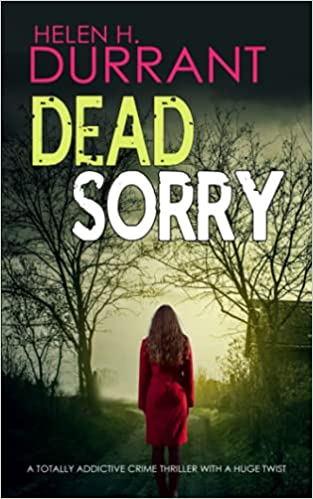 As the plot develops we learn that the dead woman, Becca O’Brien, was pretty much human wreckage, drug addicted and feckless. Interestingly, her daughter (who now lives in sheltered accommodation0, was involved in an act of criminality which happened twenty five years earlier (see first paragraph) at a moorland location called Gorse Farm, where human bones have recently been discovered. In an ostensibly separate plot thread, Calladine is being threatened by a criminal adversary (something of a stage eastern European gangster) called Lazarov. When Lazarov threatens to harm Calladine’s grand-daughter if he doesn’t facilitate the Bulgarian’s take-over of the Leesdon drug scene, the tension ratchets up several notches.


 fullybooked2017