

The introduction to this feature on Colin Watson,
including a biographical timeline, is here.
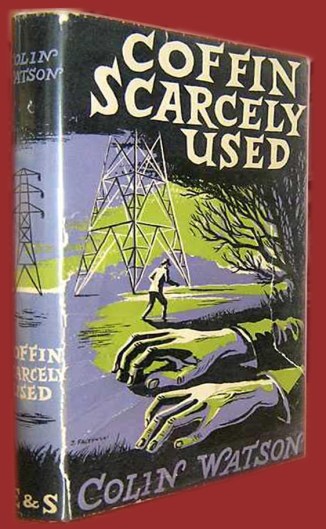 Coffin Scarcely Used – the first of The Flaxborough Chronicles – begins with the owner of the local newspaper dead in his carpet slippers, beneath an electricity pylon, on a winter’s night. Throw into the mix an over-sexed undertaker, a credulous housekeeper, the strangely shaped burns on the hands of the deceased, a chief constable who cannot believe that any of his golf chums could be up to no good, and a coffin containing only ballast, and we have a mystery which might be a Golden Age classic, were it not for the fact that Watson was, at heart, a satirist, and a writer who left no balloon of self importance unpricked.
The permanent central character of Inspector Walter Purbright is beautifully named. ‘Purbright’ gives us a sense of sparky intelligence gleaming out from a solid, quintessentially English, impermeable foundation. He is described as a heavy man, with corn coloured hair. He has a deceptively reverential manner when dealing with the aldermen and worthies of Flaxborough, but he is no-one’s fool.
The sheer joy of this book in particular, and the Flaxborough novels in general, is the language. Perhaps it looks back rather than forward, but there are many modern writers who would happily pay homage to the unobtrusive Lincolnshire journalist. Of Mr Chubb, the Chief Constable, Watson observes:
“Not for the first time, he was visited with the suspicion that Chubb had donned the uniform of head of the Borough police force in a moment of municipal confusion when someone had overlooked the fact that he was really a candidate for the curatorship of the Fish Street Museum.”
Of the detecting skills of Sergeant Love, Purbright’s long-suffering subordinate, we learn:
“The sergeant was no adept of self effacing observation. When he wished to see without being seen, he adopted an air of nonchalance so extravagant that people followed him in expectation of his throwing handfuls of pound notes in the air.”
With such an ability to turn a phrase, it is almost irrelevant how the book pans out, but Watson does not let us down. Purbright uncovers a conspiracy involving loose women, a psychotic doctor and a distinctly underhand undertaker – hence the title. Watson himself remains mostly unknown to today’s reading public, but is rightly revered by connoisseurs of crime fiction. He was politically incorrect before the phrase was even invented and, although his pen pictures of self important provincial dignitaries are sharply perceptive, they also portray a fondness for the mundane and the ordinary lives lived beneath the layers of pretension.
There were to be be eleven more Flaxborough novels, and the final episode was Whatever’s Been Going On At Mumblesby? It again features Mr Bradlaw, the shamed undertaker from the very first novel. He has served his time for his part in those earlier misdeeds, however, and has returned to Flaxborough, thus giving the series a sense of things having come full circle. In 2011, Faber republished the series digitally, but the Kindle versions are not cheap and you might be better off seeking a secondhand paperback.
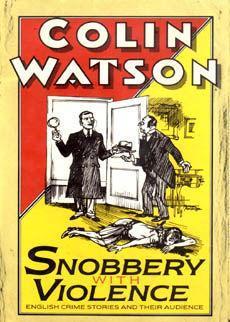 In addition to such delightful titles as Broomsticks Over Flaxborough and Six Nuns And A Shotgun (in which Flaxborough is visited by a New York hitman) Watson also wrote an account of the English crime novel in its social context. In Snobbery With Violence (1971), he sought to explore the attitudes that are reflected in the detective story and the thriller. Readers expecting to find Watson reflecting warmly on his contemporaries and predecessors will be disappointed. The general tone of the book is almost universally waspish and, on some occasions, downright scathing.
He is particularly unimpressed by the efforts of writers such as H C McNeile (Sapper), Arthur Henry Sarsfield Ward (Sax Rohmer) and E W Hornung. Whereas modern commentators might smile indulgently at the activities of Bulldog Drummond, Denis Nayland Smith and Arthur J Raffles, and view them as being ‘of their time’, Watson has none of it. He finds them racist bullies, insuperably snobbish and created purely to pander to the xenophobic and blinkered readership of what we would now call Middle England.

Watson’s apparent contempt for the Public School ethos prevalent in these writers of the first part of the twentieth century seems, at first glance, strange. He was educated at Whitgift School in Croydon, but in his day the school was a direct grant school, meaning that its charter stipulated that it provide scholarships for what its founder, Archbishop John Whitgift, termed,”poor, needy and impotent people” from the parishes of Croydon and Lambeth. The school has been fully independent for many years, but in Watson’s time there may have been an uneasy mix of scholarship boys and those whose wealthy parents paid full fees. Despite Watson and other local lads having gained their places by virtue of their brains, it is quite possible that they were looked down on by the ‘toffs’ who were there courtesy of their parents’ wealth.
As Watson trawls the deep for crime writers, even Dorothy L Sayers doesn’t escape his censure, as he is irritated by Lord Peter Wimsey’s foppishness and tendency to make snide remarks at the expense of the lower classes. Edgar Wallace and E Phillips Oppenheim who, between them, sold millions of novels, are dismissed as mere hacks, but he does show begrudging admiration for the works of the woman he calls ‘Mrs Christie’, despite rubbishing her archetypal English village crime scene, which he scorns as Mayhem Parva. Watson admires Conan Doyle’s clever product placement, Margery Allingham’s inventiveness and ends the book with a reasonably affectionate study of James Bond, although he is less than sanguine about 007’s prowess as a womaniser:
‘The sexual encounters in the Bond books are as regular and predictable as bouts of fisticuffs in the ‘Saint’ adventures or end-of-chapter red herrings in the detective novels of Gladys Mitchell, and not much more erotic.”
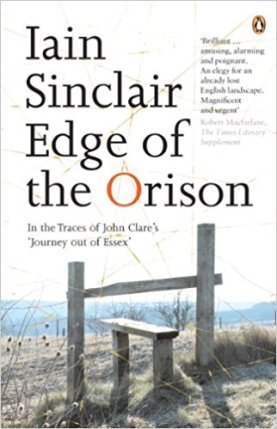 In the end, it seems that Watson had supped full of crime fiction writing. Iain Sinclair sought him out in his later years at Folkingham, and wrote
“Gaunt, sharp-featured, a little wary of the stranger on the step, Watson interrupted his work as a silversmith. Eyeglass. Tools in hand. He couldn’t understand where it had all gone wrong. His novels were well-received and they’d even had a few moments of television time, with Anton Rodgers as the detective. The problem was that Watson, lèse-majesté , had trashed Agatha Christie in an essay called ‘The Little World of Mayhem Parva’.
Watson put away his instruments, took me upstairs to the living room. He signed my books, we parted. He was astonished that all his early first editions were a desirable commodity while his current publications, the boxes of Book Club editions, filled his shelves. He would have to let the writing game go, it didn’t pay. Concentrate on silver rings and decorative trinkets.” (Iain Sinclair “Edge of the Orison” Hamish Hamilton 2005.)



 The Dancing Man was published in 1971, and is set in Welsh hill country. An engineer, Mark Hawkins travels to a remote house to collect his late brother’s belongings. Dick Hawkins was an archaeologist by profession and mountaineering was his drug of choice. He set off one day for the nearby mountains, and never returned.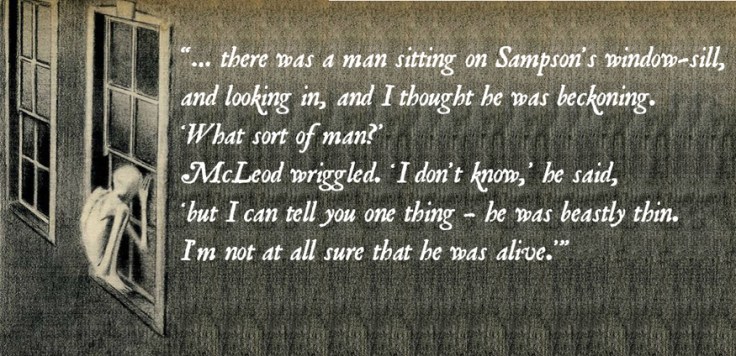

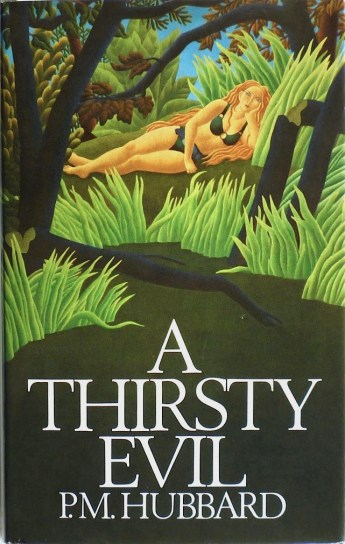 With A Thirsty Evil (1974) Hubbard once again mines Shakespeare for his title, in this case, Measure For Measure.
 The story moves swiftly on. Hubbard’s novels are, anyway, relatively short but his narrative drive never lets us rest. Beth’s carnality and opportunism get the better of Mackellar in a brief but shocking encounter, but this is only a staging post on the path to a violent and tragic conclusion to the novel. Mackellar survives, but he writes his own epitaph in the very first chapter.

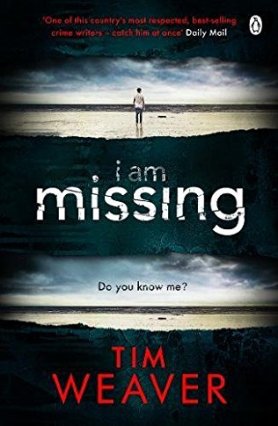 Raker agrees to take on the case on a more-or-less pro bono basis. Whatever and whoever Richard Kite once was, he has not brought wealth of any kind with him into his new life. Raker’s initial trip south to meet Kite is less than fruitful. Kite only recalls two shadowy images from his past; one is that he is looking out across a lonely beach to a grey expanse of water; is it the sea, perhaps, or a river? The other image is just as enigmatic; Kite sees a television screen, and on it is a graphic of a broadcasting pylon emitting what seems to be a children’s programme.
 Meanwhile, Weaver (right) gives us what seems to be a parallel but unconnected narrative. Two girls, sister and step sister, apparently living in a remote moorland community, perhaps in the north of England, have taken to sneaking out of their house after dark, and climbing up the hill onto the moors, where they have constructed an imaginary and malevolent presence out there in the wind and rain-swept darkness. Malevolent it certainly seems to be, but is it just a figment of the girls’ lurid imaginings?


 Charles Harris (right), a best-selling non-fiction author and writer-director for film and television sets in train a disastrous serious of mishaps, each of which stems from Kati’s ostensibly harmless error. Too exhausted from her daily grind making sure that Every Little Helps at everyone’s favourite supermarket, she sends her hapless son, Liam, off to the cashpoint, armed with her debit card and its vital PIN. Sadly, Liam never makes it home with the cash, the pizza guy remains unpaid, and Kati Glass is pitched into a nightmare.
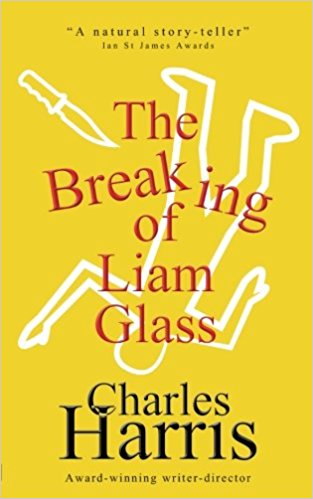 Trying to find out who stabbed Liam Glass is Detective Constable Andy Rackham. He is a walking tick-box of all the difficulties faced by an ambitious copper trying to please his bosses while being a supportive husband and father. The third member of this unholy trinity is Jamila Hasan, an earnest politician of Bengali origin who senses that the attack might be just the campaign platform she needs to ensure that she is re-elected. But what if Liam’s attackers are from her own community? Sadly, in her efforts to gain credibility on the street, Jamila has been duped.


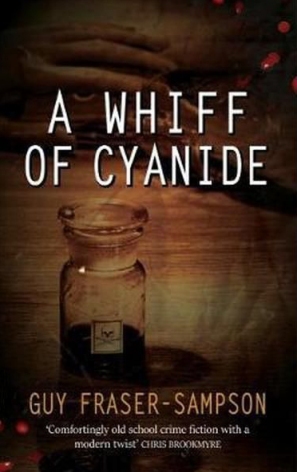 Readers of the two previous books in the Hampstead Murders series, Death In Profile and Miss Christie Regrets, will know what to expect, but for readers new to the novels here is a Bluffers’ Guide. The stories are set in modern day Hampstead, a very select and expensive district of London. The police officers involved are, principally, Detective Superintendent Simon Collison, a civilised and gentlemanly type who, despite his charm and urbanity, is reluctant to climb the promotion ladder which is presented to him. Detective Sergeant Karen Willis is, likewise, of finishing school material, but also a very good copper with – as we are often reminded – legs to die for. She is in love, but not exclusively, with Detective Inspector Bob Metcalfe, a decent sort with a heart of gold. If he were operating back in the Bulldog Drummond era he would certainly have a lantern jaw and blue eyes that could be steely, or twinkle with kindness as circumstances dictate.
 Collison, Metcalfe, Willis and Collins have an ever lengthening list of questions to be answered. Why was Ann Durham brandishing a bottle of cyanide as she presided over one of the convention panels? Who actually wrote her most popular – and best selling – series of novels? Fraser-Sampson (right) spins a beautiful yarn here, with regular nods to The Golden Age during a convincing account of modern police procedure. Not only is the crime eventually solved, but he provides us with a delightful solution to the Willis – Metcalfe – Collins love triangle.
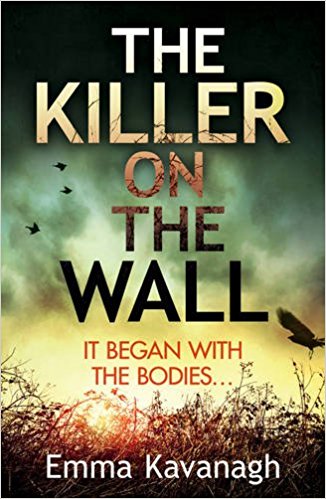

 The name Briganton, to most British people, conjures up a series of murders, where the victims were dragged up the steep hillside and posed, in death, gazing with sightless eyes out over the windswept moorland. But all that was long ago. The killer, Heath McGowan, was brought to justice by the determination of Eric Bell, a local policeman who has since been promoted and has achieved national celebrity due to his solving the case. His triumph had added poignancy because it was his teenage daughter, Isla, who discovered the first bodies while out for an early morning run.


 He has killed at the bidding of his masters, who are shadowy government types, but now things have changed. Stoner has been stitched up, people close to him have been badly hurt, and he has retreated from the his former world. He is shattered, mentally and physically.
 Like its two predecessors, The Redemption of Charm is immensely entertaining and another bravura performance from Frank Westworth (right), who shares his creation’s love of Harleys and fine guitars. We are led to believe that a love of killing and a knowledge of inventive ways to use an SAS dagger are skills that, to date, divide the two men.
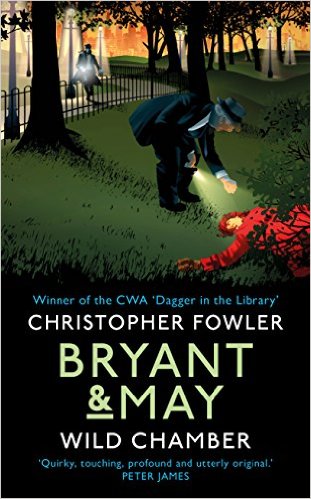

 Other murders follow, and each has been committed in one of the parks and gardens – the Wild Chambers – which are scattered throughout central London. Are the gardens linked, like some erratically plotted ley line? Why are the murders connected to a tragic freak accident in a road tunnel near London Bridge? Why are the murder sites speckled with tiny balls of lead?
 Along the way, Fowler (right) has the eagle eye of John Betjeman in the way that he recognises the potency of ostensibly insignificant brand names and the way that they can instantly recreate a period of history, or a passing social mood. At one point, Bryant tries to pay for a round of drinks in a pub:


 fullybooked2017