ELIOT’S PESSIMISM comes to mean more and more the older I get. The contrast between the annual rebirth of ‘the dead land’ gets starker with every little personal infirmity that old age brings. But, hey-ho, that’s another winter ticked off, and the poignant lines from Bilbo’s song can be put back in the box for another few months:
 Leaving aside the morbid musings, there’s no shortage of cruelty in the latest crop of excellent crime reads on the Fully Booked shelf. For me, the highlight has to be the latest Tom Thorne novel, where our man goes head-to-head with a particularly nasty specimen of humanity who bears out the adage that the female is deadlier than the male.
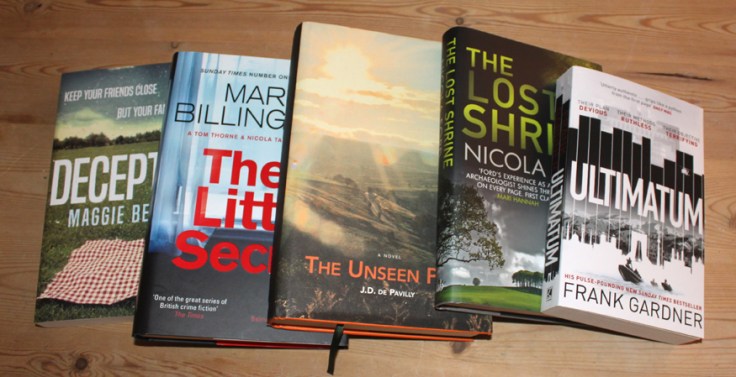
DECEPTION by Maggie Belvoir
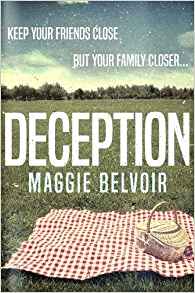 Set in the university town of Cambridge, Deception tells the tale of a how an ostensibly ideal family of perfect children, loving parents and comfortable circumstances is rent asunder when their good deed – adopting a troubled schoolgirl – certainly does not go unpunished. Add to the mix a nasty murder and a conflicted police officer, and we have a witches’ cauldron of dark deeds against the serene background of an ancient seat of learning. Maggie Belvoir has lived in Cambridge for 40 years. She is writing under a pseudonym as members of her social and family circle, may be shocked at some of the scenes depicted in her novel. Published by Matador, Deception is out now.
THEIR LITTLE SECRET by Mark Billingham
 London copper Tom Thorne has become an institution for those who like a brilliant police procedural with a distinctly individual cast list, a Pandora’s Box of nasty villains and plot twists to confound the best of us. A conman whose set-piece scam is to befriend wealthy women and separate them from their fortune meets his match when he chooses his next victim – only to find that she is a borderline insane psychopath. You can get your copy of Their Little Secret from 2nd May, and it’s published by Little, Brown.
For more on Mark Billingham on Fully Booked, follow this link.
THE UNSEEN PATH by JD De Pavilly
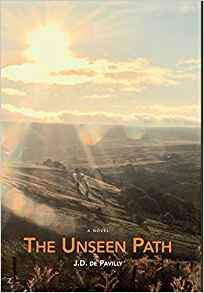 For starters, the copy I received today is a beautifully presented hardback, with that simplest, but most welcome delight – a ribbon bookmark. The novel is centred around the life of a security officer, Andy Bowson whose witnessing of the death of a notorious jihadi draws him down into a vortex of corruption, international subterfuge and political mayhem. As if Bowson hasn’t enough to deal with, his personal life has begun to unravel at an alarming rate, and when his wife disappears on Exmoor while driving to visit her parents, he discovers a sinister link to what appears to be a vigilante campaign against the Islamic community. I normally take publicity blurbs with several sizeable grains of NaCl, but one line intrigued me here:

This thriller marks the debut of an exciting new writing talent, and will be published by Matador on 28th April.
THE LOST SHRINE by Nicola Ford
 I confess a vested interest here in that one of my sons is a professional archaeologist who is employed by a major construction company. He identifies and records ancient traces before they are covered with tons of steel and concrete. In the real world, this commercial work keeps archaeology alive, and so the Nicola Ford’s fictional sleuth Clare Hills and her university colleague Dr David Barbrook know they have to accept, albeit reluctantly the developers’ shilling. Murder, however, is a different matter, and a corpse found on an historical site high on a Cotswold hill leads Hills and Barbrook into dangerous territory. The Lost Shrine is published by Alison &Busby and is out on 23rd May. Please read the Fully Booked review of the first novel in this series, The Hidden Bones.
ULTIMATUM by Frank Gardner
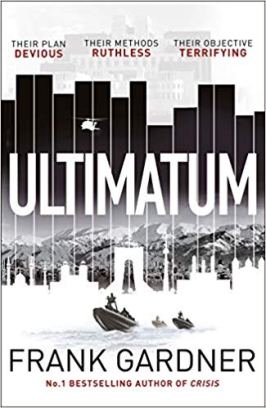 Intelligence agent Luke Carlton is the creation of the celebrated BBC security correspondent Frank Gardner. Carlton made his debut in the 2017 best-seller Crisis, and now he returns for a second adventure set in that apotheosis of anti-Western malice, Iran. The feared Iranian Revolutionary Guard Corps are working on a weapon which will destroy the fragile international balance of power. When a search-and-destroy mission involving Carlton goes disastrously wrong, the clock starts to tick on a potentially devastating military and political time bomb. Ultimatum is published by Corgi and will be available from 31st May.


 nspector Shan Tao Yun is a Chinese policeman whose honesty and integrity has discomforted the faceless members of whatever dreadful committee deals with public employees who don’t toe the line. Considered too valuable to be dispatched with a 9mm Parabellum round, he is exiled to the wilds of Tibet to be the constable for the settlement of Yangkar. As an extra insurance, his son is arrested and kept in a prison camp; if Shan’s independent streak becomes too troublesome, then his son will simply become collateral damage.
 In Bones Of The Earth (the tenth and final book in the series) Shan becomes involved in a complex murder mystery involving a massive civil engineering project and a dead American.archaeology student, whose father has come to Tibet to investigate if his daughter’s death was, as the authorities declare, an unfortunate accident or something more sinister. As ever in the series, Shan’s complex relationship with Colonel Tan, the governor of Lhadrung county, is central to the narrative. Tan is as brutal and ruthless as his party masters need him to be, but there is a tiny spark of something – perhaps not integrity, but something close – which enables him to do business with Shan.
 he sheer intensity of the detail Pattison adds to the narrative is astonishing, particularly when he is describing the humdrum world of Yangkar. As eavesdroppers, flies on the wall or what you will, it seems a grey kind of place; the ubiquitous breeze block is everywhere, naked light bulbs swing from the ceilings and even the food – rice, noodles, vegetables, dumplings – is functional and plain. Yangkar is, of course, dwarfed by the sheer immensity of the mountain peaks and snow fields. When colour emerges it is not chromatic in a visual sense, but in the indomitable spirituality and humanity of the Tibetans themselves. Try as they might, the Chinese rarely come close to understanding or even identifying the primal bond the people of Tibet have with their religion. It is a bond partly forged in fear, but also made of a oneness with the caves, the rocks and the wild peaks where the gods – and devils – dwell.
 I doubt that Pattison (right) is on the diplomatic Christmas Card list of President Xi Jinping and, were the author to fly into Lhasa, he is unlikely to be greeted with open arms. His disdain for the charmless and monolithic mindset of The People’s Republic is obvious, but Inspector Shan has to stay alive and keep himself on the outside of the Re-education Camps. Shan reminds me of another great fictional detective who has to do business with monsters: the late Philip Kerr’s Bernie Gunther sits down with minsters such as Goebbels and Heydrich; he will even smoke a cigar with them and accept a snifter of Schnapps while, metaphorically, holding his nose. Such is Shan’s relationship with his Chinese masters. He is a realist. If he says the wrong thing he (or his imprisoned son) is dead. Raymond Chandler’s immortal words fit the Inspector very well:


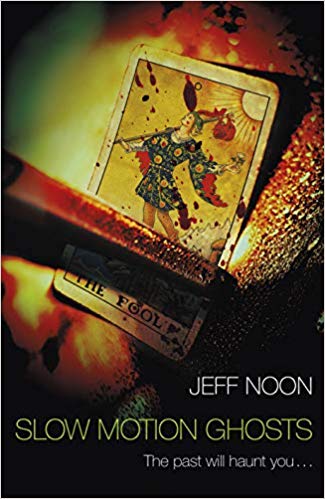 Later that year, with Brixton quieter, despite other English towns and cities erupting in copycat anger, Hobbes has become embroiled in a bitter internal dispute. A fellow copper, Charlie Jenkes (who rescued Hobbs from the mob on that fateful April night) after being indicted for savagely beating a black suspect, has taken his own life. And the officer who testified to Jenkes’s violence? Henry Hobbes, who, with that single act of honesty, is branded as a Judas by his own colleagues.


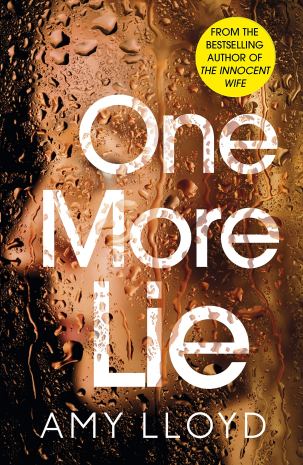 Two children, Sean and Lilly, murder a third child, Luke – disabled physically and mentally. In a case that whips up a storm of public revulsion, both are sentenced to long prison terms. Eventually, both are released on licence subject to supervision. Lilly is now Charlotte, ankle-tagged and nervous about a new world full of strange things that never existed when she lost her liberty all those years ago.
 Secondly, and inevitably, we are drawn into acting as judge and jury about the complex matter of culpability for Luke’s death. Remember, there is no Him:Then. We only see the young Sean through Lilly’s eyes and it seems, for a time at least, that he is the dangerous one, the wild card, the ten year-old Dark Angel, if you will. For sure, he is not neglected in the sense that his home life attracts the attention of Children’s Services, even though the family routine is haphazard. By contrast, Lilly’s life with her bruised and beaten mother ends in tragedy, although once she has moved in with her aunt she receives love, compassion and care. But is she already too badly damaged from the nightmare of her mother’s death for the new life to heal the wounds?

 I have become a great fan of the Crampton of the Chronicle mysteries. Despite having multifarious murders and diverse dirty deeds, they are breezy, funny, beautifully written and they have a definite feel-good factor. Peter Bartram (left) is an old newspaper hand himself, and the background of a 1960s newsroom in a provincial newspaper is as authentic as it can get. Colin Crampton’s latest journey into the criminal underworld of Brighton is The Comedy Club Mystery. The cover blurb tells us:
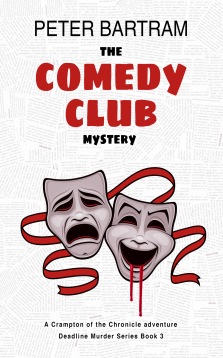 “When theatrical agent Daniel Bernstein sues the Evening Chronicle for libel, crime reporter Colin Crampton is called in to sort out the problem.
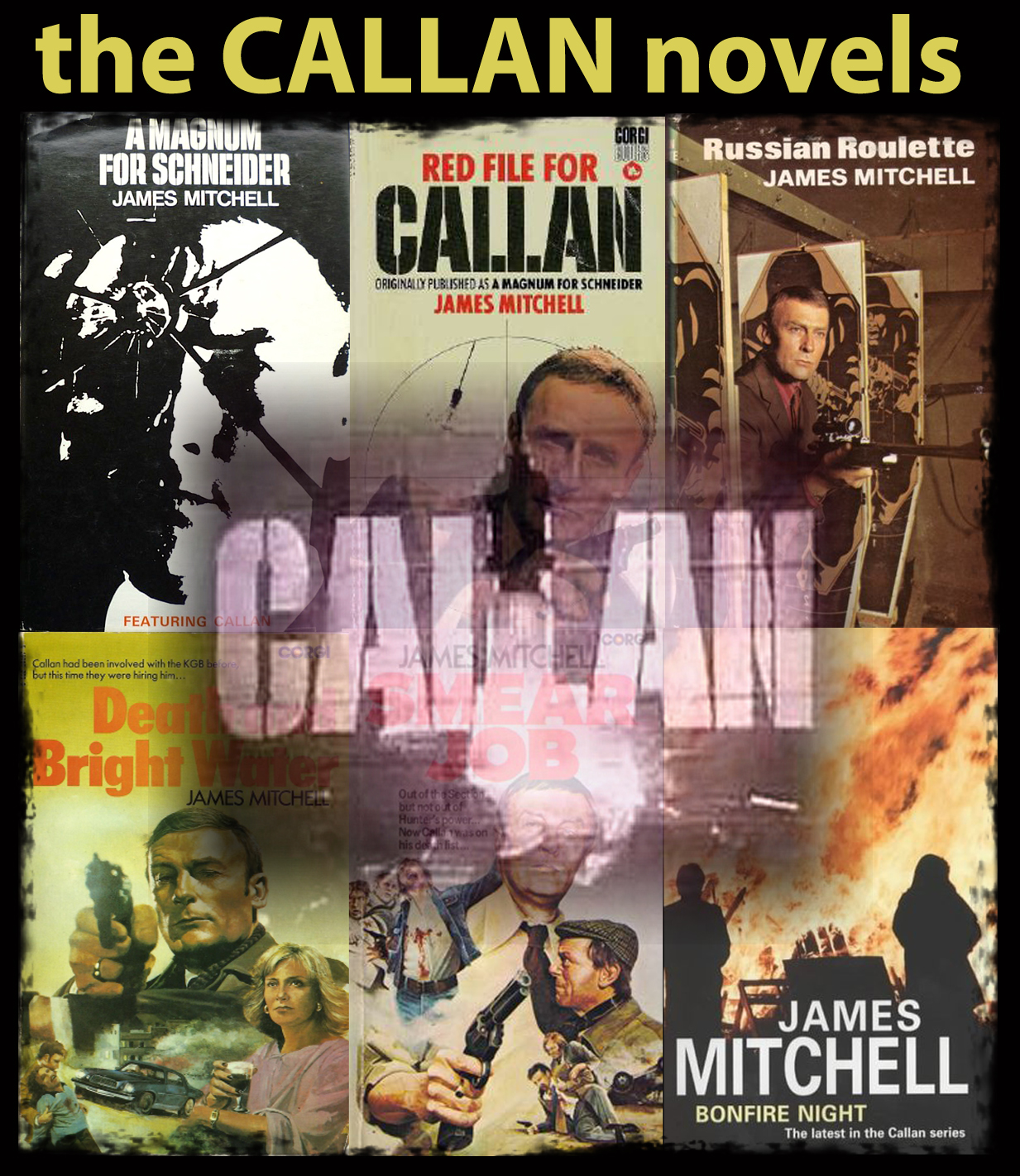
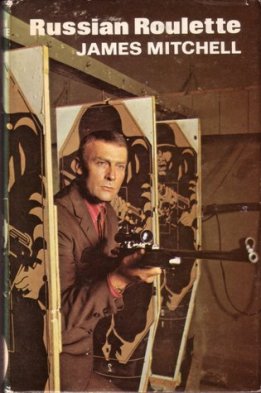
 The first Callan novel, and perhaps the locus classicus of all Callan plots, on page and screen: A disillusioned Callan has left the Section and is living and working in reduced circumstances, until “persuaded” by Hunter to return and carry out one more job. The target is Herr Schneider who, once Callan knows more of him, doesn’t seem to be as black as he’s painted…

 Although published in 1973 this book makes no reference to the events of high drama with which the final TV series concluded a year earlier. Here, Callan is still settled in the Section and all the supporting characters are in place.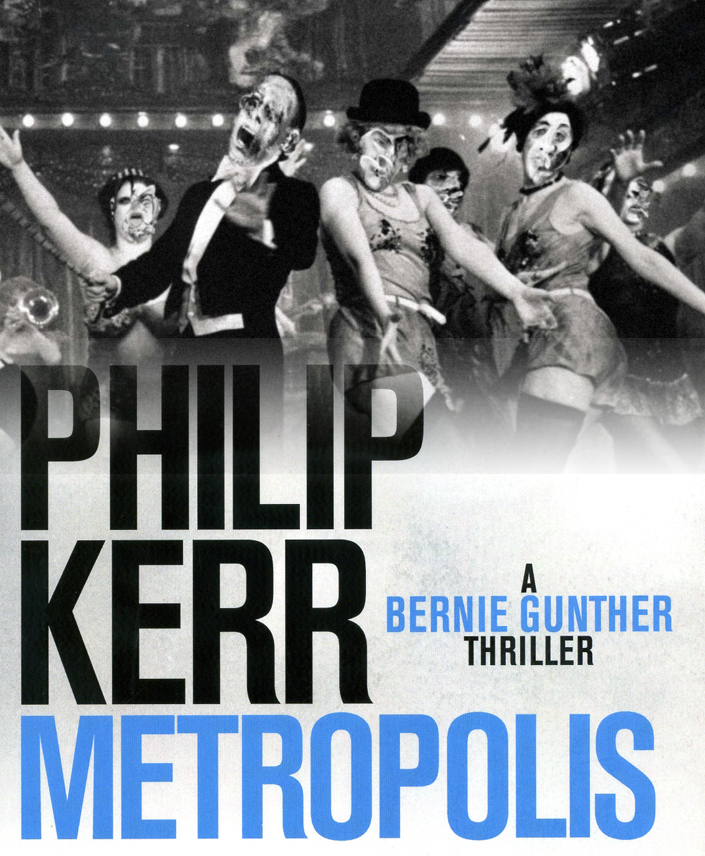

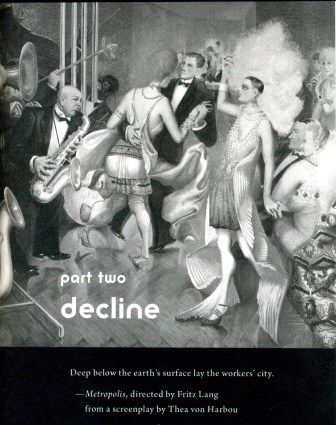
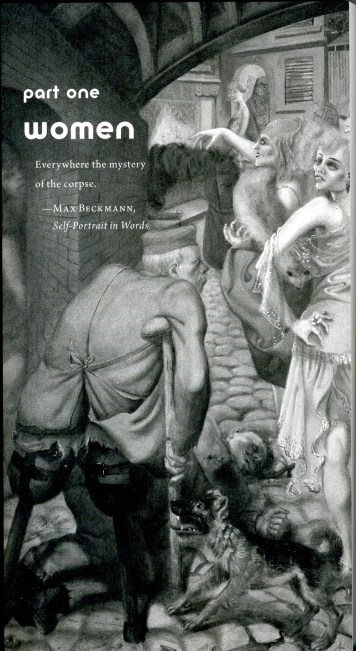 First up, Metropolis is a bloody good detective story. Philip Kerr gives us a credible copper, he lets us see the same clues and evidence that the central character sees and, like all the best writers do, he throws a few false trails in our path and encourages us to follow them. We are in Berlin in the late 1920s. A decade after the German army was defeated on the battlefield and its political leaders presided over a disintegrating home front, some things are beginning to return to normal. Yes, there are crippled ex-soldiers on the streets selling bootlaces and matches, and there are clubs in the city where the determined thrill-seeker can indulge every sexual vice known to man – and a few practices that surely have their origin in hell. The bars, restaurants and cafes of Berlin are buzzing with talk of a new political party, but this is Berlin, and Berliners are much too sophisticated and cynical to do anything other than mock the ridiculous rhetoric coming from the National Socialists. Besides, most of them are Bavarians and since when did a Bavarian have either wit, word or worth?
 Metropolis sees Gunther in pursuit of a Berlin Jack The Ripper who is certainly “down on whores.” Four prostitutes are killed and scalped, but when the fifth girl to die is the daughter of a well-connected city mobster, her death is a game-changer, and Gunther suddenly has a whole new world of information and inside knowledge at his fingertips. He is drawn into another series of killings, this time the shooting of disabled war veterans. Are the two sets of murders connected? When the police receive gloating letters, apparently from the perpetrator, does it mean that someone from the emergent extreme right wing of politics is, as they might put it, “cleaning up the streets”?
 Mölbling helps Gunther disguise himself as one of the disabled ex-soldiers, as he reluctantly accepts the role in order to attract the killer who, in his letters to the cops, signs himself Dr. Gnadenschuss. Gunther’s trap eventually draws forth the predator, but not in the way either he or his bosses might have anticipated.
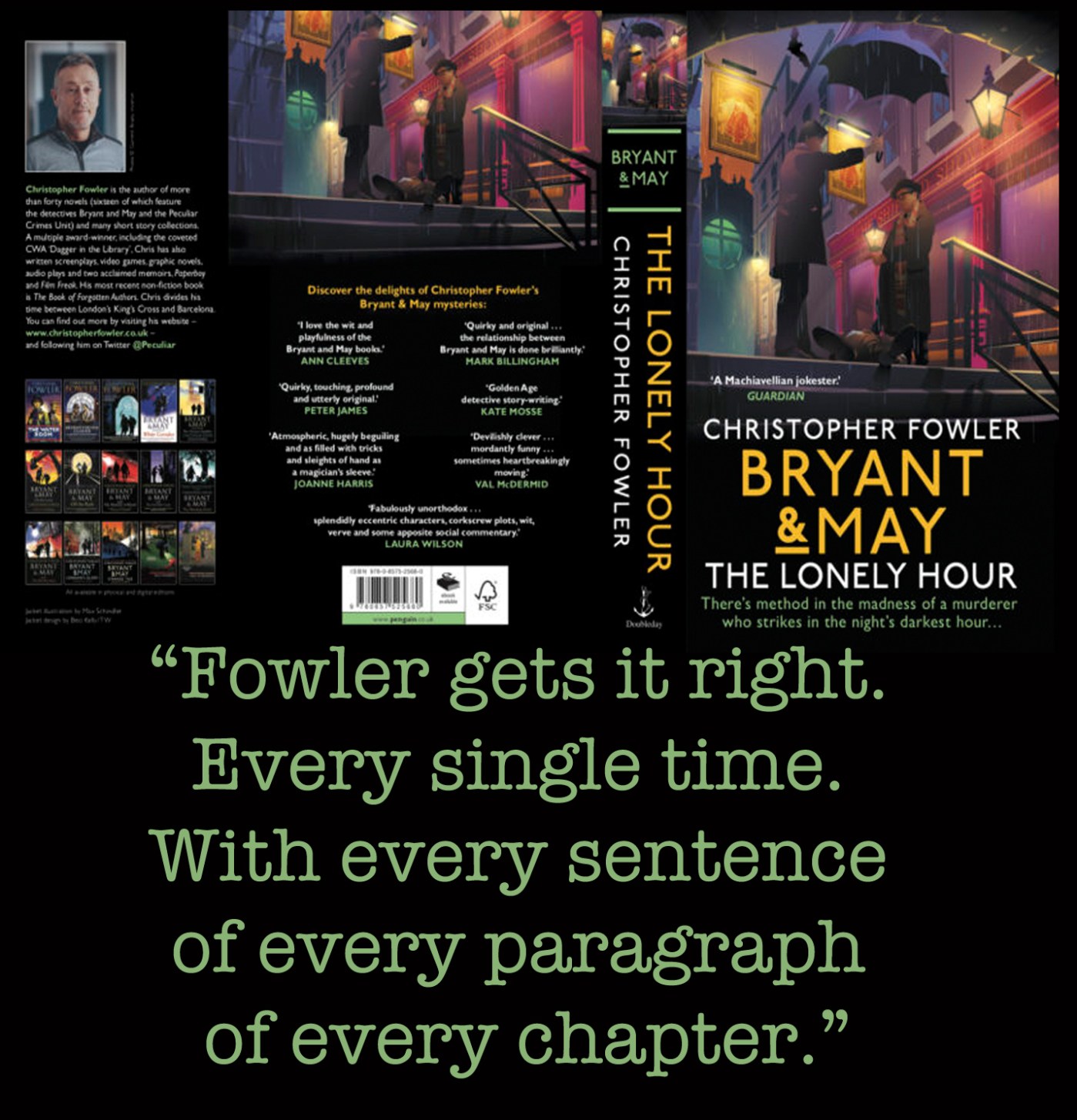

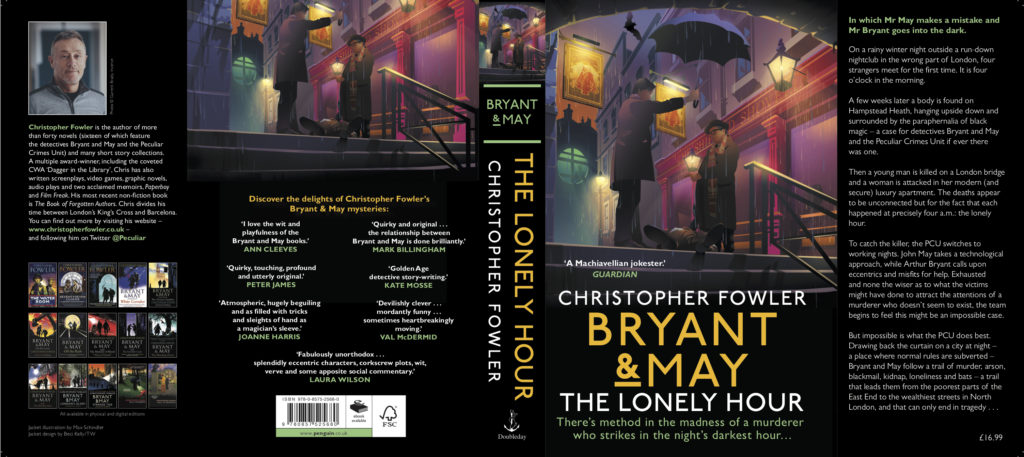
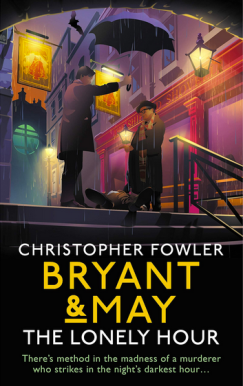 Bryant and May – and the rest of the Peculiar Crimes Unit – have been threatened with closure before, but this time their impatient and disapproving police bosses mean business. The PCU, both collectively and individually flounder around trying to work out what connects the corpses, and who is expertly wielding the trocar. Like Andrew Marvell’s ‘Time’s Winged Chariot’, the accountants and political schemers of the Metropolitan Police are ‘hurrying near’, and failure to catch this killer will certainly mean that the shambolic HQ of the Peculiar Crimes Unit on Caledonian Road will soon be in need of new tenants.
 Thanks to Bryant’s genius, the mystery is solved and the killer brought to justice, but these are certainly the grimmest days ever for the PCU, and as this brilliantly entertaining story reaches its conclusion, Fowler (right) slowly but irrevocably turns the tap marked Darkness to its fully open position. The Lonely Hour is published by Doubleday