The final five in my personal list of the best twenty five British TV detectives all have one thing in common, and it is that they were dominated by bravura performances from the lead characters. Of course the other twenty actors, Helen Mirren, George Baker, Rupert Davies et al were good – maybe even excellent – but these five were in a different league.
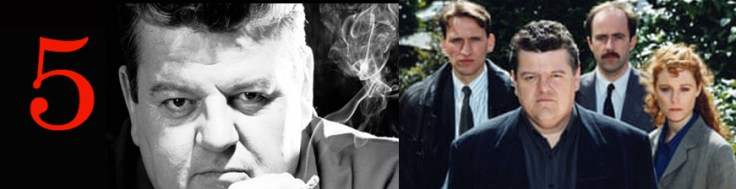
A big man, playing an outsize role – that was Robbie Coltrane’s portrayal of Eddie ‘Fitz’ Fitzgerald, the criminal psychologist whose astonishing powers of analysis gave him the nickname Cracker. Fitz smoked too much, drank too much, gambled way, way too much; in so many ways, especially for his long suffering wife (Barbara Flynn) and the police officers who employed him (Christopher Eccleston and Geraldine Somerville), the overweight and overbearing Scotsman simply was too much. Cracker was no Sunday evening show to snuggle up with; it was brutal, bleak and frequently uncomfortable viewing, featuring some genuinely disturbed and disturbing criminals, perhaps none more so than the truly frightful Albie Kinsella (Robert Carlyle). There were three series between 1993 and 1995, with two specials in 1996 and 2006. The series was set in Manchester, but the initial writing by Jimmy McGovern, and the inclusion of such actors as Ricky Tomlinson somehow gave the shows a Liverpool mood. This was never more evident than the episodes featuring the murderous Kinsella, who claimed that much of his rage was fuelled by the injustices which followed the Hillsborough disaster. There were moments of bitter humour, particularly in the exchanges between Fitz and some of the more unreconstructed coppers:
Jimmy Beck: Shall I tell you why I can’t stand lesbians?
Eddie “Fitz” Fitzgerald: Please.
Jimmy Beck: Queers are OK, as long as I don’t turn my back on you, you’re OK. Two queers doing it, that’s two women going spare. But two lesbians doing it, that’s two men going short.
Eddie “Fitz” Fitzgerald: You can tell he reads The Guardian can’t you?
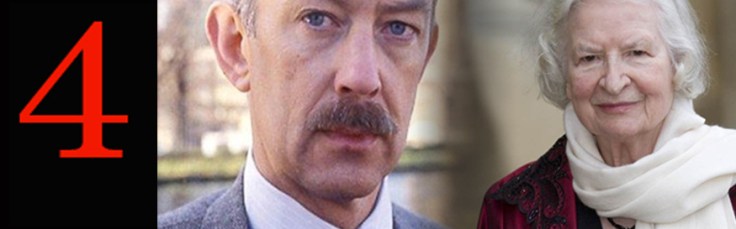
Fictional detectives can be many things. Some are brutal, some are happily married with stable families, many are embittered, doing a difficult job despite personal heartbreak Few, however, have been poets. One such was Adam Dalgliesh. His creator, PD James not only made him a published and widely respected poet, but also gave him the highest police rank of all my chosen coppers – by the end of the novels he had risen to the rank of Commander in London’s Metropolitan Police. Of the fourteen Dalgliesh novels ten were filmed for ITV, each starring Roy Marsden ans the cerebral detective. Two other novels, Death In Holy Orders and The Murder Room were commissioned by the BBC with Martin Shaw playing Dalgliesh. Marsden was perfect as the slightly old fashioned gentleman detective who, rather like Lord Peter Wimsey, was of independent means, thanks to his wealthy family. Tall, always beautifully dressed and with a studied elegance almost out of keeping with the often brutal deaths he had to investigate, he was a compelling screen presence. Dalgliesh does have romantic relationships with women, but they are usually on his own terms, and characterised by his reluctance to commit himself fully. Althouh the TV adapatations were not always resolutely faithful to the novels, they still retained the original elegance and sense that we were engaging with something rather more profound that a crime fiction potboiler. The series began with Death Of An Expert Witness in 1983 and concluded with A Certain Justice in 1998.
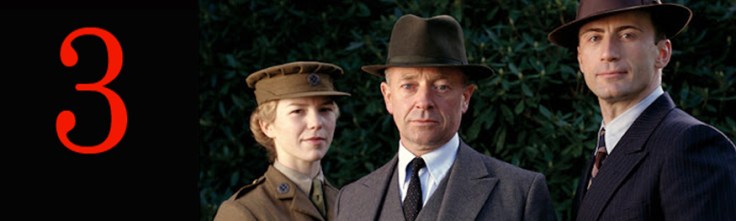
Another suave and quietly spoken detective graced our screens across eight series between 2002 and 2015. Foyle’s War had the benefit of being almost exclusively written by its creator Anthony Horowitz, and the continuity of tone and atmosphere was almost tangible. Michael Kitchen played Detective Chief Superintendent Christopher Foyle, a policeman operating on the south coast of England during WWII. He is a Great War veteran, a widower, and has a son serving as a pilot in the RAF. Wartime England was not a tranquil oasis of plucky folk all pulling together, keeping calm and ‘carrying on’. Regular criminals rejoiced in the police losing manpower to the armed services and relished the blackout regulations. A new breed of villain emerged – men and women who sought to exploit the stringent austerity regulations imposed by the wartime government. Sometimes Foyle finds these are relatively petty spivs, ‘Wholesale Suppliers’ like Private Walker of Dad’s Army, but on other occasions they are much higher up the food chain – factory bosses or high ranked civil servants. With the rather dour and troubled Sergeant Milner (Anthony Howell) at his side, and ferried everywhere by Samantha Stewart (Honeysuckle Weeks) with her ‘jolly hockey sticks’ charm, Foyle is frequently underestimated by the criminals he pursues, and often viwed with suspicion by his superiors, who suspect him of being a member of ‘the awkward squad’. The final two series saw the end of the war, and Foyle working for MI5, but Kitchen’s impeccable and understated screen presence never faltered. He had a superbly quizzical facial tic, something like a sideways grimace; when he produced that, we always knew that he knew he was being told lies, and it was only a matter of time before he upset the official apple-cart, and had the real crooks under lock and key.

I haven’t made it the basis of my long-deferred PhD thesis, so there is no peer-reviewed data, but there can be no fictional detective with as many stage and screen – and radio – impersonations as Sherlock Holmes. In my lifetime I can name Rathbone, Cushing, Wilmer, Hobbs, Merrison, Gielgud, Plummer, McKellen – and that’s without mentioning the times he was played for laughs, or modernised beyond the pale. Each of these gentlemen brought something different to the role, but for me the late Jeremy Brett will never be bettered. His untimely death in 1994 ended a series which began a decade earlier, but with forty two canonical stories completed his legacy is beyong compare. Why was he so good? Where to start! Purely physically, Brett had the dry and sometimes sardonic voice, the crisp and mannered delivery and the piercing stare. The raised eyebrow, the steepled fingertips and the eyes half-closed in contemplation were, of course, totally studied and practiced, but how effective they were. Brett was rarely called upon to demonstrate Holme’s skill as a pugilist, but nonetheless his movements gave the impression of a man of intense vitality and energy stored like a coiled spring. The wonderful production values did the series no harm at all, neither did the fact that several ‘A’ list actors graced the show with their presence, in particular Colin Jeavons as Lestrade, Eric Porter as Moriarty and Charles Gray as brother Mycroft. Watson? I think that such was Brett’s dominance that it didn’t matter too much who played Watson, and although David Burke and Edward Hardwicke put in perfectly adequate performances, neither would come to be mentioned in the same sense that we look back on Rathbone and Bruce, or Cushing and Stock. Jeremy Brett’s personal life was complex in the extreme, and his deteriorating health became a great challenge as the series reached its premature end. Perhaps it was this personal distress which made viewers of a different and more complex Holmes – a troubled man whose inner conflicts were hidden beneath the icy exterior.

And so to number one, the nonpareil. Some of my choices – or their positions in the ‘chart’ – will not have met with universal agreement, but that is fine. This, and any other ‘best of’ feature is never going to be based on irrefutable data, or numbers, or scientific evaluation. It’s all about emotional impact, memory, and whichever heart-strings are tugged. I was pointed in the direction of Colin Dexter’s Inspector Morse novels when I was an earnest young teacher at a posh preparatory school back in the mid 1970s. Last Bus To Woodstock was still relatively hot off the press and – thank God for public libraries – I followed the progress of the quirky Oxford copper into the 1980s. When TV finally caught up with the reading public, and commissioned The Dead of Jericho, broadcast in January 1987, it was a revelation. In my mind’s eye I saw Morse as being a rather younger version of his creator, but here was a revelation. John Thaw was already a TV star, but gone was the brash violence, snarling cockney slang and horribly flared trousers of The Sweeney. Instead, we were shown a private, circumspect and conflicted man. Sometimes uncomfortable in company, but bolstered professionally – and sometimes personally – by the down-to-earth solidity of Sergeant Robbie Lewis, Morse was a genuine one-off. Apparently from a humble background, his intellect encompassed rattling through The Times crossword, a love of the divine music of Mozart and Wagner and a ‘cleverness’ which made him a constant irritant to Chief Superintendent Strange, memorably played by James Grout. This will be controversial, but I contend that John Thaw took the character of Colin Dexter’s Morse and shifted it from being simply memorable, to being immortal. A screen version better than the original book? I can already hear cries of ‘heretic!’, ‘burn him!’. Sorry, but I will approach my funeral pyre with my head held high. Thaw’s Morse will live for ever in my memory, whether cruising around the streets of Oxford in his blissful red Jaguar, or hunkered down over a decent pint trying to explain something to the slightly dim Lewis (beautifully imagined by Kevin Whately) or – most memorably, alone in his house with a glass of single malt in his hand, pondering the imponderable with, perhaps, Siegfried’s funeral music from Götterdämmerung playing in the background. Nothing will ever cap this for me and, for what it’s worth I can still hum every bar of Barrington Pheloung’s wonderful theme music to what was the best detective series ever broadcast on British television.
READ PARTS ONE AND TWO OF MY BEST TV DETECTIVES
BY CLICKING ON THE IMAGE BELOW
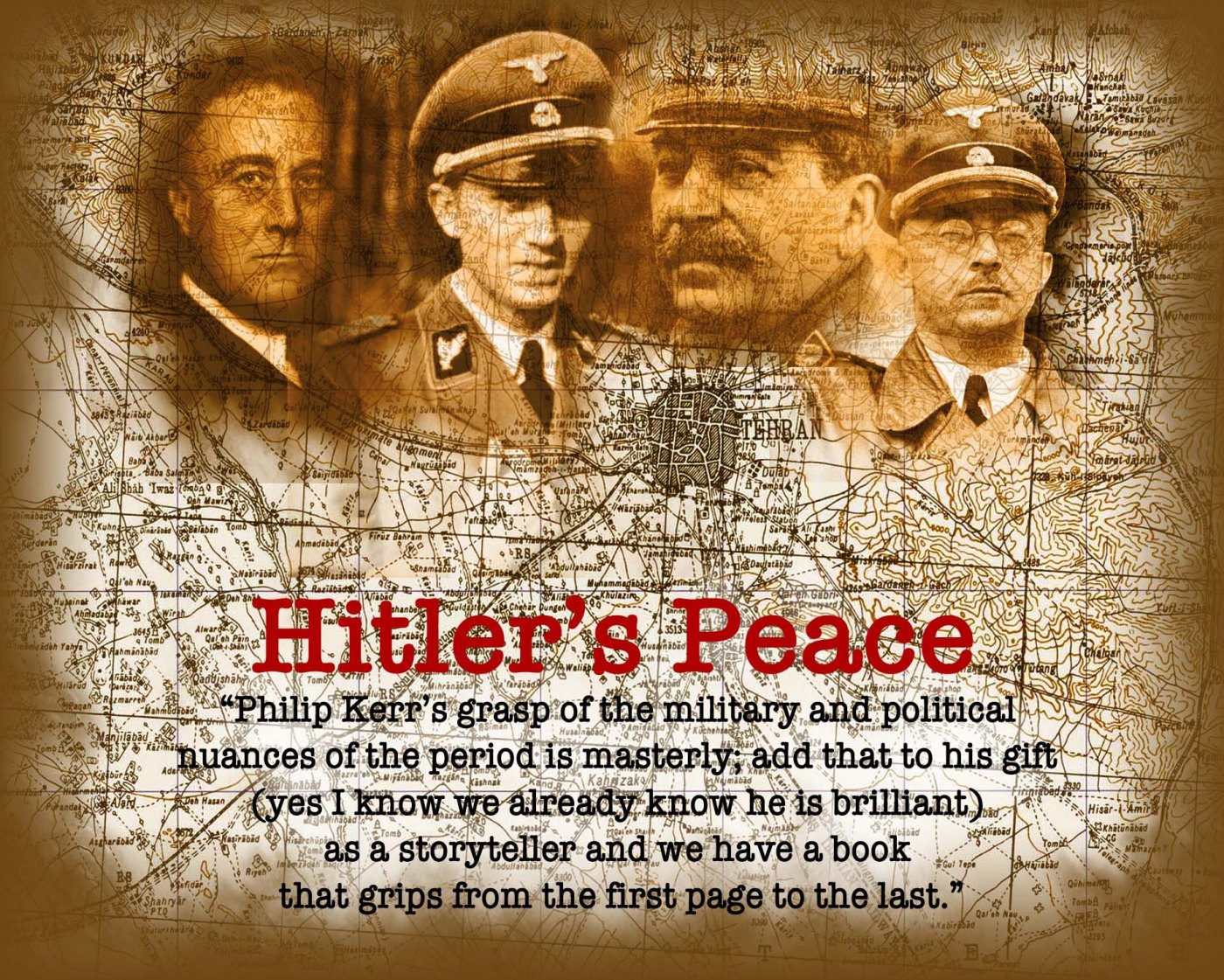

 We are in the autumn of 1943. Hitler’s war has, to be vulgar, gone tits-up. In Italy, Mussolini has been overthrown, imprisoned and then rescued by German special forces, but the Allies have a foothold on mainland Italy. On the eastern front, the Wehrmacht divisions and the Red Army have fought each other to a bloody standstill at the Battle of Kursk, but it is clear to anyone but a fool that the Russian advance is inexorable. Against this background, there are voices within the Nazi party – notably SS chief Heinrich Himmler – who are in favour of putting out tentative peace approaches to both the Russians and the Americans.
 hat is the trajectory which brings Schellenberg and Mayer together? The German is sent to neutral Sweden with secret peace proposals. Roosevelt, with re-election in mind, knows that the tens of thousands of American lives which will be lost should an invasion of France become necessary, earmarks Mayer for a similar task.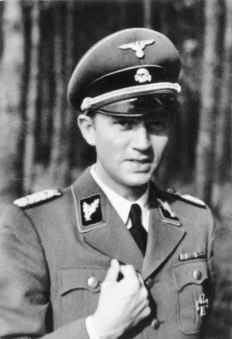
 err’s use of so many real characters is hypnotic. Of course it’s fiction. Of course the writer has only his research – and imagination – to use when describing Himmler’s mannerisms, or those of Roosevelt and Stalin. Of course, it being Philip Kerr, it works beautifully. Schellenberg (right) is a cleverly drawn character; resourceful, intelligent and attractive to women, in particular Lina Heydrich, widow of the Deputy Reich Protector of Bohemia and Moravia. The fictional Mayer, for his part, is equally convincing; urbane, debonair, gifted, hyper intelligent but not lacking in physical courage. His part in the finale of this book is both heroic and crucial.



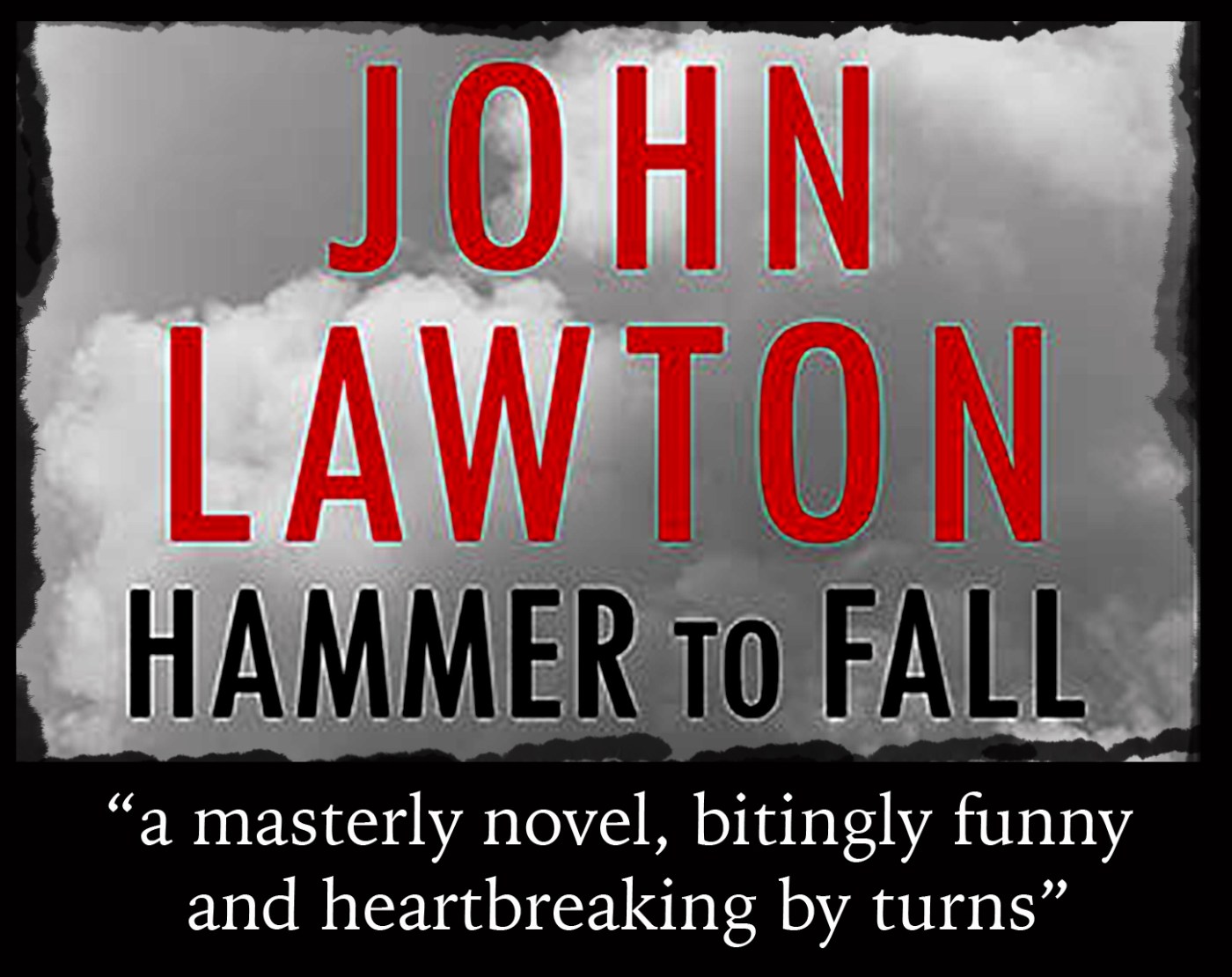

 He is no James Bond figure, however. His dark arts are practised in corners, and with as little overt violence as possible. Hammer To Fall begins with a flashback scene,establishing Joe’s credentials as someone who would have felt at home in the company of Harry Lime, but we move then to the 1960s, and Joe is in a spot of bother. He is thought to have mishandled one of those classic prisoner exchanges which are the staple of spy thrillers, and he is sent by his bosses to weather the storm as a cultural attaché in Finland. His ‘mission’ is to promote British culture by traveling around the frozen north promoting visiting artists, or showing British films. His accommodation is spartan, to say the least. In his apartment:
 So far, so funny – and Lawton (right) is in full-on Evelyn Waugh mode as he sends up pretty much everything and anyone. The final act of farce in Finland is when Joe earns his keep by sending back to London, via the diplomatic bag, several plane loads of …. well, state secrets, as one of Joe’s Russian contacts explains:
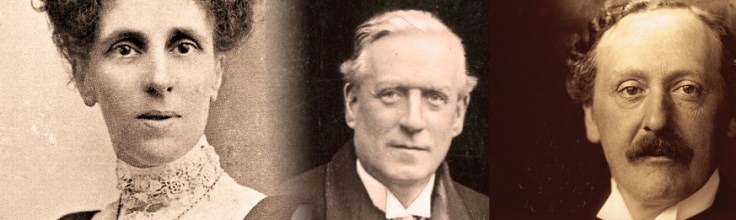
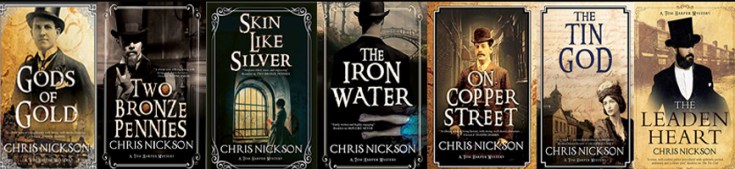
 We first met Leeds policeman Tom Harper in Gods of Gold (2014) when he was a young CID officer, and the land was still ruled by Queen Victoria. Now, in The Molten City, Harper is a Superintendent and the Queen is seven years dead. ‘Bertie’ – Edward VII – is King, and England is a different place. Leeds, though, is still a thriving hub of heavy industry, pulsing with the throb of heavy machinery. And it remains grimy, soot blackened and with pockets of degradation and poverty largely ignored by the wealthy middle classes. But there are motor cars on the street, and the police have telephones. Other things are stirring, too. Not all women are content to remain second class citizens, and pressure is being put on politicians to consider giving women the vote. Sometimes this is a peaceful attempt to change things, but other women are prepared to go to greater lengths.


 SM Hardy, aka Sue Tingey, has put together a thoroughly enjoyable and, at times, genuinely scary ghost story. The Evil Within tells the tale of Jim Hawkes, a young London banker who has an attack of conscience about the bloodthirsty nature of his trade, and tells his boss to go forth and multiply. This rush of blood to the head is not entirely unconnected to the fact that he is still grieving for his dead sweetheart, who drowned herself after breaking off their engagement in a calamitous row. Jim decides that a physical exit from London is essential, and so he takes out a short term lease on a cottage in England’s West Country.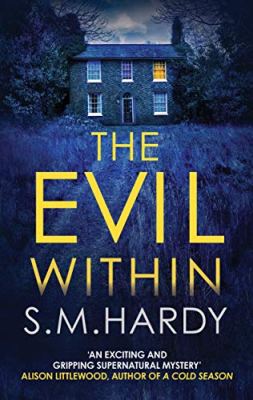






 The two women have little in common
 The structure of the book is intriguing;

 There are three narrative viewpoints;
  Her estranged sister, Sadie,