Search

fullybooked2017

BOOKS OF THE YEAR 2020 . . . Best Police Procedural

Blurb

BOTYPPheader

For many of us, the Police Procedural remains the staple of our crime fiction reading diet. That the genre remains so lively after so many decades is a tribute to the ingenuity and assiduous research of the authors. Here are the four books that I enjoyed the most in 2020. To read the full review, just click the titles.

STILL LIFE by VAL McDERMID

PP4

CRY BABY by MARK BILLINGHAM

PP3

AFTER THE FIRE by JO SPAIN

PP2

BEST POLICE PROCEDURAL 2020
BURY THEM DEEP by JAMES OSWALD

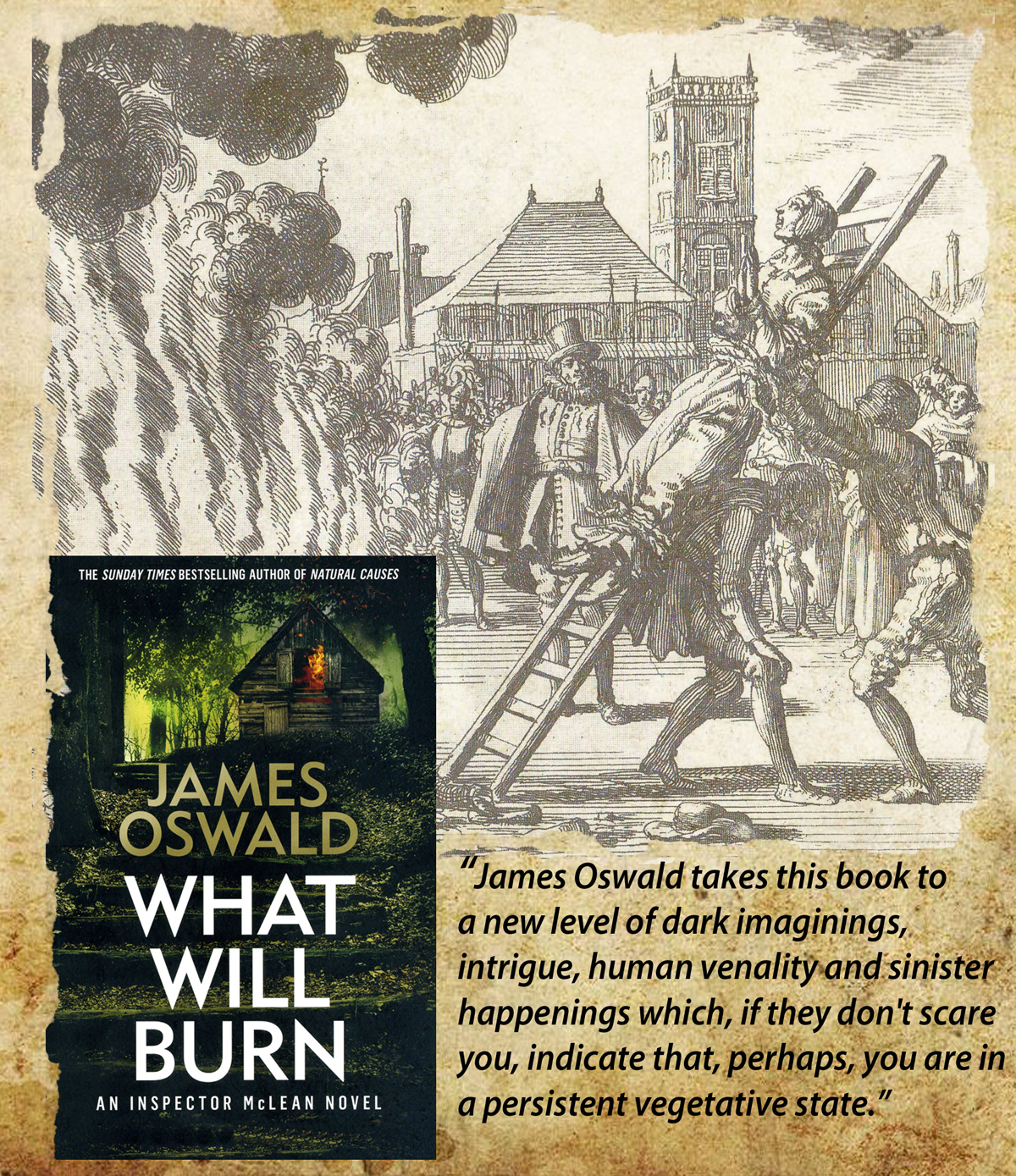
Screen Shot 2020-12-11 at 18.53.09The most crowded room in the mansion of Crime Fiction is the one containing all the Detective Inspectors. Why so many? Probably because in real life a DI’s seniority allows them to become involved in serious criminal cases, but they are not so elevated that they spend most of their time behind a desk juggling budgets and ticking boxes on diversity surveys. So, for a fictional DI to standout from the throng, they must have something a little bit different. With due apologies for execuspeak, Tony McLean’s USP is that he has an awareness of another world beyond the one inhabited with fellow – living – human beings. This is both a blessing and a curse, but James Oswald handles it with a great deal of nuance and restraint. There are no Woman In Black type shocks, and McLean certainly doesn’t “see dead people”. What we do have is a growing sense of unease, with something just at the corner of our peripheral vision maybe, and that something is certainly not benevolent. For more about James Oswald, click his picture (above left).

ppbest

CRIME FICTION ADVENT CALENDAR 2021 . . .Week Three

ADVENT HEADER

Each decorative bar is a clickable link to
a video of the book of the day and a piece of seasonal music

DEC15

DEC16

DEC17

DEC18

DEC19

DEC20

DEC21


BETWEEN THE COVERS . . . The End Of Her

TEOH HEADER006

Firstly an apology. I have had this book for some time, and it had languished in my TBR pile, sadly ignored because of other pressing deadlines. I have now read it and, goodness me, if you want a razor sharp examination of people under stress, this is it! I am not sure if  Anxiety Porn is a thing, but The End of Her tugs at the frayed ends of your nerves and insecurities – with a vengeance.

TEOH COVER00smallWe are in the (fictional) town of Aylesford, New York State, and the cast is quite extensive. To start with, I had to go back to the beginning a couple of times to make sure I knew who was who. Central to the story are a married couple, Patrick and Stephanie. They have twin baby girls. Stephanie is Patrick’s second wife, his first having died a few years earlier in a tragic accident. Patrick is in an architectural partnership with Niall, who is married to Nancy. In a different town we have have Cheryl, Gary, and their adopted son Devin. The person who links these families is a woman called Erica Voss.

It is, hopefully, no spoiler to make it clear that Ms Voss is a nasty piece of work, so how does she tie in with the three couples? Back in the day, during Patrick’s first marriage – to the late Lindsey – she and Patrick had an affair which resulted in Erica becoming pregnant. Concealing the fact from Patrick, she gave birth to a son who she effectively sells, outside of normal adoption procedures, to Cheryl and Gary. Now, nine years later, she enters the three families lives like a malignant growth. After applying for a job at the architectural firm, she seduces Niall (for reasons which only become apparent later in the story). She then blackmails Cheryl and Gary, but her trump card is played when she informs Patrick that she has evidence that Lindsey’s death was not an accident, and she is prepared to have the case reopened unless, of course, she is paid to keep her mouth shut.

The sequence of events which caused Lindsey’s death is, apparently ‘a thing’ in places like Colorado, where deep snow is a winter certainty. Preparing to drive to visit Lindsey’s parents, Patrick has gone outside to dig the car out of four feet of snow. He has turned the engine on to warm the car, and while he is digging, the heavily pregnant Lindsey comes outside and sits in the car. The exhaust is, unfortunately, blocked with snow, and the resultant build-up of carbon monoxide inside the car sends Lindsey unconscious, and by the time Patrick has finished his digging, she is dead. The emergency services are called, but to no avail, and after an investigation, the case is closed, and goes on file as a tragic accident.

What happens next is for you to find out. One of Shari Lapena’s many gifts is to use the ploy of the unreliable narrator to great effect. Yes, Erica Voss is clearly a scheming and highly plausible villain, but who else is up to no good? I have to say that I didn’t see the final resolution coming, but is there a happy ending? You can judge for yourself. The End of Her is published by Bantam Press and is available now in all formats.

CRIME FICTION ADVENT CALENDAR 2021 . . . Week Two

ADVENT HEADER

Each decorative bar is a clickable link to
a video of the book of the day and a piece of seasonal music

Dec8

Dec9

Dec10

Dec11

Dec12

Dec13

DEc14

BASED ON THE BOOK BY . . . Paths of Glory (part two)

Header

HCHumphrey Cobb (left)  was born on 5th September 1899, in Siena, Italy. His mother was a doctor, and his father was an artist. He was sent to England for his early schooling, but then received his secondary education in America. After being expelled from high school in 1916, he decided to join the Canadian Army and was sent to Europe to fight. Remember that America did not join the war until 1917. He kept a war diary, and October 1917 has him at Shoreham Camp, in Sussex, as part of the 23rd Canadian Reserve battalion. January of 1918 has him near Hill 70, in front of Loos. He describes the death of a friend from his platoon.
“What happened to Young, no-one ever knew for sure. Some thought a Fritz potato masher had landed on his respirator and that it had exploded just as he was brushing it off. Evidence: face blown in and right hand blown off. “
He saw the war out, and after being stationed in post-war Cologne for a spell, he finally arrived back in Montreal on 31st May 1919.

ac2b-2-768x508

164644The years after The Great War saw Cobb involved in a variety of enterprises. He wrote Paths of Glory while working for Gallup, the advertising and polling company, and it was published in 1935 by The Viking Press. It is believed that Cobb took the core of his story from real events on the Marne front, where for Corporals from the 136th Regiment were executed after a failed attack on a German strong-point near Souain.

So how does the book stand when set alongside the film? Firstly, it has to be said that Cobb died in 1944, so any input from him was clearly impossible. Anecdote has it that Kubrick had read the book as a teenager, and had been deeply affected by it, but a chain of events led to the film screenplay differing in one essential element from the book. In the mid 1950s Kubrick was still an emerging talent as a director, and did not have the clout to persuade big studios to put up the money for an anti-war film, made in black and white. The crucial intervention came with the interest (and influence) of Kirk Douglas. The star clearly had to have a main part in the film, but who?

In the novel, Colonel Dax is a relatively peripheral figure who, reluctantly, goes along with the doomed plan to storm the German bastion which is, incidentally, called ‘The Pimple” in the novel. So, it was a bold stroke in one way for Kubrick to re-imagine Dax as the forthright and confrontational character whose personal bravery is never in doubt, and a man who just happens to have been a lawyer in civilian life. And who better to play Dax than the dimple-chinned Hollywood heart-throb Kirk Douglas?

Cobb focuses almost all of his attention in the novel on the three men who were executed, and on the various reasons why they came to be shot by their own comrades. The book has no pantomime villains, and certainly no one person who has the blood of the victims on his hands. The men die as a result of the inexorable grinding of the military machine and the numbing effect of battlefield casualty statistics. Men are reduced to numbers, compassion is subverted by casualty statistics, and procedure trumps initiative every time. As William Tecumseh Sherman may (or may not) have said, I tell you, war is Hell!

Screen Shot 2020-12-01 at 20.21.47There are places where Kubrick and his screenwriters – Calder Willingham and Jim Thompson – did stick close to the book. The first is with the three man patrol into No Man’s Land where the cowardly and drunken Lieutenant causes the death of one of the men, thus setting up the selection of the other to be one of the judicial victims. The film plays it pretty straight, too with the events immediately prior to the execution. The character of Private Ferol is played with characteristic bravura by Timothy Carey, (right) There is one crucial difference; in the book, Ferol is chosen because he he is anti-social and widely disliked for his unpleasant behaviour, and he continues to be sarcastic and foul-mouthed right up to the point where he is strapped to the execution post. In the film, however, the enormity of his fate finally overwhelms him, and he in the unforgettable procession from the chateau to the place of execution – a chilling via dolorosa – he is reduced to a weeping, stumbling figure, clutching the arm of the Padre.

The final confrontation between Dax and the general doesn’t happen in the book, neither does the powerful final scene where the soldiers in the estaminet boo and mock the captured German girl who is forced to sing to them, but then they are reduced first to silence, with some in tears, and then they join in with the simple old song she is singing. Outside, Dax has just been told that the regiment has been ordered to return to the Trenches, but he walks away, leaving his men to their brief hour of peace.

It is worth repeating that Cobb’s gaze is focused on the rigid mechanism of army life. It whirrs, ticks and chimes the hours with little regard for the human lives caught up in its cogs. He shapes this in many different ways, but never better than when he describes the efforts made to make sure the execution is done ‘properly’.

“Regimental Sergeant-Major Boulanger was there, busy, competent as regimental sergeant-majors always are, in the same way that head waiters are busy, competent, or seem to be so, if they are good head waiters.”

It is to Boulanger that Cobb gives the very last action, in the last paragraph of the book, where he is given the task of administering the coup de grace to the bodies slumped against their posts.

“It must be said of Boulanger that he had some instinct for the decency of things, for, when he came to Langlois, his first thought and act was to free him from the shocking and abject pose he was in before putting an end to any life that might be clinging to him. His first shot was, therefore, one that deftly cut the rope and let the body fall away from the post to the ground. The next shot went into a brain that was already dead.”

I think that Kubrick (below) takes the gist of the novel, and shaped it to his own ends, and in doing so created a magnificent piece of cinema. His anti-war message is different from Cobb’s, but was clearly something he felt very deeply. A decade or so later he was able to return to his theme in Dr Strangelove, but this time he used satire and the comedy of the absurd to make his point.

MV5BMTIwMzAwMzg1MV5BMl5BanBnXkFtZTYwMjc4ODQ2._V1_UY1200_CR82,0,630,1200_AL_

BASED ON THE BOOK BY . . . Paths of Glory (Part One)

Header

Stanley Kubrick’s 1957 film The Paths of Glory was a limited success at the time – it just about broke even at the box office – and was initially highly controversial. It was banned in France for twenty years, and several other European countries refused to show it as a gesture of solidarity with France. It was also banned in all American military establishments. So, why the fuss?

George-macready-trailer

The film, based on a book by American writer Humphrey Cobb, focuses on a section of The Western Front in 1916 held by the French. Although it is never mentioned in the film, we assume that the action takes place around Verdun, the most costly single engagement in a war that chewed up men’s lives like a meat grinder. The 701st Regiment are ordered to attack an impregnable German position known as ‘The Anthill’. General Miraud, (George Macready, above) after initially protesting to his superior that the attack would be suicidal, changes his mind after being offered promotion.

38-kirk-douglas-theredlist

Colonel Dax (Kirk Douglas, above) is the officer who will lead the attack. He is dubious about the prospects, but obeys the order. The attack is an unmitigated disaster. German shellfire halts progress in No Man’s Land, while one company is unable even to leave the trench, such is the ferocity of the bombardment. In a rage, Miraud orders his artillery to fire on his own lines in order to force the men to attack.

Miraud feels that his own honour has been impugned, and, after removing the regiment out of the line to a chateau some miles away, orders that 100 of the surviving men be arrested and charged with cowardice. The scheming General Broulard ( Adolphe Menjou, below) suggests that just three men will be enough pour encourager les autres, and Dax is forced to ask three of his company commanders to select three sacrificial victims.

adolphe menjou


Three men are chosen: Corporal Paris (Ralph Meeker) is selected because his superior officer, Lieutenant Roget, needs to silence him in case he exposes Roget’s cowardice. Private Arnaud’s name is simply drawn out of a hat, while Private Ferol (Timothy Carey) is a deeply unpleasant individual who, it seems, ‘has it coming’.

The three men are tried
in a mockery of a judicial process, despite an impassioned defence by Dax, who was a lawyer in civilian life. They are sentenced to death. Dax has one last card to play. He has a written testimony that Miraud has ordered gunfire down on his own men, but it is dismissed by Broulard. The men are duly executed, with one of them, Arnaud, strapped to a stretcher after being seriously injured in a fight with his guards.

Broulard and Miraud are enjoying a leisurely breakfast in luxurious surroundings, when Dax is invited to join them. He shares his information about Miraud’s order to shell his own trenches. Miraud is told that he will face and enquiry, and then storms out voicing a sense of betrayal. Broulard congratulates Dax on a very clever plan to secure his own promotion. Dax finally loses his temper at this interpretation of his motives and rages at his superior officer.

Back at the chateau, the surviving members of the 701st Regiment are in an estaminet, drunk and reckless. The proprietor pushes a young German girl onto the makeshift stage and forces her to sing. She hesitantly sings an old song. “Der treue Husar” (The Faithful Hussar). The men’s mockery turns to empathy and then grief, as they join in with the song. Outside, Dax has just been given the order that the 701st are to return to the front line with immediate effect.

In Part two of this feature, I will explore the differences between the book and the film, and attempt to understand what Cobb and Kubrick were trying to say about this tragic episode in European history.

CRIME FICTION ADVENT CALENDAR 2021 . . . Week One

ADVENT HEADER

Each decorative bar is a clickable link to
a video of the book of the day and a piece of seasonal music

Dec1

Dec2

Dec3

Dec4

Dec5

Dec6

Dec7

OUT FOR BLOOD . . . Between the covers

OFB 002

Aberdeen, Scotland.The Granite City. To say that Police Scotland’s DI Eve Hunter has baggage would be something of an understatement. Physically and mentally damaged by a ruinous encounter with a notorious crime family, she is only allowed back to work on the understanding that she undergoes tortuous (for her) therapy sessions with Dr Shetty, the police psychologist. We first met Hunter in Hold Your Tongue, and you can read that review by clicking the link.

OFB 001We start with two corpses. One is an unidentified young woman, strung up by her neck to a tree on a golf course. The other, a young man, is found in more comfortable surroundings – his flat – but he is equally dead. As Hunter’s team begin to investigate the cases it seems that they could not be further apart. The dead man is an old boy of one of the area’s most prestigious independent schools, and has a rich father. The girl, however, is an Eastern European prostitute. Links between the two deaths slowly turn from gossamer to steel. Was one using the other? Is it that simple? Why do the names of powerful local figures crop up over and over again on the peripheries of the case?

In some ways we are on familiar territory here. We have the classic police procedural trope of the tired and overworked detectives trying to keep their family lives on track, while still having to give everything to ‘the job’. We have some coppers who are, if not actually corrupt, downright idle, their only concern being how to protect their pension Somehow, these stresses and strains of police work come over as fresh and as harrowing as if it were the first time we had read them.

This is not the first novel in recent years to highlight the deeply unpleasant trade in human lives carried out by Eastern European criminals. I live in a town where it happens, and nothing Deborah Massen (below) has written here is in any way exaggerated or fanciful. She vividly portrays the brutality of the men – and women – who run the rackets, and the misery of the girls who become enslaved.

DM

Masson showed in her previous book that she has a talent for having her police characters (and with them, we readers) pursue one line of enquiry, convinced that solution can only lie in that single direction, only for events to take a startling turn in another direction altogether. In proving that we are all wrong, and making the plot twist plausible, she takes a great risk, but I have to say her gamble pays off, and she produces a startling conclusion with the true flourish of a literary magician. Out For Blood is available in Kindle from Transworld Digital now, and will be out in paperback under the Corgi imprint on 10th December.

RIVER OF SINS . . . Between the covers

River Header

A little while ago I reviewed a novel set in Worcestershire – it was the beginning of WW2, and it centred on the fictional village of Ambridge and, of course, featured The Archers. History of a very different kind now. River of Sins is the seventh in a series of historical mysteries written by Sarah Hawkswood set in and around the city of Worcester in the 12th century.

Filler 1
I am new to the series but I enjoyed the fact that we have that most dependable of crime fiction tropes – a pair of investigators. There is a slight variation a theme in this case, as they are aided by an intrepid young apprentice. The dynamic between the three works well. Hugh Bradecote is the Under Sheriff, and is of noble birth with a degree of hauteur, while Sergeant Catchpoll is Worcester through-and-through, rough and ready, but very street-wise. Walkelin – the apprentice – is something of a ‘gofer’, but is bright, perceptive, and not afraid to speak his mind.

Filler 2

The novel begins with a woman being brutally done to death on a small island in the River Severn on the northern outskirts of Worcester. We learn that the woman and her killer are acquainted, but just how, and what the significance is, only unfolds with the investigation.

The dead woman is Ricolde, known throughout the city as The Whore of Worcester. She was widely despised by the gentlewomen of the city, while being used by their husbands, but as Bradecote and Catchpoll discover, there was another dimension to Ricolde. Educated, and perfectly content to talk the night through with men who demanded nothing other than her company, she also gave money to the church to be used to ameliorate the misery of other women of the street who were less resilient than she.

The investigators struggle to find a motive for the murder. Moral disapproval doesn’t usually lead to someone being dismembered with a woodsman’s axe, but does the clue to Ricolde’s death lie deep in her past, and has it to do with the horrific scars on the soles of her feet, inflicted decades earlier?

Sarah Hawkswood’s Worcester is a place we can see, hear, feel, breathe – and smell – as the mystery unfolds. What is the River of the title? It is the River Severn, broad and deep, a source of fresh food, a vital artery of transport at a time when roads were just beaten dirt, but also a means of escape and concealment. With only the most rudimentary forensic skills available, Bradecote and Catchpoll must rely on the most basic and time-honoured methods of detection, means, motive and opportunity. This is an excellent detective story which also gives us an intriguing glimpse into a long-lost world.

River of Sins is published by Allison & Busby and will be out in paperback and as a Kindle on 19th November.

Hawkswood books

Blog at WordPress.com.

Up ↑