V: ADAGIO
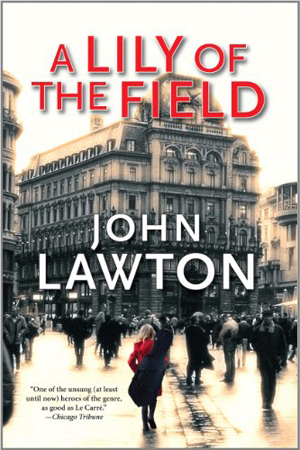 John Lawton is a master of historical fiction set in and around World War II. His central character is Fred Troy, a policeman of Russian descent. His emigré father is what used to be called a ‘Press Baron’. Fred’s brother Rod will go on to become a Labour Party MP in the 1960s, but is interned during the war. His sisters are bit players, but memorable for their sexual voracity. Neither man nor woman is safe from their advances.
Fred becomes one of London’s top coppers, but to categorise the novels as police procedurals is accurate only in as far as that there are policemen in the books, and they occasionally have procedures. All this being said, Troy is in the background during much of A Lily of the Field, where we follow the life of teenager Méret Voytek, a brilliant young Viennese cellist.
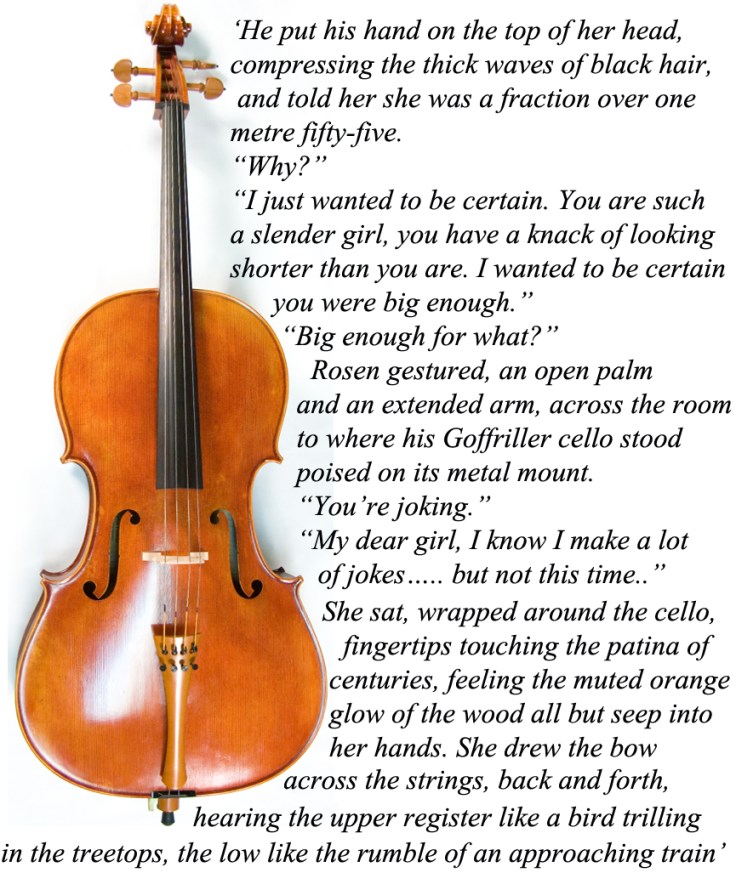
As a twelve-year-old, she begins lessons in cello and piano from an eminent musician, Viktor Rosen. He realises instantly that she is prodigiously talented, and he gives her a gift:
After the Anschluss, through her own naivete and a tragic act of fate, she is caught holding a bundle of anti-Nazi leaflets while traveling on the tram. She is taken by the SS and ends up in Auschwitz. Meanwhile, her parents have been likewise detained, and their family home ransacked. Méret’s skill as a musician has already been noted but, ever naive, she questions her friend Magda about why she has been singled out.
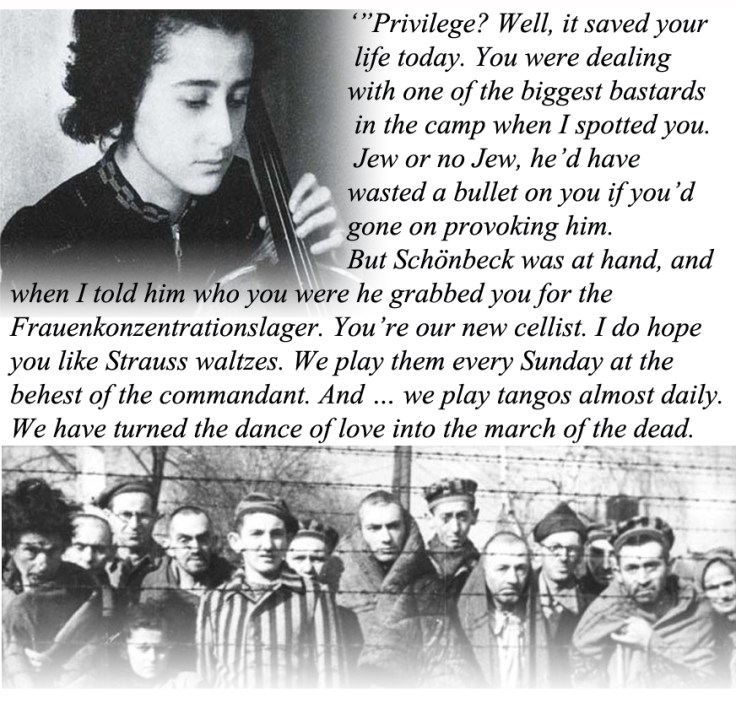 In the bitterest of paradoxes, the Auschwitz commandant, has a musical ear, and so he puts together an orchestra made up of the many skilled inmates. One of their bizarre duties is to play beautiful music as their less talented companions trudge off to work in the morning. Méret plays for her life, literally. The physical privations she undergoes are heart-breaking, but still she plays, still she clings on to what is left of her humanity.
In January 1945, with the Russians approaching from the east, and the British and Americans from the west, the Germans realise that the game is up. Auschwitz inmates who are too infirm to walk are shot, and the remainder are sent out, under guard, to start the infamous Death March. In the freezing conditions few survive, but just as Meret is about to succumb, their column is overtaken by a Russian detachment. Salvation? Hardly. The first instinct of the Russian soldiers is to rape the women. Méret is saved by a no-nonsense officer. At this point, Fred Troy aficionados will recognise Major Larissa Tosca, Fred’s one-time lover. She has, in her time, spied for both America and for Russia, but here her cap bears the Red Star.
Long-time Lawton readers will know that he leaps about between the years with a sometimes bewildering agility. True to form, the climax of this book is played out in post war London and Paris. Méret’s rescue by the Russians has come at a price, and we find her tangled up in the spy ‘games’ which characterised much of the Cold War period. Lawton is much too clever a writer just to tell this one tale, however gripping it may be. Woven into the fabric is another thread which involves an interned Hungarian physicist, Dr. Karel Szabo, who ends up as a key figure in the American efforts to build and test the first atomic bomb.
One of the key figures from the spy ring of which Méret is a part is murdered in London, and it is then that Fred Troy becomes involved. For all his many qualities, Troy is an inveterate womaniser, but he is not a sexual beast, and the late scenes where he spends time with the fragile Méret, still beautiful but old before her time, are haunting in their compassion.
‘Troy had never heard her laugh. It was like that moment in Ninotchka when Garbo laughs on-screen for the first time. It is not merely that she laughs, but that she laughs so long and so loud.
As the laughter subsided she was grasping at words and not managing to get a sentence out.
“Oh, Troy ….oh, Troy..this is….this is a farce. Don’t you see? Viktor taught us the same part.”
“We’re two left-handed women trying to dance backward. Neither of us knows the man’s part.”
She reached up her sleeve for a handkerchief to dab her tears and found none. Troy gave her his, a huge square of Irish linen with an overfancy ‘f’ in one corner.
Being drunk did not make her loquacious. In that, she was like Troy. At two in the morning Voytek was deeply asleep in front of the fire. Troy picked her up, astonished at how little she weighed, carried her upstairs and slid her into the spare bed. She did not wake. He went to his own bed.
A Lily of the Field is far from being a dry history novel where the factual details are more important than the plot and the dialogue. It is tense, funny, occasionally very violent, and written with a style and fluency which leaves lesser authors struggling in Lawton’s wake. Above all, of course, it is about music. Méret’s brilliance as a musician is both her curse and her salvation.
A final little gem, which I only noticed recently. If you look closely at the book’s cover, you can see Méret Voytek, in her red coat, moving away from us. With her cello slung over her shoulder, she walks into history.

Follow the links below to read the previous four parts in the series.





 The grisly exploits of the Muswell Hill murderer Denis Nilsen still defy belief over thirty years later. As you read the story you can rub your eyes and hope that you have woken up from a particularly sordid and violent dream, but you haven’t: everything on the page in front of you is the grim reality. We covered the case briefly in our
 From the ghastly to the ghostly – or at least, a world where fantasy and literary trickery take us away from the mundanity of murder. The Readymade Thief is the debut novel from the Chicago based teacher and screenwriter Augustus Rose, (right) and has just been published by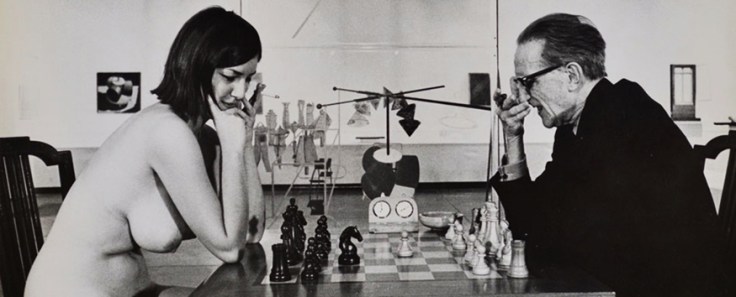
 Samantha King (left) also serves up a nightmare, but unlike the shifting and illusory Philadelphia of Augustus Rose and Lee Cuddy, hers is very real and down-to-earth, but equally chilling. Madeleine and Dom have twins, Aidan and Annabel. Make that past tense. Had twins. For now Annabel is gone. Just a memory of red-gold curls in a photograph. “Choose one, bitch,” the killer said, and Madeleine chose. This terrifying psychological thriller is a startling debut from an author who is a former editor and is also a qualified psychotherapist. You can find out more on her
 Mark Pepper is an actor, and in his wryly self- deprecating potted biography he wonders why he never received the Oscar he deserved for his pivotal role in Titanic –
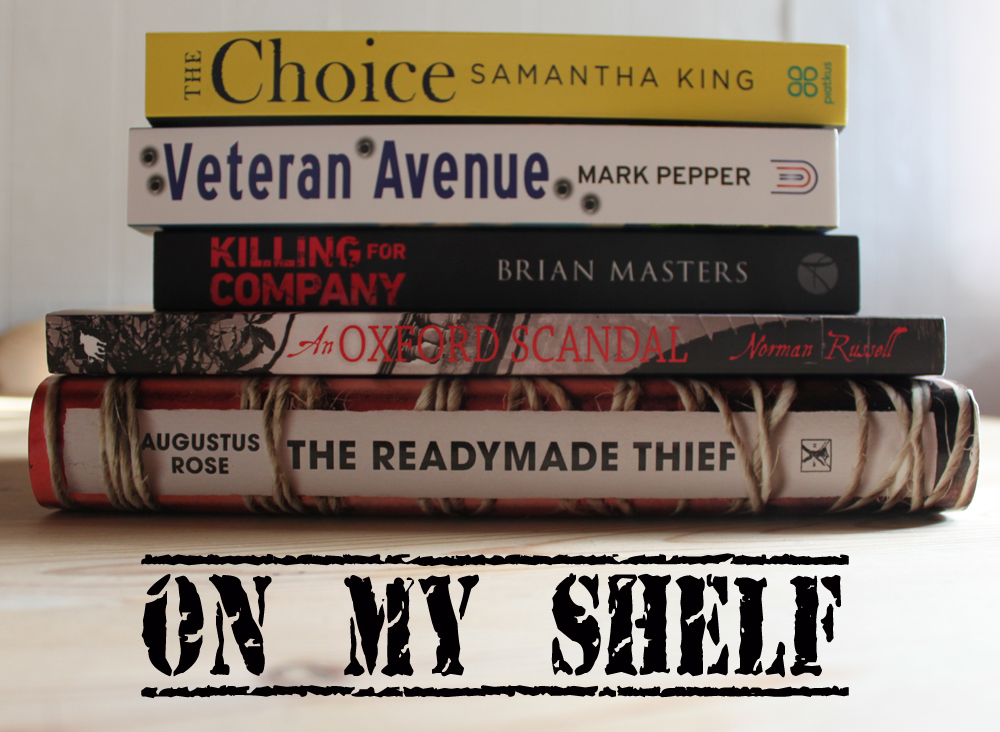
 From the badlands of Oregon to the cloistered calm of Oxford, in the late nineteenth century. The opening lines set the tone:


 Kristy puts food on the table and tries to make sure that Ryan isn’t disadvantaged. She has a job, and it is one that demands every ounce of her compassion and every droplet of her sang froid. Her official title? Public Information Officer for the Texas Department of Criminal Justice. If that sounds like some bureaucratic walk-in-the-park, think again. Acting as mediator between inmates, the press and the prison system is one thing, but remember that The Lone Star State is one of the thirty one American states which retains the death penalty. Consequently, Kristy not only has to manage the fraught liaison between prisoners on death row and the media, but she is also required to be an official witness at executions.
 It will come as no surprise to learn that Hollie Overton (right) is an experienced writer for TV. In The Walls every set-piece, every scene is intensely visual and immediate. With consummate cleverness she sets up two story lines which at first run parallel, but then converge. Two men. One is definitely guilty. One possibly innocent. Both are condemned to death. One by the State of Texas. The other by his battered wife.


 Many people in their sixties – particularly those who are comfortably off – plan ahead for their own funerals. Daytime television programmes are interspersed with advertisements featuring either be-cardiganed senior citizens smugly telling us that they have taken insurance with Coffins ‘R’ Us, or rueful widows plaintively wishing that they had been better prepared for the demise of poor Jack, Barry or Derek. However, it would be unusual to hear that the be-cardiganed senior citizen had died only hours after planning and paying for their own send-off from the world of the living.
 During the story, Horowitz (right) drops plenty of names but, to be fair, the real AH has plenty of names to drop. His CV as a writer is, to say the least, impressive. But just when you might be thinking that he is banging his own drum or blowing his own trumpet – select your favourite musical metaphor – he plays a tremendous practical joke on himself. He is summoned to Soho for a vital pre-production meeting with Steven and Peter (that will be Mr Spielberg and Mr Jackson to you and me), but his star gazing is rudely interrupted by none other than the totally unembarrassable person of Daniel Hawthorne, who barges his way into the meeting to collect Horowitz so that the pair can attend the funeral of Diana Cowper.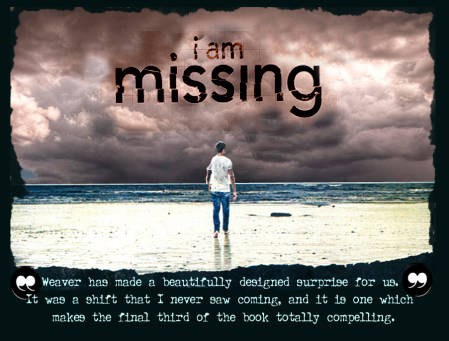
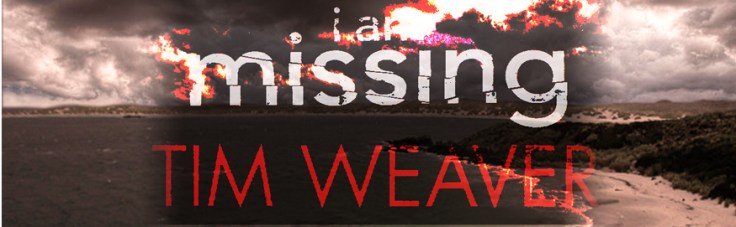
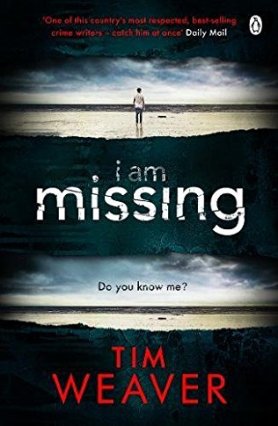 Raker agrees to take on the case on a more-or-less pro bono basis. Whatever and whoever Richard Kite once was, he has not brought wealth of any kind with him into his new life. Raker’s initial trip south to meet Kite is less than fruitful. Kite only recalls two shadowy images from his past; one is that he is looking out across a lonely beach to a grey expanse of water; is it the sea, perhaps, or a river? The other image is just as enigmatic; Kite sees a television screen, and on it is a graphic of a broadcasting pylon emitting what seems to be a children’s programme.
 Meanwhile, Weaver (right) gives us what seems to be a parallel but unconnected narrative. Two girls, sister and step sister, apparently living in a remote moorland community, perhaps in the north of England, have taken to sneaking out of their house after dark, and climbing up the hill onto the moors, where they have constructed an imaginary and malevolent presence out there in the wind and rain-swept darkness. Malevolent it certainly seems to be, but is it just a figment of the girls’ lurid imaginings?
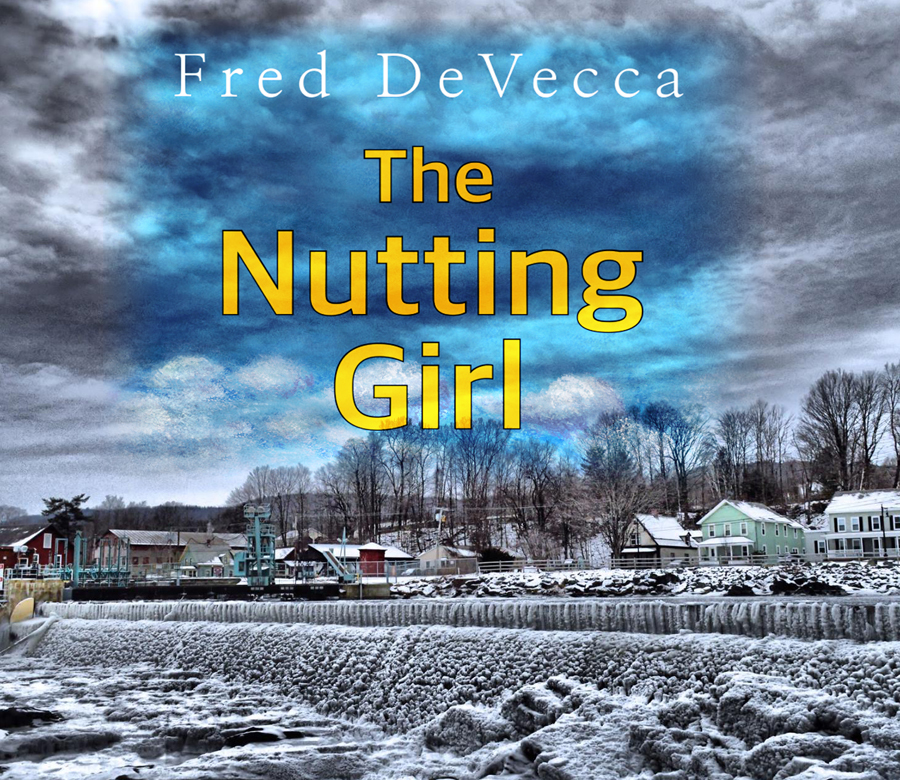

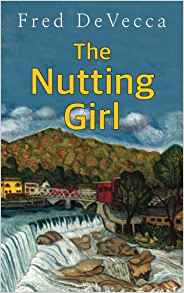 Raven’s job seems like money for nothing until the fateful day when, after a spell of heavy rain, the normally placid stream running through Shelburne Falls is turned into a deadly torrent. ‘Velcro’ ends up in the water, and disappears. Did she fall? Was she pushed? Or is there another more disturbing and puzzling solution? Frank Raven, with the help of Sarah, the eighteen year-old daughter of Clara (Raven’s love interest), unlocks the door to a labyrinth of deception, false identities, dark motives and venal behaviour which they work their way through more in the spirit of hope than the expectation of ever finding the door marked ‘Exit’.
 Finding a new path through the undergrowth of PI novels, overgrown as it is with violent, cynical, wisecracking and tough, amoral men (and women) must be a difficult task, but Fred De Vecca (right) makes his way with a minimum of fuss and bother. Frank Raven rarely raises his voice, let alone his fists, but his intelligence and empathy with decent people shines through like a beacon in a storm. It would be a forgivable mistake to place this novel in the pile marked ‘Cosy small-town domestic drama’, but it is a mistake, nonetheless. Of the people Raven is tasked with looking for, he finds some and loses some – because he is human, fallible and as susceptible to professional bullshitters as the next guy. What he does find, most importantly, is a kind of personal salvation, and a renewal of his belief in people, and their capacity to change.

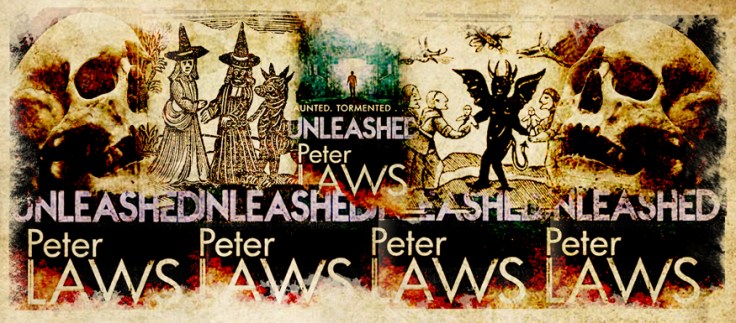
 If the South London suburb of Menham could be described as unremarkable, then we might call the down-at-heel terraced houses of Barley Street positively nondescript. Except, that is, for number 29. For a while, the home of Mary Wasson and her daughters became as notorious as 112 Ocean Avenue, Amityville. But the British tabloid press being what it is, there are always new horrors, fresh outrages and riper scandals, and so the focus moved on. The facts, however, were this. After a spell of unexplained poltergeist phenomena turned the house (almost literally) upside down, the body of nine year-old Holly Wasson was found – by her older sister Rachel – hanging from a beam in her bedroom.
 Laws (right) takes a leaf out of the book of the master of atmospheric and haunted landscapes, M R James. The drab suburban topography of Menham comes alive with all manner of dark interventions; we jump as a wayward tree branch scrapes like a dead hand across a gazebo roof; we recoil in fear as a white muslin curtain forms itself into something unspeakable; dead things scuttle and scrabble about in dark corners while, in our peripheral vision, shapes form themselves into dreadful spectres. When we turn our heads, however, there is nothing there but our own imagination.