

Rex Todhunter Stout (above) packed several lives into his 88 years on God’s earth. He was a publisher, a propagandist, a radio celebrity, a campaigner for author rights, inventor, husband and father – and the creator of one of the immortal crime fiction partnerships. The son of Quaker parents, Stout was born in Noblesville Indiana in 1886, and if the tale of him reading the Holy Bible from cover to cover twice by his fourth birthday is true, then he must have been an extremely precocious child.
After serving in the U.S. Navy and honing his writing skills with magazine articles and stories for pulp periodicals Stout achieved some level of financial independence in an unusual fashion. Had it been in the digital age, his achievement would probably be that he designed a piece of software, but this was 1916, and his creation was a banking system designed for school to keep track of cash paid in by children. Stout was clearly canny enough to demand royalties, and the income enabled him to travel widely, and to write what he wanted to write, rather than what paid.
 For all that Stout was an intellectual and a vigorous campaigner for what he believed in, his legacy remains the creation of Nero Wolfe. Wolfe is an obese, physically lazy but improbably intelligent detective who loves his food and alcohol, cultivates orchids, but never leaves his brownstone house on New York’s West 35th Street. Much of Wolfe’s crime solving is done from the comfort of his armchair, or while consuming fine food and drink. His mind can only achieve so much, however, and he needs access to the streets. This comes in the form of Archie Goodwin (pictured left in a period illustration). Archie would, in truth, have made a perfectly good PI on his own. He is physically fit, handsome, as sharp as a tack, and can handle himself when it comes to physical violence. He lives on another floor of Wolfe’s house, and according to a memo written from Rex Stout to a friend, Archie is:
“Height 6 feet. Weight 180 lbs. Age 32.”
The pair first appeared in 1934 in Fer de Lance, published by the New York company Farrar & Rinehart. Re-reading it for the first time in many years, I was struck by how easily Stout introduces the Wolfe household, almost as if he is gently reminding us of old acquaintances of long standing. As well as Wolfe and Archie, we have Fritz Brenner the cook, and Theodore Horstmann the cantankerous expert who does the hard work up in the expertly-designed cultivation rooms where the precious and capricious orchids are pampered like dissolute and demanding princesses from a bygone era. When heavy lifting out on the tough streets of New York is needed, Saul Panzer, Fred Durkin and Ollie Cather can always be called upon to get their knuckles grazed.
It is little short of astonishing how Fer de Lance delivers the Nero Wolfe template complete and ready formed, almost as if Stout had already written all the books in one superhuman creative effort. A Family Affair (1975) was the 46th and final Nero Wolfe mystery, and it shows just how successfully Stout was able to keep the train chugging along on the same rails for over 40 years. Goodwin and Wolfe have, of course, not aged by a day, nor do their characteristics and personality quirks deviate by so much as the thickness of a cigarette paper. Wolfe still takes the lift up to his orchid rooms twice a day, while Fritz prepares the gourmet meals. Goodwin still likes the odd slug of whisky, but his drink of choice remains a glass of cold milk.
In Part Two of this feature, we will look in detail at both Fer de Lance and A Family Affair, while assessing Rex Stout’s legacy. To close, though. here’s a quote from the early chapters of Fer de Lance, where Goodwin gives us some idea of the sheer physical presence of his boss.
“Wolfe lifted his head. I mention that, because his head was so big that lifting it struck you as being quite a job. It was probably really bigger than it looked, for the rest of him was so large that any head on top of it but his own would have escaped your notice entirely.”



 Don’t Let Go by Harlan Coben
 Can You Keep A Secret? by Karen Perry
 Dead Lands by Lloyd Otis


 The Dancing Man was published in 1971, and is set in Welsh hill country. An engineer, Mark Hawkins travels to a remote house to collect his late brother’s belongings. Dick Hawkins was an archaeologist by profession and mountaineering was his drug of choice. He set off one day for the nearby mountains, and never returned.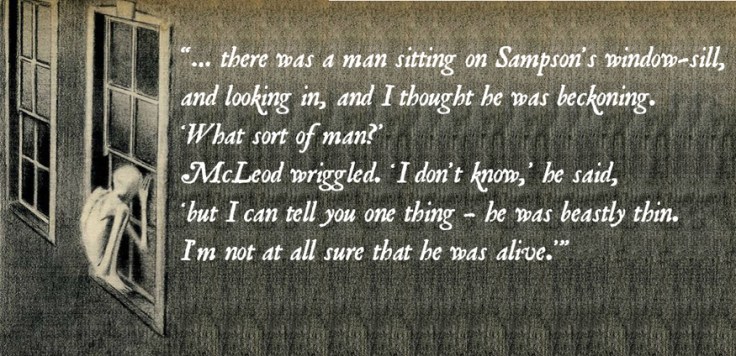

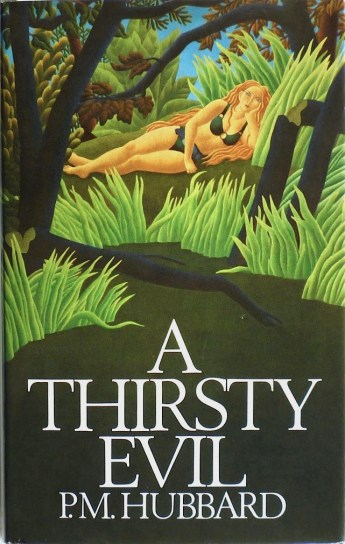 With A Thirsty Evil (1974) Hubbard once again mines Shakespeare for his title, in this case, Measure For Measure.
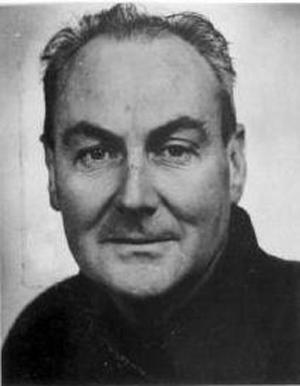 The story moves swiftly on. Hubbard’s novels are, anyway, relatively short but his narrative drive never lets us rest. Beth’s carnality and opportunism get the better of Mackellar in a brief but shocking encounter, but this is only a staging post on the path to a violent and tragic conclusion to the novel. Mackellar survives, but he writes his own epitaph in the very first chapter.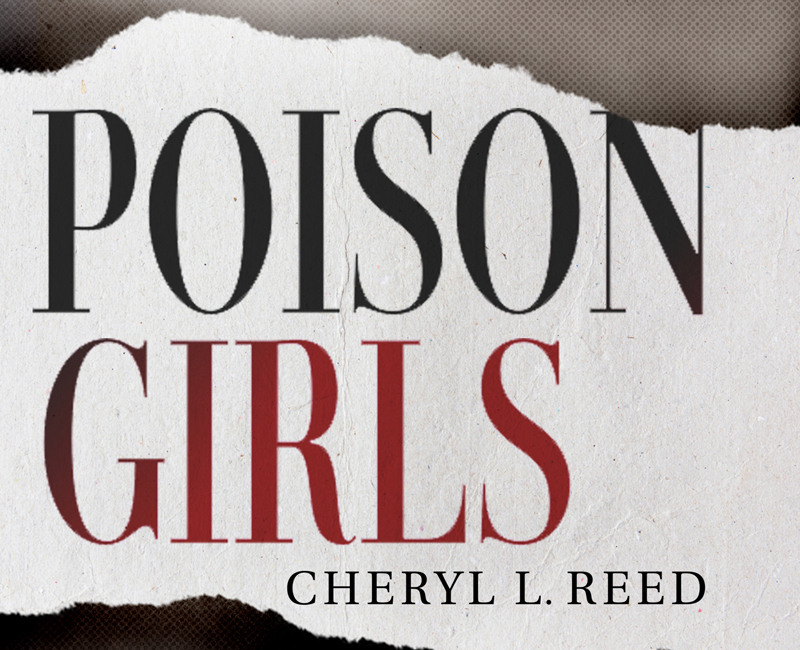

 Cheryl Reed
 I didn’t have to meet Theodore. But I would argue that my new debut novel, Poison Girls, is much richer for my having done so. Theodore was just one of many real characters I met as I explored the underbelly of the heroin drug culture, researching the real story of fentanyl-laced heroin in Chicago that killed more than 250 people in a few months. One thing I learned working for more than two decades as a journalist—many of those as a crime reporter—is that real people are far more complex and interesting than solely relying on my imagination. I’ve read a lot of books and watched a lot of movies that feature drug dealers and drug fixers, but I’ve never read one named Theodore who wore a candy necklace that he chewed on with a single fang. Shit like that, you just can’t make up.
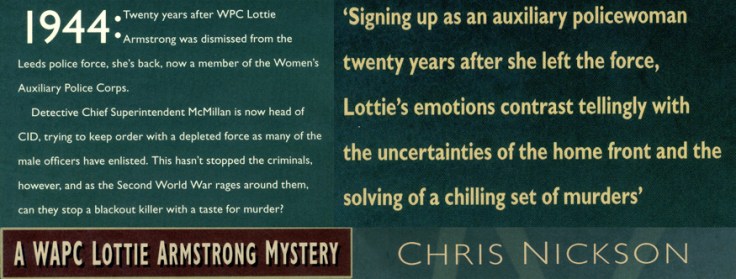
 So, Lottie is back in uniform again, but this time as a lowly member of the Women’s Auxiliary Police Corps. Her main job is to drive her boss, Detective Superintendent McMillan, to wherever he needs to go. McMillan, a veteran of The Great War, certainly needs his transport as a killer seems to be stalking vulnerable young women across the city. Kate Patterson, a Private in The Auxiliary Territorial Service (ATS) is found dead in the sombre ruins of the medieval Kirkstall Abbey. She is the first victim, but others follow, and Lottie and McMillan are soon convinced that the killer is a member of the American forces based in the city.
 You will note the date – spring 1944 – and will not need a degree in military history to work out what those ‘vital operations’ might be. Invasion or no invasion, McMillan still has a job to do, and the murderer is eventually cornered. Don’t anticipate a comfortable outcome, however. Nickson (right) doesn’t do cosy, and the conclusion of this fine novel is as dark as a blacked out city street.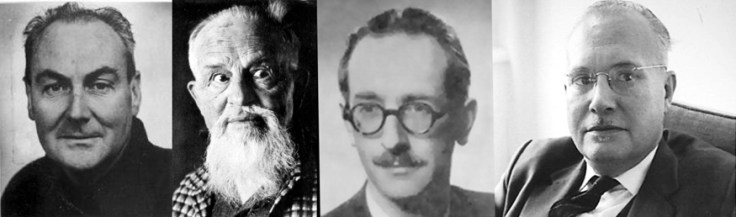
 Flush As May (1963) takes its title from a soliloquy by Hamlet, and Hubbard sets the piece in an ostensibly idyllic rural England, contemporary with the time of the novel’s publication. Margaret Canting is an Oxford undergraduate staying in the nearby village of Lodstone She takes it upon herself to see in May Morning, not by carolling from the top of a church tower, but with a dawn stroll. Her idyll is interrupted when she finds the corpse of a man, sleeping his final sleep against the grassy bank at the edge of a field.
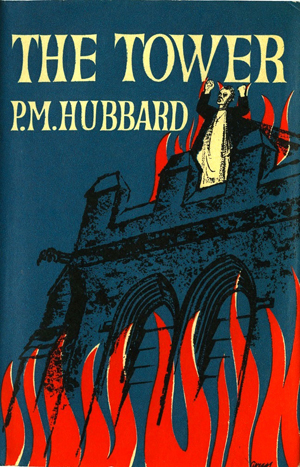 The Tower (1968) begins with Hubbard tipping his hat in a gentlemanly fashion in the direction of a lady. The lady is none other than Dorothy L Sayers. Her masterpiece (other opinions are available), The Nine Tailors, begins with Bunter and Lord Peter abandoning their car in a snowy ditch outside a remote Fenland village. So it is that John Smith, the central character in The Tower, finds his car refusing to travel an inch further on an inky black night, a mile or so outside the village of Coyle. That, however is pretty much where the homage ends. Coyle is a far more sinister place that Fenchurch St Peter, and its vicar, Father Freeman, is infinitely less benevolent than dear old Reverend Venables.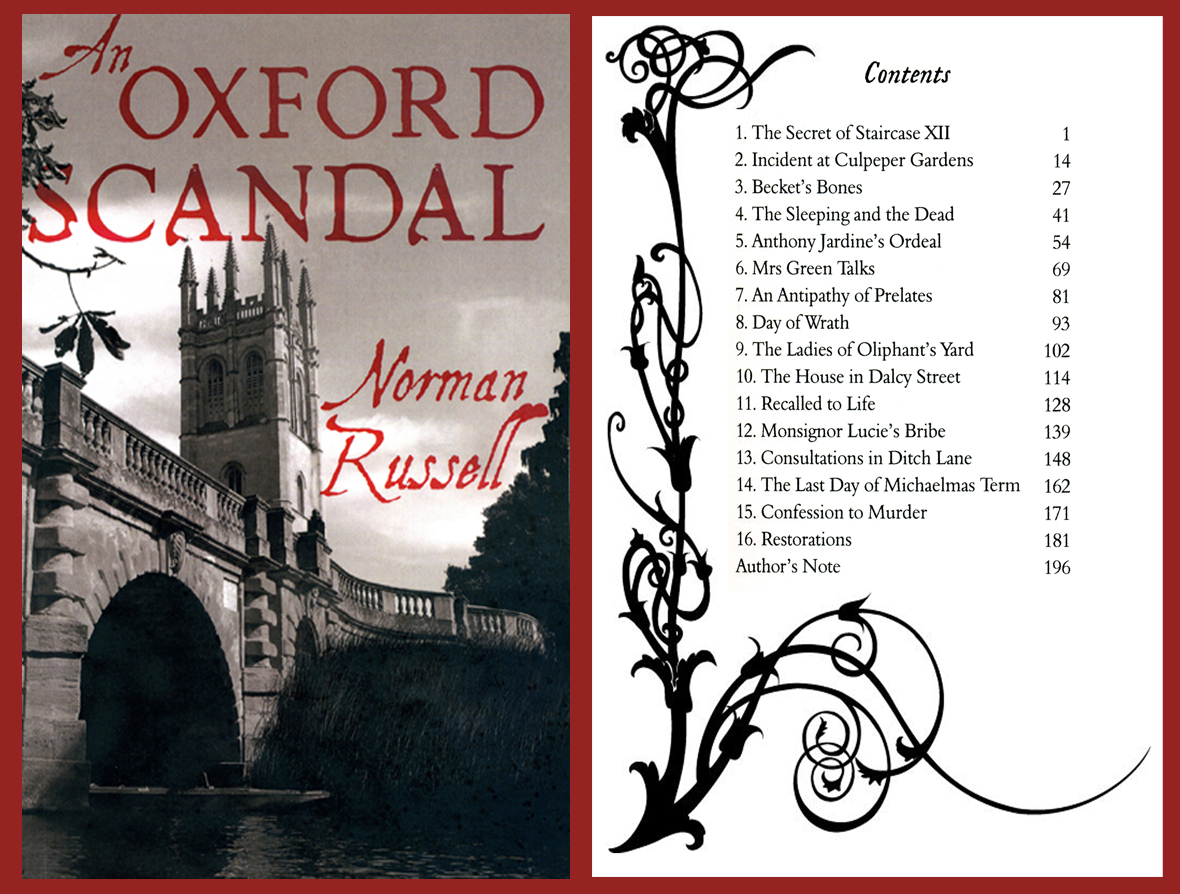

 Oxford, 1895. The spires may well be dreaming, but for Anthony Jardine, Fellow of St Gabriel’s College, the nightmare is just beginning. His drug addicted wife is found stabbed to death, slumped in the corner of a horse tram carriage. His mourning is shattered when his mistress is also found dead – murdered in the house she shares with her elderly eccentric husband. With a background story of an archaeological discovery threatening to shake the English religious establishment to its very roots, Inspector James Antrobus must avoid the temptation to make Jardine a swift and easy culprit. Helped by the uncanny perception of Sophia Jex-Blake, a pioneering woman doctor, Antrobus finds the answer to the killings lies in London, just forty miles away on the railway.
 Norman Russell (right) is a writer and academic, who has had fifteen novels published. He is an acknowledged authority on Victorian finance and its reflections in the literature of the period, and his book on the subject, The Novelist and Mammon, was published by Oxford University Press in 1986. He is a graduate of Oxford and London Universities. After military service in the West Indies, he became a teacher of English in a large Liverpool comprehensive school, where he stayed for twenty-six years, retiring early to take up writing as a second career.

 HIRAMIC BROTHERHOOD, Ezekiel’s Temple Prophecy – written by
  COLD BLOOD – written by
  THE YEAR OF THE GUN – written by

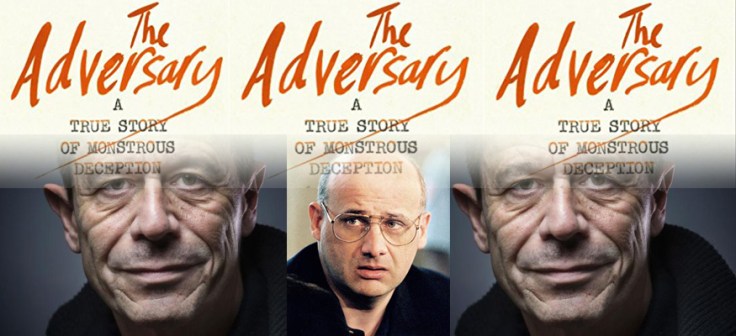
 To this farrago of lies and deception add fraud on a grand scale. Romand was able to keep himself and his family in relative prosperity by claiming that he had access to investment opportunities which would pay handsome dividends to those fortunate enough to be ‘in the know’. He relieved relatives and members of his wider family of hundreds of thousands of French francs – every one of which went into his numerous personal bank accounts. Separating his mistress and her vast personal fortune was his undoing. She was sharp enough – eventually – to call him out and, with his fantasy world on the verge of unraveling, Romand, on an icy weekend in January 1993, killed his wife, two children, and both of his parents.
 Inevitably, Romand was found guilty of murder, and in 1996 was sentenced to life imprisonment with no chance of parole for at least twenty two years. Prior to the trial, Carrère had begun a correspondence with Romand (right) with a view to writing an account of the case. In this account, aside from the factual detail, Carrère invites us to ponder the true nature of evil and insanity, and makes us wonder if the two states are totally separate, or whether or not they are actually bedfellows.
 Carrère (left) concludes:


