 Something we do all too rarely on Fully Booked, mea culpa, is to feature articles and reviews by guest writers. I am delighted that an old mate of mine, Stuart Radmore (we go back to the then-down-at-heel Melbourne suburbs of Carlton and Parkville in the 1970s, where he was a law student and I was teaching art at Wesley College) has written this feature on a writer who, as an individual, never actually existed. Stuart’s knowledge of crime fiction is immense, and so I will let him take up the story.
P.B Yuill was the transparent alias of Gordon Williams and Terry Venables, who in the early to mid 1970s wrote a number of novels together. Gordon Williams (1934-2017) and pictured below, started out as a straight novelist, but over time would turn his hand to almost anything literary – thrillers, SF screenplays, even ghosted footballer’s memoirs. Terry Venables (b. 1943) was at this time described as “top football star already worth over £150,000 in transfer fees”.

 Their first joint outing (published under their own names) was They Used To Play On Grass (1971). Described, not incorrectly, on the paperback cover as “the greatest soccer novel ever”, it’s still an enjoyable read, with each man’s contribution being pretty obvious.
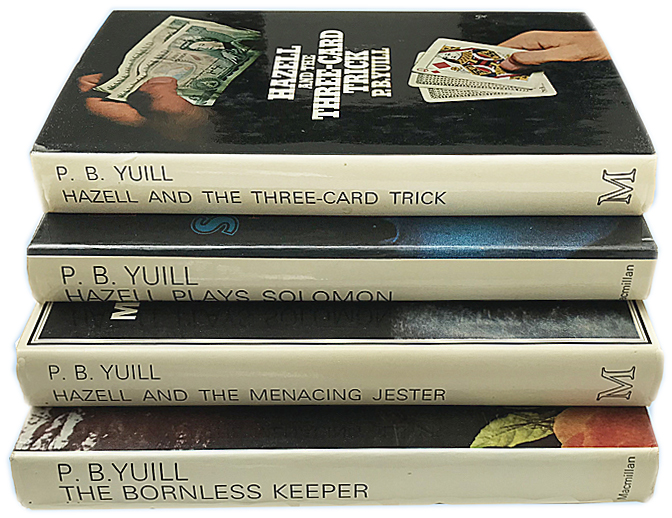
Next up was The Bornless Keeper (1974), published under the name of PB Yuill. A credible horror/thriller, set in modern times.
“Peacock Island lies just off the English south coast. But it could belong to an earlier century; its secret overgrown coverts, its strange historic legends are maintained and hidden by the rich old lady who lives there as a recluse.”.
If the tale now seems overfamiliar – the moody locals, the over-inquisitive visiting film crew, the one person who won’t be told not to go out alone – it’s partly because these elements, perhaps corny even then, have been over-used in too many slasher movies since. Although credited to P.B Yuill, the setting and theme of the novel reads as the work of Gordon Williams alone
Now to Hazell. There are three Hazell novels, published by Macmillan in 1974, ’75 and ’76 – Hazell Plays Solomon, Hazell and the Three Card Trick, and Hazell and the Menacing Jester.
The premise of the first novel is original; James Hazell, ex-copper and self-described “biggest bastard who ever pushed your bell button” is hired by a London woman, now wealthy and living in the US, to confirm her suspicion that her child was switched for another shortly after its birth in an East London maternity hospital. Clearly, there can be no happy ending to such enquiries, and the story leads to dark places and deep secrets.
The next two novels are a little lighter in tone, but still deal with the grittier side of London life. In Three Card Trick a man has apparently suicided by jumping in front of a Tube train. His widow doesn’t accept this – there is the insurance to consider – and hires Hazell to prove her right.
In Menacing Jester we are on slightly more familiar PI ground; a millionaire and his wife are apparently the victims of a practical joker. Or is there something more sinister behind it?
All three novels contain plenty of sex, violence and local colour – card sharps, clip joint hostesses, Soho drinking dens – and the authors were clearly familiar with the more picturesque aspects of the London underworld and portray these with energy and humour. Readers looking for evidence of the “casual racism/sexism/whatever” of the 1970s will not come away empty-handed.
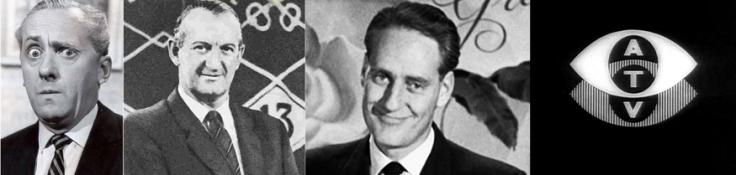
 The authors were keen to develop the Hazell character into a possible TV series, and the later two books seem to be written with this in mind. This duly came to pass, via Thames Television, and the first series was broadcast in 1978, starring Nicholas Ball as a youthful James Hazell. Gordon Williams, with Venables (right) and other writers, was responsible for a number of the episodes (including ‘Hazell Plays Solomon’), and it remains a very watchable series. The second, and final, series broadcast in 1979/80 was not so successful. The hardness was gone, Hazell and Inspector ‘Choc’ Minty had become something of a double act and, while not outright comedy, it came close at times. It’s not surprising to learn that Leon Griffiths, one of the second series screenwriters, went on to create and develop the very successful series Minder later that year.
And that was about it. But there was to be a last hurrah for Hazell in print. Two Hazell annuals, “based on the popular television series”, appeared in 1978 and 1979. The tales in these books are surprisingly tough, bearing in mind the intended teenage readership. Hazell’s adventures are told via short stories and comic strips, and include strong-ish violence, blackmail and other criminality. While the contribution of “P. B Yuill” was probably nil, the stories are true to the feel of the first series of the TV programme.

To conclude: English fictional private eyes are a rare breed, and fewer still can claim to have begun as a literary, rather than television, creation. Hazell is among the best of these. The three novels rightly remain in print, and are eminently readable.
There is a postscript. There was one last appearance of P.B Yuill. In early 1981 ‘Arena’, a BBC2 documentary series, devoted a programme to the attempts of Williams and Venables to write a new Hazell adventure – tentatively entitled ‘Hazell and the Floating Voter’ – and it featured such worthies as John Bindon and Michael Elphick playing the part of Hazell. It’s never been broadcast since, and while it was pleasing to see the authors discussing the character of Hazell, in retrospect the programme seems like an excuse for a few days’ drinking on licence-payers’ money.


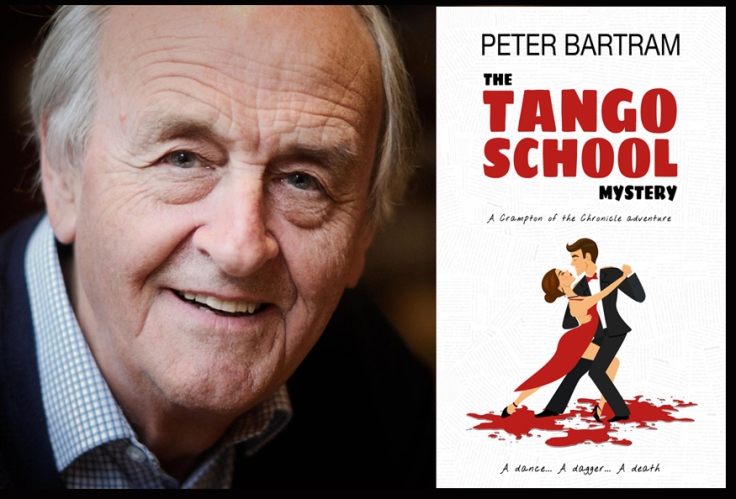




 Six Strings is a quick thriller, an hour’s intrigue and entertainment. It features characters from the JJ Stoner / Killing Sisters series. You don’t need to have read any of the other stories in the series: you can start right here if you like.
 The rider wears a helmet – great head protection, that’s why the law compels them. He wears a face mask, great precaution against suicidal 100mph wasps, and a perfect disguise. He wears leather, and body armour tough enough to slow a small calibre handgun round to the point where it hurts, but is unlikely to be fatal. All of that in full view of anyone who might be looking.
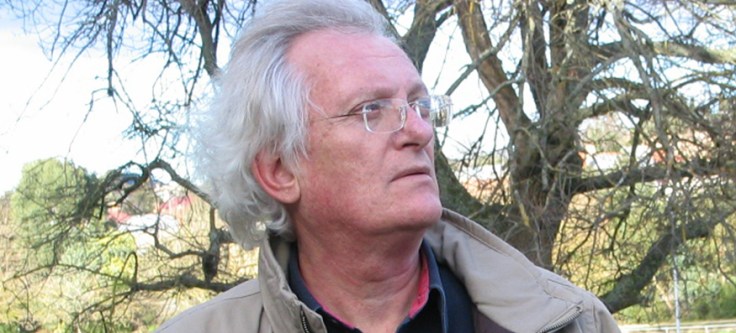
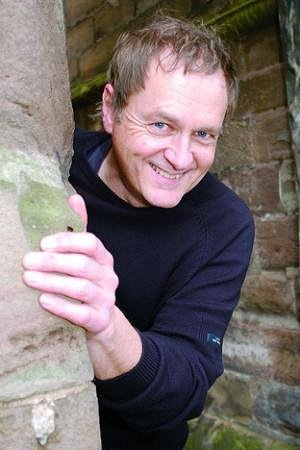
 When it comes to creating a sense of place in their novels, there are two living British writers who tower above their contemporaries. Phil Rickman, (left) in his Merrily Watkins books, has recreated an English – Welsh borderland which is, by turn, magical, mysterious – and menacing. The past – usually the darker aspects of recent history – seeps like a pervasive damp from every beam of the region’s black and white cottages, and from every weathered stone of its derelict Methodist chapels. Jim Kelly’s world is different altogether. Kelly was born in what we used to call The Home Counties, north of London, and after studying in Sheffield and spending his working life between London and York, he settled in the Cambridgeshire cathedral city of Ely.
 It is there that we became acquainted with Philip Dryden, a newspaperman like his creator but someone who frequently finds murder on his doorstep (except he lives on a houseboat, which may not have doorsteps). While modern Ely has made the most of its wonderful architecture (and relative proximity to London) and is now a very chic place to live, visit, or work in, very little of the Dryden novels takes place in Ely itself. Instead, Kelly, has shone his torch on the bleak and vast former fens surrounding the city. Visitors will be well aware that much of Ely sits on a rare hill overlooking fenland in every direction. Those who like a metaphor might well say that, as well as in terms of height and space, Ely looks down on the fens in a haughty fashion, probably accompanying its haughty glance with a disdainful sniff. Kelly (above) is much more interested in the hard-scrabble fenland settlements, sometimes – literally – dust blown, and its reclusive, suspicious criminal types with hearts as black as the soil they used to work on. Dryden usually finds that the murder cases he becomes involved with are usually the result of old grievances gone bad, but as a resident in the area I can reassure you that in the fens, grudges and family feuds very rarely last more than ninety years
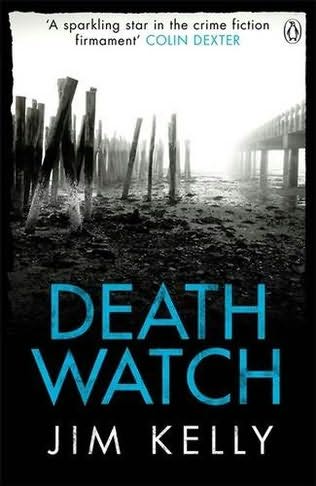 In the Peter Shaw novels, Kelly moved north. Very often in non-literal speech, going north can mean a move to darker, colder and less forgiving climates of both the spiritual and geographical kind, but the reverse is true here. Shaw is a police officer in King’s Lynn, but he lives up the coast near the resort town of Hunstanton. Either by accident or design, Kelly turns the Philip Dryden template on its head. King’s Lynn is a hard town, full of tough men, some of whom are descendants of the old fishing families. There is a smattering of gentility in the town centre, but the rough-as-boots housing estates that surround the town to the west and the south provide plenty of work for Shaw and his gruff sergeant George Valentine. By contrast, it is in the rural areas to the north-east of Lynn where Shaw’s patch includes expensive retirement homes, holiday-rental flint cottages, bird reserves for the twitchers to twitch in, and second homes bought by Londoners which have earned places like Brancaster the epithet “Chelsea-on-Sea.”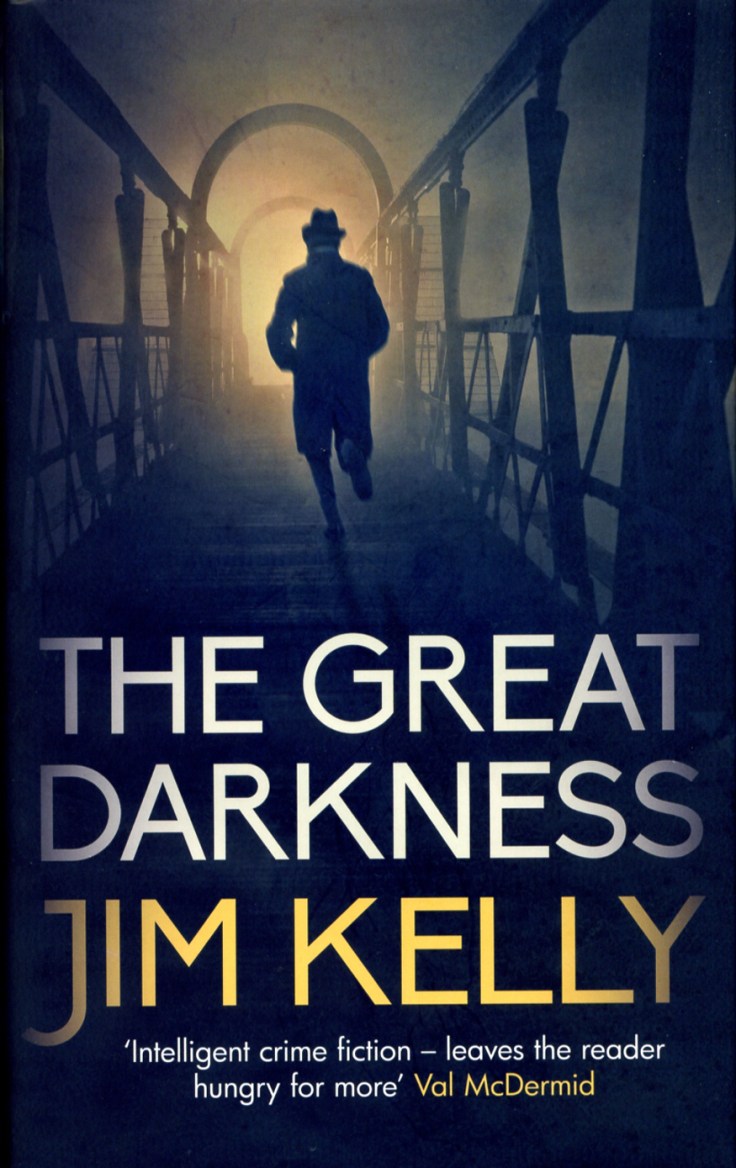

 There are no honourable mentions here, because, (if you’ve been good) you will have seen them all in the previous four posts. Regular readers of this blog, and those who read my interviews, reviews and features on Crime Fiction Lover, will know that I am a massive fan of Phil Rickman’s books and, in particular, the series featuring the thoroughly modern, but often conflicted, parish priest, Merrily Watkins. She is one of the most intriguing and best written characters in modern fiction, but Rickman (left) doesn’t stop there. He has created a whole repertory company of supporting characters who range in style and substance from the wizened sage Gomer Parry – he of the roll-up fags and uncanny perception (often revealed as he digs holes for septic tanks) – to the twin-set and pearls imperturbability of the Bishop’s secretary, Sophie. In between we have the fragile genius of Merrily’s boyfriend, musician Lol Robinson, the maverick Scouse policeman Frannie Bliss and, of course, Merrily’s adventurous daughter Jane, for whom the soubriquet ‘Calamity” would fit nicely, such is her propensity to go where both angels – and her anxious mother – fear to tread.
 In All Of a Winter’s Night a young man has been killed in a mysterious car crash, and his funeral attracts bitterly opposed members of the same family. Merrily tries to preside over potential chaos, and her efforts to ensure that Aidan Lloyd rest in peace are not helped when his body is disinterred, dressed in his Morris Man costume, and then clumsily reburied. Rickman adds to the mix the very real and solid presence of the ancient church at Kilpeck, with its pagan – and downright vulgar (in some eyes) carvings. The climax of the novel comes when Merrily tries to conduct a service of remembrance in the tiny church. What happens next is, literally, breathtaking – and one of the most terrifying and disturbing chapters of any novel you will read this year or next. With its memorable mix of crime fiction, menacing landscape, human jealousy, sinister tradition and pure menace, All Of a Winter’s Night is my book of 2017.




 So, who thrilled me the most? First across the line by a nose, in a very competitive field, was


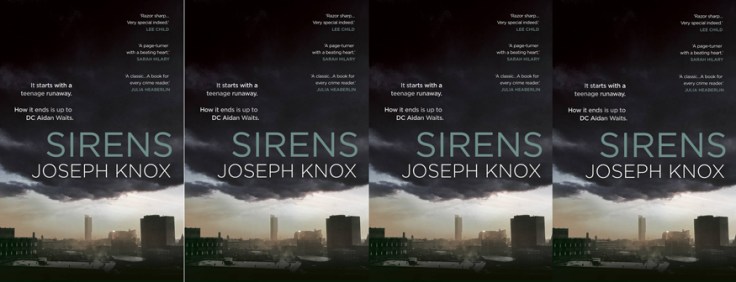
 Every book I’ve mentioned won admirers from different sections of the reading public but, for me, the die was cast when a rather shy young man read the opening paragraphs of his soon-to-be-published novel at a book promotion evening in a smart Fitzrovia Hotel. Joseph Knox (left) may still have work to do to become a Richard Burton in the making, but