Search

fullybooked2017

Category

FEATURES

THE MUSIC OF CRIME FICTION

TMOCF header

IV. SCHERZO

I like to think I have a wide taste in music, and can get something out of almost every genre and style. I do draw the line at ‘modern’ jazz, however. My view is – and I show my age by borrowing a phrase from the 1957 Wolfenden Report – that it should be permissible only between consenting adults, and very definitely in private. So, no Crime Fiction set around an alto sax player who plays thirty-five minute solos (sadly, he’s not fictional, but he is certainly committing a crime.)

51G3AhWKo0L._SX311_BO1,204,203,200_I do love Operas, though – at least those written up to the death of Giacomo Antonio Domenico Michele Secondo Maria Puccini (who would be just as wonderful even if he didn’t have six christian names.) I would add the personal caveat that for me it is sometimes better heard than seen, as stage productions can sometimes demand too much suspension of disbelief. Our chosen book, then, is Spur Of The Moment by David Linzee, and it is set around the St Louis Opera company as they prepare a performance of Bizet’s wonderful, preposterous, exhilarating four-act classic, Carmen.

The central character in the book is Renata Radleigh, an English mezzo-soprano who is employed by the St Louis Opera to sing the relatively minor role of Mercédès. Her brother, fellow ex-pat David, is also employed by the SLO, but his task is to tout far and wide for commercial sponsorship.

When a key company patron Helen Stromberg-Brand is found brutally murdered, the police suspect David Radleigh and arrest him. His motive? It seems that Helen – nicknamed Sturm und Drang – and her husband were on the verge of cancelling a huge donation. Could they have argued? Did David lose his temper with the headstrong woman?

But there could be another motive. Helen Stromberg-Brand was a national celebrity, at least in the field of pharmaceutical research. She and her team were on the threshold of patenting a revolutionary drug to combat urinary tract infection in women. In partnership with the charismatic billionaire Keith Bryson – who has the casual dress sense, long hair and boyish charm of Richard Branson – Helen’s unit at the Adams University Medical Centre were about to find even greater fame and riches. Now she lies in the police mortuary, her head shattered by a heavy glass bowl.

Renata is not the world’s most loving sister, but she refuses to accept that David could have killed Sturm und Drang, if only because he is far too wet and wimpy for murder. Together with a former reporter, Peter Lombardo, she thinks the lady’s demise was less to do with the SLO, and more to do with the cut-throat world of drug patenting.

DLDavid Linzee has himself been a ‘supernumary’ – basically the opera equivalent of a spear carrier – and he enjoys several digs at the way an opera company in a mid-sized city is run. I particularly enjoyed his jibes at the ubiquitous need for sponsorship. Linzee (right) explains that the SLO has to make sure that literally every brick in the building has corporate support. Thus we have the Peter J Calvocoressi Administration Building, the Charles Macnamara III Auditorium and – best of all – the Endeavour Rent-a-Car Endowed Artist. In this case it’s Amy Song, the woman playing Carmen.

By the time Renata and Peter think they have unraveled the mystery of who killed the formidable Mrs Stromberg-Brand, the unorthodox stage set of the Carmen production experiences a malfunction. A giant playing card land on the heroine’s head. An all-points-bulletin is issued for the only actress who can replace the stricken Ms Song – none other than our very own Renata Radleigh. Renata takes the stage in triumph, but before the distraught Don José can plunge his stage dagger into Carmen’s heart, a real killer pre-empts the drama at the bull-fighting arena.

SOTM middle

If anything, the plot of Spur Of The Moment is even more unlikely than the full blooded passion and drama taking place on stage between the doomed gypsy girl and her battling lovers, but what the tabloid press might call THE SHENANIGANS IN SEVILLE make a wonderful backdrop for this beautifully written and sharply funny murder mystery. A tad cosy, perhaps? Maybe, but when something is as well written as this, you won’t hear me complaining. A final word, if I may. Try to get to a production of Bizet’s masterpiece as soon as you can. Why the hurry? Well, it stands to reason, surely? Not only was Bizet not Spanish, his opera may well come to be classified as ‘cultural appropriation’ as well as making harmful stereotypes of people from Seville, women who make cigars, gypsies, policemen and bullfighters. Don’t say you weren’t warned.

Spur Of The Moment is published by Coffeetown Press and is available here.

You can catch up with the previous parts of this series by clicking the links.

I. PRELUDE and FUGUE
II. MARCHE FUNEBRE
III. RONDO

SOTM footer

THE MUSIC OF CRIME FICTION

TMOCF header

III. RONDO

Existing fans of Phil Rickman’s superbly evocative Merrily Watkins novels can skip this paragraph. As in all the best fiction series, there is a stable cast of recurring characters. So, for new readers, the Rickman Repertory Company is led by the Reverend Merrily Watkins: widow, mother, parish priest and Dioceson Deliverance officer (modern C of E speak for exorcist). Then comes Jane, her teenage daughter and inveterate dabbler-into-things-she-oughtn’t-to-be-dabbling-in. Gomer Parry, local drainage contractor, voice of common sense and elderly savant. Representing the forces of law and order is Frannie Bliss, detective with the Herefordshire Constabulary, scouser and all-purpose square peg. The musical director of this ensemble is Lawrence ‘Lol’ Robinson, dazzling guitarist, singer songwriter, sometime depressive, sufferer from paralysing stage fright – and the long term boyfriend of Merrily.

Lol has a serious back-story. In To Dream of The Dead, Rickman spells it out in stark clarity:

“Barely twenty and convicted of sexually assaulting a fourteen-year-old girl while on tour with Hazey Jane. An offence actually committed, while Lol was asleep, by the band’s bass player, who’d walked away, leaving Lol on probation, unjustly disgraced, disowned by his creepy Pentecostalist parents, swallowed by the psychiatric system. His career wrecked, his spirit smashed.”

As he creates Lol’s complex character, Rickman wants us to think of a real-life singer and guitarist, Nick Drake. Cynics might say that when the Gods take young musicians, it is a cast iron guarantee that both victim and music will achieve a kind of immortal celebrity that they may not have reached had they lived. Who can say with certainty that Eddie Cochran, Buddy Holly, Janis Joplin, Marc Bolan, Jimi Hendrix and others in the pantheon of dead rock stars would now be as famous in life as they have become in death?

Lol Robinson shares Nick Drake’s intensity, delicate guitar playing, haunting voice and sense of sublime anxiety about himself and the world he lives in. But, thanks to the support of Merrily Watkins and others, Lol comes through his bad times and lives to perform and record again. As he emerges from the darkness, he almost becomes as one with his guitar. Like Frank Westworth, Phil Rickman clearly knows, loves and plays the instrument, and he gifts Lol a beautiful hand-made guitar. Its maker is Al Boswell, a unique craftsman; part gypsy, part mystic and a man whose hands seem guided by forces older than any skills learned in a school woodwork class.

LOL

Not content with making one of the spear-carriers in his ensemble a fascinating and compelling character, Rickman goes one step further. He has actually recreated Lol’s band Hazey Jane, and they have made videos and sound recordings to prove the point.

https://www.youtube.com/watch?v=5ND_CkcUb78

Click on the image below to visit Phil Rickman’s own site, and learn more – and hear more – about Lol Robinson and Hazey Jane II.

Screen Shot 2017-06-30 at 21.01.10

philrickmanBefore he had the brainwave which gave us Merrily Watkins in The Wine of Angels (1998), Rickman wrote several standalone novels. The most music-centred one was December (1994). It begins on the evening of Monday 8th December, 1980. For most people of a certain age, that date will be an instant trigger, but Rickman (right) sets us down in a ruined abbey in the remote Welsh hamlet of Ystrad Ddu, which sits at the foot of one of The Black Mountains, Ysgyryd Fawr – more commonly known by its anglicised form The Skirrid. Part of the medieval abbey has been fitted out as a recording studio and, in a cynical act of niche marketing, a record impresario has contracted a folk rock band, The Philosopher’s Stone, to record an album of mystical songs in the haunted building, and he has stipulated that the tracks must be laid down between midnight and dawn.

Shortly before 4.00am, as the band are playing a song which relates the tragic story of Aelwyn, a young Celtic man who was hacked to death in the abbey grounds by Norman invaders in 1175, what was already a fractious and uneasy atmosphere turns distinctly sinister. Acoustic guitarist Dave Reilly is overcome by disturbing visions and, as he escapes the studio to shelter under an ancient oak tree, over three thousand miles away it is 10.50 pm and a disturbed young Hawaiian man called Mark David Chapman is pumping four bullets into former Beatle and musical legend, John Lennon.

As if the ill-fated recording session is not already attracting enough malevolent vibrations, things are about to get worse – much, much worse. Lead guitarist Tom Storey – as notorious for his abuse of drink and drugs as he is celebrated for his guitar virtuosity – has had enough. He has left his pregnant wife Deborah in a nearby hotel and, angry at the shambolic and disturbing recording session, commandeers a Land Rover and storms off to be with her. Deborah, meanwhile has decided to come out to Ystrad Ddu to ‘rescue’ her husband. As John Lennon is bleeding to death in the back of a police car, Tom’s Land Rover smashes into Deborah’s Lotus sports car.

“Twenty yards away, the old blue Land Rover driven by Tom Storey has brought down a low, sleek Lotus Elan, like a lion with a gazelle. The Land Rover has torn into the Lotus and savaged it and its guts are out and still heaving, and Dave can see flames leaping into the vertical rain …..”

December middle.jpg

Rickman takes us forward to the present day. The Philosopher’s Stone is no more. It died on that fateful December night. Tom Storey has remarried, but lives as a recluse in a Cotswold mansion with his second wife and daughter Vanessa, removed from the dying body of her mother but afflicted with Down’s Syndrome. Singer Moira Cairns has flirted with the folk music scene, but has largely retreated from public life. Dave Reilly has eked out a threadbare living as a musician, but is cursed with an ability to sense the supernatural, and his ‘gift’ has done him no favours. Bass player Simon St John has abandoned music altogether (apart from in the privacy of his own room) and has taken holy orders.

Novels and, indeed, films, would not be able to create their magic were it not for the priceless ability of fictional characters to make decisions which turn out to be disastrous – and often fatal – mistakes. So it is in December. An unscrupulous music executive, desperate for something that will give his flagging career an edge, discovers a box of tapes, all that remains of the fatal pre-dawn music making in December 1980. A highly respected producer, Ken ‘Prof’ Levin (who features as a mentor to Lol Robinson in the Merrily Watkins novels) is persuaded to restore the tapes. To say that all hell breaks loose as a consequence is putting it mildly. Ghosts don’t like being woken from their dreamless sleep by money-grubbing mortals, and they exact a high price for their inconvenience.

Amid all the psychic mayhem, this is unashamedly a novel about guitars and their magic. We have Stratocasters, Martins, Takemines, Ovations, Telecasters and Les Pauls. Rickman’s fascination with his chosen instrument shines through, and his enthusiasm will inspire many a lapsed player to blow the dust off their guitar case, open it up and coax an old tune from their neglected lover.

Check out the buying options for December, and other Phil Rickman novels, here.

You can also read the Fully Booked review of the most recent Merrily Watkins novel
All Of A Winter’s Night

You can catch up with the previous parts of this series by clicking the links.

I. PRELUDE and FUGUE
II. MARCHE FUNEBRE

Guitars

THE MUSIC OF CRIME FICTION

TMOCF header

II. MARCHE FUNEBRE

Stoner044Jean-Jacques ‘JJ’ Stoner is a stone cold killer. His creator, Frank Westworth gives us a first glimpse of him as an army sergeant serving in Iraq. One of his squad has just been fatally wounded by a knife thrown by one of a group of Iraqis who:

“….. plainly considered that the knife’s flight was the result of heavenly intervention and that they were all witnesses to a miraculous act, rather than a clever murderous attempt.”

The sergeant quietly but forcefully demands information:

“His words produced only more theatrical incomprehension. Five sets of open palms were paraded before the sergeant; all of them as innocent as the other, was the suggestion. A single shot interrupted the stage grief; one of the Iraqis sagged from seated to fallen, his dark blood draining from his exploded head into the sands of his native home. The sergeant held his smoking handgun in plain view, spread his arms wide to express his regret, his masculine sorrow.”

Sergeant Stoner assassinates the remaining Iraqis with neither hesitation nor sentiment. Shortly after, he is recruited by a government official we come to know as The Hard Man. Stoner’s new job is to use sharp blades and blunt instruments to discreetly resolve difficult situations for the British government. If Stoner has a gruesome talent for taking life, he also has a paradoxical skill which requires sensitivity, a delicate touch and an awareness of the human soul and its emotional depths; he is a gifted guitarist. In one of Westworth’s short stories, First Contract, Stoner uses his musical ear to imitate a Belfast accent when in a pub full of staunch Republicans:

“Beaming broadly, Stoner took a seat with the band. His lady companion ….. watched with some surprise as Stoner changed the tuning on the borrowed acoustic guitar, acknowledged a generous introduction from the leader of the band, then launched into a medley of furious Provo protest songs, familiar to all in that Catholic bar, all with their choruses to share.”

In the short story Two Wrongs Stoner is in America and we are introduced to a character who appears regularly in the Stoner stories, the navy SEAL known as Stretch. He and Stoner are in a bar, tangling with an agent from the FBI. Stoner, though, always has time for music:

“ Stoner finished his Bud, smacked his lips, and moved smoothly through the quietened attentive crowd to the stage, where he picked up the borrowed Fender Telecaster, smacked it a little to confirm the inaccuracy of its tuning, and launched into a spontaneous version of Johnny B. Goode set to a strange rolling rockabilly rhythm which found Stretch running, actually running from the restrooms to the stage in what proved to be a successful attempt to save the song from the amused Englishman’s attempt to publicly destroy such an important icon of American history.”

Westworth header

Westworth’s skill as a writer of quirky thrillers is shown to best effect in his Killing Sisters trilogy. In A Last Act of Charity (2014), The Corruption of Chastity (2015) and The Redemption of Charm (2017) Stoner encounters three sisters who are just as deadly and homicidal as he is. We also learn that in his downtime, when he is not despatching people who are being an embarrassment to HM Government, he is running a jazz and blues club called The Blue Cube. The closest thing that Stoner has to a girlfriend is a diminutive bass player called Bili who plays in the house band from which Stoner is often conspicuously absent due to his murderous day job.

“Bili swung her big red Rickenbacker bass into what might have been a comfortable playing position, and all three looked to far stage left, where Amanda rolled her eyes, took a deep breath and surprised them all by blasting from her shiny tenor saxophone the opening stanza of Baker Street, one of the most recognisable lumps of sax music of all time.”

Westworth realIt doesn’t take a genius to work out that Westworth (right) is deeply immersed in the lore and legend of pop music as well as knowing his guitars. The Killing Sisters books are scattered with references – some subtle, but others more obvious – to great songs and singers. Later in The Redemption of Charm, Stoner renews his acquaintance with his favourite guitar:

“His old Fender guitar sat easily in his lap as he tuned, fingered a few chords, tuned again, hummed a few verses, tuned some more, strangely restless. The guitar felt odd … polished maybe. The strings were certainly new enough, although of the correct weight for his taste. He replaced it in its case, wandered around and discovered another case, standing by the closed piano, this one containing an acoustic guitar, a fine blonde Gibson model unfamiliar to him.”

 Stoner is gloomy, and overcome with melancholy, states of mind with which he is unfamiliar, and strange moods sit heavy on his shoulders:

“He played a finger-picked instrumental tune he half remembered from the days before his playing focused entirely on electric solid-bodied guitars. A famous tune by Davey Graham dedicated to some woman called Anji. Unbidden and unwelcome somehow, his memory unearthed a series of images of women to whom he’d dedicated the song down the years.”

 You can follow the blue links to the Amazon pages for Westworth’s novels, and on Fully Booked we have a detailed review of The Redemption of Charm, and an entertaining piece by the author on how to kill people, again borrowing from the title of a classic song – Killing Me Softly.

Next up in our musical journey is the story of a gifted singer-songwriter whose career has been shattered by depression and stage fright, and the sombre tale of a band whose obsession with the Dakota Building and the death of John Lennon takes them to a very dark place.

Check out PRELUDE AND FUGUE,
the first movement in this composition.

THE MUSIC OF CRIME FICTION

TMOCF header

I -PRELUDE AND FUGUE

This look at how music features as a soundtrack to many crime fiction novels will ignore works which simply have song titles or lyrics as chapter headings, or books which mention various popular songs merely as a device to establish the authenticity of the era in which the action takes place. Also, we will largely leave alone the police procedurals of the maverick Detective Inspector type where the cop in question wears his musical taste not perhaps on his sleeve but certainly on the pages of the narrative. Much to the distaste of most of his colleagues, Mark Billingham’s Tom Thorne has a penchant for country music, particularly the lonesome heartbreak of Hank Williams, while his Yorkshire counterpart Alan Banks veers in the more sophisticated direction of niche blues and jazz. Neither of these performs music, however, except perhaps humming along to something on the car music player.

While everyone is familiar with dear old Endeavour Morse, particularly in his John Thaw personification, glumly consoling himself with his precious recordings of Mozart and Wagner, he squeezes in as a performer of music only because of the TV adaptations. In the novel The Dead of Jericho (1981) he meets the soon-to-be-murdered Anne Scott at a party, but the TV version has them both as members of an Oxford choir.

Death and the MaidenColin Dexter’s stories of the wonderful curmudgeon are among the widest read in the last quarter of the 20th century, but less well known are the Vienna-set novels of Frank Tallis featuring policeman Oskar Rheinhardt and his young pyschiatrist friend Dr Max Liebermann. The younger man often plays piano for Rheinhardt melodic baritone as they seek solace from the stresses and strains of catching murderers.
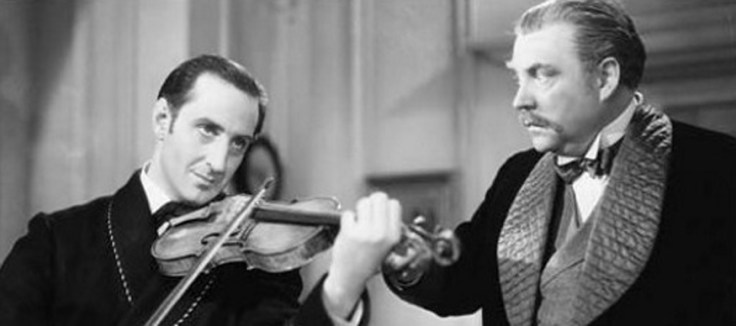
Not only are the pair devotees of their sublime fellow townsman Schubert, but Death And The Maiden (2011) actually features a walk-on part by none other than Gustave Mahler, as Liebermann and Rheinhardt track down the killer of a diva from The State Opera. Among other police officers and investigators who can do rather more than knock out a tune we must include James Patterson’s prolific profiler Alex Cross who, when the mood takes him, plays a mean jazz piano. The violin offers our own Sherlock Holmes a more healthy alternative stimulus to one, two or even three pipes of his favourite tobacco, or a syringe full of his opiate of choice. In A Study In Scarlet we learn:

“His powers upon the violin were very remarkable, but as eccentric as all his other accomplishments. When left to himself he would seldom produce any music or attempt any recognised air ….he would scrape carelessly at the fiddle which was thrown across his knee.”

In the next movement we will hear of the embittered intelligence operative who not only plays a mean Fender Stratocaster, but also owns a jazz/blues club in London.

Holmes Violin

AUTHOR SPOTLIGHT … Brian Stoddart

Spotlight

There is a long and honourable list of crime fiction novels set in places of learning. With Harriet Vane solving murder in Shrewsbury College (Gaudy Night, Dorothy L Sayers, 1935), Sir Richard Cherrington stalking criminals in Fisher College (The Cambridge Murders, 1945, Welcome Death, 1954, Glyn Daniel), and a rich seam of Inspector Morse novels set among Oxford Colleges (Colin Dexter, between 1975 and 1999). But what of academics turning the tables and writing their own crime novels?

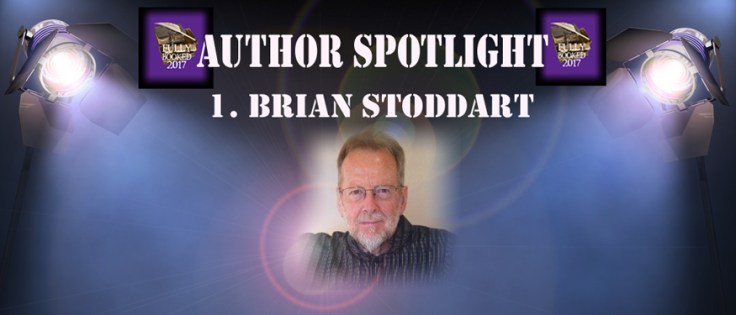
Emeritus professor Brian Stoddart is an academic who was the vice-chancellor of La Trobe University, Melbourne. He is a well-known commentator on sporting matters, being involved in the foundation of the Australian Institute of Sport and being the author of many books exploring the history and importance of sports in society. It is as a writer of crime fiction, however, that we focus on Brian Stoddart.

Born and raised in New Zealand, Stoddart’s academic career took him all over the world including long periods in India, Malaysia, Canada, the Caribbean, China and Southeast Asia, and it is as an ‘old India hand’ that he emerged as a crime writer. A Madras Miasma was published in 2014, and it introduces us to Superintendent Christian Le Fanu, of the Madras Police. Le Fanu is estranged from his English family and, after experiencing at first hand the horrors of the trenches in The Great War he has, some would say, cast himself adrift in post-war India.

The Great War changed many things in the world, and its aftermath has given new life to the desire of Indians to be their own masters. While many in the civilian administration cannot – or will not – see it, there is a wind of change blowing across the land, led by men such as the young lawyer Mohandas Karamchand Gandhi. Some of Le Fanu’s superiors think he has ‘gone native’. He has a live-in lover-cum-housekeeper, Anglo-Indian Roisin, and is far too friendly with his assistant, Sergeant Habibullah, for the liking of many in the English community.

LeFanu

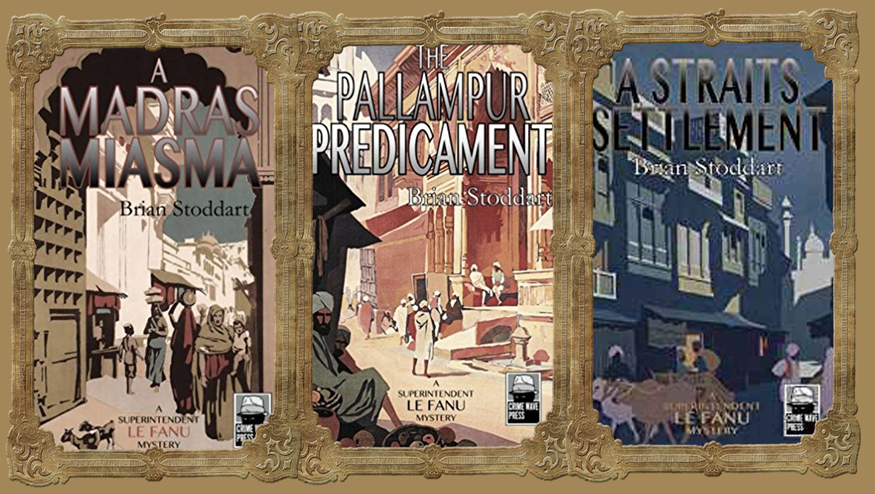
There have been three Le Fanu novels thus farA Madras Miasma, The Pallampur Predicament and A Straits Settlement. Le Fanu travels far and wide, particularly in the latter book, but always in the background the death knell for British imperialism is sonorously tolling. Stoddart gives us all points of view, from the starched collared and inappropriately dark suited old-style administrators who refuse to accept that the world is changing, via men like Le Fanu who can feel the winds of change, through to firebrand revolutionary types who want to see the back of the British at any price.

AHIDStoddart wears his scholarship lightly in the crime novels, but he is a gifted and compelling writer when dealing with the real world. In A House in Damascus – Before the Fall (2012) he examines the tragedy of the Syrian conflict and its effect on ordinary people for whom the complex political issues mean nothing but shattered lives, hardship – and death.

There is no activity, short of waging war, however, which arouses passions quite like sport, and for those in the southern hemisphere donning the baggy green cap, or pulling on that shirt which bears the simple – but uniquely intimidating – logo of the silver fern, is the closest many get to out-and-out conflict.

With this in mind, the closest Britain and Australia ever came to war with each other was during the legendary 1932-33 Bodyline cricket tour of Australia when every stereotype box was ticked. Douglas Jardine, the autocratic English snob, was depicted as a close relative of the army officers who sent brave Australians ‘over the top’ in The Great War. to combat German cricket-empiresteel and bullets with nothing but their manly chests. Don Bradman and Bill Woodfull, plucky Australian lads, direct descendants of the ANZACS, faced the barrage of Larwood and Voce with nothing but a small piece of shaped willow wood.  Stoddart co-authored, with Ric Sissons,  Cricket and Empire, an account of this bitter battle.

Stoddart’s fascination with cricket – not only as a game, but as a means of national identity – is never far from the surface, and co-edited Liberation Cricket, described thus:

“The essayists argue that cricket mirrors the anti-colonial tensions and ideological and social conflicts over race and class that have shaped West Indian society. In consequence, it has helped promote the region’s democratic ethos and fragmented nationalism.”

You can read more about what makes Stoddart tick both as a writer and an influential thinker by checking out his website:

https://professorbrianstoddart.com/

The most recent Christian Le Fanu novel, A Straits Settlement, was the Fully Booked Historical Novel of the Year for 2016, and you can read a detailed review of the novel by linking back to the feature here.

Stoddart footer

DEATH MESSAGE …Kate London

DM Header

“Earlier on today, apparently, a woman rang the BBC and said she heard there was a hurricane on the way… well, if you’re watching, don’t worry, there isn’t!”

Poor old Michael Fish. To have spent a worthy professional life reassuring the British public about what weather was coming their way, only to have your career summed up in twenty eight words. Twenty eight words which couldn’t have been more inaccurate. However, the aftermath of The Great Storm of 15th October 1987 is where Kate London’s new novel begins.

Death Message005A 15 year-old girl, Tania Mills, walks out of her front door and out of the lives of her parents, her family and her friends. She becomes just another statistic. Just another missing person for the police to make a dutiful attempt to appear involved. Just another file, first of all gathering dust on a shelf, and then occupying a tiny space on someone’s hard drive.

Almost three decades later, after the meteorological catastrophe which laid waste to large areas of south-east England, and the emotional storm which devastated the life of Claire Mills following her daughter’s disappearance, a determined Met Police officer, DS Sarah Collins is haunted by the cold case, and is determined to find answers.

Her search for the facts of what really became of Tania Mills is hindered when she is inexorably drawn into a pressing new case of domestic violence. She and a vulnerable young police constable, Lizzie Griffiths, have something of a history, but as Sarah Collins attempts to safeguard a mother and daughter from a very real and present danger, she discovers that the past is not so much another country, but an adjacent room in the same house. Death Message is out on 6th April as a paperback and a Kindle, and is published by Corvus.

DM Footer

SINS OF THE FATHER … Sheryl Browne

SOTF header

What if you’d been accused of one of the worst crimes imaginable?

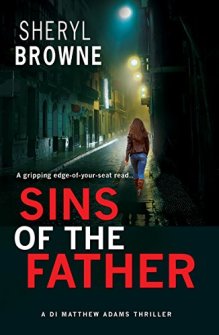
SOTFDetective Inspector Matthew Adams is slowly picking up the pieces from a case that nearly cost him the lives of his entire family and his own sanity too. On the surface, he seems to be moving on, but he drinks to forget – and when he closes his eyes, the nightmares still come.



But the past is the past – or is it? Because the evil Patrick Sullivan might be out of the picture, but there’s somebody who is just as intent on making Matthew’s life hell, and they’re doing it in the cruelest way possible.

When Matthew finds himself accused of a horrific and violent crime, will his family stand by him? And will he even be around to help when his new enemy goes after them as well?

Sins Of The Father is published by the endearingly named Death By Choc Lit, and is out now in Kindle, with a print version due soon. You can click on the image bar below to see a snappy trailer for the first book in the series, After She’s Gone.

Screen Shot 2017-03-09 at 13.50.53
Sheryl Browne
writes edgy, sexy contemporary fiction and psychological thrillers. This is the second in Matthew Adams series. Sheryl is a
member of the Crime Writers’ Association, Romantic Novelists’ Association and awarded a Red Ribbon by The Wishing Shelf Book Awards, Sheryl has several books published and two short stories in Birmingham City University anthologies, where she completed her MA in Creative Writing.If you click on the image below, it will take you to Sheryl’s website where you can learn more about her.

stencil.wp-banner-3


BOOKS OF THE YEAR 2016 … The winner!

boty

THE FULLY BOOKED BEST BOOK OF 2016

We already have selections for Best Dialogue, Best Historical Novel, and Best Psychological Thriller. Next up came the awards for Best Non-UK Novel, Best Police Procedural and Best PI Novel. Now, though, it’s drum roll time, and this is the book which, for me, was the outstanding publication of 2016.

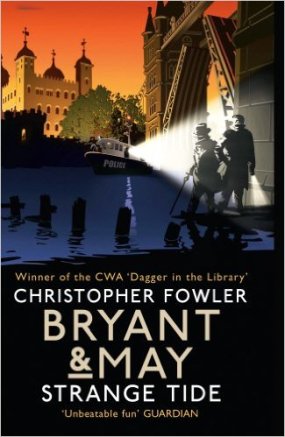
Strange Tide by Christopher Fowler

The Peculiar Crimes Unit is a kind of lost property facility for London’s Metropolitan Police. Orphan crimes, unsolved murders, unexplained disappearances – in short, investigations which would cost the cash-strapped Met Police valuable man hours are left on the doorstep of the PCU. Its two senior detectives, Arthur Bryant and John May are impossibly ancient but have an irreplaceable knowledge of London’s unique criminal history. The odd couple, particularly the apparently shambolic Bryant, have an almost visceral connection to the countless misdeeds committed on the capital’s ancient streets and lanes.

strange-tideBut all is not well. Arthur Bryant is physically sound enough, but his encyclopaedic mind is starting to betray him. He is suffering episodes of serious dislocation. He causes havoc in what he thinks is an academic library when he’s actually in the soft furnishings department of British Home Stores. While soaking up the ambiance of a Thames-side crime scene, all he can sense are the sights, sounds and smells of the early 20th century docks. John May and the more sprightly members of the PCU have to keep Arthur virtually under lock and key, for his own protection.

While trying to stop Arthur from wandering off and doing himself a mischief, the PCU team are investigating a bizarre death. A disturbed young woman has been found – drowned – chained to a concrete block on what had been an artificial Edwardian beach on a neglected section of the riverbank. She was several months pregnant, but her insouciant chancer of a boyfriend is innocent of both her demise and her impregnation. Why was there only one set of footprints leading towards the corpse?

As well as being among Britain’s best current crime writers, Fowler also carries the torch passed on by the great English humourists. With his gentle, quirky but needle sharp observations of the sheer daftness of the way we live now, he links hands with such writers as George and Weedon Grossmith, JB ‘Beachcomber’ Morton,  John Betjeman, Israel Zangwill and Colin Watson.

Behind the gags, the knowing cultural references, the ingenious plotting and the clever characterisations, we have Fowler’s unique take on London itself. No living writer save, perhaps, in their different ways, Peter Ackroyd and Iain Sinclair, knows London quite like Christopher Fowler. In other books in the series he has turned his expert eye on the theatres, the city’s lost rivers, and its medieval legends. The star of the show in Strange Tide is the River Thames itself. The crime is eventually solved, Arthur’s malaise is mostly cured, but the powerful river remains the city’s lifeblood. In a telling paragraph, Fowler reveals the deep, dark, blue centre of what he is about.

“…the metropolis is ultimately changeless. Its people remain the same because London is a state of mind. They do not make London. London makes them.”

Strange Tide is published by Doubleday.

b-and-m-footer


BOOKS OF THE YEAR … part two

boty

My first three selections were in the Best Dialogue, Best Historical Novel and best Psychological Thriller categories, and you can review those by clicking this link. Here are my next three ‘best of’ choices.

best-non-uk

BEST NON-UK NOVEL

Murder In Mt Martha by Janice Simpson
There was certainly some red hot competition in this category, particularly from such American superstars as Harlan Coben and Walter Mosley, but there was something about this book that struck a chord. I’ll own up to being a fan of most things Australian, having lived and worked in The Lucky Country, but this story had something rather special.

On the one hand we have the murder itself, based on a real-life crime in the 1950s which remains unsolved to this day. It is true mystery in the sense of both words, but in the book we pretty much know who the killer is quite early in the piece. Simpson treads the tightrope of telling a story through different eyes and times, and she performs like a seasoned veteran, never once coming close to losing her balance. The modern day narrative involves a young Melbourne post graduate student, Nick Szabo, transcribing the memories of the elderly Arthur Boyle.

mimmThe past times take us back to the 1950s, both in Melbourne and then further north in rural Queensland. We enter the home of the young Arthur Boyle, who is looked after by his adult sister. Also resident in the Melbourne home is Ern Kavanagh, a twenty-something young man who has ambitions to be something other than a car mechanic. He then leaves Victoria and travels north, in search of fortune, if not fame in Queensland.

One of the great qualities of this book is the way Simpson plays a game with us about the exact relationships between Arthur, Ern and ‘Sissy’. We think we know what’s what, but it becomes clear as the story unfolds that we most certainly do not. There is, if you will, a two part harmony here, because Simpson then introduces another ‘tune’ which involves the history of the Szabo family, refugees from the Hungarian uprising, and once again, as the two melodies complement each other, family secrets unfold like a timelapse video of a flower opening.

The ghost of the murdered girl, clubbed to death and brutalised in a seaside resort near Melbourne, never quite goes away, and the sheer pity and wasteful nature of her death winds like a deep purple thread of mourning through the fabric of the story. The details of ordinary life in the 1950s are compelling and are given with a sense of wistfulness which never descends into mawkish sentiment. The conclusion of the book is brilliant, and the story comes to an end in a way which I least expected, but is entirely fitting and in keeping with the tone of the narrative. Murder In Mt Martha is published by Hybrid Publishers.

police-procedural

BEST POLICE PROCEDURAL

Death Ship by Jim Kelly
Odd couples are many and varied in the world of crime fiction, and many authors have explored the Yin & Yang possibilities that open up.  There are many critical appraisals of the device, such as this one from Early Bird Books. I have chosen a beautifully mis-matched duo who are perfect foils for each other. They are Detective Inspector Peter Shaw and Sergeant George Valentine of Norfolk Constabulary, based in King’s Lynn.

Shaw is the younger of the two. In fact, so much so that Valentine actually served on the force with Shaw’s late father. Shaw is a physical fitness enthusiast, a cerebral deep thinker, and is married to an exotic wife whose family is of Caribbean origin. George Valentine is a widower, a suicidally heavy smoker, curmudgeonly but with a razor sharp eye for detail. Together, they have appeared in Jim Kelly’s ‘Death’ series, the previous novels being Death Wore White, Death Watch, Death Toll, Death’s Door and At Death’s Window.

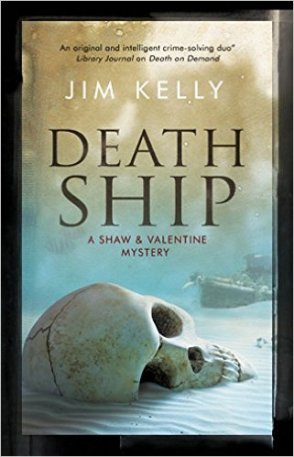
death-shipIn Death Ship, as with all the previous books, the sea is never far away. The seaside town of Hunstanton has been literally rocked by an explosion on its crowded beach. Something buried deep beneath the sand is triggered by some boys determined to dig a sink-hole sized pit before the tide sweeps in. There is a brief moment when something metallic and shiny appears in the wall of their excavation, but then hell is unleashed. Miraculously, no-one is seriously hurt, but the beach is closed to holidaymakers while forensic experts and a bomb disposal team from the army do their stuff.
But the sea holds other mysteries. In the terrible storm of January 31st 1953, a tempest that battered the East Anglian coast and claimed over 300 lives, a dilapidated Dutch coaster, the Coralia, went down, taking its captain and crew with her. With this in mind, Shaw’s investigations are further complicated by the discovery of a dead diver, tethered to the underwater remains of Hunstanton’s Victorian Pier, destroyed by storms in 1978. Eventually, he learns that the murdered diver is the son of one of the crew members of another wrecked ship, the ill-fated Lagan, whose remains are rotting on the seabed a couple of miles distant from the pleasure beach.

Shaw and Valentine eventually pull the different threads of the mysteries together, with a combination of good solid police work and a touch of vision – the classic combination of perspiration and inspiration. All fine novels offer something extra, however, and as in all Jim Kelly’s novels, there is a deep rooted awareness of the past and the long shadows it can cast over the present. In Death Ship the past is like a sunken ship that has lain undisturbed on the sea bed for decades. Then, with a freak tide, or maybe some seismic shift, the ship’s blackened timbers surface once again, breaking through the surface of the present. There can be few novels where the metaphor is more apt. Death Ship is published by Severn House.

private-eyes

BEST PI NOVEL

A Time of Torment by John Connolly
It is safe to say that Irish author John Connolly has taken the PI genre out of its care home for elderly gentlefolk, given it a good scrub down, bought it a new suit of clothes, given it a good slap and generally breathed new life into it. The beneficiary of this rejuvenation? A haunted (literally) and violent investigator from Portland Maine by the name of Charlie Parker.

atotParker’s ghosts are those of his wife and daughter, brutally and shockingly murdered years ago by men whose physical presence was all too temporal, but men whose puppet strings were being pulled by evil forces not entirely of this world. In this novel, Parker is contacted by a former public hero who went from hero to zero when child pornography was found on his computer. Jerome Burnel was given a long jail sentence and suffered the usual fate at the hands of other prisoners for whom sex crimes against children are worse than murder.

Moved by the man’s brutal jail-time story, Parker tries to reassure him that he can rebuild his life. Bernel disappears, however, and his conviction that his days are numbered becomes sadly prescient. Parker and his two New York associates, Louis and Angel, track down Burnel’s chief prison tormentor, Harpur Griffin, also now a free man. Griffin is found in a bar with two companions who register off the scale on Parker’s danger meter. When Griffin is found burned alive in his car shortly after the meeting, Parker, Louis and Angel realise that they are dealing with men who are fueled with something more potent than simple criminality.

Eventually, Parker narrows down his search for Burnel’s tormentors, and his investigations lead him to an isolated – and incestuous – community in Plassey County, West Virginia. The people and their village are known as The Cut, and they have lived in Amish-like seclusion for as long as anyone can recall. The comparison with the Amish begins and ends with reclusiveness, as the god of The Cut isn’t the one found in The Bible. Their god is called The Dead King.

Parker and the people of The Cut circle each other relatively cautiously in the fashion of partners in a courtly dance, but when they do engage, the last 50 pages of the book are violent and remorseless. This is dry mouth time – superb entertainment, but very unsettling too. A Time of Torment is published by Hodder & Stoughton.

Blog at WordPress.com.

Up ↑