

I have always been a fan of historical fiction and, more recently, crime fiction set ‘back in the day’. Sadly, there are those writers whose thirst for period accuracy produces lavish costume drama at the expense of a decent plot and good storytelling. Happily, the five books on my 2019 shortlist don’t fall into that trap – take a look, and if you haven’t read them yet, do so – you won’t be disappointed.
 The Familiars by Stacey Halls was one of the publishing successes of 2019, and rightly so. The evocative visual presentation was matched by superb writing and the conviction of a natural storyteller. The story is not a conventional crime mystery, but involves suspicion, injustice, intrigue, political chicanery and personal bravery. We are in rural Lancashire in the early years of the seventeenth century and young Fleetwood Shuttleworth has been married off to a wealthy landowner. Far away in London, King James is obsessed with a fear of witches and daemons, and those anxious to please His Majesty are falling over themselves to demonstrate their loyalty. Fleetwood’s new home, Gawthorpe Hall, sits under the looming Pendle Hill, and all around the district, harmless old women – and some not so old – are being rounded up as witches. Fleetwood is under pressure from husband Richard to provide a male heir and when, after several miscarriages, she seeks the help of a young peasant midwife, Alice Gray, her actions put her in direct conflict with the King’s men.
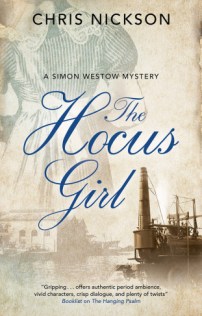 Chris Nickson’s historical novels may be narrow in geographical scope – they are mostly set in Leeds across the centuries – but they are magnificent in their emotional, political and social breadth. In The Hocus Girl, we meet Simon Westow who earns his living as a thieftaker. In America they still have them, after a fashion, but they call them bail skip tracers, or bounty hunters. Leeds in the 1820s had no police force except inept and frequently infirm Parish Constables, and so thieftakers pursued criminals on commission from victims of crime. Westow has a formidable ally in the shape of a teenage girl called Jane. Sexually abused as a youngster, she is ruthless and streetwise, and God help the man who mistakes her for a waif. Westow and Jane have a different kind of fight on their hands here, as they try to prevent a campaigner for social justice being sent to the gallows by political conspirators.
 SW Perry has written an excellent thriller about religious extremism, media manipulation and political treachery. The fact that The Serpent’s Mark is set in Elizabethan London rather than 2019 can only make the reader wonder at how little things have changed. Nicholas Shelby is a physician who, despite his relative youth, has served on the battlefields of Europe and has emerged from a debilitating period of alcoholism caused by the tragic death of his wife and child. With many a real life character – including Robert Cecil and John Evelyn – making an appearance, Shelby becomes involved in a desperate affair which seeks to supplant Queen Elizabeth herself with a hitherto unknown child of Mary Tudor – and return the land of Gloriana to the old faith, Roman Catholicism.
 For all that the era was in my lifetime, the 1950s may just as well be the 1650s given the gulf between then and the modern world. In Nightwatch David C Taylor takes us back to New York in 1954, and we follow a convincingly tough and hard-nosed NYPD cop, Michael Cassidy, who becomes involved in a case which is way, way above his relatively humble pay grade. There were many former Nazis who escaped Nuremburg and had vanished into the ether by 1954 and although many of them were undoubtedly bastards, the sinister folk in American intelligence agencies gave them a lifeline by making sure that they became their bastards. Awkwardly for the CIA, there were also survivors of Hitler’s death camps who had made their way to America, and although they may have been scratching a relatively meagre living, they still had access to information and a burning desire for revenge. Cassidy battles both the indifference of his bosses and the unwanted attention of some very powerful people as he tries to solve a series of murders and make his streets a little less mean.

Click the text image above to link to my review of The Mathematical Bridge.


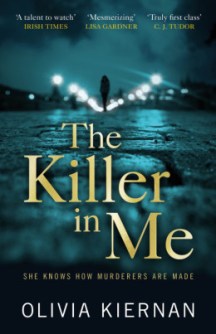 There are some very special Irish crime writers these days. Some mine the uniquely bitter and bleak seam of Belfast, with its raw and recent memories, while further south the city of Dublin, where “the girls are so pretty”, has its fair share of malcontents and evil doers. Olivia Kiernan and her Chief Superintendent Frankie Sheehan were new to me, but
 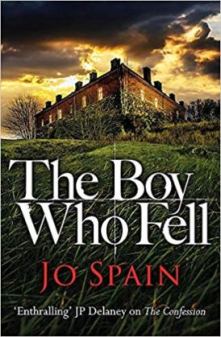 Staying in Ireland, it has to be said that Jo Spain is ridiculously talented. She has created a bankable stock character in the affable Dublin copper Tom Reynolds, but this has not stopped her from writing such brilliant stand-alones as
  Vulnerability as a character trait is perhaps more common in British fictional coppers that their American counterparts, and few fit that bill quite like James Oswald’s Edinburgh detective Tony McLean.
  In
In 


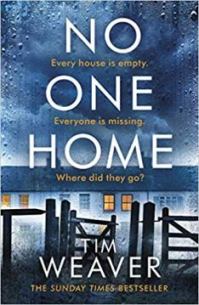 Tim Weaver’s intrepid searcher for the physically lost, David Raker, faced his hardest challenge yet in
  Clergymen writing crime novels? That can only mean cosy village mysteries centred around tweedy villages and eccentric old ladies, surely? Not if Peter Laws has his way. He is a minister in the Baptist Church in Bedforshire, but his Matthew Hunter novels are dark, scary and blood-spattered. In
  Ben Bracken is a Jack Reacher do-alike transported to contemporary England. Much as I have enjoyed the invincible Reacher over the years, Rob Parker has created a more thoughtful and vulnerable – at least psychologically – version in Ben Bracken, a former soldier who exists in the shady hinterland which lies between law enforcement, special services and officially-sanctioned skullduggery.
  Sad to say, there is no-one more vulnerable in modern society – at least in novels – than a single mother trying to bring up her child. In

 here is an debate in the Twittersphere at this time of year about whether Die Hard is, or isn’t a Christmas movie. Maybe there is also a discussion to be had as to whether this latest adventure for Rob Parker’s invincible iron man, Ben Bracken, is a Christmas thriller. Those with young children, or fond memories of their own childhood, will surely recognise the source of the book’s title. Preface it with the words “And stay by my cradle ..” and you should have the answer.
 We are in a wintry Manchester. The time is the present. As usual, the giant plastic Santa is hoist by his breeches on the Victorian gothic façade of the town hall, dispensing silent jollity to the shoppers and merry-makers scurrying beneath his furry boots. In Albert Square, homeless men try to find solace in their threadbare coats, wondering where the next coffee, the next Greggs pasty – or the next fix of chemical oblivion – is going to come from.
 mong these sad footnotes to the tidings of comfort and joy, Ben Bracken moves, asking questions. The former soldier, imprisoned in nearby Strangeways for something he didn’t do, has escaped and now leads a perilous existence employed by a shadowy government agency who have uses for his particular skillset, which involves an immense capacity for violence and superb fieldcraft honed both in the killing fields of Afghanistan and the mean streets of Britain’s cities.
 ack in the real world for a moment, we are told by experts that the biggest terrorist threat to our society in Britain comes from right wing extremist organisations. Only a few days ago a number of men – all fans of Hitler, Breivik and other assorted homicidal lunatics – were convicted of planning terrorism via social media. The fictional group which Ben Bracken infiltrates are, however, not pimply twenty-somethings operating out of a bedroom in their mum’s house, but serious players, ex-military and financing their ambitions via the trade in hard drugs. They are well trained, armed with more than just a Facebook account, and they mean business.
 Parker is a fine young writer. He can muse ruefully on the inadequate protection the human body has against steel wielded with extreme malice:


 Bryndza already has an established audience for his Detective Erika Foster series, and he now introduces another female copper to the crime scene. Fifteen years earlier, Kate Marshall was an emerging talent with London’s Met Police – until a near fatal encounter with a serial killer ended her career. When a copycat killer starts to mimic the work of the man who nearly killed her, she is inexorably drawn back into the investigative front line. Nine Elms is published by Sphere, is out now as a Kindle and in hardback
 This came out in Kindle back in the summer of this year, but now readers who like the feel of a printed book in their hands get to join the party. They say there is nothing as ferocious, either in the animal world or the human sphere, as a mother protecting her young. A woman has to look on helplessly as the man accused of attacking her daughter is set free. Tess’s quest for justice, however, plunges those she loves most into a cauldron bubbling with hatred and danger. Out on 26th December,
  It may well be that someone, somewhere, has written a cosy ‘feet up in front of the fire’ crime novel set in Belfast. If they have, it has passed me by, as the streets of that city, their very stones stained to the core with the ancient bitterness of sectarian violence, always seem to provide a natural backdrop for gritty thrillers. When London Detective Inspector Owen Sheen returns to his home turf to set up a special crime unit, he is sucked into an investigation which, in double quick time, becomes political – and personal. This, Gary Donnelly’s debut thriller will be out on 20th February and is
  Set in a 1960s mental hospital with the ominous name of Black Roding, this is the story of an idealistic and progressive young psychiatrist, Ruth, whose ideas for a more enlightened regime find no favour with the suspicious staff. Becoming rather too close to a complex and troubled inmate of Black Rodings, Ruth’s determination to find new ways of doing things draws her into a horrifying vortex of hidden crimes and shocking revelations. Published by Matador,
  Lesley Kara captured the potentially poisonous dynamic of small town gossip in her 2018 thriller
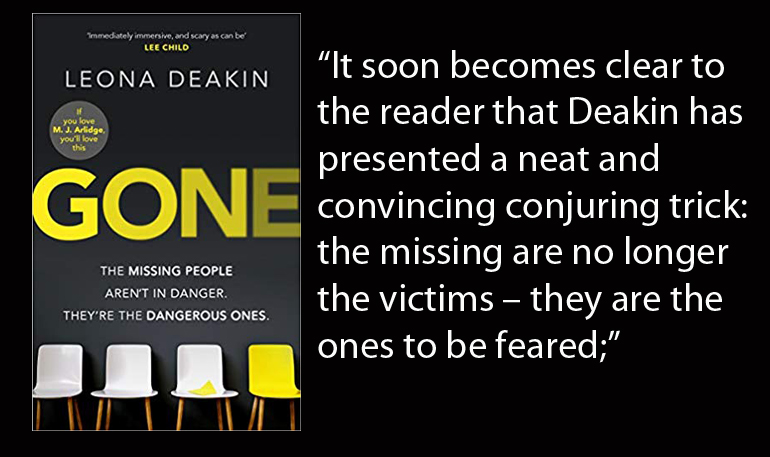

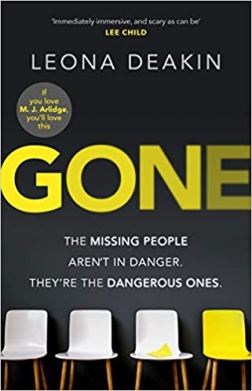 Jameson’s sister Claire has, for some time, fulfilled a mixed role of aunt, mother and babysitter to a teenage girl called Jane. Jane’s mother Lana, is a single mum, loving but chaotic, perhaps suffering from PTSD after several tours in conflict zones when she was a soldier in the army. Now she has disappeared, leaving Jane with no money for food or rent. Knowing of her mum’s fragile mental state. Jane was not initially alarmed, but when she began to investigate, after receiving no help from the police, she made several disturbing discoveries.
Lana disappeared on her birthday. Immediately before her disappearance she had received a mysterious card inviting her to play a game. The beautifully presented card bore the words, elegantly embossed in silver on cream:
Jameson’s sister Claire has, for some time, fulfilled a mixed role of aunt, mother and babysitter to a teenage girl called Jane. Jane’s mother Lana, is a single mum, loving but chaotic, perhaps suffering from PTSD after several tours in conflict zones when she was a soldier in the army. Now she has disappeared, leaving Jane with no money for food or rent. Knowing of her mum’s fragile mental state. Jane was not initially alarmed, but when she began to investigate, after receiving no help from the police, she made several disturbing discoveries.
Lana disappeared on her birthday. Immediately before her disappearance she had received a mysterious card inviting her to play a game. The beautifully presented card bore the words, elegantly embossed in silver on cream: Leona Deakin’s own experience and training in psychology gives this novel a framework of authenticity to which the more fanciful parts of the narrative can cling. It soon becomes clear to the reader that Deakin has presented a neat and convincing conjuring trick: the missing are no longer the victims – they are the ones to be feared; those left behind have become the prey.
The relationship between Bloom and Jameson is intriguing. It reminded me of the unresolved tension and undeclared love between Val McDermid’s doomed lovers Tony Hill and Carol Jordan. We are left to decide for ourselves what Augusta Bloom looks like; Deakin (right) suggests that she might be rather dowdy, an academic in flat shoes. She is certainly razor sharp mentally, however, and she plays a devastating human chess game with the organisation behind the birthday card disappearances.
Leona Deakin’s own experience and training in psychology gives this novel a framework of authenticity to which the more fanciful parts of the narrative can cling. It soon becomes clear to the reader that Deakin has presented a neat and convincing conjuring trick: the missing are no longer the victims – they are the ones to be feared; those left behind have become the prey.
The relationship between Bloom and Jameson is intriguing. It reminded me of the unresolved tension and undeclared love between Val McDermid’s doomed lovers Tony Hill and Carol Jordan. We are left to decide for ourselves what Augusta Bloom looks like; Deakin (right) suggests that she might be rather dowdy, an academic in flat shoes. She is certainly razor sharp mentally, however, and she plays a devastating human chess game with the organisation behind the birthday card disappearances.
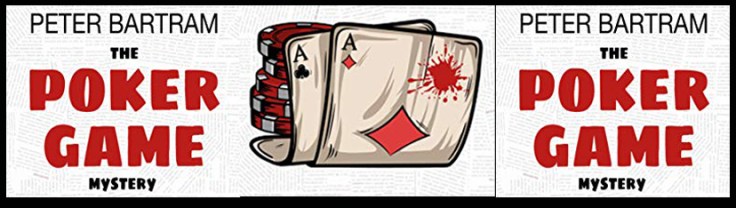
 istorical crime fiction is all the more accessible when the history is recent enough for readers such as I to recognise it as authentic, and give a nostalgic sigh when some piece of popular consumer ephemera – a brand of chocolate, a radio programme or a make of car – crops up in the narrative. Colin Crampton may possibly be the autobiographical alter ego of author Peter Bartram, himself a distinguished and experienced journalist who remembers the deafening sound of the printing presses, the smell of ink, the jangle of telephones in the press room, the scratch of a pen on the paper of a notebook, and the overiding miasma of Woodbines and Senior Service drifting on the air. The Poker Game Mystery is the latest episode in the eventful career of Colin Crampton, crime reporter for the Brighton Evening Chronicle.
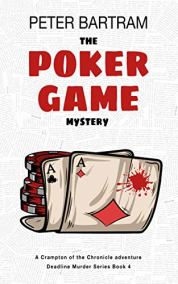 One of the many joys of the Colin Crampton novels is that Peter Bartram usually manages to set the tales against actual circumstances appropriate to the period and, sometimes, we have a very thinly disguised version of a real person. In this case, we meet an outlandish minor aristocrat, heir to daddy’s millions but, more luridly, a fancier of young women. He collects them, rather like a lepidopterist collects butterflies, but rather than sticking his prizes into a display case with a pin, he keeps his young lovelies in cottages the length and breadth of the extensive estate, and has managed to organise one for each day of the week. For the life of me, I can’t think of whom Peter might have as his template for this roué, but I expect it will come to me in the middle of the night, rather like Ms Monday and the others do to their lord and master.
 hen the body of a widely disliked local bouncer is found – his face a rictus of horror and agony – with a suspiciously large sum of used notes beside him, Crampton is sucked into a case which involves a shadowy WW2 home defence unit known as The Scallywags. Crampton discovers that they were a strange combination of Dad’s Army and the SAS – trained to wreak havoc on the Germans should they ever succeed in invading Britain. To enliven matters further, the aforementioned noble Lothario becomes the new owner of The Chronicle on the death of his father, but then promptly signs away the paper as a stake in a losing card game, this threatening the existence of The Chronicle – and those who sail in her.
 ided by his feisty (and rather beautiful) Australian girlfriend, Crampton is up to his neck in a sea of trouble involving, among other things, dead bodies, wartime gold bullion, a predatory newspaper baron, and the arcane skill of doctoring a set of playing cards. It’s wonderful stuff – not just a crime caper, but another fine novel from a writer who wears his learning lightly.
 Colin Crampton’s Brighton is slightly down at heel but all the more charming for not yet having succumbed to the deadening hand which has now made it the world capital of all things green, ‘woke’, diverse and inclusive. There are still saucy postcards to be bought at the sea-front newsagent, and incorrect jokes to be delivered by Brylcreemed comedians in faded variety halls. Peter Bartram (right) has set the bar very high with his previous Crampton novels but he just gets better and better, and The Poker Game Mystery clears that bar with loads to spare. We even have a finale worthy of Indiana Jones, albeit in a murky tunnel somewhere in Sussex rather than in some more exotic location. A word of warning. If the words Atrax Robustus make you feel queasy, then you might need someone to mop your fearful brow while you read the final pages. Clue – not all of Australia’s exports are as cuddly as Crampton’s gorgeous girlfriend, Shirley Goldsmith.


 Guy Portman (left) introduced us to Dyson Devereux in Necropolis (2014). I gave it 5* when writing for another review site, and I’ll include a link to that at the end of this post. Dyson was Head of Burials and Cemeteries in a fictional Essex town, and a rather individual young man. He is narcissistic, punctilious, cultured and, outwardly polite and thoughtful, but with an anarchic mind and a terrible propensity for extreme violence. The book both horrified and fascinated me but made me laugh out loud. Dyson Devereux was a Home Counties version of Patrick Bateman and his antics allowed Portman to poke savage fun at all kinds of modern social idiocies.
 When he finally has his day in court, Dyson scorns the efforts of his lack-lustre lawyer and relies on his own charm and nobility of bearing to convince the court that he is an innocent man. He escapes the clinging arms of Alegra and returns to England without delay, anxious to be reunited with something from which separation has become a cruel burden. A loving family? A childhood sweetheart? The clear skies and careless rapture of an English summer day? No. A tin box containing several memento mori of his previous victims. Little oddments that he can sniff, fondle and treasure. Little bits of people who have had the temerity to upset him, and have paid the price.


 eaders of a Simon Kernick thriller should know by now what they are getting. There will be violence a-plenty, betrayal, corrupt cops, unscrupulous politicians, improbable escapes from certain death and a narrative style which grips the reader from start to finish. Like many popular writers he has separate series on the go, but Kernick isn’t averse to cross-referencing characters. By my reckoning, Die Alone is the eleventh book to feature the abrasive and resourceful Tina Boyd – once a copper but, in this novel a private investigator. The main man I Die Alone is another copper – Ray Mason. He first featured in The Witness (2016). Then came The Bone Field (2017) and The Hanged Man (2018) but with Tina Boyd – and her former lover Mike Bolt – in attendance.
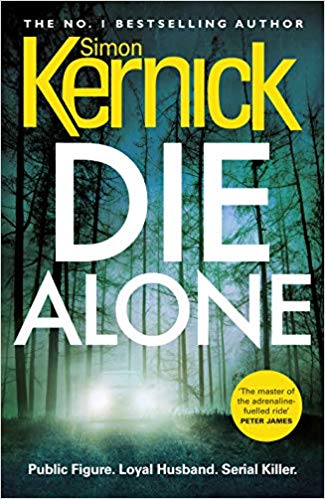 We start with Mason in the Vulnerable Prisoner wing at a high security British prison. He is serving life sentences for the killing of two deeply unpleasant characters in the course of his duties. The deaths were judged not to be judicial, and so Mason inhabits a world shared with paedophiles, rapists, child pornographers – and disgraced coppers. When he is injured on the periphery of a prison riot, he is taken off to hospital in a supposedly secure van, which is then hijacked – the target being Mason himself. He is taken to what seems to be some kind of safe house run on government lines and, after being well fed and housed for a couple of days, he is given an ultimatum by the masked official who is in charge of things – carry out a hit on a Very Important target. He is left in no doubt as to what will happen if he refuses, but he takes little persuading, as the intended victim is someone whose life Mason would have little compunction in ending.
 y now Kernick has introduced us to the repulsive Alastair Sheridan, a millionaire former hedge fund manager who has found his niche in politics and is regarded as everyone’s favourite to reach the top because of his affable style, movie star good looks and undoubted charisma. What the adoring public, and a bevy of fellow MPs who are about to support his leadership don’t now is that Sheridan is a sadistic sexual killer with links to organised crime and some of the most evil people in Europe.
 ecuring the help of former colleague Tina Boyd gets Mason out of one scrape, but as he avoids the clutches of one set of villains, the next shootout or escape in the boot of someone’s car is just around the corner, with the action ranging from oily Tottenham car workshops, to rural Essex and then via Brittany to the bloodstained hills surrounding Sarajevo.


 fullybooked2017