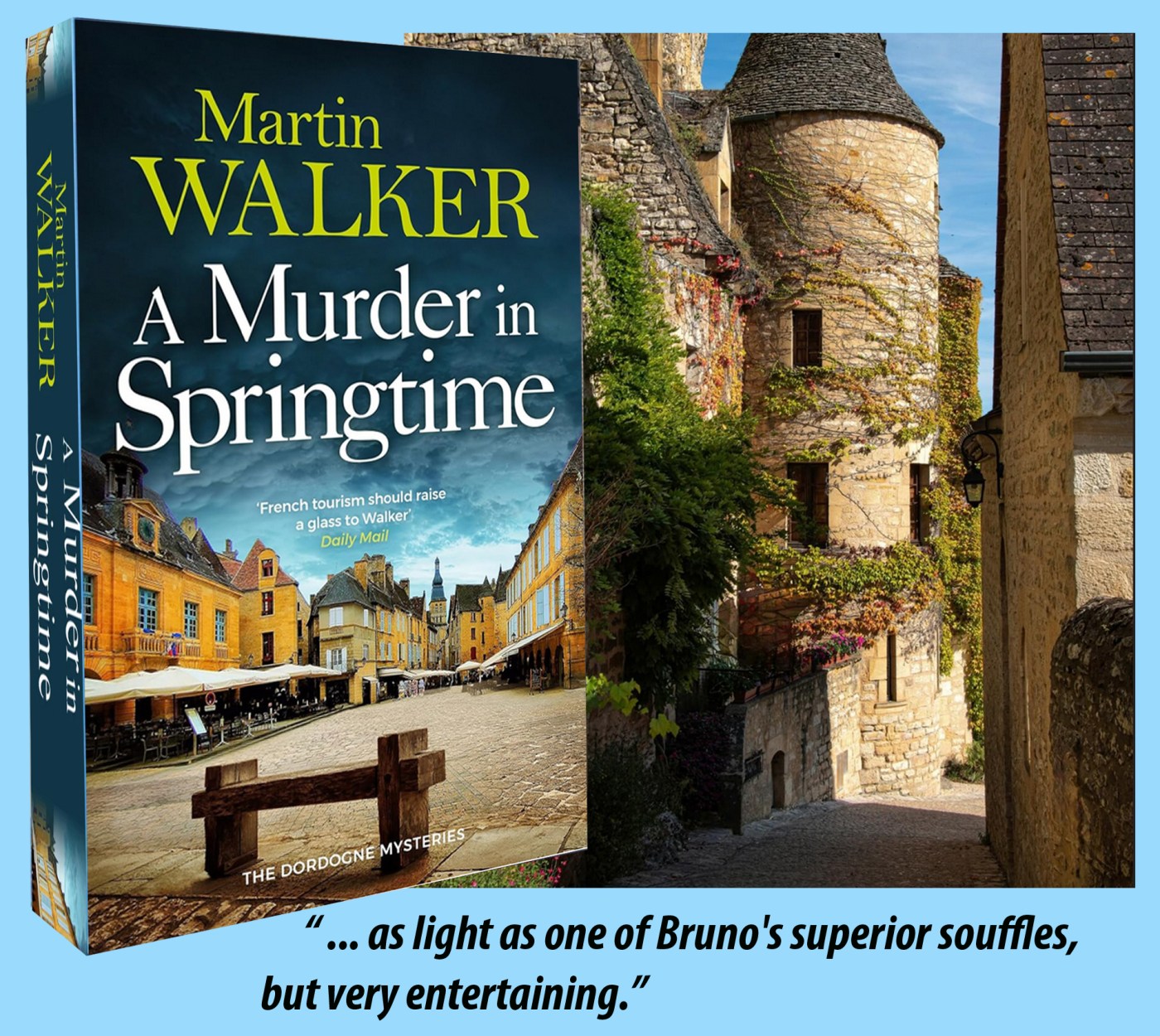

Bruno Courrèges is the Chief of Police of the Vézère Valley in the Périgord region of France. It is springtime in the little market town of St Denis. The genial Bruno does have a past, and it is somewhat darker than the constant sunlight if St Denis. He was raised in an orphanage and, as a young soldier, experienced the mind numbing brutality of the Balkan wars in the 1990s. When his friend Pamela, who runs a riding stables, returns to her house and finds her lodger, Josette Quirit, battered to death on the patio, he is informed, but is forced to recuse himself from the investigation due to his friendship with Pamela. Instead, an old friend Jean-Jacques Jalipeau from Périgeux attends, along with his colleague Fabien Panton.
There are two subplots. The gentler of the two is Bruno’s concern for the declining fortunes of St Denis in commercial terms. The weekly market is shrinking: stallholders are relocating to a nearby town, and shops are losing footfall. I realise that a picturesque Dordogne town is very different from where I live – a hard-scrabble town in one of England’s more deprived areas, but at least St Denis seems to have escaped the dubious pleasures of fake barber shops, nail bars, money laundering ventures posing as vape stores, and a proliferation of bookmakers. Bruno hatches a rejuvenation plan.
As to the second, we have a mysterious prelude, apparently unrelated to St Denis or the murdered woman. I am not keen on this literary device, and I think it is over-used, but that’s just a personal grouch. In an unidentified school, a young boy is made to stand for ages, holding heavy books on his outstretched arms. Then he falls, cracks his head, and all hell breaks loose. We come to believe that this is the same Catholic boarding school that Fabien Panton was sent by his parents. The mysterious prelude makes sudden – and rather grim – sense, when it is revealed that the school matron who inflicted the fatal punishment on the schoolboy was Joséphine Tauton, convicted of manslaughter. On her release from prison she became Josette Quirit.
Bruno and Fabien have another lead. Vehicles captured on CCTV in the vicinity of the murder site are connected to a Netflix crew filming a historical drama series in the area.In the end, it is a curious blend of of technical data – the readings from a FitBit watch – and Bruno’s very human intuition that brings the killer to justice, and the novel ends on a festive note, if not for the victim and her killer, but for the market stallholders of St Denis.
This is, of course, cosy crime, but of a superior nature. Bruno is a confirmed gastronome, and the book is full of descriptions of meal preparation, rural charcuterie delicacies and, of course, delicious local wines. Bruno”s world is, of course pure fantasy, albeit of a delightful kind. Despite its perceived decline, St Denis has a proper boulangerie and a shop where a Belgian chocolatier creates his own irresistible treats. There is, of course a high class butcher, from whom Bruno thinks nothing of ordering a 35 kilo lamb in order to treat his friends to an Easter méchoui. Even the rather reduced market has stalls selling proper farm-made cheeses, and the hills around the town are still peopled by small vineyards, each producing delicious – and affordable – wines. This is heady stuff, especially for British readers in provincial towns where genuine locally produced food is either hideously expensive, or completely unavailable.
Martin Walker writes of what he knows, as in 2013, he was made a chevalier of foie gras, in the confrérie of paté de Périgueux, and also an honorary Ambassador of the Périgord, which means he gets to accompany the traveling exhibition of the Lascaux cave as it goes on display at museums around the world. He also helps promote the wines of Bergerac at international wine fairs, and was chairman of the jury for this year’s Prix Ragueneau, the international culinary prize. A Murder in Springtime is as light as one of Bruno’s superior souffles, but very entertaining. It will be published by Quercus on 18th June.
è ç à é à á â


Leave a Reply