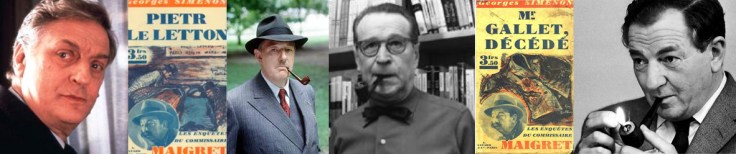
Maigret’s method? It is both complex and simple. Its complexity is deeply rooted in his own humble upbringing in the country, and his understanding of the ways of villagers still in an almost feudal relationship with the Comte in his Chateau. This is tempered with his more recently acquired world-weary awareness of the men and – mostly – the women who live in the demi monde of the Paris streets. The street girls who;
“… were young and retained a certain freshness; in some respects they seemed barely more than children …. and there were too many disgusting images in their no longer sparkling eyes.”
He also has the uncanny ability to put himself inside the minds and metaphorical shoes of witnesses and suspects. He is also deeply empathetic, particularly with criminals who are the victims of circumstances and their own human weakness.
The simplicity lies in one abiding principle. Maigret is slow to judge and never, ever jumps to premature conclusions. Someone asks him,
“Do you still think he killed Lulu?”
His answer occurs frequently both on the page and on the screen;
“I don’t think anything”
Here I quote the preface to the Penguin editions of the Simenon novels.
“Simenon always resisted identifying himself with his famous literary character, but acknowledged that they shared an important characteristic.
“”My motto, to the extent that I have one, has been noted often enough, and I’ve always conformed to it. It’s the one I’ve given to old Maigret, who resembles me in certain points…..”Understand and judge not.””
Rather less cerebral, but pivotal to many of the stories and their adaptations, is Simenon’s love of boating. His aunt kept a shop on the banks of the Meuse and, as a child, he would help out there. He loved pleasure boating, but the massive and ponderous progress of the huge barges patiently hauling their cargoes along the Seine, or the wide canals, left a lasting impression, and it is no coincidence that so many of the novels (and their adaptations) feature barge captains, lock keepers, waterside cafes and their patrons.
One of the many joys of the Maigret novels is Simenon’s love of superimposing bizarre or incongruous details onto the squalid business of murdered citizens. In Maigret and the Man on the Bench, the body of Louis Thouret is found in a dingy alley with a knife in his back. When his widow is taken to the mortuary she is flabbergasted to see that he is wearing greenish-yellow shoes and a bright red tie. She avers that she would never have allowed him out of the house ‘looking like that’.
As in all other long running crime series, time stands still in the Maigret novels. In The Late Monsieur Gallet (1931) we learn that Maigret is already 45 years old, heavily built and – according to the translation I read – wears a bowler hat. He was born, then, in 1886. This probably explains why he didn’t fight in WW1, because at the age of 28, he was already a policeman, and probably exempt from conscription. This early novel does not feature The Faithful Four. Neither does Madame Maigret appear, except for the briefest of mentions right at the end. Incidentally the solution to Monsieur Gallet’s demise is one of the most bizarre and unlikely all the novels, but that is another story.
The final full length Maigret novel was written in 1972, so in terms of society, ambience, manners and procedure the earlier books in particular must fall into the genre of historical crime fiction. Everything is so different; Maigret and his officers drink all the time; they take regular breaks for meals, despite occasionally pulling ‘all-nighters’ with difficult interrogations. There is, occasionally, violence meted out to prisoners; Maigret answers an accusation of such treatment by a defence barrister by admitting,
“I boxed his ears, as I might have done to my own son.”
When the barrister asks him if he actually has children of his own, the Chief Inspector has to dig deep into personal regret by replying that he had a daughter, but she didn’t survive. We are left to assume that Madame Maigret, years ago, miscarried, or that the baby died soon after birth. Maigret always treats children fondly, and Simenon often puts him into schools, or introduces children as witnesses.Think Maigret and the Seven Little Crosses or Maigret Goes to School
Simenon continued to publish Maigret novels during WW2, but wisely steered clear of what the actual Paris Police Prefecture were doing at the time, which was providing a very efficient helping hand to the Gestapo in their quest to round up and deport Jews. The author had his own brush with the system when he was accused of being Jewish. He was able to refute the accusation with appropriate certificates of birth and baptism.
Where, then, does Simenon stand in the pantheon of great 20th century crime writers? In part one, I suggested that he would share the podium with Conan Doyle and Chandler. “No Christie?”, comes the cry, followed by equally impassioned advocacies for Sayers, Mitchell and, in the espionage field, “Le Carre, Deighton and Ambler. I’ll stick with my three. We must not forget that Simenon was certainly the most prolific of the three. As well as the Maigret stories, he wrote longer, more literary novels which he classed as ‘Romans durs’ (literally ‘hard novels’) which we might classify ask ‘Noir’. These have not had the enduring appeal, at least for English readers, as the Maigret stories. Apart from the four longer books, all the Sherlock Holmes adventures were short stories, as were the Brigadier Gerard tales, The full novels such as The White Compan, Sir Nigel, and Micah Clark are little read today.
For me, the decider is that here in the UK most of us read Maigret in translation. We can never be entirely sure that what we read is entirely what Simenon intended. In contrast, when Chandler wrote – “There was a desert wind blowing that night. It was one of those hot dry Santa Anas that come down through the mountain passes and curl your hair and make your nerves jump and your skin itch. On nights like that every booze party ends in a fight. Meek little wives feel the edge of the carving knife and study their husbands’ necks. Anything can happen. You can even get a full glass of beer at a cocktail lounge.” – we know precisely what he meant, even if we have been no further west than Llandudno. Philip Marlowe was far too complex and conflicted ever to attract TV producers, so we must be grateful that the relative brevity of the Holmes and Maigret tales have made them them attractive to producers and popular with viewers.


