Search

fullybooked2017

Tag

Scottish Crime Fiction

THE DEVIL STONE . . . Between the covers

TDS spine019 copy

Detective Inspectors – and their bosses the DCIs – are hardly a dying breed in crime fiction, so what is distinctive about Christine Caplan, the central figure in Caro Ramsay’s latest book? For starters, she has been demoted from DCI because her previous case involved some evidence mysteriously going ‘walkies’. Her run of bad continues when, after a night out the ballet in Glasgow (she used to be a dancer) she inadvertently becomes involved in a mugging, and the drug-frazzled perpetrator  subsequently dies from falling from his bike. Family-wise, things are not much better. Her husband, Aklan, formerly something of a creative high flyer, has a serious case of depression and rarely leaves his bed. When he does, it’s only to stagger to the sofa where, wrapped in a blanket, he binges on daytime TV. Son Kenny is a ne’er-do-well drug user, flunking college and a bit too handy with mum’s credit card. Daughter Emma is the only glimmer of light. She seems relatively healthy, bright and has something of a future once she finishes her degree.

Things don’t improve for Caplan when she is sent off to the Scottish west coast where, near the village of Cronchie, a multiple murder has taken place. Two teenage boys – “neds”, to use the Scottish slang, have broken into Otterburn House, a mansion belonging to the McGregor family. The intruders get more than they bargained for:

“…jerking the phone, causing the beam to drop suddenly where it caught the ghostly white face staring at the ceiling with nacreous clouded eyes. Unable to stop himself, he looked along. Another face. Then another. Five of them in a row, cheek to cheek. Dried white skin clinging to thin cheekbones, mouths open, teeth bared.”

The lads – one of whom is a devotee of Satanism –  have burgled the house looking for a legendary artifact known as The Devil Stone which, according to the ancient lore, is able to predict impending tragedy. They leg it away from the house as if Old Nick himself is chasing them. They are hospitalised suffering from shock, the police are summoned and a major investigation is triggered.

In charge of the investigation is Detective Chief Inspector Bob Oswald, a highly respected officer just weeks away from retirement. When he goes missing, Caplan finds herself put in charge of the case, rather to her own discomfort and the resentment of the local team. One member of the McGregor family – Adam, a New Age hippy and something of a black sheep – is missing from the gruesome line of corpses, and thus he becomes the main suspect.

When Bob Oswald is finally located dead – in mysterious circumstances – Caplan realises that whatever happened at Otterburn House is part of a much bigger conspiracy, involving the distribution of a dangerous new narcotic known as Snapdragon. While she suspects that a nearby New Age community living on the nearby island of Skone may be involved, another discomforting thought is nagging away at her, and it is the suspicion that someone in the police team is batting for the other side. How far can she trust DC Toni Mackie, a larger-than-life woman, with a slightly cartoonish air about her? And what is to be made of the bumbling DC Craigo, with his strange slow blink, and his lack of social graces?

Already facing a twin-pronged attack on her career, Caplan realises that her relentless determination to solve the Otterburn House mystery has brought her head-to-head with some people who are determined to take her life if she gets in their way.

This edition of The Devil Stone is published by Canongate and is out now.

TO DIE IN JUNE . . . Between the covers

TDIJ header

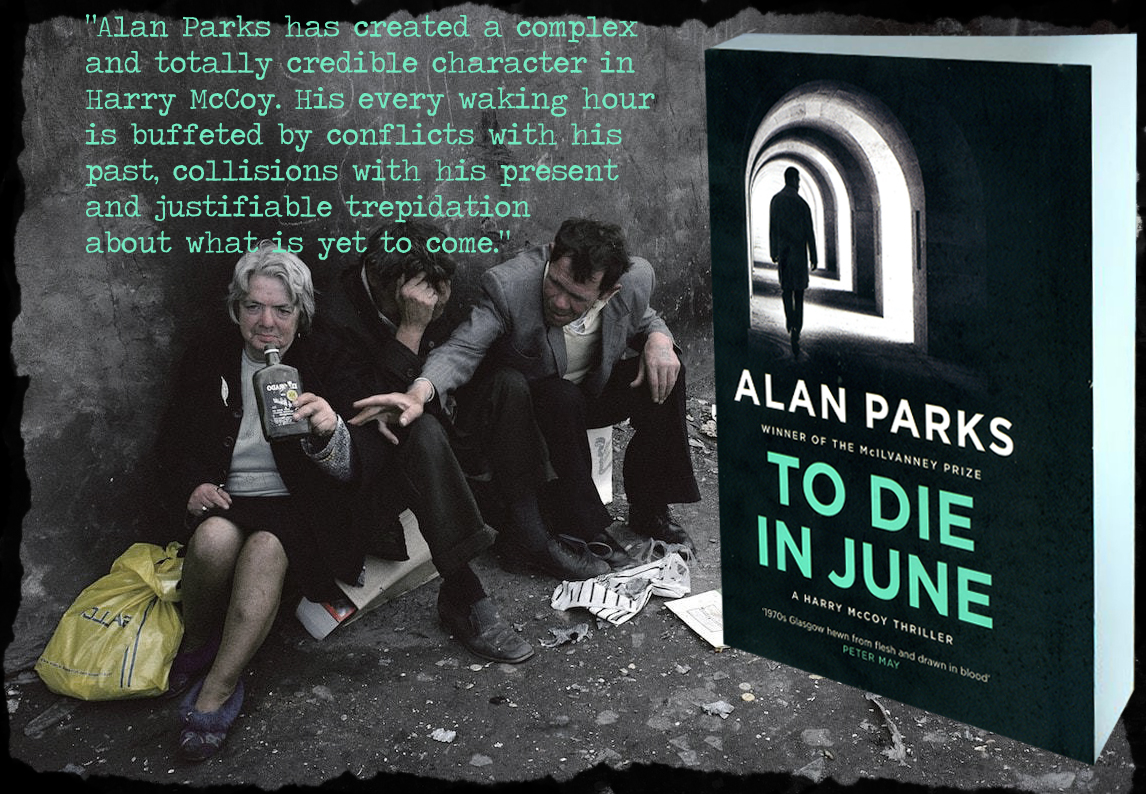
Screen Shot 2023-06-05 at 07.43.52Alan Parks (left) introduced us to Glasgow cop Harry McCoy in 2018 with Bloody January, and he has been resolutely working through the months with succeeding novels. Fictional Detective Inspectors in British crime fiction are many and varied. You would certainly need a fair sized village hall to seat them comfortably were they all to meet, so what about Harry McCoy? He has a fairly dark back-story. He was in and out of care institutions as a child. His mother is long dead, and his father – never the most consistent of parents – has now abandoned any sense of normality and is a homeless alcoholic. Through childhood connections – both were in care – he is connected to underworld boss Stevie Cooper. While not exactly in his pay, McCoy owes his old friend big-time, due to incidents in their shared past.

We are in the summer of 1975 so, in one sense this a historical novel, with many little period features that the author has to get right. No internet, computers or mobile phones, obviously, but early on in the story Parks sets the scene beautifully. McCoy has a celebrity girlfriend – a famous actress – and they are together at an showbiz awards function in the company of a young Billy Connolly, Stanley Baxter, Marie McDonald McLaughlin Lawrie (Google her) and Hamish Imlach. For those not versed in Scottish entertainers, Parks has Michael Aspel overseeing the evening.

McCoy has been transferred from his usual base to the insalubrious district of Possil, an area renowned for crime and deprivation. There is a purpose behind the move. McCoy’s boss, Chief Inspector Murray, believes that a group of detectives at the Possil station are corrupt, and he wants McCoy to infiltrate the cabal. Before McCoy can get close to the bent coppers, two urgent cases demand his attention. First, a vagrant is found dead, foaming at the mouth from having imbibed some kind of toxic drink. McCoy attends the scene, praying that the victim is not his dad. It isn’t, but the blasé dismissal of the case by the ‘experts’ as “just another alkie drank himself into an early grave” annoys him, and he senses something more sinister.

Then, a distraught woman presents herself at the station telling him that her young son has been abducted. Understandably, McCoy takes the woman at her word, and hits the panic button, with ensuing door-to-door, enquiries, blue lights flashing everywhere, and all leave cancelled. The woman then has some kind of fit and is hospitalised. When McCoy visits the home, and talks to the woman’s husband, the Reverend West, he is told that there is no son – never was – and that his wife has been  suffering with sever mental health issues for some years. West is the pastor at an obscure fundamentalist church, The Church of Christ’s Suffering.

When Mrs West throws herself to her death from a bridge, and more homeless men are found dead, McCoy hardly knows which way to turn. Added into the mix of his misery is that his old chum Stevie Cooper is about to initiate a turf war with a rival gangster, and expects McCoy to play his part. The plot twists this way and that, and there is a final hairpin bend which runs off the road anyone who is hoping for a warm and comfortable outcome to to this case for Harry McCoy.

lan Parks has created a complex and totally credible character in Harry McCoy. His every waking hour is buffeted by conflicts with his past, collisions with his present and justifiable trepidation about what is yet to come. To Die In June was published by Canongate on 25th May.

THE POSTMAN DELIVERS . . . Fox & Parks

TPD HEADER NEW

THE FASCINATION by Essie Fox

Victorians loved a freak. Think of Joseph Merrick. Think of The Bearded Lady and The Crocodile Woman at traveling funfairs. Are we any better today? Think of Dylan Mulvaney, and I guess not. However, to the book. Twin sisters Keziah and Tilly Lovell are far from identical. They are both fifteen years old, but Tilly hasn’t grown an inch since she was five. Their father uses the pair to promote a fake elixir at his traveling show, but then he sells them to a mysterious Italian impresario, known as ‘Captain’, who senses an opportunity to make money. All roads lead to London, where within Dr Summerwell’s Museum of Anatomy, the twins meet a young man called Theo, and are drawn into a web of intrigue, deceit and criminality. This is published by Orenda Books, and will be out on 22nd June.

TO DIE IN JUNE by Alan Parks

The blurb says, “ONE LOST CHILD. TWO MEN DEAD. A MIDSUMMER NIGHTMARE. This is the sixth in the Harry McCoy series, which is new to me, but the book sounds a cracker. A word-association test using the word ‘Glasgow’ would, certainly among crime fiction fans, produce obvious results. Hashtags might include:

#grit #violence #deprivation #noir #murder #drugs #gangs #extortion #hardman

McCoy investigates the disappearance of a boy, whose parents are devotees of a a bizarre cult, The Church of Christ’s Sufferings. At the same time, reports come in of unexplained poisonings among the city’s down-and-out community. McCoy has a dog in this fight. His own father is one of the dispossed. Throw into this toxic mix a case of police corruption which McCoy cannot ignore, and you have a spellbinding police thriller. Published by Canongate Books, this will be available from 25th May.

FROM THE ASHES . . . Between the covers

fta header009 copy

Deborah Masson is back with another gritty police thriller set in her home town of Aberdeen. This time, DI Eve Hunter (previously seen in Out For Blood and Hold Your Tongue) faces the grimmest challenge presented to police officers all over the world – the death of a child. Lucas Fyfe – dead mother, drug addicted father and unfeeling grandmother – has been in care since he was little. When someone deliberately sets fire to Wellwood, a children’s home, he is the one resident who doesn’t make it out. Why? Because the body of the eleven year-old is discovered in the cellar, and the trapdoor which is the only access is concealed under a heavy carpet.

Literally from page one, Masson gives us another perspective – that of the presumed arsonist. We know it’s a ‘he’, and we know that he was a former resident of Wellwood when it was run by the current warden’s father, William Alderton and the sadistic Sally Fields. I find that the backstory narrative trope can be irritating when an author uses too many viewpoints and too many time frames, but here it is used with subtlety and works very well.

Eve Hunter’s team consists of DS Cooper, DS Mearns and DC Ferguson, and the sparky dynamics between them provide an intriguing counterpoint to the investigation. Scott Ferguson is peripherally involved in a road accident on his way to work, but his obsession with the young man who was the main casualty starts to distract him from the Wellwood case. When a further shocking discovery is made in the cellar where Lucas Fyfe died, Ferguson’s lack of attention becomes even more serious. We eventually learn why Ferguson feels compelled to be at the bedside of the young vagrant who was badly injured in the RTA, and it turns the case on its head.

Hunter and her team soon realise that the surviving children and the three adult staff of Wellwood are not telling all that they know. That much is obvious, but penetrating the veil of secrecy proves more difficult. With both of the original owners dead, and local Children’s Services being very protective of the few remaining historic records of the children who were residents, the case seems to go round in circles, until Ferguson’s with Archie, the young RTA victim, finally pays off.

Deborah Masson is a writer who enjoys providing her readers with the unexpected, and the finale of the novel, in the grim basement of Wellwood, is a prime example. Eve Hunter comes over as tough and uncompromising in pursuit of the bad guys, but her family background has left her with a strong streak of compassion, and when Scott Ferguson finally reveals his own secrets – and his link to the Wellwood basement – she is well-equipped to provide emotional support.

This novel is dark, cleverly plotted, full of well-concealed surprises and a master class in how to write a good police-procedural. From The Ashes is published by Transworld/Penguin and is available now.

THE LONG KNIVES . . . Between the covers

LOng Knives header005

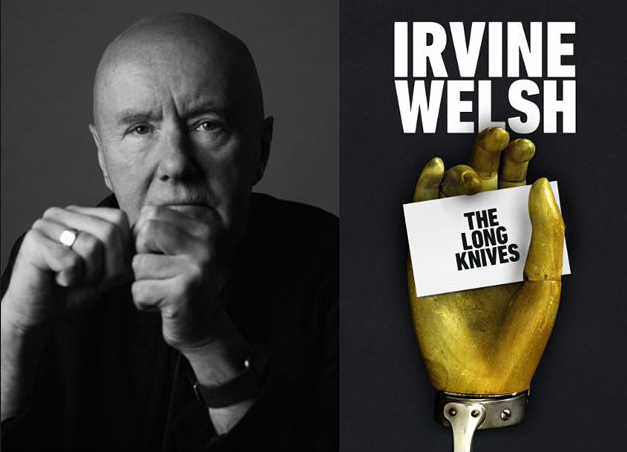
Irvine Welsh introduced us to Edinburgh detective Ray Lennox in Crime, but it has taken fourteen years for the second in the series – The Long Knives – to emerge. The title is not a metaphor, as the opening chapter describes the castration of a rather unpleasant Conservative MP in an empty warehouse in Leith.

There is no shortage of people who might have wanted Ritchie Gulliver dead. They range from political opponents, via victims of his predatory sexual habits, to activist groups he has offended. Lennox is given the case, and is immediately alerted to a recent incident in London which sounds similar. Home Office civil servant Christopher Piggott-Wilkins has been attacked in the Savoy Hotel. He managed to escape, badly wounded, and immediately transferred himself to a Harley Street hospital, after which what occurred in his suite has been cleaned up, both literally and metaphorically, by un-named but powerful agencies. Piggott-Wilkins has been left with one testicle, while Gulliver’s complete ‘package’ was discovered, draped from the Sir Walter Scott memorial, by an unsuspecting tourist.

After a lighting trip to London to speak to Mark Hollis, the larger-than-life Met copper investigating the Savoy case, Lennox returns to Edinburgh to face a sea of troubles. His fiancee Trudi not only seems to be ignoring his calls, but may have another love in her life. A former colleague, Jim McVittie, has transitioned to female, but has been found horrifically beaten up and is not expected to survive. Before the assault, Lennox meets one of the more ‘in your face’ transexuals in the local scene:

“What appears to be a brawny young man of around six foot four in a blue dress not so much enters as bulldozes in, a charged storm of bristling rage. He has a big hooked nose, and long flowing brown hair, which seems to have been given the attention of crimping tongs fashionable in the eighties. On his face a long scar bubbles thickly from under a  trowelling of foundation.”

An investigative journalist has tipped Lennox off that the two cases may be linked to a serious sexual assault at a ski resort some years earlier, and that high class prostitutes – and the men who run them – may be involved.

TLK author

Readers familiar with Welsh’s style over the years will recognise his trademarks, including the unpunctuated rapid-fire dialogue, the demi-monde of drugs, violence, sex and alcohol, and the underpinning ground-bass that tells us it’s an us-and-them world. There is even a passing reference to the most infamous of the author’s creations, Francis Begbie.

One of the more memorable characters in the drama is the brilliantly over-the-top Mark Hollis. He is more redolent of the glory days of The Sweeney than the current fashion of dancing the Macarena at Gay Pride marches. Hollis provides valuable information to Lennox, and slowly but surely the Edinburgh cop connects the pieces of the jigsaw. The picture that emerges is a chilling one. The killings are the work of a partnership. The man is linked to an act of random cruelty some years previously in Tehran, while his female partner is, indeed, seeking revenge for her abuse in a ski-lift gondola, but when her identity is revealed, Lennox is beyond shocked.

Welsh brings us horrific violence, but also the dark poetry of compassion. I can only liken Ray Lennox’s desire to avenge the murder victims whose suffering is imprinted on his soul, to Derek Raymond’s nameless Sergeant in books like I Was Dora Suarez. This is a magnificent work of fiction, not just a good crime novel. It is published by Jonathan Cape and will be out on 25th August.

UNDER THE MARSH . . . Between the covers

UTM header

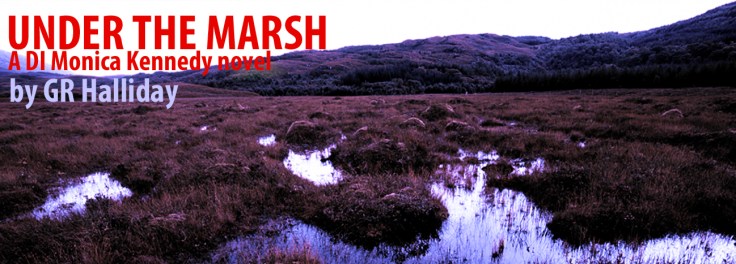
This is the third novel by GR Halliday featuring Inverness copper DI Monica Kennedy, and you can read my review of the previous book, Dark Waters, by clicking on the title link. DI Kennedy’s life revolves around being the best mother she can be for her five year-old daughter Lucy, and solving serious crime for Police Scotland. When those two vocations collide, she is helped out by her willing, but rather reproachful mother.

The novel begins with one of those “She’s Leaving Home” moments, but there is a difference. The worst that we know of what became of the girl in the Beatles song is that she went off with a man from the motor trade. What happens here is worse. Much, much worse.

Screen Shot 2022-08-11 at 19.53.18

UTM coverOne of Kennedy’s chief scalps was serial killer Pauline Tosh, who now faces spending the rest of her days in a remote high security jail. Out of the blue, Tosh requests a visit from the officer who ended her murderous career, and what she reveals sets off a search for a body. When it is discovered, and is revealed to be that of the long-since missing Freya Sutherland, what is in effect a massive cold-case-murder hunt is put into place.

I am not the greatest fan of the split time frame mode of storytelling, but Halliday uses it sparingly. Freya’s links with some minor celebrities back in the day provide leads for the investigation, but they are not necessarily fruitful. Along the way, the author has fun painting dark pictures of people who were once ‘something’ in the entertainment business, but whose best days are long behind them, but the questionable ethics and narcissism that brought them fame are as strong as ever. More troubling for Monica Kennedy is that one of the people who crops up in her investigation into what happened decades ago is now a prominent Scottish politician.

Monica Kennedy gets on really well with her professional partner, DC Connor Crawford, but then he goes AWOL at a time when the investigation is floundering. When he does surface, it is to tell Kennedy that he is in la merde profonde. He has become captivated with a Lithuanian stripper who works for one of Scotland’s major villains, who now has compromising footage of Crawford and Emilija. This footage will be revealed to all and sundry unless Crawford agrees to feed him with information. It is not all doom and gloom, however, as Crawford has had a bit of luck via a cassette tape which seems to indict several of Kennedy’s suspects in the search for Freya’s killer.

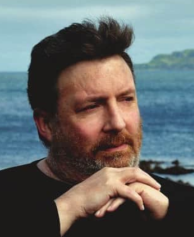
Screen Shot 2022-08-13 at 19.09.20As with all good crime writers, Halliday (right) leads us up the garden path, and killers (plural) are actually found, but the solution is surprising and beautifully complex. Oh yes, I almost forgot. From his bio, GR Halliday is a lover of cats, so if you share his passion, there are cats in this story. Several of them.

The author brings us a dark and compelling mystery set against the dramatic and occasionally unforgiving landscape of the Scottish Highlands. Monica Kennedy is a fully fleshed out character we can all believe in. Under the Marsh is published by Vintage, and is available now.

NO LESS THE DEVIL . . . Between the covers

nltd header

610XqcYjnhL._SX450_This is a new police procedural from Stuart MacBride (left) and it introduces Detective Sergeant Lucy McVeigh. Her beat is the fictional town of Oldcastle (not to be confused with the actual city of Oldcastle, which lies between Aberdeen and Dundee). Aberdeen, of course, is where DS Logan McRae operated in the hugely successful earlier series from MacBride. Also, DS McVeigh comes across – to me at any rate – as a younger version of McRae’s boss, the foul-mouthed and acerbic DCI Roberta Steel. McVeigh is equally sharp tempered, and similarly indisposed to suffer fools gladly.

Early on, we are aware that McVeigh has been involved a high profile incident where she killed a man – Neil Black –  in the line of duty. This requires her to suffer – by order of her bosses – psychological treatment and counselling. Like the good storyteller that he is, MacBride doesn’t let us know the nature of the incident right away, thus keeping us guessing for a while. When we do learn what happened, over seven terrifying pages, it is horrific stuff.

McVeigh is involved in the  hunt for a serial killer nicknamed The Bloodsmith. He – or she – eviscerates victims and scrawls “Help Me’ on the wall of the murder scene, using the blood of the unfortunate prey. The trail is cold, but when a new victim emerges McVeigh and her ‘gofer’ Detective Constable Fraser (aka The Dunk) have some fresh clues to work with. It turns out that the latest corpse is the remains of a former police officer who did time for petty theft, and then ended up as a vagrant on the streets.

Women are supposed to multi-task better than men, but Lucy McVeigh has two other problems. Firstly, she is being harassed by the family of the man she killed. They are determined to end her career by fair means or foul, and the press are lapping up every minute of the feud. Secondly, a case from the past surfaces. Years earlier, McVeigh was involved in putting behind bars an eleven year-old boy who, along with another boy as yet unidentified, committed a terrible murder. Now a young man, Benedict Strachan  is back – literally – on the streets, using an alias, misusing drugs, living rough, and he is convinced that someone is trying to kill him.

Screen Shot 2022-04-19 at 19.51.13As the search for The Bloodsmith continues, and Lucy McVeigh struggles to keep abreast of that investigation, as well as her battle with the Black family and coping with the mental agonies of Benedict Strachan, MacBride treats us to his signature mixture of Noir, visceral horror and bleak humour. Even though his Oldcastle is a fictional place, it is vividly brought to life to the extent that I would not be in the least surprised if the author has a map of the place hanging on the wall of his writing room. The situation becomes ever more complex for Lucy McVeigh when she learns there is a connection between the murdered former policeman and Benedict Strachan. That connection is a prestigious and exclusive independent school, known colloquially as St Nicks’s. When she visits the school, she unearths more questions than answers.
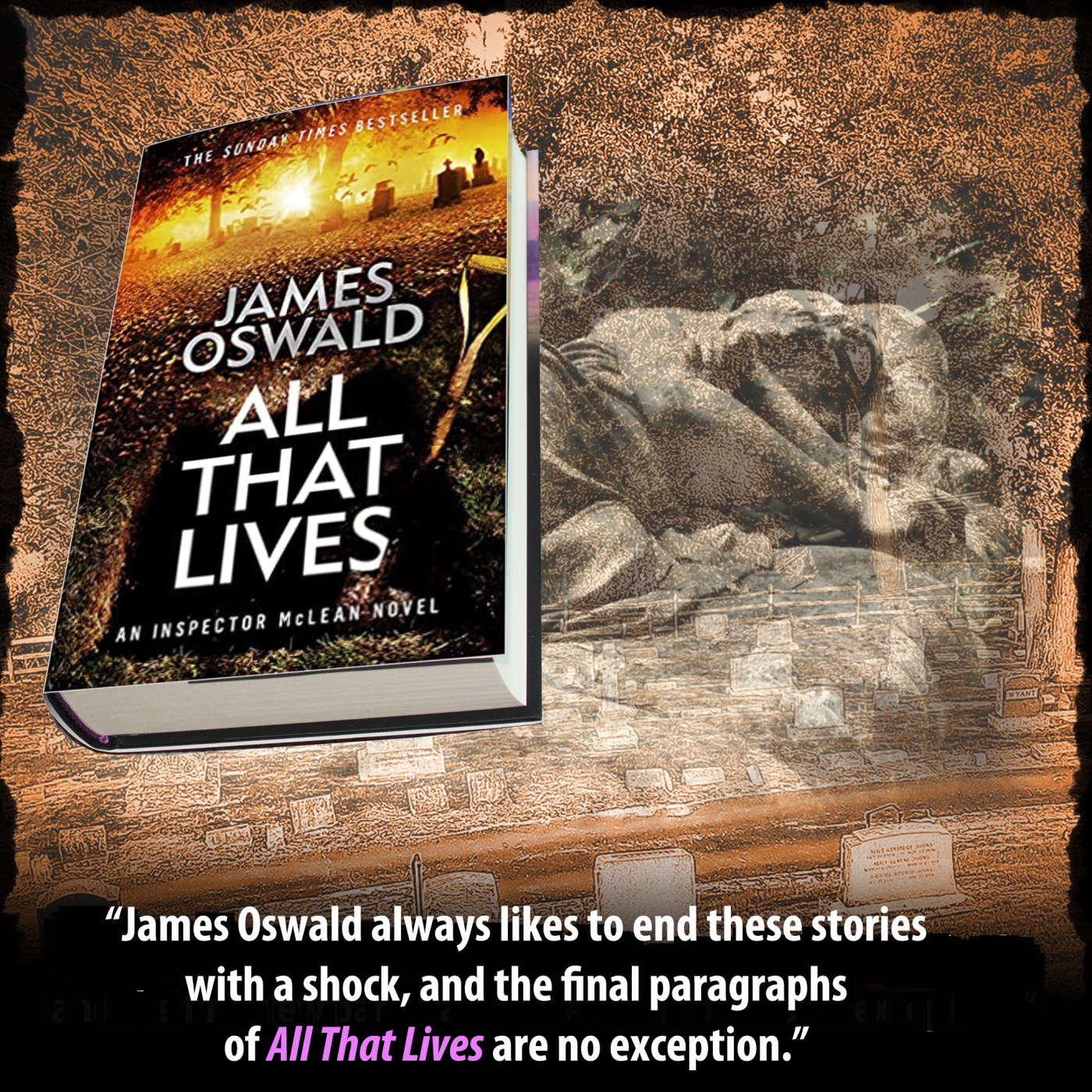

Novels that use the name of the Devil in their title are making a statement that the writer has to live up to. No-one did it better than the great Derek Raymond in his 1984 The Devil’s Home On Leave, but what about this book? I won’t over-egg the pudding and say that it’s an existential treatise on the nature of evil. It’s just a crime novel, albeit a very superior one. Suffice it to say that Stuart MacBride takes us to some very dark places, and convinces us that the Devil is real, if only in the sense that he lives in the hearts and souls of certain human beings.

No Less The Devil will be published by Bantam Press on 28th April. As a postscript, I have to say that I found the last hundred or so  pages seriously strange, and it took me all the way back to the 1990s and my weekly (and increasingly puzzled) visits to Twin Peaks. Without any further spoilers, I will simply say that I think I know what happens, but I aIso believe readers will be divided over the plot swerve.  I would be interested to hear from other people what they made of it.

ALL THAT LIVES . . . Between the covers

atl011 copy

Back in the day I was a school music teacher, and I remember one Christmas – always the busiest time of year – turning out one cold night for yet another carol service. I remember saying something along the lines of, “I never want to hear ‘O Little Town of Bethlehem’ ever again in my life!” An older and wiser colleague said, “Yes this is the sixth carol service you’ve played at in as many days, but you need to remember that for most of the people here tonight, it’s their only one this Christmas, and those are the people you are playing for.”

ATL coverThat reminiscence may seem unrelated to a book review, but it is relevant. When reviewing the latest book in a long and successful series it is tempting to think that all prospective readers will be fully up to speed with the quirks and history of the main characters. But that’s not so. Thankfully, people come to books at different times and for different reasons, so a paragraph about Edinburgh copper DI Tony McLean won’t be wasted. If you already know, then just skip ahead.
DI Tony McLean is a middle-aged police officer, but not your normal fictional copper. For a start he is very rich, thanks to a family inheritance. He was educated privately at a boarding school in England, an experience he hated at the time, and it still gives him nightmares. His significant other is a woman called Emma, and author Oswald gives her an interesting role in the books. She has been subject to various health scares in the past – including a tragic miscarriage – and she has always seemed the vulnerable one in the partnership. McLean has been gifted – or cursed – with a certain sensibility towards things paranormal, and although the supernatural is not overplayed in the books, there is a sense that McLean sees – and feels – things that his colleagues cannot. One of his acquaintances is a person who lives his life as a female psychic called Rose, and she is frequently warns McLean of things which he may not yet be aware of. McLean’s nemesis (apart from his various bosses) is a mysterious woman called Mrs Saifre, ostensibly a rich patron of charitable causes, but with a sinister hand in all manner of more dubious enterprises.

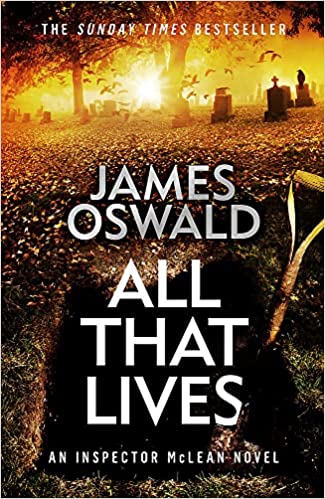
Still with me? Good! So, to All That Lives, the twelfth in an unfailingly brilliant series. The core of the novel is the police search for the source of a virulent narcotic which, when ingested, causes extremely violent – and fatal –  seizures. Just as troubling for McLean is a pair of discovered bodies – one from medieval times, and another from the 1990s. What disturbs him, is that the positioning of the bodies is unusual – and identical in both cases. A third body is discovered and the circumstances match the previous two. What hellish connection links the three corpses over a period of 700 years?

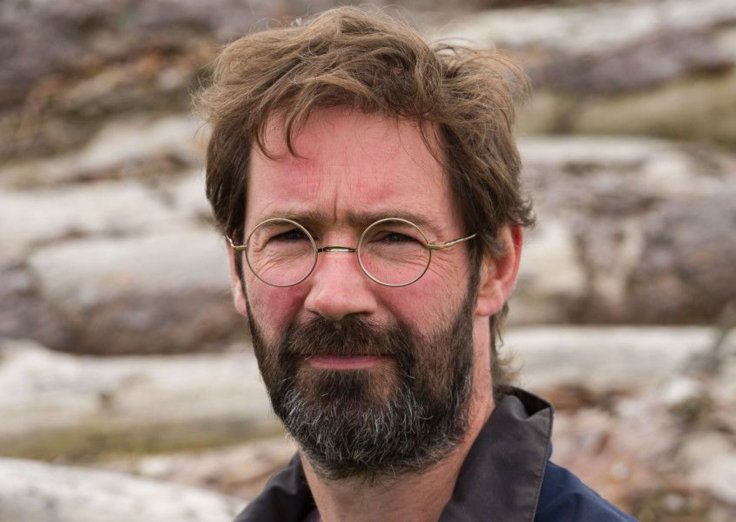
Things go from bad to worse for McLean’s major Incidents Team. First McLean is distracted by Emma falling seriously ill, and he wears himself thin between being at her bedside and trying to solve the case. When he himself disappears, the investigation is in danger of imploding. Detective Sergeant Janie Harrison, with the help of Grumpy Bob – the pensioned-off copper who is in charge of old case files – manages to find what links the bodies and the fatal drug, and the conclusion is violent and dramatic. James Oswald always likes to end these stories with a shock, and the final few paragraphs of All That Lives which is published by Wildfire on 17th February – are no exception. For reviews of earlier books in this series, click the author’s image below.

JO

WHAT WILL BURN . . . Between the covers

WWB030

As the title suggests, What Will Burn is all about fire. It begins with an old woman, badly beaten and then set alight. There are passages which hark back to the late sixteenth century, and describe the dreadful end of women who were accused of witchcraft and burnt at the stake. A man apparently spontaneously combusts as he sits in his basement flat. It ends with a grim parallel to those scenes when one of the book’s main characters, suffers a similar fate in a grim parody of those historical executions.

So, what has all this to do with James Oswald’s Edinburgh copper
, Detective Chief Inspector Tony McLean? Or, to be more accurate, Detective Inspector McLean, as he returns to duty busted down a rank after a lengthy investigation into misconduct.

His ‘welcome back Tony” case is that of the agonising death of Cecily Slater, an elderly member of an aristocratic family, who has lived alone in a crumbling cottage in the woods above Edinburgh. Her charred remains have gone unnoticed for some time, until an estate worker who runs the odd errand for the old woman makes a grisly discovery.

McLean also becomes involved with a controversial campaign called Dad’s Army. They are not the avuncular dodderers from Walmington-on-Sea, but a group of embittered men who, for one reason or another, have been denied access to their children. They are led – and empowered – by a lawyer called Tommy Fielding, a man who who has a seemingly pathological hatred of women, and is undeterred by the fact that many of his clients have been separated from their children due to allegations of serious sexual abuse.

All good police procedural series
need a repertory company of regular characters, and the Tony McLean books are no exception. There’s Grumpy Bob, guardian of the cold case records down in the basement, Detective Constable Janie Harrison – now Acting Detective Sergeant Harrison, the lugubrious Detective Constable ‘Lofty’ Blane. McLean himself is a fascinating character. Thanks to a legacy, he has the luxury of being financially independent of his job, but loves the work. He also has the mixed blessing of being someone who is sensitive to things paranormal, and beyond the ken of the Police Scotland operational handbook. Away from the station, there is the strange character of Madame Rose, a transexual psychic who can always be relied upon to provide a sense of things “not dreamt of in our philosophy”.Last but not least, there is Mrs McCutcheon’s cat. We never see the owner, but the moggie is a permanent resident in McLean’s house.

There is a new member of the cast
in this novel, in the person of Chief Superintendent Gail Elmwood, freshly signed from the Metropolitan Police to head up Tony’s team. Let’s just say that she is not your conventional senior police officer.

WWB029

As the reviewers’ cliché has it, the body count gets higher. Readers expecting a conventional solution to the criminal activity in What Will Burn will search in vain. James Oswald takes this book to a new level of dark imaginings, intrigue, human venality and sinister happenings which, if they don’t scare you, it perhaps means that you are in a persistent vegetative state. What Will Burn is published by Wildfire, and is out today, 18th February.

I am a confirmed and long-standing fan of the Tony McLean series. To read reviews of earlier novels, click here.

Blog at WordPress.com.

Up ↑