Search

fullybooked2017

Tag

Police Procedural

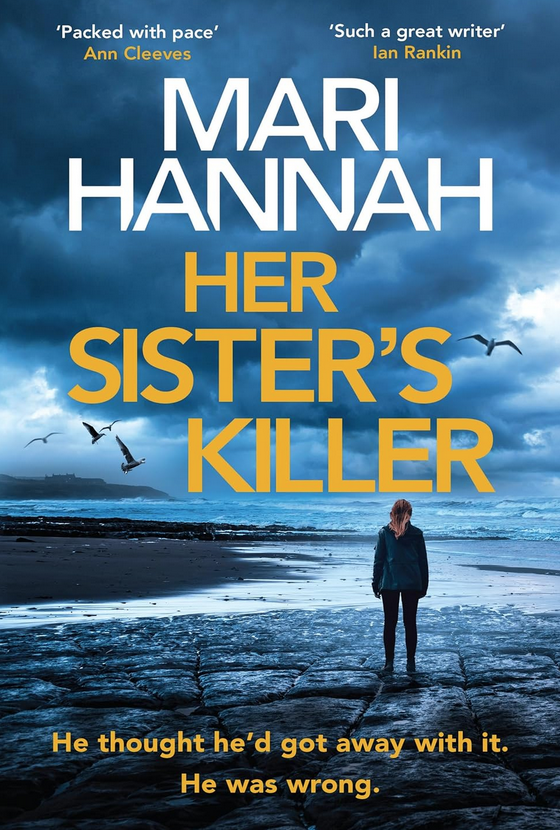
HER SISTER’S KILLER . . . Between the covers

All too often, opening pages of crime novels headed ‘Prologue’ are enigmatic flashbacks, and they leave the reader wondering what their relevance is to the emerging narrative. Not so here. It is short, brutal and and painfully obvious. A Tyneside detective has been called to a murder scene. The body is that of his teenage daughter. That was then.

Now. For some arcane reason, when police Sergeants are promoted to Inspector, they have to serve a term in uniform, away from their home station. So it is that Frances ‘Frankie’ Oliver – the younger sister of the girl whose murder is revealed in the prologue –  is sent away from the city hub of Newcastle to the relative backwater of Berwick – England’s last outpost before the Scottish border. Her first major call-out is a serious RTA – with fatalities. In the back of a wrecked van, Frankie finds a seriously injured child, his wrist secured to a stanchion with cable ties.

Meanwhile, DCI David Stone – Frankie’s on-off romantic interest, acting on loose talk overheard at a police social function, has reopened the investigation into the unsolved murder of Joanna Oliver. Frankie’s secondment to Berwick takes on a life of its own as, amid the wreckage beside the A1, evidence emerges that an organised crime gang has been hard at work trafficking children.

Mari Hannah has penned a classic ‘two plot’, novel, in that DI Frankie Oliver is heading up a multi-agency investigation into a Bulgarian people smuggling gang, while DCI David Stone is in charge of a covert cold-case operation into the murder of Frankie’s sister. Why covert? Stone believes that a serving policeman was her killer and, the law being what it is, any involvement by Frankie Oliver would mean the case would be thrown out of court.

I have meta-tagged this book as a police procedural which, on one level, it is. There is so much more, however. Mari Hannah’s ability to create vividly authentic characters is here for all to see. In no particular order, we have retired copper Frank Oliver, father of Frances, the murdered Joanna and older sister Rae; his torment at being called to a murder scene, only to find that the victim is his own daughter is lifelong; Frankie herself is a brilliant police officer, fearless but vulnerable, intuitive but analytical; David Stone is a ruthless career policeman but, like Frank Stone, the scar on his heart from when his former lover, Jane, was shot dead by an insane gunman, has never healed; I was also particularly taken with rookie PC Indira Sharma who, apart from his boss (Detective Superintendent Bright) is Stone’s only confidante. She is new to the job, but incisive, courageous and has a gimlet eye for detail.

The best crime novels have an authentic sense of place and location and, as with her Kate Daniels novels, Mari Hannah’s heart is never far from England’s north east and the contrast between the bright lights of ‘big city’ Newcastle, and the windswept horizons of rural Northumbria. There is so much to admire about this novel but I suspect, like me, you will be left breathless by David Stone’s ruthless and remorseless interview room demolition of Joanna Oliver’s killer at the end of the book. I don’t do checklists, but if I did, I would be ticking the boxes for brilliant thriller, credible characters, narrative verve, great sense of place and bloody good read. Her Sister’s Killer is published by Orion and is available now.

THE MASKED BAND . . . Between the covers

Two things immediately endeared me to the the main character in the book (a.k.a. the author, I imagine) First, he is a fan of country music, and was quick to reference the divine trio of Emmylou, Dolly and Linda. Second, he is no fan of the more self indulgent excesses of modern jazz. But there’s a good story here, too.

The Okay Boomers are a celebrity amateur rock band. In two ways. Confused? The five-piece outfit are actually media celebs themselves, but they wear masks on stage. Masks of Bob Dylan, Mick Jagger, Paul McCartney, Debbie Harry and David Bowie. They play a pub gig in the affluent London district of Barnes, and have an ‘after party’ at the mansion owned by one of the band members. When a body is discovered the next morning, dead as can be on the gravel underneath a balcony,  DI Garibaldi hops on his bike (literally, as he doesn’t drive) and joins the investigators at the crime scene. The dead body is eventually revealed to be that of Frankie Dunne, an unremarkable young man who – apparently – was completely unknown to any of the Okay Boomers.

Bernard O’Keefe has some sly fun with a couple of the celebrities. There’s Larry Benton, a former footballer turned presenter who sees himself as the champion of middle class liberal sentiments, and Charlie Brougham, the handsome, floppy-haired toff whose boyish charm once graced many a British comedy drama. Hmm. Let me ponder. Who could he have been thinking of?

As you might expect, beneath the veneer of showbiz cameradie, the members of The Masked Band have, in private, little good to think or say about each other. In a rather neat bit of technical business Bernard O’Keeffe has five of the band masks go missing from the crime scene, with the  only surviving mask – that of Mick Jagger – placed on the face of the defenestrated corpse, thus placing the latex Bowie, Dylan, Harry and McCartney faces out there in the community and ready to be used and abused.

We know from the brief and enigmatic prologue, that a young man who has drunk well rather than wisely heads of in search of his girlfriend and his missing ‘phone. He arrives at the house where he thinks both are and ….. end of prologue.

Were you to organise a convention of fictional Detective Inspectors you would need something larger than the average town hall. So how does DI Jim Garibaldi measure up? Italian heritage, obviously; lapsed Roman Catholic, parents died together in a road accident – hence his refusal to learn to drive; his marriage broke down, but he has a bond with his son, renewed every time they go to Loftus Road to watch QPR; he is widely read but wears his learning lightly.

Garibaldi is an engaging central character. Like all the best fictional DIs, he is prepared to think outside the box. The quirky copper resolving cases that baffle his senior officers is an oft repeated trope in police procedural novels, but it works well here. The identity of the person responsible for Frankie Dunne’s death does not exactly come out of the blue, but it is cleverly hidden until the final pages. This is a thoroughly engaging police procedural tale with just the right blend of mystery, dry humour and credible characters. The Masked Band is published by the Muswell Press and is out now.

BURIED IN THE PAST . . . Between the covers

Heather Peck’s Greg Geldard books are, as far as I am aware, unique in that they operate almost as serials, with at least one case continuing from the previous novel, alongside a new investigation. The previous novel Beyond Closed Doors (click for more details) dealt with the troubling case of two children going missing, after their mother was murdered by their father. The book ended with Kate and Jake Mirren being held captive by a reclusive woman in a perfectly ordinary village bungalow. She feeds them well, and looks after them, but they are not free to leave the room in which are confined. The case weighs heavily on Geldard’s mind, as his boss and other senior officers having metaphorically, at least, ticked the box marked ‘missing, presumed dead’.

One of the plotlines here is centred on the vexatious pursuit of hare coursing. Far from the open fields of East Anglia, it has a long history, and in some countries it is regulated and controlled by official bodies, and is regarded as a sport for the gentry. Here, it is very different. It has been illegal since 2004, and is, at least in my backyard, largely carried out by those who, in polite speech, are known as ‘The Travelling Community.’ As I write this, villages not far from me are still reeling from the havoc caused a few days ago by a convoy of twenty five four-by-four vehicles, driven by balaclava clad men, cutting a swathe of destruction across fields and  property and leaving burnt out vehicles in their wake. In this novel, farmers who try to disrupt the activity become victims of violence and arson. When a farm worker dies from a blast caused by one of the arson attacks, this becomes a murder investigation.

While this carries on, hampered by Covid restrictions, Heather Peck focuses on the strange case of the Mirren children. We know they are still alive, but the mystery is why the woman who has, albeit benevolently, imprisoned them in the first place. The apparently inoffensive and ordinary bungalow becomes the scene of something much more dramatic towards the end of the book, when Heather Peck cleverly weaves in a story line which she introduced in the early pages, buy appeared to have no apparent connection with the events in East Anglia.

Like many readers, I always want my crime stories to have a definite and developed sense of place, and Heather Peck definitely doesn’t let us down. In my case, it helps that Greg Geldof’s stamping ground is not too far away from where I live, and I can appreciate the depth of knowledge and fondness for the fields and waterways of Norfolk and Suffolk which are embedded in the story. Buried In The Past is as enthralling and addictive a police thriller as you could wish to read. It is published by Ormesby Publishing, and is available now. Incidentally, the book ends, as all good serials should, by leaving us in suspense after Geldard suffers a harrowing few days, but I have blacked out the final words to avoid a spoiler!

BYE BYE BABY . . . Between the covers

bbb spine012 copy

DI Jack Hawksworth is a rising star in the Metropolitan Police. He is clever, charismatic, and very good looking. His life has not been without tragedy. His parents died in a dreadful road accident, but thanks to a family bequest, he is able to live in an otherwise unaffordable apartment in London’s much sought-after Hampstead. When a man in Lincolnshire is found dead with his hands apparently clutching the remains of his genitals – and his lips – local police soon realise that this is too big for them to handle, and Hawksworth and his team are called in.

The killing is soon repeated in almost identical circumstances, but in Sussex, and it becomes obvious that there is a serial killer at work. The two dead men are linked by where they went to school – an unremarkable High School near Brighton, but what happened back in the day that someone should want to enact such terrible vengeance? Meanwhile, Hawksworth has become romantically involved with a young woman called Sophie who lives in the apartment above his. She suffers from a wasting disease and is mostly wheelchair bound, but she is funny, intelligent, vivacious – and very attractive.

One of Hawksworth’s team, DS Kate Carter is – despite being engaged to an IT expert called Dan – becoming increasingly smitten with her boss, but is trying (and mostly failing) to keep things as professional as possible. Fiona McIntosh invites readers to fall into the same traps as her investigating coppers, and those traps involve us making assumptions, which she delights in overturning. The plot is labyrinthine in its twists and turns, and McIntosh achieves the difficult task of making both the police officers – and us readers – have more than a sneaking sympathy for the killer.

As good as this novel is, in publishing terms it is unusual, in that it was first published in Australia in 2007. It is mildly frustrating that it ends enigmatically, at least in terms of Hawksworth and the serial killer. The follow up novel was Beautiful Death, which is, according to Amazon UK, a steal at just under £60, due to the strange price protocols of the world of publishing! Presumably, Australian readers know what happened next. The author was born in England, but seems to spend much of her time in the beautiful city of Adelaide. I can only say that Bye Bye Baby is a complex and sometimes gruesome read, but a brilliant police thriller. As I mentioned earlier, this is the first in an established series, but UK publishing rights are now with No Exit Press, and this edition is available now.

Screen Shot 2024-12-26 at 17.55.56

GONE . . . Between the covers

gone spine011

Bristol DCI John Meredith is not at peace with the world. His wife and fellow police officer Patsy Hodge was seriously injured when she came face to face with a serial killer. Her physical injuries are, albeit slowly, healing. Mentally, however, she is shattered. Her relationship with Meredith is now fraught, riven with anxiety and tension.

At work, Meredith is saddled with an exasperating pair of cold case crimes. Decades ago, two young women, unknown to each other and years apart, caught trains from Bristol to London. Neither reached their destination, and their bodies were eventually discovered in separate locations in farmland near Reading. What links the two cases is that the forensics indicate that the two young women were not killed when they first disappeared. It seems that they lived for years before being killed. But where? And with whom? Doing what,? The timeline suggests that the first girl, Jasmine was killed in 2008/9, while Louise disappeared in 2010. Could Louise have been Jasmine’s successor, a replacement of some kind? Jasmine Jones was given up by her mother, put in care and then fostered. She married a man called Carl, but the relationship disintegrated when he had a fling with another woman. Louise Marshall was another woman anxious for a fresh start and a new job, but she found only violence and an unmarked grave.

As is often the way in crime fiction, we know the answer to the puzzle facing the investigators long before they do. In this case, there is a decidedly weird and disfunctional farming family who have a disconcerting habit of employing women as a sinister mix of housekeeper and bed-mate – and then killing them.

As involving as this is, the real beating heart of the book is John Meredith’s personal life. The scene where he meets up with his first true love (after Patsy ups sticks and goes to stay with relations in New Zealand) is brilliantly written, and so, so poignant. They wine and dine, make it back to her hotel and …. I am not going to spoil it for you, but it is the most emotionally intuitive piece of writing I have read for a long time.

John Meredith is an engaging and complex man. Realising that Patsy is mentally damaged, he is bowed beneath her slights, physical indifference, and emotional instability, but he never buckles. He hopes (rather than believes) that somewhere ahead are the sunlit uplands of the days before Patsy was so badly wounded. He wants to believe what Philip Larkin once wrote. “What will survive of us is love.” It is, at the end of the day, all he has to offer.

The dark secrets of Brandon farm are eventually exposed to sunlight and justice – after a fashion – is served. What will remain with me about this book, however, is the wonderfully observed account of Meredith’s personal life. Yes, we know that most fictional police Inspectors have tangled lives away from the job. I could start with Tom Thorne, Alan Banks and John Rebus, but CriFi buffs do not need me to continue the list, as it would be a long one. My last words of praise for this excellent novel are to say that the dialogue, copper to copper and Meredith to acquaintances and family, absolutely sparkles. Gone is published by 127 Publishing and is available now.

Screen Shot 2024-12-19 at 17.25.50

MURDER FOR BUSY PEOPLE . . . Between the covers

MFBPspine010 copy

The good news is that DS Max Wolfe is back, and the even better news is that, after a long absence, our man is in very good form. As a young uniformed copper, only days out of Hendon Police College, Wolfe was first on the scene at a safe heist in a palatial London villa. All he found was a gaping hole in the wall, two corpses – and a young woman called Emma Moon, a girlfriend of the mobsters who committed the heist. Wolfe put the cuffs on her, she was tried, convicted, and served a long jail term, during which her troubled son committed suicide. Never once, during the whole process, did she utter a word about those who profited from the robbery. Now, she is out, suffering with terminal cancer, but on a ice cold revenge mission to kill as many of her former associates as she can in the brief time she has left.

Old Max Wolfe hands will know that there is an autobiographical strand running through the novels. Parsons’ breakthrough book was Man and Boy, an account of a male single parent. Here, Wolfe brings up his daughter Scout, rather than a son. Both Wolfe and Parsons are lovers of a dog called Stan, and it was sad to see an RIP notice to the real Stan in the frontispiece of this novel.  Max Wolfe lives within sight, sound and smell of the historic meat market known as Smithfield, for centuries the beating heart of a country that loves beef, pork and lamb. Parsons may not have known, when this book was signed off to the printers, that the death knell would be sounded on this historic site. It will, no doubt, be demolished and something trite and anodyne built in its place. This is a purely personal paragraph, as Parsons doesn’t preach, but I think London is gone for us now: pubs are closing at an alarming rate, institutions like the iconic chop house Simpsons of Cornhill lie empty, derelict and vandalised. Philip Larkin was right when he wrote, “And that will be England gone.”

Wolfe juggles several criminal – and personal – issues. He knows that a group of Jack-The-Lad firearms officers have a flat where they abuse young women, wrongly arrested when they flash their warrant cards. The murder of a young woman of the streets, Suzanne, seems unsolvable. On a personal level, he struggles to keep tabs on Scout, his twelve-year-old daughter. She is wilful, disobedient, but highly intelligent. Every single second while he is working, he is worried about where she is, and what she is doing. One by one, the foot soldiers of the  heist succumb, each apparently, to natural causes. Wolfe does, in the end, unmask the killer, but more by accident that intention.

Apart from being a gripping read from the first page to the last, this novel is remarkably prescient. I believe that there are many months between the final edition of a book being sent to the printers, and its appearance on bookshop shelves. Parsons weaves two very recent issues into the warp and wedt of his novel. One is a subtle and reflective elegy on Smithfield and its sanguinary history. Just weeks ago, an enquiry released its findings into the killing of a London criminal at the hands of firearms officers. Parsons lets us know, in excruciating detail, the hell that descends on any officer who fires a fatal shot.

Max Wolfe is both convincing and endearing. He doesn’t always get things right. Here, his judgment of Sarah Moon veers from spot-on to plain-wrong (and back again) several times. For all that certain critics and reviewers turn up their noses at Tony Parsons because of his political views, and the newspapers he has written for, the last pages of this book reveal what I have known ever since I met the man at a publishers’ party. He is observant, fiercely honest, and a deeply sensitive writer. Max Wolfe may be only marginally autobiographical but, like his creator, he only dances to the tunes he hears in his own head, and not those streamed in from elsewhere. Murder For Busy People will be published by Century on 2nd January.

Screen Shot 2024-12-19 at 17.29.08

A KILLING IN NOVEMBER . . . Between the covers

akin spine

Somehow, I missed this first time round, but reviewed books two and three in this excellent series but Simon Mason. In Ryan Wilkins and Ray Wilkins we met one a rather unusual cop partnership. Ryan is something of a chav, scruffily dressed and with a huge chip on his shoulder. He is, however, very astute. Equally clever, but much more an establishment man, despite his ethnic origin, is black officer Ray. He is a family man, suave and well spoken, and clearly destined for higher things. Their beat is Oxford.

The contrast between the Oxford educated Ray and Ryan, graduate of a seedy South Oxford caravan site (trailer park for American readers) couldn’t be greater. Simon Mason chooses a superb location for their first professional engagement. Barnabus College is where a young woman has been found strangled in the rooms of the college Provost. Ray is all diplomacy and respect, while Ryan, much the more observant, needles the well-to-do members of the college by refusing to grovel at the altar of their social and academic status. It is eventually confirmed that the dead is Syrian, from a wealth family, but due to the political situation, has been forced to earn a living as a porn model. Working as a domestic servant in the college is Ameena Najib, also from Syria, but from a very different background. She is a devout and militant Muslim, and when she is found dead, also strangled, the mystery deepens.

In the background to this murder investigation is civil unrest in the Oxford district of Blackbird Leys. A child has died after being hit by a police car, and protests are violent and bloody. The Leys is a real place, and is a superb example of urban planners concocting idyllic rural names for dire housing estates. I was at Teacher Training College nearby and, trust me, if it was announced the Leys was where you were sent for Teaching Practice, you were not happy.

Simon Mason lets us know, in one of the most scary scenes in the book, why Ryan is so disturbed. Ryan’s wife Michelle died of a drug overdose, leaving him to bring up their little son, also called Ryan. When Ryan senior fails to collect the lad from nursery, the staff phoned one of the contact numbers – that of the little boy’s grandparents. Bad call. They are a disaster. Grandma is, literally, bruised and battered by her feral husband, and when Ryan and Ray break into the shabby caravan on the grim site in South Oxford to rescue the child, all hell breaks loose.

Ryan’s propensity for violence, his unwillingness to ‘play the game’, and his chaotic personal life make it inevitable that he is dismissed from the force. However, his sharp insight into what makes people tick combined with his intuition, enable him to solve the mystery. Ray, despite his initial horror at Ryan’s manner and attitude, keeps the phone line open with his former colleague, and the Barnabus killer is brought to justice.

This is a wonderful read, and I finished it in just a few sessions. My only quibble is that Ryan Wilkins is such an outrageously out-of-kilter character, dressed in his trackies, trainers and baseball cap (back to front, naturally) that it is hard to imagine him making senior rank in the modern police force, which is notorious for signing up to all the latest DEI fads, and renowned for its many acts that seem woker than woke. Simon Mason has created a brilliant – and unique – member of the Cri-Fi Detective Inspector union, and any crime enthusiast who doesn’t enjoy this needs to collect their hat and make for the nearest exit. A Killing In November is published by Riverrun, and is available now.

Screen Shot 2024-11-14 at 15.13.52

DEATH AT DEAD MAN’S STAKE . . . Between the covers

DADMS HEADER

Death at Dead Man’s Stake sounds like something from the Wild West, but it is, in this new novel by former copper Nick Oldham, an incident at an isolated farm in Lancashire. With his veteran Henry Christie perhaps taking a well-deserved break at his (hopefully) rebuilt moorland pub, Oldham introduces Detective Sergeant Jessica Raker. After fatally shooting a London gangster following a botched raid on a jewellers’ in Greenwich, Raker has been moved to the North West – where she grew up – in an attempt to distance her from the dead man’s vengeful relatives.

Her first day is nothing if not eventful. She has barely unloaded her kit into the Sergeant’s office from her car, when she is called out to a crisis at Dead Man’s Stake. When the local fire brigade attends an unexplained fire in the derelict farmyard, one of the firefighters is grabbed and held hostage by the farmer, a drunken, mildly crazed man called Bill Ramsden. Jessica rescues the fireman after tazering Ramsden. Her day is not over, however. A cantankerous old man, resident of a local cafe home, is found dead, his corpse floating in a nearby reservoir. Raker, viewing the scene, suspects that a physical struggle lead to the old man ending up in the water.

Jessica Raker is a good copper, but she has been dealt a poor hand. At the Greenwich heist, who was one of the customers eying up an expensive item at the moment the robbers burst in? None other than her husband Josh, a high flying player in a City firm. And the piece of jewellery was intended not for Jessica, but for his secretary. Improbably, the marriage has survived, and Josh is now working in Manchester, but resentful at the move.

Meanwhile, we learn a little more about the man Jessica shot dead in Greenwich. He was the most ungovernable  of the sons of Billy Moss, a millionaire crook grown rich on the proceeds of all manner of criminaity, ranging from the inevitable drug trade to trafficking people. Goss wants revenge. He wants the hapless amateurs who lured Terry Moss into the doomed jewellery raid, but most of all, he wants Jessica. The problem is that the Met Police have done a very good job in smuggling her away to the Ribble Valley, and she has gone completely off the Moss radar. Nonetheless, a professional killer is hired to hunt her down and end her life. While on the school run, Jessica bumps into an old adversary. Years ago, when she was growing up in Clitheroe Jessica and Maggie Goss fell out over a mutually desired boyfriend, and Maggie, now boss of huge scrapyard empire, hasn’t forgotten the teenage slights. What is more important is that the scrapyard business is a million miles away from being strictly legit, and one of Maggie’s LinkedIn buddies is none other than Billy Moss.

It is not just Nick Oldham’s years of experience as a working copper that makes his books so good. Nor is it the loving and detailed sense of place, where he describes a beautiful and windswept rural Lancashire, blissful yet only an hour’s drive from pockets of deprivation and criminality like Blackpool. For me, what puts his novels up there on a pinnacle is his sense of dialogue – nothing flashy or pretentiously poetic – but an unerring version of how real people actually speak to each other.

As the Moss organisation moves against Jessica Raker, there is a satisfying symmetry to the main plot, as it ends where it began, out at Dead Man’s Stake. This is a firecracker of a police thriller, and Nick Oldham has established a cast of coppers, with Jess Raker at its heart, who will keep us entertained for many years to come. The novel is published by Severn House, and is available now.

Screen Shot 2024-09-25 at 19.40.39

A VIOLENT HEART . . . Between the covers

AVH spine078 copy

David Fennell introduced us to London copper DI Grace Archer in The Art of Death (2021) Now, she returns  in a complex new case which involves cold case crime and the murders of sex workers, decades apart. The investigation becomes very here-and-now when the body of a young Croatian woman called Elena Zoric is found. She died from a puncture wound to her chest, but whatever killed her, it wasn’t a bullet.

The best police procedurals always give us a fly-on-the-wall account of the personalities and tensions that exist inside a police station. Because her previous superior has been sideline and has to care for her husband, struck down with Long Covid, Grace Archer has a new boss, Chief Inspector Les Fletcher, He is described as a “gammon-faced Yorkshireman” with more than a trace of the toxic masculinity common to that breed. Archer’s wing man is Belfast born DS Harry Quinn – reliable and intuitive. Less helpful is DI Lee Parry, nephew of the Metropolitan Police Commissioner, but about as much use as a chocolate fireguard. He is lazy, venal and prepared to cut corners for an easy life.

I have often observed that Detective Inspectors in British crime novels are, perhaps, overused. There are very sound reasons for this, however. DIs are perfectly placed to be both at the centre of investigations bureaucratically, while able to be out on the street, at the crime scene, and in the faces of the bad guys. Much more rare is the novel where a humble DC is the locus of activity. I can think of only one series, and that was written by Alison Bruce, and featured Cambridge Detective Constable Gary Goodhew. My review of The Silence is here. That being said DI Grace Archer is a welcome guest at a party held in a very crowded room.

We have here something of a whirling dervish of a plot, which spins this way and that and incorporates apparently disconnected events. We have a bizarre (but sadly all-too-credible) social ‘influencer’ called Calvin ‘Dixy’ Dixon whose latest Tik-Tok sensation shows him talking to the dessicated corpse of a woman sitting in a wheelchair in an abandoned house. There is also something that might become a ‘love interest’ angle, when Liam, a builder friend of Harry Quinn, is booked to renovate Archer’s house. He also happens to be extremely handsome, and brings with him freshly baked croissants to share before he starts work each day.

Then there is Mallory Jones, the guiding light in a successful podcast called Mallory Jones Investigates. She alternately helps and hinders Archer’s search for a man whose weapon of choice appears to be some kind of bolt gun. Finally, in far-off Berwick on Tweed, we have the Mercer family. Barry and Isla, and Isla’s brother Simon. Barry and Isla are both ex-coppers, but their teenage daughter Lily has fallen in with a bad crowd, and makes fistfuls of cash by appearing in amateur porn videos with her bestie, Gemma.

Archer is concerned to discover that, back in the day, her new boss Les Fletcher was, as a young PC, involved in the older murder investigations, and her informants tell her that he was rude and unsympathetic, strongly showing his prejudice that as ‘working girls’, getting assaulted by clients just went with the job.

As you might expect, David Fennell seizes the frayed ends of these plot strands and weaves them together to make for a highly satisfying conclusion. There is a savage and sanguinary denouement in, most appropriately, a disused abattoir. Not everyone survives the carnage, but as the emergency vehicles trundle off into the night, we have catharsis. Grace Archer certainly has her own demons to torment her, but she is a courageous and resourceful copper with a fierce determination to pursue the truth. A Violent Heart is published by Zaffre and is available now.

Blog at WordPress.com.

Up ↑