
“OVER-PAID, OVER-FED, OVER-SEXED, and OVER HERE!” The phrase is attributed to the comedian and entertainer Tommy Trinder, but for many British people his barbed catchphrase rang all too true. American servicemen had left a country unaffected by German bombing, rationing and austerity, and brought with them an abundance of delights in the way of cigarettes, alcohol, chocolate and nylon stockings. For some women, young and not so young, the brash appeal of these loud and confident young men was irresistible. But things did not always turn out for the best for either the hosts or the visitors. The American men sometimes strayed from the straight and narrow path, and in the most severe cases, justice was swift and terrible. In all, eighteen American servicemen were executed within the forbidding grey walls of Shepton Mallet Prison in Somerset. Two met their death by firing squad, but sixteen were hanged. This is the story of some of them.

 THE MOST HORRIFIC of the crimes occurred not on the British mainland, but in the sleepy countryside of County Tyrone, one of the Six Counties of Northern Ireland, in September 1944. The victim, Patricia Wylie was just seven years old. There is something about a child killing that curdles the blood of even the most hardened observer of criminal misdeeds. Private William Harrison was known to the Wylie family, who lived in a cottage near the remote village of Killclopy, and when he called at the house on 25th September, he found Patricia there on her own. She said she had to go into the village to do some shopping for her mother, and Harrison went with her. Patricia never reached the village, however, and after an extensive search her bloodied body – sexually assaulted – was found in a field, casually covered up with hay.
Harrison was quickly arrested and at his subsequent court martial in Cookstown his defence was that of diminished responsibility due to being drunk, and having had a traumatic childhood in Ohio. It was stated that when he was born, his mother was a mere 14 years old, and that he had his first sexual experience at the age of 15, partly due to being drunk. Prior to his arrest he had been court martialled no fewer than 5 times for being drunk or absent without leave. The submission by his lawyer that he had insufficient moral awareness to realise that the assault on Patricia (which he admitted) was wrong fell on deaf ears, and he was sentenced to death on Saturday 18th November 1944.
He was removed to Shepton Mallet, and was hanged on 7th April 1945, by Thomas Pierrepont and Herbert Morris.

Death is no respecter of persons, but the most high profile victim of American violence during WW2 in Britain was certainly Sir Eric Teichman. He was a distinguished career diplomat, and had written books about his experiences in the far flung corners of what remained of the British Empire. He was no dour and over-cautious emissary, however, and was described as “a flamboyantly enigmatic explorer-cum-special agent.”
 On 3rd December 1944, whilst at home at Honingham Hall, his estate in Norfolk, Teichman (left) heard the sound of gunfire nearby. He went out to confront two poachers (Private George E. Smith of Pittsburgh and Private Leonard S. Wijpacha of Detroit) who were trespassing in the grounds of his estate. Both intruders were American soldiers based at a nearby USAAF airfield and each was armed with an M1 carbine. Sir Eric was killed during the confrontation, receiving a fatal gunshot wound to the head.
Private Smith (army serial number: 33288266) was subsequently court-martialled at RAF Attlebridge, convicted of murder and executed by hanging at Shepton Mallet on 8th May 1945 (i.e. VE day), despite appeals for clemency, including one from Lady Ellen Teichman. His companion, Private Wijpacha was charged with being an accessory to murder, but was not sentenced to death. The hangman on this occasion was, again, Thomas Pierrepoint, assisted by Herbert Morris.

 Perhaps the most dramatic of the murders occurred on a peaceful street in the well-to-do Oxfordshire town of Henley on Thames. Doris Staples was 35 years old, and had been ‘courting’ an American soldier who was currently on active service in North Africa. It seems, however, that Private John H. Waters, a 38-year-old soldier from Perth Amboy, New Jersey, and the old adage “while the cat’s away..” on his mind. Doris worked in a dress shop at 11A Greys Road. The building is still there, but is now a solicitors’ office. On the afternoon of 14th July 1943, locals were disturbed to hear gunshots coming from the premises. The police tried to force an entry to the shop, but it wasn’t until a tear gas grenade was lobbed in through the window, and the local fire brigade called to direct powerful jets of water into the building, that the authorities felt safe enough to enter. Once inside, they found a very dead Doris Staples, and a seriously wounded John Waters. It seems that Waters was driven to madness by his unrequited passion for Doris Staples, and after mortally wounding her, he turned the gun on himself.
Either by accident or design, Waters survived, but his appointment to meet his maker was only postponed, not cancelled. At a court martial in Watford he was found guilty, and sentenced to death. He was removed to Shepton Mallet and on 10th February 1944 he was hanged by Thomas Pierrepoint and his assistant Alex Riley.

Along with other great forested areas in ancient England such as Sherwood, Arden, Epping, and Charnwood, Savernake Forest in Wiltshire owed its development to the love the English royalty and aristocracy had for hunting. In late September 1943, however, the historic woodland was the scene of a different kind of hunting – and the prey was human. It needs to be remembered, not in any sense of expiation for these terrible crimes, but by way of establishing what life was like in wartime Britain, that hundreds of thousands of husbands, boyfriends and other eligible young men were all away at the war, leaving women very much on their own. Someone once unkindly likened the situation to a careless farmer leaving the chicken run unlatched with a hungry fox in the vicinity.
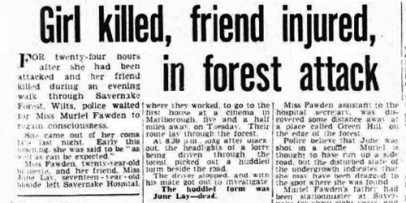
Lee A. Davis was another young G.I. who could not resist the temptation of the hen coop door swinging open. near Marlborough Wilts., as On the night of 28th September, two young women walked back from the cinema near Marlborough Wiltshire. Davis asked the girls what they were doing and one, Muriel Fawden, said she was returning to the hospital where she worked as a nurse. They tried to get away from Davis who shouted after them “Stand still, or I’ll shoot”. He instructed the terrified girls to go into some bushes beside the footpath. Muriel’s companion June Lay decided to make a run for it and Davis shot her dead.
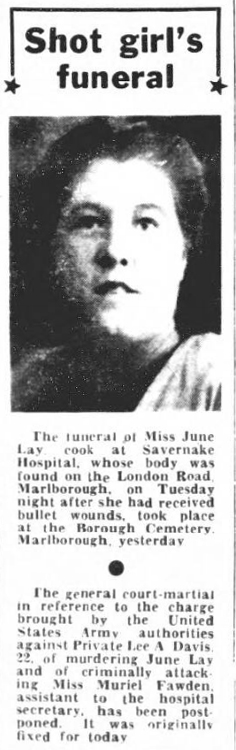 He now forced Muriel into some bushes and raped her but surprisingly did not kill her. When she recovered from her ordeal she was able to give a full statement to the police and as a result all the rifles of the American soldiers stationed nearby were examined. Davis’ was found to have been fired and forensic tests matched it to the shell cases found near June’s body. Davis admitted he had been at the scene of the crime but said he had only meant to fire over the heads of the girls. He was court-martialled at Marlborough on the 6th of October for the murder and the rape, both crimes carrying the death penalty under US Military law. He was hanged on the 14th of December, 1943 by Thomas Pierrepoint, assisted by Alex Riley.
The full list of military executions of American servicemen at Shepton Mallet is as follows:
Pte. David Cobb, a 22 year old G.I. was the first to be hanged. He had shot and killed another soldier and was executed on 12th March, 1943.
Pte. Harold Smith a a 20 year old from LaGrange, Georgia shot and killed Pte. Harry Jenkins He made a full statement admitting his guilt and was duly hanged on the 25th of June, 1943 by Thomas and Albert Pierrepoint.
20 year old Lee A. Davis (see main article) was executed for rape and murder in 1943.
John Waters from Perth Amboy in New Jersey was, at 39, rather older than the rest of these soldiers. He was hanged on the 10th of February 1944 by Tom Pierrepoint, assisted by Alex Riley. (see main article)
J.C. Leatherberry, a 22 year old from Hazelhurst, Mississippi, was executed for the murder of Colchester taxi driver Henry Hailstone on the evening of 5th of December 1943. Leatherberry was sent to Shepton Mallet to be hanged by Thomas and Albert Pierrepoint on the 16th of March 1944.
25 year old Pte. Wiley Harris Jr. from Greenville, Georgia, was another soldier who was stationed in Belfast in Northern Ireland. After a fight broke out in a bar, Harris stabbed a local pimp called Coogan 17 times. The court martial were not prepared to accept self defence in view of the number of stab wounds and so Harris was convicted. He was hanged by Thomas Pierrepoint, assisted by Alex Riley, on the 26th of May 1944.
20 year old Alex F. Miranda from Santa Ana, California, became the first American serviceman to suffer death by musketry as the US Army called shooting by firing squad, at Shepton Mallet. He was executed on Tuesday the 30th of May 1944 for the murder of his sergeant, Sgt. Thomas Evison at Broomhill Camp in Devon.
25 year old Eliga Brinson from Tallahassee Florida and 22 year old Willie Smith from Birmingham Alabama, were hanged by Thomas Pierrepoint on the 11th of August 1944 for the rape of 16 year old Dorothy Holmes after a dance at Bishop’s Cleeve in Gloucestershire.
Madison Thomas, a 23 year old from Arnaudville, Louisiana, was another soldier convicted of rape. His victim was Beatrice Reynolds. He was court martialled at Plymouth on the 21st of August and hanged by Thomas and Albert Pierrepoint on the 12th of October 1944.
35 year old Benjamin Pyegate from Dillon, South Carolina, was the second and last US soldier to face a firing squad at Shepton Mallet. The crime – stabbing a fellow soldier – took place at Tidworth Barracks in Wiltshire on the 15th of July 1944.
24 year old Ernest Lee Clark from Clifton Forge, Virginia and Augustine M. Guerra aged 20 from Cibolo, Texas were jointly convicted of the rape and murder of 15 year old Elizabeth Green at Ashford Kent on 22nd of August 1944. They were hanged side by side on the 8th of January 1945, by Thomas and Albert Pierrepoint.
Robert L. Pearson, a 21 year old from Mayflower, Arkansas and 24 year old Parson (also given as Cubia) Jones from Thompson, Georgia, were convicted by court martial of the rape of Joyce Brown at Chard in Somerset on the 3rd of December 1944. They were tried at Chard on the 16th of December 1944 and hanged side by side on the 17th of March 1945 by Thomas Pierrepoint, assisted by Herbert Morris.
22 year old William Harrison Jr. from Ironton, Ohio sexually assaulted and strangled seven year old Patricia Wylie in Killycolpy Co. Tyrone, Northern Ireland. (see main article)
George E. Smith Jr. aged 28 from Pittsburgh, Pennsylvania, (see main article) was hanged on 8th May, 1945 by Thomas Pierrepoint, assisted by Herbert Morris.
Aniceto Martinez, a 23 year old Mexican American soldier from Vallecitos New Mexico was the last person to be hanged for rape – that of an elderly woman – in the UK, when he went to the gallows on the 15th of June 1945. Thomas Pierrepoint, assisted by his nephew Albert, carried out the execution.

There is a macabre postscript to this story. Initially, the bodies of the executed soldiers were interred in the huge cemetery at Brookwood in Surrey. Later, though, the remains were transferred to Plot E, Oise-Aisne American cemetery near Fère-en-Tardenois, Aisne, Picardy, France.
Plot E is approximately 100 metres away from the main cemetery and is a separate, hidden section which currently contains the remains of 94 American military prisoners, all of whom were executed by hanging or firing squad under military authority for crimes committed during or shortly after World War II. Their victims were 26 fellow American soldiers (all murdered) and 71 British, French, German, Italian, Polish and Algerian civilians (both male and female) who were raped or murdered. No US flag is permitted to fly over the section, and the numbered graves literally lie with their backs turned to the main cemetery on the other side of the road.


 Many people in their sixties – particularly those who are comfortably off – plan ahead for their own funerals. Daytime television programmes are interspersed with advertisements featuring either be-cardiganed senior citizens smugly telling us that they have taken insurance with Coffins ‘R’ Us, or rueful widows plaintively wishing that they had been better prepared for the demise of poor Jack, Barry or Derek. However, it would be unusual to hear that the be-cardiganed senior citizen had died only hours after planning and paying for their own send-off from the world of the living.
 During the story, Horowitz (right) drops plenty of names but, to be fair, the real AH has plenty of names to drop. His CV as a writer is, to say the least, impressive. But just when you might be thinking that he is banging his own drum or blowing his own trumpet – select your favourite musical metaphor – he plays a tremendous practical joke on himself. He is summoned to Soho for a vital pre-production meeting with Steven and Peter (that will be Mr Spielberg and Mr Jackson to you and me), but his star gazing is rudely interrupted by none other than the totally unembarrassable person of Daniel Hawthorne, who barges his way into the meeting to collect Horowitz so that the pair can attend the funeral of Diana Cowper.
 If the South London suburb of Menham could be described as unremarkable, then we might call the down-at-heel terraced houses of Barley Street positively nondescript. Except, that is, for number 29. For a while, the home of Mary Wasson and her daughters became as notorious as 112 Ocean Avenue, Amityville. But the British tabloid press being what it is, there are always new horrors, fresh outrages and riper scandals, and so the focus moved on. The facts, however, were this. After a spell of unexplained poltergeist phenomena turned the house (almost literally) upside down, the body of nine year-old Holly Wasson was found – by her older sister Rachel – hanging from a beam in her bedroom.
 Laws (right) takes a leaf out of the book of the master of atmospheric and haunted landscapes, M R James. The drab suburban topography of Menham comes alive with all manner of dark interventions; we jump as a wayward tree branch scrapes like a dead hand across a gazebo roof; we recoil in fear as a white muslin curtain forms itself into something unspeakable; dead things scuttle and scrabble about in dark corners while, in our peripheral vision, shapes form themselves into dreadful spectres. When we turn our heads, however, there is nothing there but our own imagination.
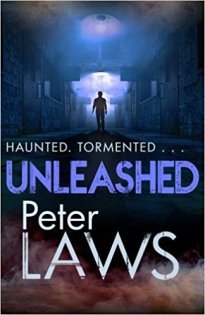 In Unleashed, his scepticism is shaken by events at an otherwise unremarkable terraced house in South London where, several years ago, a troubled nine-year-old girl committed suicide in the midst of a troubling sequence of poltergeist phenomena.

 Eddie is Eddie Newcott, the boy who used to live across the street in Chicory Lane, Limite. The boy who was just a bit different from all the other kids at school. The kid whose dad was a rough and abusive oilfield mechanic. The kid whose mom turned to the bottle to escape her violent husband and the beatings he handed out to their only child. But that was then. Now sees Eddie fallen on hard times. Times so hard that he achieved brief notoriety in the tabloid press, and has now been sentenced to death by lethal injection for murdering his pregnant girlfriend, slashing her open, dragging the foetus out and then arranging the two corpses on his front lawn, posed in an obscene mockery of a Nativity tableau. And it was Christmas Eve.
 Like Shelby Truman, Raymond Benson (right) is a highly successful writer. He has written thrillers under his own name, most notably his Black Stiletto Saga, and has also written novels based on video games. He has taken up the baton from authors who are no longer with us, like Tom Clancy, and has written several James Bond stories which have either been based on established screenplays – like Die Another Day – or standalone original stories such as The Man With The Red Tattoo.

 When the battered body of teenager Melanie Cooke is found amid the garbage bins in a seedy Bristol alleyway, it is obvious that she has been murdered. Only fourteen, she is dressed in the kind of clothes which would be considered provocative on a woman twice her age. Vogel goes to make the dreaded ‘death call’, but he only has to appear on the doorstep of the girl’s home for her mother and father to sense the worst. Like many rebellious teenagers before her, Melanie has told her parents that she is going round to a mate’s house to do some homework. When she failed to come home, their first ‘phone call confirmed Melanie’s lie, and thereafter, the long dark hours of the night are spent in increasing anxiety and then terror, as they realise that something awful has happened.
 The book actually starts with a prologue which at first glance appears to be nothing to do with Melanie’s death. It is only later – much later – that we learn its true significance. Bonner (right) is determined not to give us a straightforward narrative. The progress of Vogel’s attempts to find Melanie’s killer are sandwiched between accounts from three different men, each of whom is living a life where all is not as it seems.


 I do love Operas, though – at least those written up to the death of Giacomo Antonio Domenico Michele Secondo Maria Puccini (who would be just as wonderful even if he didn’t have six christian names.) I would add the personal caveat that for me it is sometimes better heard than seen, as stage productions can sometimes demand too much suspension of disbelief. Our chosen book, then, is Spur Of The Moment by David Linzee, and it is set around the St Louis Opera company as they prepare a performance of Bizet’s wonderful, preposterous, exhilarating four-act classic, Carmen.
 David Linzee has himself been a ‘supernumary’ – basically the opera equivalent of a spear carrier – and he enjoys several digs at the way an opera company in a mid-sized city is run. I particularly enjoyed his jibes at the ubiquitous need for sponsorship. Linzee (right) explains that the SLO has to make sure that literally every brick in the building has corporate support. Thus we have the Peter J Calvocoressi Administration Building, the Charles Macnamara III Auditorium and – best of all – the Endeavour Rent-a-Car Endowed Artist. In this case it’s Amy Song, the woman playing Carmen.



 Now, Thorne becomes involved in another kind of hell on earth, and one where all absent devils have been called home, all leave cancelled, and any recently retired fallen angels pressed back into duty. The fires stoked in this particular hellish pit illuminate the ghastly world inhabited by some British Asian communities who sanction murder in the name of their warped concept of family honour. Among the ghosts which inhabit the darker parts of Thorne’s memory is that of Meena Athwal. She was killed, he is certain, at the behest of her family, but her death remains unavenged in a court of justice.
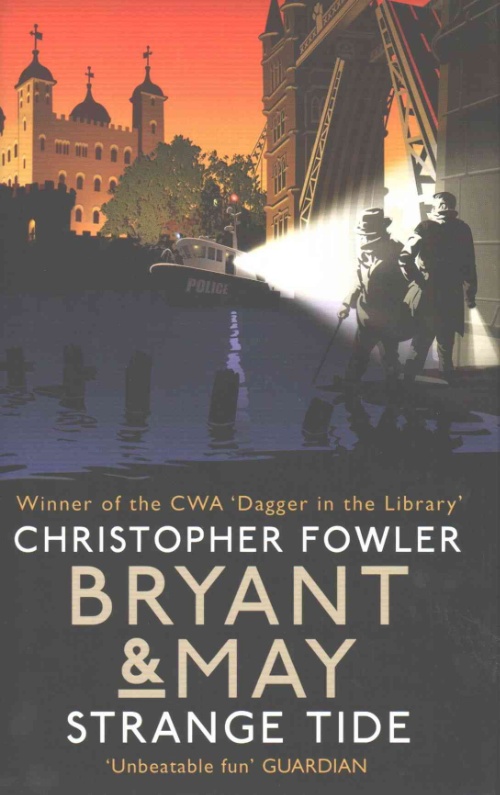

 The Urban Dictionary tells me that a “keeper” is
 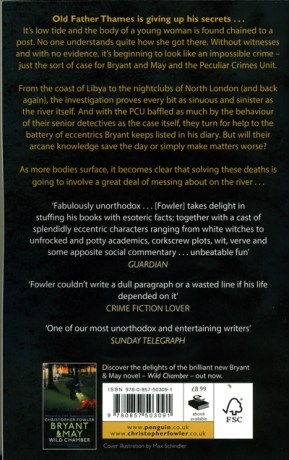 STRANGE TIDE is set, as you may expect, in London, but it’s a London few of us will ever see. It’s a world of forgotten alleyways, strange histories, abandoned amusement arcades, inexplicable legends and murder – always murder. Strange Tide was my book of the year for 2016, and you can read my review of it by following


