Search

fullybooked2017

Tag

murder

GATHERING DARK . . . Between the covers

gd013

indexCandice Fox (left) is an Australian novelist who is perhaps best known for her collaborations with James Patterson, but back in 2019 I reviewed her solo novel Gone By Midnight, and if you click the link you can read the review. That book was set in the Queensland city of Cairns, but in her latest, she goes Stateside to Los Angeles for Gathering Dark.

To borrow a cliché much loved by sports commentators, Candice Fox leaves nothing in the changing room here in the way of characters. The larger-than-life cast includes former top paediatrician jailed for murder and now working in a fast food joint, her kleptomaniac and drug-addicted chum from prison, a fixated female cop whose career seems to be spiralling out of control, and a six-foot black female gangster and strip-club owner.

What brings this formidable quartet together? The search for the missing daughter of Sneak, the aptly named kleptomaniac. After randomly robbing Blair Harbour at her greasy take-out counter, Dayly has disappeared into the nightmare neon slick that is the criminal underbelly of Los Angeles.

gd014We all love a good coincidence, and cop Jessica Sanchez just happens to have been gifted a sumptuous LA property which sits next door to the house where Blair’s son Jamie has been fostered since his mother’s unfortunate spell in jail. And who was one of the cops involved in Blair being put away for ten years? Christian name begins with J and surname starts with S!

Fox has woven a wonderfully complex web of a plot. Blair isn’t sure why the gangster, Ada, is offering to help, but she thinks it might be because she is returning a favour notched up while the two were in jail together. We eventually learn, a little way before Blair does, that Ada doesn’t do gratitude, and has an ulterior motive.

The cop, Jessica, is pretty much loathed by LAPD colleagues, and she is warned that if she accepts the multi-million dollar mansion, she will be drummed out of the force for accepting bribes.

The unholy Trinity of Ada, Blair and Jessica plough a violent and relentless furrow in their search for Dayly, and it all comes to a head in a claustrophobic and bloody shoot-out in a sewer beneath an LA suburb. Fox is a gifted storyteller and this ‘guns and gals’ thriller will guarantee a few hours of excellent entertainment. Gathering Dark is published by Arrow and is out now in paperback.


STILL LIFE . . . Between the covers

Screen Shot 2020-08-29 at 10.49.21

Still Life sees the return of Val McDermid’s DCI Karen Pirie for her sixth case. For readers new to the series, Pirie is tough, intuitive and compassionate – qualities which stand her in good stead as leader of the Historic Crimes Unit. She has her vulnerable side, and it is never more obvious than when she contemplates the emotional scars inflicted by the murder of her former colleague and lover Phil Parhatka. In the previous book, Broken Ground, she met Hamish Mackenzie, a wealthy businessman and gentleman crofter. They are not completely ‘an item’. For Karen, the jury is still out.

McDermid loves nothing better than to juggle plot strands, and here we have two absolute beauties or, should I say, bodies. In the Blue Corner we have the corpse of a male (happily for the police complete with passport in his back pocket) recovered by fisherman tending their lobster pots. In the Red Corner is the desiccated corpse of a woman, discovered in an elderly and tarpaulined camper van, rusting away in a suburban garage.

51UwcxaxExL._SX329_BO1,204,203,200_The dead man is quickly identified as the brother of a long-disappeared Scottish public figure. Iain Auld, depending on your cultural terms of reference, did either a Reggie Perrin, John Stonehouse or Lord Lucan a decade earlier. He has officially been declared dead, but Pirie’s antennae are set all of a quiver, as her investigations into Auld’s disappearance have been fruitless.

The dead woman? Just as complex and convoluted. She may have been a capriciously talented jewellery designer, neither seen nor heard of for months after a troubled residence in a Highland artists’ commune. Then again, she might be the designer’s lesbian lover, a minor talent in the world of water colour landscapes.

McDermid creates her usual magic in this brilliant police procedural. Yes, all boxes are ticked, including starchy superior police officers, duplicitous figures at the heart of the world of Fine Art, sexual jealousy and crimes passionelle, government corruption and likeable (but slightly gormless) junior coppers. Long time fans of the former director of Raith Rovers FC will know that there is more – so much more. She pulls us into the narrative from page one. We are smitten, hooked, ensnared, trapped in her web – choose your own metaphor

Val McDermid is a political person, but she generally wears her views lightly. She cannot restrain herself, however, from having a little dig at her fellow Kirkcaldian Gordon Brown for ‘bottling out’ of an election in 2009 and thus succumbing the following year to a decade or more of rule by the ‘auld enemy’. The lengthy gestation period of novels usually prevents authors from being totally topical, but the final pages of Still Life have DCI Pirie and her crew clearing their desks and preparing for a Covid-19 lockdown. Karen, as we might expect, is made of stern stuff, and she faces an uncertain future with determination:

” – people would always need the polis – and even in a pandemic, murder should never go unprosecuted.”

For my reviews of the previous two Karen Pirie novels Broken Ground and Out of Bounds, click the links and you will get each in a new tab. Still Life is published by Little, Brown and is out now.

TRUE CRIME . . . The Easter Monday Murder

Header1953 had not begun auspiciously for East Anglia. Overnight on 31st January a fierce storm had brought devastating flooding to the coast from Lincolnshire to Norfolk. Amost exactly a year earlier, King George VI had died at Sandringham, and the preparations for the June coronation of the young Queen Elizabeth were well advanced. Wisbech Town were struggling in the Midland League, but did manage to beat Gainsborough 5-3 on Easter Saturday, 4th April.

On Thursday 2nd April, Claude Butter arrived at his mother’s house in Wisbech, having traveled down from his lodgings in Church Street, Blackpool. The 51 year-old was a civilian instructor at RAF Weeton, in Lancashire. He had been away from home since he was 16. When his father died he was abroad but in a later statement he said:

“I tried to get home, but I understand that the then Superintendent of police said my presence was not necessary. That sort of gave me the impression that I was not really wanted.”

81 year-old Susannah Elizabeth Butter lived on Summerfield Close, in a modest 1930s council house in a set of terraces built around a circular green. Her other son, Charles, lived either in Milner Road, Wisbech, or with his mother – newspaper reports differ.

That Sunday, 5th April, was Easter Day. On Easter Monday, Mrs Butter and her sons sat down to supper. It was to be her last meal. At 7.45am the next day, Mrs Butter’s next door neighbour was roused by a frantic knocking on the door. When he answered the door, he saw a dishevelled Claude Butter, who said:

Fetch the police. I have killed my mother. I am mad.”

Mr Jackson and his wife went into number 74, and found Mrs Butter slumped at the foot of the stairs, her head a bloody mess. Claude, meanwhile sat slumped at the kitchen table, muttering:

“To think I should have done this.”

Several times he also said,
“I sent her to heaven. God rest her soul.”

When the doctor arrived, Mrs Butter was pronounced dead. The police had found a poker near to her body, and subsequent tests revealed that it was stained with the old lady’s blood.

When Butter appeared in Wisbech Magistrate’s Court on 22nd April, the national press were preoccupied with the misdeeds of a certain John Christie, who had been arrested on 31st March. While the full horror of what Christie had done would only emerge over the next weeks and months, Butter’s crime was relatively cut and dried, the only question being “why?”.

Being a trial for murder, business was transferred to Cambridge Assizes, and on Tuesday 20th May, Claude Butter was found guilty of his mother’s murder, but declared insane, and sentenced to be detained “until The Queen’s pleasure be known.”

Police and solicitors struggled to find a motive for Butter’s senseless act. Defending Butter in court, Mr George Pettefar called Charles Butter to the stand. Butter said:

“The accused man, my brother, was a bachelor whose life had been centred round our mother. The relationship between them was of the highest and there was genuine affection on both sides.”
(Pettefar) “Would you agree he would not have killed her had he not had a brainstorm of some kind?”
“Yes.”

“What he did that morning was to kill the nearest and dearest person to him on this earth?”
“Yes.”

There was little for the police to do except take Butter to a secure place and try to fathom out what had possessed him to kill his mother.

It was disclosed in court that Claude Butter had made the following statement to police:

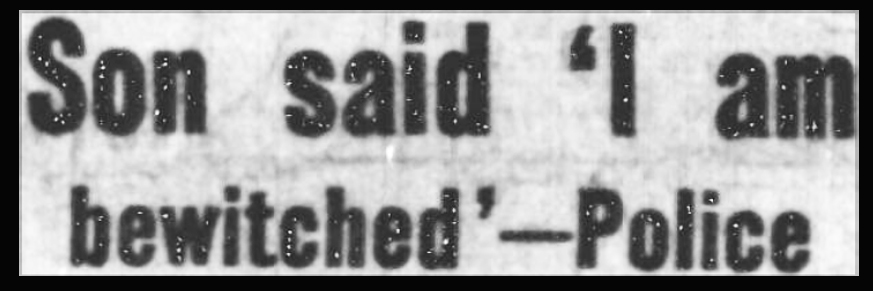
“I was not the fellow she thought I was or who anyone thought I was. I didn’t want her to know. I do things on mad impulse. All my life I have been bewitched by the devil.”

Summing up the case for the prosecution, Mr Jardine reminded the jury:

“One thing you may think is lacking in this case is any evidence of any motive for the crime. It is not essential for the prosecution’s case to prove motive, and in this case I am unable to produce any evidence of motive.”

The inner torment which drove Claude Butter to kill his mother can only be guessed at. His death was registered in the St Pancras district of London in the summer of 1960, which suggests he spent the final years of his troubled life in one of the capital’s longest established mental health institutions, St Pancras Hospital.

Screen Shot 2020-08-26 at 19.39.19

KILLING IN YOUR NAME . . . Between the covers

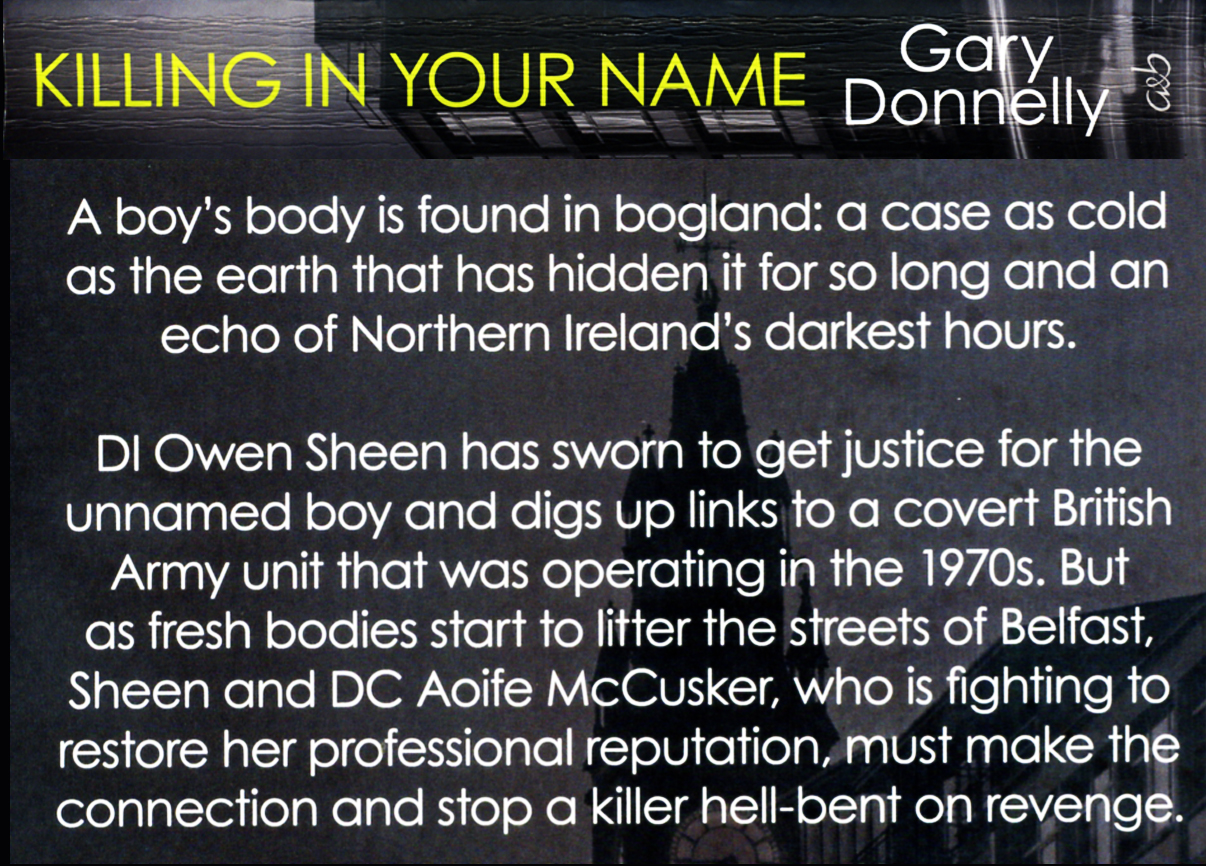
In February this year – remember when everything was normal, and Covid-19 was just something nasty that was happening in China and Italy? – I reviewed Blood Will Be Born, the debut thriller by Belfast writer Gary Donnelly. I said it was:
“… breathtakingly violent, vividly written and a bleak commentary on a seemingly terminal bitterness which makes normal human beings behave like creatures from a warped vision of hell.”

The full review of that book is here, but in no time at all, it seems, comes the second episode in the career of Met Police detective Owen Sheen. He has been seconded to the historic crimes unit of the Police Service of Northern Ireland. If ever there were a British city where historic crimes still haunt the streets, it is Belfast. Sheen was born in Belfast, and watched his own brother being blown to pieces by a terrorist bomb as the two youngsters played football in the street. Donnelly says:

“Over the decades, so much blood had spattered the streets of Belfast, all now washed away, and forgotten by many. But there would always be those, the ones who had been left behind to count the cost, for which the stain and the pain would never really go.”

The (literally) explosive conclusion to the previous case has left Sheen sidelined and his PSNI partner Aoifa McCusker walking with a stick and suspended from duty after a stash of Class ‘A’ drugs were planted in her locker. Sheen is haunted by the discovery of a boy’s body, found in remote Monaghan bogland on the border with the Republic. The body has been partially preserved by the acidic water, but even a post mortem examination reveals few details.

Meanwhile, a spate of horrific killings has perplexed PSNI detectives. A priest has been decapitated in his own sacristy; the teenage daughter of a prominent barrister has been abducted and then killed; her body, minus one of its hands has been dumped at her father’s front door. The adult son of a former hellfire Protestant preacher and politician has been found dead – again, butchered.

Against the better judgment of senior officers, Sheen is allowed to ‘get the band back together’ and so a limping McCusker, and colleague George ‘Geordie’ Brown are joined by Hayley, a mysterious transgender person who calls herself an ‘instinctive’ because she has what used to be called a sixth sense about death or extreme violence.

As ever in Belfast, the answers to modern questions lie irremovably in the past and, almost too late, Sheen and his team discover that the killings are bound up with acts of scarcely credible evil that took place decades earlier. Revenge is certainly being served cold and, for someone, it tastes delicious.

Donnelly (below) has another winner on his hands here, and it is partly due to his superb sense of narrative, but also to his ability to create truly monstrous villains, and there is at least one in Killing In Your Name to rival anything his fellow Irishman John Connolly has created. Connolly’s creations tend to have a sulphurous whiff of the supernatural about them. Donnolly’s monsters are human, if in name only. Killing In Your Name is published by Allison & Busby and is out today, 20th August.

CRY BABY . . . Between the covers

CB header

Mark Billingham is certainly a man of many parts. To name a few, there is Gary, the dim-but-lovable stooge to the Sheriff of Nottingham in Maid Marian and her Merry Men, stand up comedian and scriptwriter, acoustic guitarist with Fun Lovin’ Crime Writers and, of course, best selling crime novelist. But author of historical fiction? Well yes, in a manner of speaking. In his afterword to his latest novel Cry Baby, Billingham says that in writing this prequel to the Tom Thorne series he had to imagine a world of clunky computers the size of refrigerators, telephone boxes and ‘phone cards, and pubs where people smoked.

We are, as ever in London, but it is the summer of 1996. The city and the country – at least many of the menfolk thereof – are transfixed with the European Cup. Crosses of St George flutter from the aerials of Mondeos up and down the land and pubs are rammed with supporters of Shearer, Sheringham, Southgate and company. Detective Sergeant Tom Thorne is trying to schedule his work around the matches, but when a boy is abducted from a London park, football has to take a back seat.

54502348._UY2560_SS2560_Kieron Coyne is playing with his mate Josh under the watchful eyes of their mothers, Cat and Maria. Cat goes off for a pee, Maria settles back on the park bench and lights a fag. One minute Kieron is there, the next he has disappeared. Josh emerges from the little wood where the boys were playing hide and seek. He neither saw nor heard anything of his friend.

A major police investigation kicks in, with Thorne doing the leg work at the best of his incompetent boss. We learn that Cat and Maria are both single mothers – had ‘lone parents’ been invented in 1996? – but in different circumstances. Kieron’s father is doing a long spell in a maximum security prison, while Maria’s doctor husband divorced her a couple of years back.

Hours turn into days and there is no sign of Kieron, dead or alive. A birdwatcher thinks he saw a boy getting into a car with a man he obviously knew, and a Crimewatch presentation by the late lamented Jill Dando turns up nothing more useful than imagined sightings the length and breadth of the country, and the usual false confessions from the mentally ill.

Thorne does find a suspect – a neighbour of Cat’s with a suspicion of ‘form’ for dodgy sexual activity – but the arrest of Grantleigh Figgis does not go well for either the police of the suspect.

Billingham manages the historical details very well, and we meet one or two regular characters from the Thorne series for the first time, none more dramatically than Phil Hendricks, the much-tattooed and oft-pierced pathologist. In a rare droll moment in a seriously dark book, Billingham has gentle fun with making Thorne’s gaydar so wonky that he has our man making enquiries as to why Hendricks hasn’t found the right woman to settle down with. We also meet Thorne’s soon-to-be-ex wife Jan, and fellow copper Russell Brigstocke who, as lovers of the series know, manages subsequently to keep his CV much cleaner than Thorne.

Fans of Billingham’s novels, both the Tom Thorne series and the stand-alones, know that he likes nothing better than a dramatic twist in the final few pages, and he doesn’t let us down here. There is something of a ‘where the **** did that come from’ moment when all the patient door-knocking, statement-taking and deduction of the coppers is spun on its head in a few dazzling pages of revelation. Cry Baby is published by Little, Brown and is out now.

LOST SOULS . . . Between the covers

header

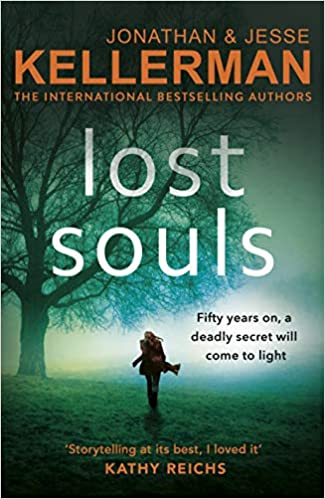
51K-Sy2OGJL._SX323_BO1,204,203,200_Lost Souls is something of an oddity, and no mistake. There’s nothing at all wrong with the novel itself apart from something of an identity crisis. Search for it on Amazon UK, and up it comes, but the page URL contains the title Half Moon Bay. Search for Half Moon Bay and up comes the same novel, but with a different cover. It looks as though Half Moon Bay is the Penguin Random House American title, while on this side of the Atlantic Century are going with Lost Souls.

Deputy US Coroner Clay Edison first appeared in Crime Scene (2017). That was followed by A Measure of Darkness in 2018, and now Edison returns but this time with baby Charlotte to look after when his wife is out on shift in her hospital. The Edisons live in that eternal bastion of West Coast sensibilities, Berkeley, and it is in the infamous People’s Park that the case begins.

LS illustration

Clay Edison is called to the park, scene of decades of hippy protest. Two bodies have been found during building excavation. The first is neither human nor animal. It is a stuffed blue teddy bear, missing an eye. The second is the skeleton of a baby, and the glare of the pathologist’s strip lights reveal that it was once a little boy. Edison is drawn into an investigation to see if the teddy bear and the boy are connected, and this means he has to visit a truly terrifying settlement of biker red-necks:

“I bounced along the tracks, wheels spitting gravel. Slowly the smudge began to resolve like a body surfacing in swamp water. Structures, then vehicles, then living things: gaunt dogs and children chasing one another, their roles as hunter or prey in constant flux. Bare feet raised a dusty haze. ….. Amid a weedy patch a woman slouched in a lawn chair. Pustulant acne ravaged her face; she could have been eighteen or forty. A slack-limbed toddler slept on her chest.”

51wZ1Fd-WIL._SX327_BO1,204,203,200_As Edison tries to link the skeleton of the baby with the abandoned cuddly toy, he accepts an ‘off-the-books’ job. A wealthy businessman, Peter Franchette, asks him to try to find the truth about his missing sister. Possibly abducted, perhaps murdered, she has disappeared into a complexity of disfunctional family events – deaths, walkouts, divorces, remarriages and rejections.

The Kellermans clearly have an ambivalent view of Berkeley. A place perhaps, where a seventy-something former revolutionary might wake up and imagine, for a fleeting moment, before old age and reality kick in, that it is 1966, and everything is still possible. The reality is more sobering, however:

” … and the countless others, men and women alike, who’d found their way to the Pacific, only to find that it was not the golden bath they’d expected but a terrifying force of nature, immense and violent and indifferent.”

I’ll be blunt and say that I have never understood the concept of writing partnerships in fiction. Over many years I enjoyed Jonathan Kellerman’s Alex Delaware books. They are slick and formulaic, but never less than gripping, and it is obvious that Kellerman is a gifted writer. Why he should want to want to pair up with someone else – even if it is his son – is for him to know and me to be left wondering. Lost Souls reads as if it has been written by one person, so I suppose that is all that matters.

Lost Souls is cleverly written and has a plot which is, like Chandler’s immortal The Big Sleep, deeply complex. Rather like the anecdote which has Chandler being asked who killed the chauffeur, and him replying that he wasn’t sure, I couldn’t put my hand on my heart and say that Edison finds Peter Franchette’s missing sister. I think he does, but you must judge for yourselves.

Lost Souls and/or Half Moon Bay are out now, and available here.

AFTER THE FIRE . . . Between the covers

ATF header

Jo Spain’s Irish copper Tom Reynolds – now Detective Chief Superintendent, if you please – returns in After The Fire and we are, as ever, in Dublin’s Fair City. Are the girls still ‘So Pretty’? The young woman walking naked down the city street, much to the astonishment of shoppers might have been pretty once, but now she is in a terrible state. Hair awry, skin blackened with dirt and a look of sheer terror in her eyes.

Except that is not dirt on her skin. It is soot, and she has escaped, traumatised, from a catastrophic house fire. The terraced house is in an area which has moved upmarket because of its proximity to the The International Financial Services Centre (IFSC) but the services being offered at the ruined house were something different altogether. First one body is recovered, and then another, and as the young woman – a Russian –  recovers in hospital, it becomes clear to the police that the house was a brothel, and she was one of the items on the grisly menu.

As a DCS, Tom Reynolds is not meant to get his hands dirty at an investigational level, but there is no drama in balancing budgets and supervising staff deployment, so the admirable Mrs Spain has Tom notionally taking a spot of leave so that he can lend a hand in the case which is being led by his former protégé Laura Lennon.

Tyanna, the woman who fled the fire, is too terrified of the people who controlled the trade at 3 Shipping Row to be of much use, but she has mentioned a baby, now missing, the child of a young woman whose corpse was discovered in the building. Another frightened young woman – Nina Cusack – who was bought and sold there has also emerged, but she has sought sanctuary with her parents and is, again, too terrified to divulge much about the identities of the guilty men who are controlling the brutal trade.

The sheer fluency of Jo Spain’s writing will come as no surprise to those of us who are long term admirers, and the bottom line is that every book she writes is, quite simply, a bloody fine read. It is, however, worth taking a moment to look at just how and why she is so good. Lesser writers will seed their narratives with gore and gruesome detail, while Spain leaves us in no doubt about how brutal people can be, but in a much more subtle way.

Some police procedurals rely too much on the central copper being a maverick, or a bitter misanthrope, or a damaged person with a hundred different devils to fight each day. Tom Reynolds doesn’t distract us in that way – he is a decent man who has been dealt a fair hand by fate, and so we don’t waste valuable time having to understand him by examining his CD collection. (Yes, I know CDs are so very yesterday, but you get my drift)

As for elaborate scene setting with endless paragraphs about how Dublin looks, smells, sounds and feels, Jo Spain puts us in the place with a couple of telling sentences. We know we are in Dublin – that’s fine – but then she gets on with the important stuff. The important stuff? That is the story and above all, Jo Spain is a storytelling genius. Those who follow her career will know she is also much sought after as a screenwriter. The Tom Reynolds books and the stand-alones are not written for the screen, but they may as well be because every page, every paragraph and every sentence comes to life as vividly – and as visually – as if we were standing right there, watching.

After The Fire is published by Quercus. It is available now as a Kindle, and will be out in paperback on 6th August.

For more on Jo Spain and her novels, click the image below.

image

ORANGES AND LEMONS . . . Between the covers

OAL header027

For a good part of its long and curious history, it seems that The Peculiar Crimes Unit of London’s Metropolitan Police has been under threat. Civil servants and box-tickers without number have tried to close it down; it has endured bombs (courtesy of both the Luftwaffe and those closer to home); it has suffered plague and the eternal pestilence of whatever vile tobacco Arthur Bryant happens to stuffing into his pipe at any particular moment. The PCU has become:

“..like a flatulent elderly relative in a roomful of
millennials,a source of profound embarrassment..”

But now, yet another crisis seems to be the fatal straw that will break the back of the noble beast. Bryant’s partner John May (the sensible one) is on sick leave recovering from a near-fatal gunshot wound. Mr B has gone AWOL (trying to have his memoirs published), and the office has been invaded by a tight lipped (and probably ashen-faced) emissary from the Home Office who has instructions to observe what he sees and then report back to Whitehall.

The PCU creaks into arthritic action when Arthur Bryant puts his literary ambitions on hold, and links three apparently random deaths. A Romanian bookseller’s shop is torched, and he dies in police custody; a popular and (unusually) principled politician is grievously wounded, apparently by a pallet of citrus fruit falling from a lorry; a well-connected campaigning celebrity is stabbed to death on the steps of a notable London church. For Bryant, the game is afoot, and he draws on his unrivaled knowledge of London’s arcane history to convince his colleagues that the killer’s business is far from finished. His colleagues? Regular B&M fans will be relieved to know that, in the words of the 1917 American song (melody by Sir Arthur Sullivan) “Hail, Hail – The Gang’s All Here!”

roster

An intern in the PCU? Yes, indeed, and in the words of Raymond Land;

“You may have noticed there’s an unfamiliar name attached to the recipients at the top of the page. Sidney Hargreaves is a girl. She’s happy to be called either Sid or Sidney because her name is, I quote, ‘non gender specific in an identity-based profession.’ It’s not for me to pass comment on gender, I got lost somewhere between Danny la Rue and RuPaul.”

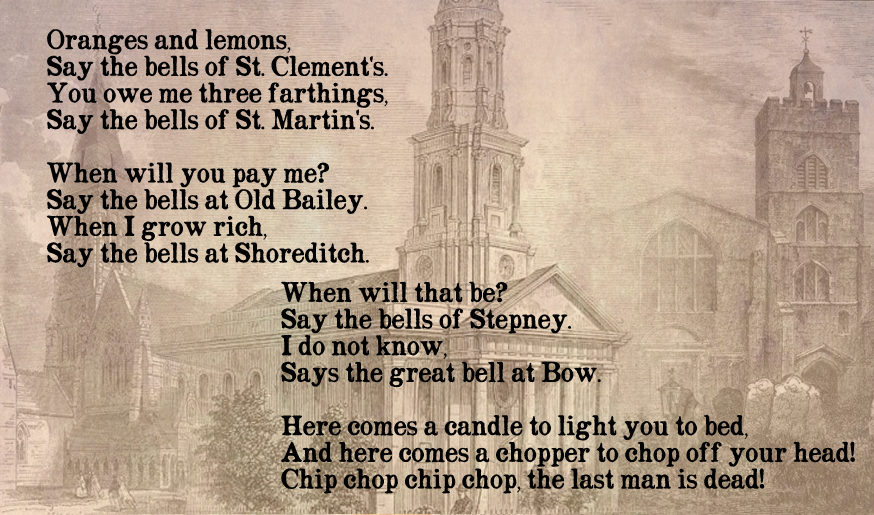
There are more deaths and Arthur Bryant is convinced that the killings are linked to the London churches immortalised in the old nursery rhyme, with its cryptic references:

Poem

But what links the victims to the killer? Beneath the joyous anarchy Arthur Bryant creates in the incomprehending digital world of modern policing, something very, very dark is going on. Fowler gives us hints, such as in this carefully selected verse between two sections of the book:

“The past is round us, those old spires
That glimmer o’er our head;
Not from the present are their fires,
Their light is from the dead.”

Also, underpinning the gags and joyfully sentimental cultural references there are moments of almost unbearable poignancy such as the moment when the two old men meet, as they always have done, on Waterloo Bridge, and think about loves won and lost and how things might have been.

There is no-one quite like Christopher Fowler among modern authors. He distills the deceptively probing gaze of John Betjeman, the sharp humour of George and Weedon Grossmith, the narrative drive of Arthur Conan Doyle and a knowledge of London’s darker corners and layers of history quite the equal of Iain Sinclair and Peter Ackroyd,  The result? A spirit that is as delicious as it is intoxicating. Oranges and Lemons is published by Doubleday and is out now.

More about the unique world of Arthur Bryant and John May can be found here, while anyone who would like to learn more about the origin of the rather sinister verse quoted earlier should click on the picture of its author, below, Letitia Elizabeth Landon.

Letitia_Elizabeth_Landon_-_Pickersgill

THE WISBECH TRAGEDY . . . Part Two

TWT HEADER

first para

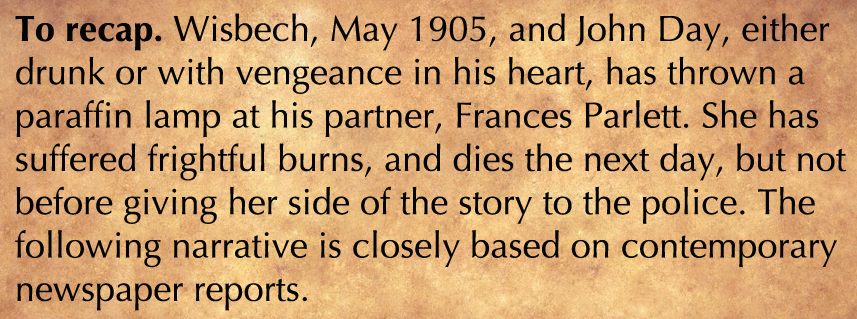
It was also alleged that after the woman was in this fearful condition, Day did nothing to help extinguish the fire except to pour some water on the woman from a small teapot. He was also said to have threatened do the same for a man who was trying put out the flames if he made fuss about it. There was no other possible conclusion at the inquest other than that Frances Parlett had met her painful end through the violent actions of John Day, and that Day must face trial for murder.

The past is never far away, and it is interesting to note that the initial defence for John Day was conducted by Mr TR Dawbarn – a distinguished Wisbech name. One of the chilling things about this case is the fact that, before she died, Frances Parlett was able to give a lucid account of events. At the trial of John Day, she spoke from beyond the grave:

“I live in Wisbech with the accused. About one o’clock this morning I and accused were alone together downstairs. I woke him up as he had fallen asleep. We had no words during the evening. He said “You ….. cow. 1 will blind you.” He then took the lamp up off the table, which was alight, and threw it at me. I caught fire, and everything I had on was burnt. I was burnt, too, almost all to pieces. I screamed and ran out. but he has knocked me about so that the people took no notice it. He is always at it. The accused did nothing, not even attempt put the fire out. Mr. Brightwell, the next-door neighbour, put it out. The accused threw some buckets of cold water over me, but not before my clothes were burnt off me. I cannot remember anything else. We have been living together nearly two vears.’’

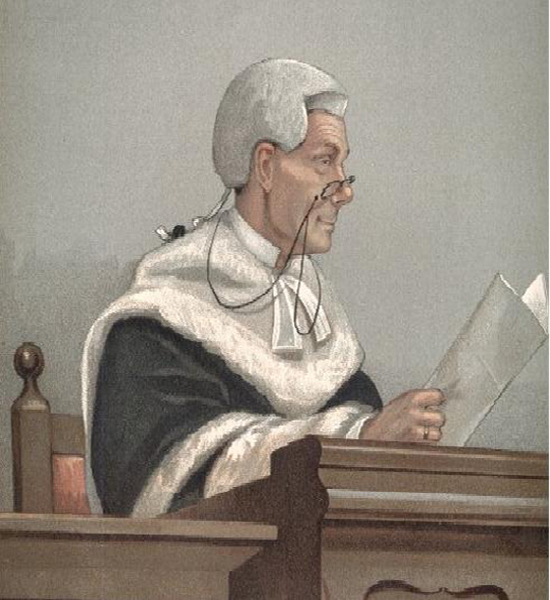
Mr-justice-bucknillAt Day’s trial in June 1905, presided over by Mr Justice Bucknill, (left, as caricatured by ‘Spy’) much was made of the fractious and often violent relationship between Frances Parlett and himself. The poor woman did not die until the next day, and in the immediate aftermath of the attack initially defended Day, but then the following exchange was relayed to the court. Sergeant Watson took the prisoner upstairs to see the deceased, and they had a conversation.
Day said,


“Frances, did I do it ?”
She answered,
Yes, you bad boy, you know you did it,”
Day said,
“It’s false.”
Frances repeated,
You did, you bad boy, you know you did.”
She was also heard to say,
You murderer, you have done it this time. You have had a good many tries, and you have done it this time.”

BarristerIn the event, the defence barrister for Day made great play on the grave responsibility that the jurors held. If they found Day guilty of murder, he would surely hang. In the words of the newspaper report, Mr Stewart, for the defence, remarked that the punishment for the crime with which the prisoner was charged was death, and it was not necessary to say more than that to bring home the jury the great and terrible responsibility that rested upon them. The onus of proof against the prisoner lay with the prosecution, and it was for them to satisfy the jury beyond the possibility of reasonable doubt that the prisoner was responsible for the deed. He contended that this had not been done. The statement of the woman was not in nature of a dying declaration, and it ought not to regarded as more important, or have more credence attached to it than was attached to any of the evidence called before the Court during the day.

closing para

Scroll

Blog at WordPress.com.

Up ↑