Search

fullybooked2017

Tag

murder

DEMOLITION . . . Between the covers

demolition header

Former Lancashire copper and now best-selling novelist Nick Oldham doesn’t muck about. By the time you have read the first half dozen pages of his latest Henry Christie novel, we have had a gangster shot dead in his own swimming pool, another very rich but rather ‘iffy’ businessman bludgeoned to death with a huge spanner he has been using to rebuild a WW2 aircraft – and Henry himself dodging bullets.

High speed back story for new readers (Where have you been? This is book 30 in the series!) Henry Christie, former senior copper, now in his 50s, rather tragic ‘love life’, runs a pub in Kendleton on the Lancashire moors, frequently engaged by his former employers as a civilian investigator, usually involving crimes committed by local gangsters operating a kind of triangle-of-death between Preston, Blackpool and Fleetwood. No kiss-me-quick hats here, just deprivation, drugs and violence.

As has been customary in the recent novels, Christie is signed back on to help with the two murders – a perfectly plausible move by the Lancashire Constabulary, as  their staffing levels have taken a hit through Covid. Henry’s police ‘chaperone’ is DS Deb Blackstone. She is a feisty and competent officer who just happens to dress like a slightly deranged Goth, with spiked pink hair and all the trimmings.

Our man has other things on his plate, too. One of the regular groups to meet in his pub rather like rural Lancashire’s answer to The Thursday Murder Club, and the case they are currently working on is not so much cold as embedded in the permafrost. It concerns the murder of Lucas Grundy, back in 1941, and spice is added to the investigation by the fact that Eric, the murdered man’s brother is still alive, albeit aged 100. Christie learns from an elderly woman in the village that she believes Eric Grundy raped her, many decades earlier, but the crime was never properly dealt with.

A couple of days before Lucas Grundy was murdered, a Heinkel bomber, damaged in a raid, crashed on the moors nearby. Three of the five-man crew died at the scene and were buried in the local churchyard, but nothing was ever found of the other two. Was it possible that they were somehow involved in Grundy’s death, and how did they simply seem to disappear of the face of the earth?

As a humble reviewer, I can’t begin to comprehend how Nick Oldham keeps so many sub plots going at the same time without the narrative collapsing in confusion. One metaphor, I suppose, is that of the plate-spinning juggler, who manages not to break any of the plates, but stacks them neatly one on top of the other at the end of his performance. Oldham rounds off the action with his customary inventiveness and panache, but be warned  – there is a particularly venomous sting in the tail. Demolition is published by Severn House, and is available now.

FOR REVIEWS OF EARLIER NOVELS IN THE SERIES,
CLICK THE AUTHOR’S IMAGE BELOW

NO

THE MURDER OF LUCY LINGARD . . . A Grimsby tragedy (part two)

LL header

SO FAR: Grimsby, 18th November 1902. Lucy Lingard is separated from her husband John. She and her children live in Hope Street, and she has been in a relationship with Samuel Harold Smith (Harry), a trawlerman. He has returned from sea, and the couple have spent the afternoon and evening drinking and arguing. Smith has hit Lucy several times, but they return to their house, both drunk. A newspaper reported what happened next.
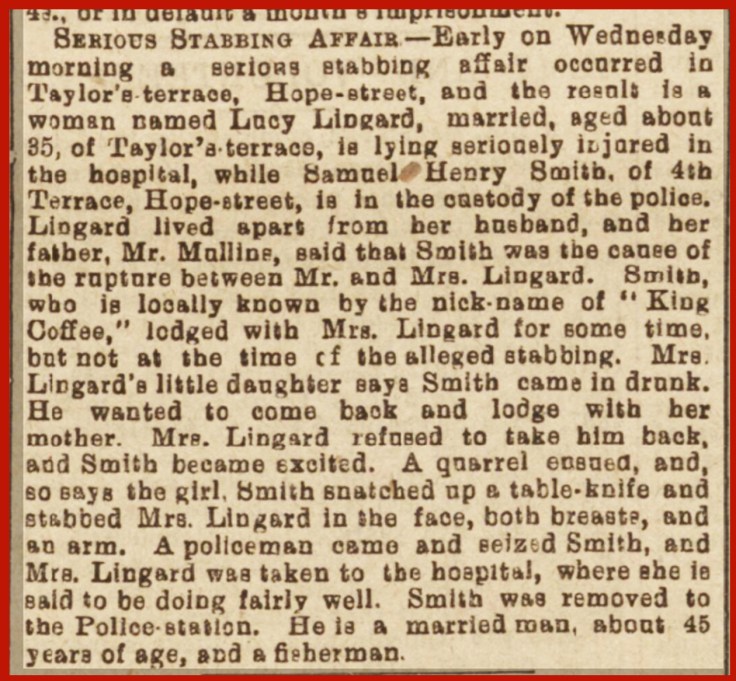
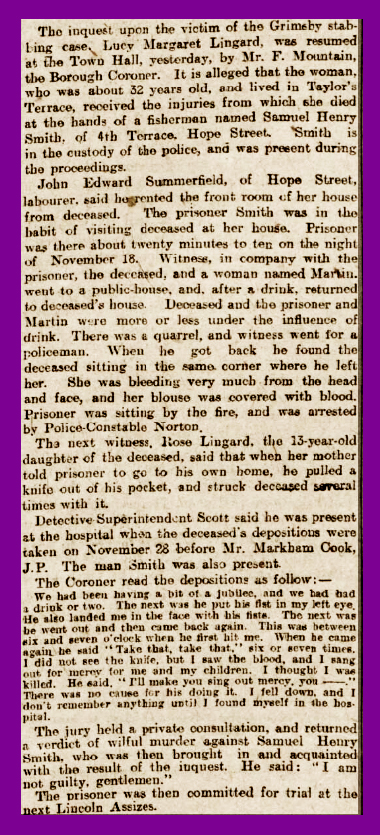
Cutting 1

InquestThe report was overly optimistic. Lucy Lingard hovered between life and death for a while, but on the Sunday, four days after the attack, she died of her injuries, described below at the subsequent inquest.

Dr Harold Freeth, house surgeon at the Hospital, gave evidence to the effect that the deceased died in the Hospital from exhaustion, following on from injuries, which he described. There were eleven incised wounds in all, chiefly on the chest and the left arm. One of the most serious wounds was that on the upper side of the left breast, and penetrated through the first rib into the chest cavity. The deceased had lost a great deal of blood. Witness had made a post-mortem examination. The wound which penetrated the chest had set up acute inflammation, and there was also inflammation of the pericardium. In reply to a juryman, the witness said the deceased’s organs were quite healthy before the injuries were inflicted.”

Bizarrely, despite the eye-witness testimony of Lucy Lingard’s daughter, who had witnessed the attack, and the fact that he had admitted his guilt when arrested, Smith pleaded not guilty. Another newspaper reported on young Rose’s demeanour.
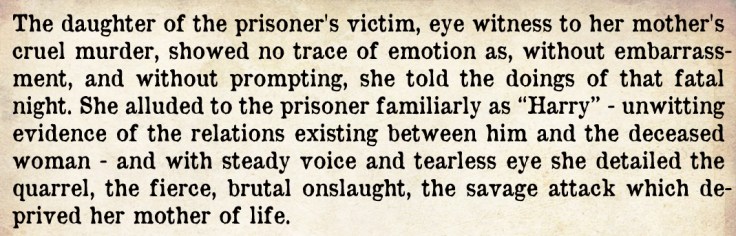
Rose

Sir_William_Rann_Kennedy_1915Inevitably, the Coroner’s court, convened at the beginning of December, declared Smith to be guilty of murder, and now it would be up to the Lincoln Assizes court, Judge and Jury, to determine his fate. Smith spent the rest of December – including Christmas – and the greater part of February in Lincoln gaol. On Wednesday 25th February 1903, before Mr Justice Kennedy (right), Samuel Henry Smith  ‘had his hour in court’. Despite the suggestion to the jury that the charge should be reduced to one of manslaughter, it all went badly for Smith.

“The Lincolnshire Assizes were resumed yesterday before Justice Kennedy. Samuel Henry Smith, aged 45, fisherman, was indicted for the wilful murder of Lucy Margaret Lingard. at Grimsby, on the 18th November last. Mr Etherington Smith and Mr Lawrence appeared for the prosecution, and at the request of the Judge Mr Bonner undertook the defence. The case was sordid one. The deceased woman lived apart from her husband at 3, Taylor’s Terrace, Hope Street, Grimsby, and the accused had been in the habit of staying with her. On November 18th last the couple were out together during the afternoon, and on their return had some words, and the prisoner struck the woman. Afterwards they again went out, and when they returned late at night with a lodger and another woman, they were the worse for drink. The quarrel was resumed after a time, and, according to the evidence of the woman’s thirteen-year-old daughter, the accused took out a knife, and, rushing at the deceased, stabbed her several times. She died in the hospital on the following Sunday. On the prisoner’s behalf, Mr Bonner suggested that the jury would be justified in finding him guilty of manslaughter. The crime was undoubtedly due to drink, and he submitted that at the time of its commission the prisoner was not in condition to exercise any discretion as to the result of what he was doing. The jury found the prisoner guilty of Wilful Murder,” and he was sentenced to death.”

William-Billington copy

Smith’s legal team had applied to the Home Secretary, Viscount Chilston, for a reprieve, but he was not minded to be merciful. Likewise a petition set up by residents of Smith’s home town, Brixham, was ignored. On Tuesday 10th March, Samuel Henry Smith was marched to the scaffold by the executioner, William Billington (left). The role of state executioners was often kept within families. Just as the Pierrepoint family had several hangmen – Henry, Thomas and Albert, William Billington took over the job – along with brothers John and Thomas – when their father, James, died in 1901. Newspaper reporters, at this time, were still officially allowed to witness executions first hand, but in practice, most prison governors (and the hangmen) preferred if they didn’t, due to sensationalised and lurid accounts of the prisoners’ last moments. Whether the reporter from the LIncolnshire Chronicle saw the end of Samuel Henry Smith with his own eyes, or simply used his imagination, we do not know:

“According to recent Home Office regulations the black flag is not now displayed and all that told of the end was the tolling of the prison bell just after hour had struck. Inside the Prison, where there were only officials, the scene was impressively quiet. Wm. Billington the executioner, and his brother John, had arrived on the previous night. Early on the fateful morn the Rev. C.H. Scott visited the condemned man, who listened to his ministrations with attention and apparent gratitude. At ten minutes to eight o’clock County Under-Sheriff (Mr. Chas. Scorer) entered the cell, and approaching Smith requested him to prepare for execution. To all appearance he remained quite calm, and with a steady voice intimated that he was prepared to meet his death. Quietly he submitted himself to the executioner for the necessary pinioning process, and walked unfalteringly to the scaffold, and within two minutes all was over. Billington allowed a drop of 7ft. 3in. To the witnesses death appeared to be absolutely instantaneous and there was scarce a motion of the rope after the body disappeared from sight in the space below the drop.”

All that remained was for Samuel Henry Smith’s body to be buried in the gaol cemetery, along with dozens of other executed killers, and his name to be entered in the official record book.

Prison record

FOR MORE LINCOLNSHIRE MURDERS, CLICK THE IMAGE BELOWramblers-church-small-thin

THE MURDER OF LUCY LINGARD . . . A Grimsby tragedy (part one)

LL header

Lucy Margaret Mullins was born in the village of Worlaby in 1869. Her father James was Irish, and worked as a groom. Her mother Jane was from the Lincolnshire village of Great Limber. In the 1881 census the family had moved to Little Limber Grange, near Brocklesby. In April 1889, Lucy married John Lingard in St James Church, Grimsby, and the census two years later shows that they were living at 6 Vesey’s Buildings in Grimsby, and they already had two children, Rose (2) and William (10 months). By 1901 they had moved to Sixth Terrace, Hope Street, and had two more children, Nellie (8) and Arthur (4). Also living in the house were two of Lucy’s adult relatives.

The 1901 census was taken on 1st April, and by the autumn of the next year John and Lucy Lingard had separated, Lucy remaining in Hope Street with the children. By the autumn of 1902 she had given birth to another child, born earlier in the year. The census also tells us that a fisherman named Samuel Henry Smith was also living in Hope Street, apparently on his own. His background has been difficult to track. The census records that he was born in Norfolk, but later newspaper reports suggest that his home town was Brixham in Devon.

It is not clear if Harry Smith was in any way responsible for the break up of the Lingards’ marriage, but by November 1902 it was clear that Lucy Lingard and Harry Smith (also separated from his spouse) were in a relationship, when he was not out on the North Sea on a trawler.

At this point, it is worth pausing the story to compare how people lived – in terms of house occupancy – back in the day. It was very common for ordinary working people to share houses with others. I was born in 1947, and my parents rented a room in a Victorian terraced house, which was shared with another couple and the owner, a single man. Each had a bedroom to themselves, and the kitchen and scullery were shared. There was no bathroom. There was running water, but also a pump in the scullery which drew water from a well. There was no electricity until, I think, 1951 and lighting was from gas lamps which were lit by pulling a little chain, which struck a flint, rather like the mechanics of a cigarette lighter.

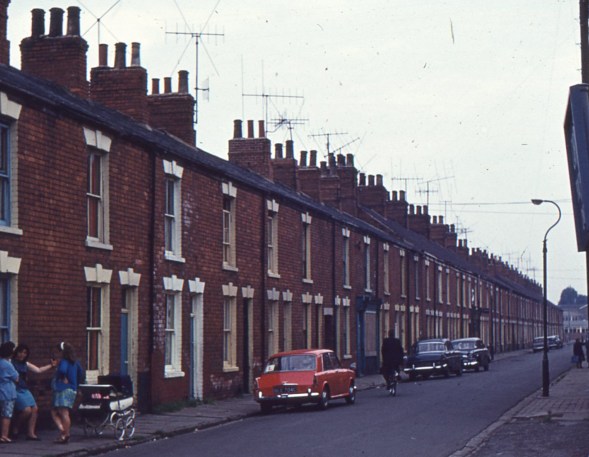
Before demolition

Screen Shot 2022-09-10 at 18.37.47Hope Street in Grimsby was cleared of its terraces in the late 1960s (pictured above, thanks to Hope Street History), but a late 19th century map shows back-to-back houses opening directly onto the street, and every so often there would courtyards, each open area being surrounded on three sides by further dwellings. For those interested in the history of Hope Street, there is a Facebook page that gives access to an excellent pdf document describing the history of the street. That link is here. It is also worth pointing out that house ownership, certainly in 1902, would have been in the hands of landlords. The great majority of people in streets like Hope Street would be tenants.

We must now move on to the events of 18th November 1902. Harry Smith’s trawler docked that morning, and he had spent the best part of the afternoon and early evening in the company of Lucy Lingard. Smith at one point went down to the docks to collect his wages from his latest voyage. He and Lucy Lingard were at each other’s throats, perhaps because she had refused him ‘conjugal rights’, and he had struck her several times, giving her two black eyes. In spite of this, they went out drinking again, but what happened when they returned to Hope Street later that evening was to send a shiver of revulsion through the whole area.

IN PART TWO
A daughter’s testimony
Denial, trial – and the black cap

FROM THE ASHES . . . Between the covers

fta header009 copy

Deborah Masson is back with another gritty police thriller set in her home town of Aberdeen. This time, DI Eve Hunter (previously seen in Out For Blood and Hold Your Tongue) faces the grimmest challenge presented to police officers all over the world – the death of a child. Lucas Fyfe – dead mother, drug addicted father and unfeeling grandmother – has been in care since he was little. When someone deliberately sets fire to Wellwood, a children’s home, he is the one resident who doesn’t make it out. Why? Because the body of the eleven year-old is discovered in the cellar, and the trapdoor which is the only access is concealed under a heavy carpet.

Literally from page one, Masson gives us another perspective – that of the presumed arsonist. We know it’s a ‘he’, and we know that he was a former resident of Wellwood when it was run by the current warden’s father, William Alderton and the sadistic Sally Fields. I find that the backstory narrative trope can be irritating when an author uses too many viewpoints and too many time frames, but here it is used with subtlety and works very well.

Eve Hunter’s team consists of DS Cooper, DS Mearns and DC Ferguson, and the sparky dynamics between them provide an intriguing counterpoint to the investigation. Scott Ferguson is peripherally involved in a road accident on his way to work, but his obsession with the young man who was the main casualty starts to distract him from the Wellwood case. When a further shocking discovery is made in the cellar where Lucas Fyfe died, Ferguson’s lack of attention becomes even more serious. We eventually learn why Ferguson feels compelled to be at the bedside of the young vagrant who was badly injured in the RTA, and it turns the case on its head.

Hunter and her team soon realise that the surviving children and the three adult staff of Wellwood are not telling all that they know. That much is obvious, but penetrating the veil of secrecy proves more difficult. With both of the original owners dead, and local Children’s Services being very protective of the few remaining historic records of the children who were residents, the case seems to go round in circles, until Ferguson’s with Archie, the young RTA victim, finally pays off.

Deborah Masson is a writer who enjoys providing her readers with the unexpected, and the finale of the novel, in the grim basement of Wellwood, is a prime example. Eve Hunter comes over as tough and uncompromising in pursuit of the bad guys, but her family background has left her with a strong streak of compassion, and when Scott Ferguson finally reveals his own secrets – and his link to the Wellwood basement – she is well-equipped to provide emotional support.

This novel is dark, cleverly plotted, full of well-concealed surprises and a master class in how to write a good police-procedural. From The Ashes is published by Transworld/Penguin and is available now.

THE LONG KNIVES . . . Between the covers

LOng Knives header005

Irvine Welsh introduced us to Edinburgh detective Ray Lennox in Crime, but it has taken fourteen years for the second in the series – The Long Knives – to emerge. The title is not a metaphor, as the opening chapter describes the castration of a rather unpleasant Conservative MP in an empty warehouse in Leith.

There is no shortage of people who might have wanted Ritchie Gulliver dead. They range from political opponents, via victims of his predatory sexual habits, to activist groups he has offended. Lennox is given the case, and is immediately alerted to a recent incident in London which sounds similar. Home Office civil servant Christopher Piggott-Wilkins has been attacked in the Savoy Hotel. He managed to escape, badly wounded, and immediately transferred himself to a Harley Street hospital, after which what occurred in his suite has been cleaned up, both literally and metaphorically, by un-named but powerful agencies. Piggott-Wilkins has been left with one testicle, while Gulliver’s complete ‘package’ was discovered, draped from the Sir Walter Scott memorial, by an unsuspecting tourist.

After a lighting trip to London to speak to Mark Hollis, the larger-than-life Met copper investigating the Savoy case, Lennox returns to Edinburgh to face a sea of troubles. His fiancee Trudi not only seems to be ignoring his calls, but may have another love in her life. A former colleague, Jim McVittie, has transitioned to female, but has been found horrifically beaten up and is not expected to survive. Before the assault, Lennox meets one of the more ‘in your face’ transexuals in the local scene:

“What appears to be a brawny young man of around six foot four in a blue dress not so much enters as bulldozes in, a charged storm of bristling rage. He has a big hooked nose, and long flowing brown hair, which seems to have been given the attention of crimping tongs fashionable in the eighties. On his face a long scar bubbles thickly from under a  trowelling of foundation.”

An investigative journalist has tipped Lennox off that the two cases may be linked to a serious sexual assault at a ski resort some years earlier, and that high class prostitutes – and the men who run them – may be involved.

TLK author

Readers familiar with Welsh’s style over the years will recognise his trademarks, including the unpunctuated rapid-fire dialogue, the demi-monde of drugs, violence, sex and alcohol, and the underpinning ground-bass that tells us it’s an us-and-them world. There is even a passing reference to the most infamous of the author’s creations, Francis Begbie.

One of the more memorable characters in the drama is the brilliantly over-the-top Mark Hollis. He is more redolent of the glory days of The Sweeney than the current fashion of dancing the Macarena at Gay Pride marches. Hollis provides valuable information to Lennox, and slowly but surely the Edinburgh cop connects the pieces of the jigsaw. The picture that emerges is a chilling one. The killings are the work of a partnership. The man is linked to an act of random cruelty some years previously in Tehran, while his female partner is, indeed, seeking revenge for her abuse in a ski-lift gondola, but when her identity is revealed, Lennox is beyond shocked.

Welsh brings us horrific violence, but also the dark poetry of compassion. I can only liken Ray Lennox’s desire to avenge the murder victims whose suffering is imprinted on his soul, to Derek Raymond’s nameless Sergeant in books like I Was Dora Suarez. This is a magnificent work of fiction, not just a good crime novel. It is published by Jonathan Cape and will be out on 25th August.

UNDER THE MARSH . . . Between the covers

UTM header

This is the third novel by GR Halliday featuring Inverness copper DI Monica Kennedy, and you can read my review of the previous book, Dark Waters, by clicking on the title link. DI Kennedy’s life revolves around being the best mother she can be for her five year-old daughter Lucy, and solving serious crime for Police Scotland. When those two vocations collide, she is helped out by her willing, but rather reproachful mother.

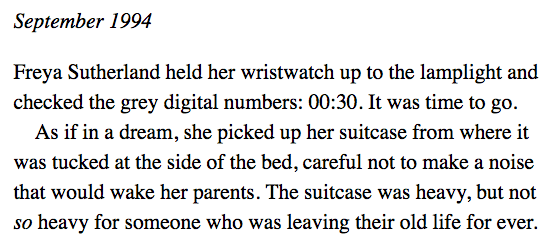
The novel begins with one of those “She’s Leaving Home” moments, but there is a difference. The worst that we know of what became of the girl in the Beatles song is that she went off with a man from the motor trade. What happens here is worse. Much, much worse.

Screen Shot 2022-08-11 at 19.53.18

UTM coverOne of Kennedy’s chief scalps was serial killer Pauline Tosh, who now faces spending the rest of her days in a remote high security jail. Out of the blue, Tosh requests a visit from the officer who ended her murderous career, and what she reveals sets off a search for a body. When it is discovered, and is revealed to be that of the long-since missing Freya Sutherland, what is in effect a massive cold-case-murder hunt is put into place.

I am not the greatest fan of the split time frame mode of storytelling, but Halliday uses it sparingly. Freya’s links with some minor celebrities back in the day provide leads for the investigation, but they are not necessarily fruitful. Along the way, the author has fun painting dark pictures of people who were once ‘something’ in the entertainment business, but whose best days are long behind them, but the questionable ethics and narcissism that brought them fame are as strong as ever. More troubling for Monica Kennedy is that one of the people who crops up in her investigation into what happened decades ago is now a prominent Scottish politician.

Monica Kennedy gets on really well with her professional partner, DC Connor Crawford, but then he goes AWOL at a time when the investigation is floundering. When he does surface, it is to tell Kennedy that he is in la merde profonde. He has become captivated with a Lithuanian stripper who works for one of Scotland’s major villains, who now has compromising footage of Crawford and Emilija. This footage will be revealed to all and sundry unless Crawford agrees to feed him with information. It is not all doom and gloom, however, as Crawford has had a bit of luck via a cassette tape which seems to indict several of Kennedy’s suspects in the search for Freya’s killer.

Screen Shot 2022-08-13 at 19.09.20As with all good crime writers, Halliday (right) leads us up the garden path, and killers (plural) are actually found, but the solution is surprising and beautifully complex. Oh yes, I almost forgot. From his bio, GR Halliday is a lover of cats, so if you share his passion, there are cats in this story. Several of them.
The author brings us a dark and compelling mystery set against the dramatic and occasionally unforgiving landscape of the Scottish Highlands. Monica Kennedy is a fully fleshed out character we can all believe in. Under the Marsh is published by Vintage, and is available now.

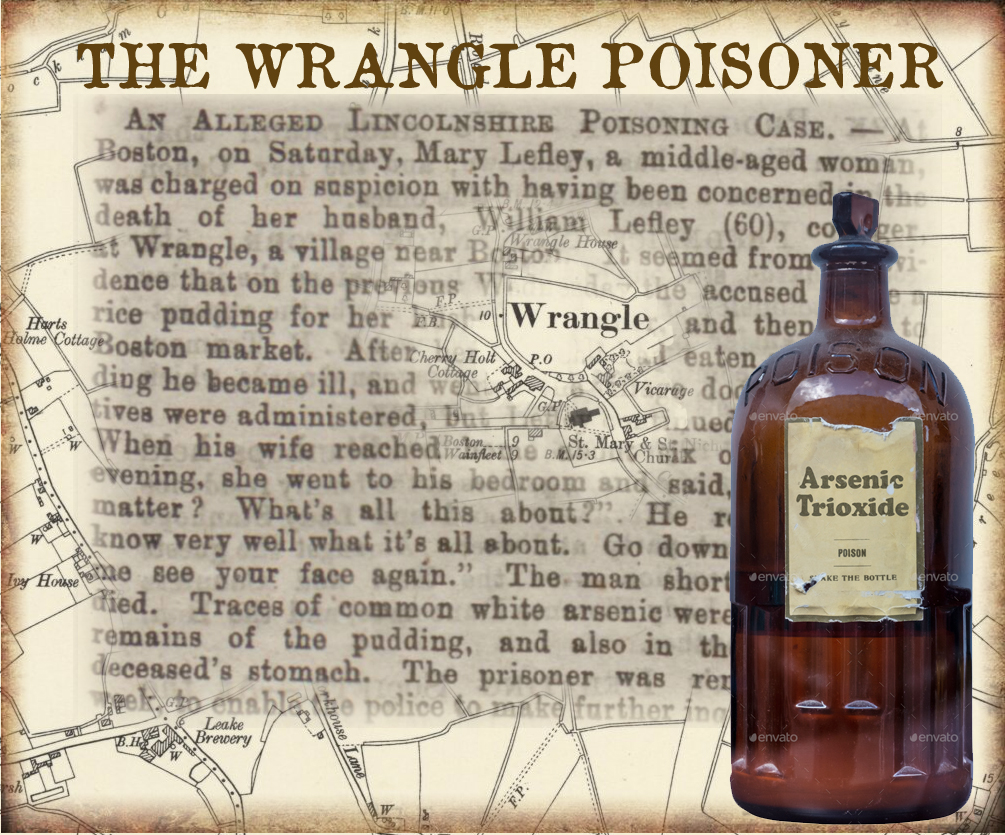
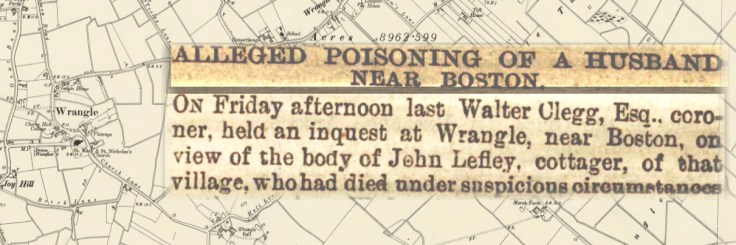
“ENOUGH TO KILL FIFTY PEOPLE” . . . The Wrangle Poisoner, 1884 (2)

Wrangle header

SO FAR: Wrangle Tofts, Lincolnshire, February 1884. 60 year-old Willam Lefley has died in agony, after eating what he claimed was poisoned rice pudding. Forensic investigations have discovered that there was a huge amount of arsenic in the pudding. Lefley’s wife Mary has been arrested on suspicion of causing his death.

FIFTY PEOPLE copy

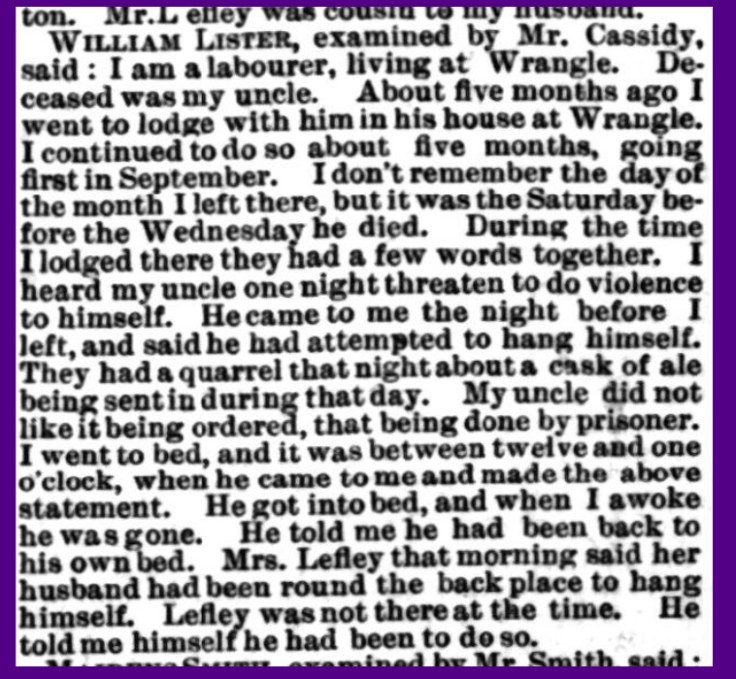
It came to light that Lefley was not in the best of health mentally. There were reports that he had contemplated suicide. Why? We do not know. He was not in any great debt. His marriage was relatively loveless, but many people muddle through that particular situation without seeking to kill themselves. A family member called William Lister later gave evidence under oath:

Suicide

Sir_Ford_North_Vanity_Fair_29_October_1887Based mainly on the question, “Who else could have done it?” Mary Lefley was sent for trial at the Lincoln Assizes. She was to appear before Mr Justice North. Mary’s defence barrister made the point:

“Unfortunately you must know in this county of Lincoln, the possession of arsenic in the country districts is not unusual. Arsenic is used for a of purposes of harmless character; and it Is for that very reason it may get into the possession of persons without exciting suspicions that may render very difficult to trace the particular occasion when arsenic came Into the possession of any individual or any house.”

The main spine of Mary Lefley’s defence had two strands:
(1) Absence of motive. Despite the lack of love between the pair, there was neither a huge sum of money nor commercial prospects coming to Mary Lefley on her husband’s death. There was never any suggestion that there was another man with whom she planned to make a new life after William’s death.
(2) No forensic connection between Mary Lefley and the arsenic overload in the fatal rice pudding.

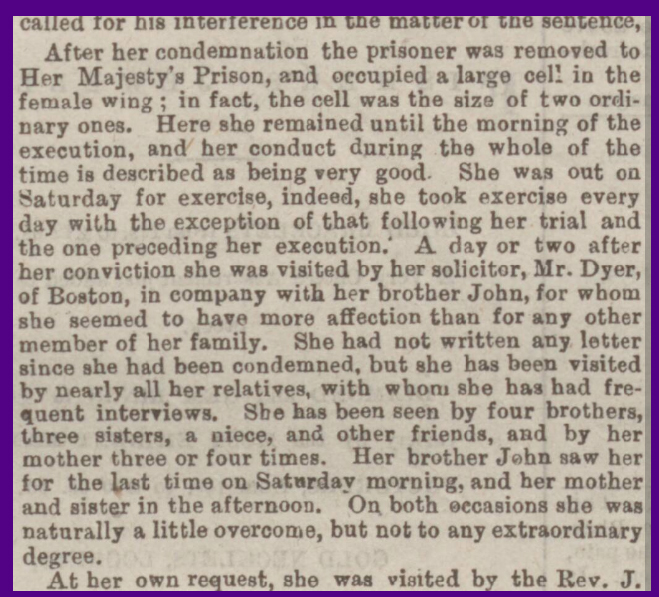
The Lincoln Assizes jury found Mary Lefley guilty of murder, and Mr Justice North (above right) duly donned his black cap and sentenced her to death. She was sent back to Lincoln gaol to await her fate.

Awaiting death

Newspapers at the time loved a good hanging. It gave them the opportunity to sympathise with the condemned prisoner while, at the same time, signaling their virtue (a condition which is still alive and well in 2022) Despite the fact that no reporters were present at the fateful event, one newspaper was able to report:

“A WOMAN HANGED AT LINCOLN. SCENE ON THE SCAFFOLD. Mary Lefley was executed in Lincoln on Monday morning, for having murdered her husband at Wrangle, near Boston, last February, by mixing arsenic with a rice pudding. A small crowd gathered outside the prison to await the hoisting of the black flag. The execution was entirely private, representatives of the press being excluded. Berry, of Bradford, was the executioner. Berry, it appears, carried out all the arrangements in a satisfactory manner, giving the culprit a drop of 9ft. A Wesleyan minister attended her up to the time of execution, when the chaplain of the prison continued his ministrations to the end. The prisoner was in a very despondent condition. She screamed with terror whilst being pinioned, and her lamentations are described as having been heartrending as she was being led to her doom. She had to be assisted on to the scaffold, and on the white cap being placed over her face, and just the bolt was withdrawn, she gave long despairing cry. She asserted her innocence the Wesleyan minister shortly before he left her, and to the last hoped a reprieve would be forthcoming.”

Mary Lefley was presumably interred along with previously executed men and women in the little burial ground which had been established in the Lucy Tower of Lincoln Castle. Was she the victim of a huge injustice? The only other alternatives to her being guilty are (1) That William Lefley committed suicide in a most elaborate and unlikely fashion, presumably to spite his wife and bring about her downfall. (2) That a third party, un-named and with no apparent motive, had put the poison in the rice pudding.

If Mary Lefley was innocent, she would not have been the first woman from the area to be wrongly convicted. In 1868, Stickney woman Priscilla Biggadyke was hanged for poisoning her husband. Her lodger, Thomas Proctor, was also initially charged with murder, but the charge was dropped. Years later, on his deathbed, Proctor confessed that he had administered the fatal dose.

In part one of this story I wrote that Lefley’s marriage was childless. Mick Lake contacted me and kindly gave me the information that there had been four children, James, Sarah, George and John. Sadly, Sarah died in childhood, but the three boys survived and had left home by 1881. There is no mention of them visiting their mother in prison.

This sad case, if nothing else, makes a departure from the mainstream litany of historical Lincolnshire murders, where men killed women. For other murder cases from Lincolnshire, click the image below.


Wolds

“ENOUGH TO KILL FIFTY PEOPLE” . . . The Wrangle Poisoner, 1884 (1)

Wrangle header

Wiki tells us that Wrangle Tofts “is a 0.8–1 km-wide band of raised ground along part of the Lincolnshire coast, running between Wainfleet All Saints and Wrangle parallel to the Wash.” Toft is an old English word for homestead, derived from the Norse topf. The 1881 census tells us that one of the cottages on Wrangle Tofts was occupied by William Lefley and his wife Mary.

1881 census

Mary was from the nearby village of Stickney, but William was born in in East Harling, Norfolk. Not that far away in these days, but far enough in 1884. William was described as a cottager, a person – usually a man – who leased a small plot of land with a cottage on it. The land was usually worked like a family vegetable plot and may have had a pen for a pig or a couple of sheep.

Contemporary accounts suggest that William and Mary shared a rather loveless marriage. There were no children. A modern family history researcher has suggested that Mary, the younger of the two, had another suitor, but there is no evidence for this, and it is pure speculation.

On the afternoon of 6th February 1884, William Lefley went home for lunch. He ate beef and potatoes, and then had some rice pudding. He  became violently ill with sickness and stomach pains. He managed to get himself to the doctor’s surgery in Wrangle, and  Doctor Bubb’s housemaid (Elizabeth Hill) later told the court:
” I remember the deceased coming to my master’s house on the 6th February. He asked for the doctor, and said he wanted him at once, as he had been poisoned by eating rice pudding. He was ill, and went to lay in an outhouse. He fell in the yard, was sick and very cold. After being seen by the Doctor’s assistant, he was taken home by a man named Chapman”.

Doctor Bubb’s sister also testified:

“I saw Lefley at my brother’s surgery. He said he had been poisoned, and was going to die. He vomited, complained of being cold, appeared be in pain, and groaned. He said he had had some pudding at dinner, and was quite well before he ate it, adding, “My wife has done it.” He said he should like to alter his will before he died. He had left everything to his wife, and his anxiety for the doctor was very great. He brought a portion of the pudding with him in the tin.”

Mary Lefley had prepared the rice pudding and left it for her husband to cook through, while she took the carrier’s cart in to Boston. By the time she returned, William Lefley was close to death. The court heard the sequence of events:

“About 6.30 pm. Mrs. Lefley came upstairs, having returned home from Boston market. Mrs. Lefley said, “Now then, what’s the matter?” William Lefley said, “You know what’s the matter; go away from me, I don’t want to see you any more.” Mrs. Lefley made no answer, and went downstairs. Another doctor was called, and he was at Lefley’s bedside when he died, just after 9.00pm”

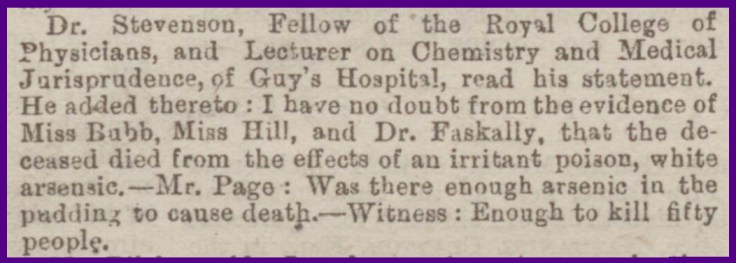
Forensic science has come a long way since the death of William Lefley, but the work of the pathologist, exploring the remains of the human body, searching for answers, was well established in 1884, but not, perhaps in Boston. A macabre parcel was sent south, by rail, to Guys Hospital in London. In the shipment was a large stoneware jar containing the stomach, bowel, spleen, kidneys and liver of the dead man. Dr Thomas Stevenson testified:

“The stomach itself was red and highly inflamed, as if from the administration of irritant poison. The  large mass of the small and large bowel, intensely inflamed so far regards the small bowel, had the appearance commonly observed after the administration of irritant poison. The jar also contained nine fluid ounces of bloody fluid. I found arsenic, which is an irritant poison. There was arsenic in the fluid in the stomach, the stomach itself, in the fluid the bowels, and the liver. These results, to me, say that arsenic had been administered during life, and had been absorbed into the system.”

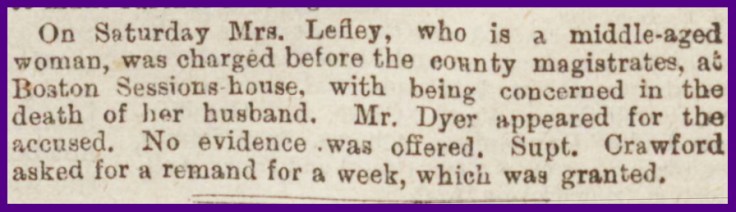
Despite there being no trace of arsenic in the house, the police drew the inevitable conclusion, and acted accordingly.

Arrest

IN PART TWO

Trial and retribution
A mystery

THE WARWICKSHIRE TRIPLE MURDER . . . Violent death visits Baddesley Ensor (2)

Place header

SO FAR: It is Sunday 24th August 1902, and in the colliery village of Badley Ensor, the Chetwynd family live on Watling Street Road. The household consists of widow Eliza Chetwynd (62) her son Joseph (24) daughter Eliza (21) and Eliza’s eleven week old son, who had not yet been named. The baby’s father, George Place (29) also lives there, but there is a tense atmosphere, as Place had just been served with am Affiliation Summons, which made him legally responsible for the upkeep of the child.

The events of that fateful Sunday morning were reported thus in a local newspaper:

HeadlineLate on Saturday evening, after leaving a public-house in Wilnecote, Place told two men that he intended to do for the three of them (meaning the women and the child), and showed the men a six-chambered revolver and a packet of cartridges. He got to his lodgings shortly after midnight, and it was a curious circumstance that at ten minutes past one in the morning Mrs. Chetwynd saw a neighbour, Mrs. Shilton, and told her she was afraid Place was going to do something to them, for he had a revolver and had got a knife to open a packet of cartridges. 

The four rooms of the house were all occupied. The victims slept together in one bed in the room the right on the ground floor; the kitchen on the same floor was occupied by the son of Mrs. Chetwynd, who slept on a sofa ; Place slept in one room on the upper floor; and Jesse Chetwynd, another son of Mrs. Chetwynd, with his wife, who had come from Upper Baddesley for the night, used the other room.

At about a quarter to six in the morning Place came downstairs and entering the room where the women and child were asleep, deliberately shot each of them through the head, the bullets entering the right side of the head. The baby was in its mother’s arms at the time. The older woman must have had her hand up to her head, for two of her fingers had been wounded by the bullet. Jesse Chetwynd rushed downstairs on hearing the reports, and found Place sitting on the doorstep with the revolver in his hand. Place had neither hat nor jacket on. Jesse Chetwynd said to him ” Whatever have you been doing ” but Place made no reply.

The other son, Joseph, said Place had threatened him. and that Jesse’s coming down saved him from being shot. The poor old woman and the child died almost immediately, but the daughter lay unconscious for about four hours, when she succumbed. The old lady was heard to exclaim “Oh !” when Mrs. Jackson, a neighbour, went in. The murderer walked, away quietly from the scene of the tragedy. He took the the public road to Atherstone, and was followed by Samuel Shilton, whom gave up the revolver and 14 cartridges. On the way, Place said to Shilton, ” If you hadn’t come after me I would been comfortable at the bottom of the canal.”

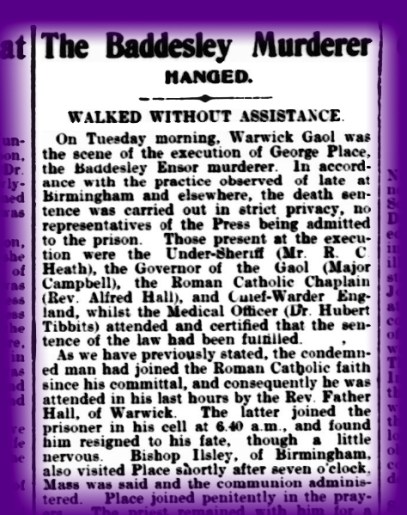
executionThe rest of this grim tale almost tells itself. George Place, apparently unrepentant throughout, was taken through the usual procedure of Coroner’s inquest, Magistrates’ court, and then sent to the Autumn Assizes at Warwick in December. Presiding over the court was Richard Webster, 1st Viscount Alverstone, and the trial was brief. Despite the obligatory plea from Place’s defence team that he was insane when he pulled the trigger three times in that Baddesely Ensor cottage, the jury were having none of it, and the judge donned the black cap, sentencing George Place to death by hanging. The trial was at the beginning of December, the date fixed for the execution was fixed for 13th December, but George Place did not meet his maker until 30th December. It is idle to speculate about quite what kind of Christmas Place spent in his condemned cell, but for some reason, during his incarceration, he had converted to Roman Catholicism. It seems he left this world with more dignity than he had allowed his three victims. The executioner was Henry Pierrepoint.
FOR MORE TRUE CRIME STORIES FROM WARWICKSHIRE, CLICK THE IMAGE BELOW

Bear and B

Blog at WordPress.com.

Up ↑