
Search

fullybooked2017

Tag

Merrily Watkins

THE FABRIC OF SIN . . . A masterpiece

Long before I started Fully Booked, or began my brief career reviewing for Crime Fiction Lover, I was an ardent customer of the local library. I still had the day job then, and so it was always a Saturday afternoon when I visited. There, I discovered wonderful crime writers such as Jonathan Kellerman, Christopher Fowler, Jim Kelly, David Baldacci, Anne Perry, Nick Oldham and, in particular, Phil Rickman. It would have been in 2008 when I borrowed The Fabric of Sin, which had been published a year earlier. It frightened the hell out of me back then and so, eighteen years later, with Phil sadly dead and in his grave, I bought a copy to re-read.

Perhaps I had been too easily impressed. Maybe, like childhood memories, things improve with age. Not so. I have just turned the last page, and I will say that it is the best crime novel I have read this century. Straightforward crime, as Rickman fans will be quick to remind me, is not central to this, or any of his other Merrily Watkins novels. Yes, there is straightforward villainy, and Rickman shrewdly inserted the Hereford copper Frannie Bliss and his investigations into most of the books in order to tick the CriFi box.

The background. Merrily Watkins is a widow with a teenage daughter, Jane. Merrily is the vicar of a Herefordshire village, and she is also the Deliverance Consultant for the diocese. In the past, she would have been known as an exorcist. Through prayer and the use of Christian ritual she calms people – and places – that are spiritually disturbed. I once asked Phil if Merrily believes in the paranormal. His answer was enigmatic. “She believes that other people do“, he replied.

Here, the problem is a building
, an old converted barn in the village of Garway. Garway is a real place, and has a distinctive church which owes its origin to the Knights Templar. The estate of which The Master House is part has been recently bought by none other than The Duchy of Cornwall, the head of which, of course, was. at the time the book was written, the heir to the throne, and a man known for his unconventional views on religion and spirituality. When the builder hired to renovate the house quits because of the atmosphere of evil he feels the house exudes, Merrily is instructed by her boss, the Bishop, to investigate. The builder is later found battered to death on the steps of his mobile home and his girlfriend – perhaps his killer – has lain down on a railway line in front of an oncoming train.

Phil Rickman’s awareness of the warp and weft that underlays both English folklore and paranormal fiction was both deep and broad. It was he who directed me to the books of PM Hubbard, a novelist who specialised in describing how the normal trappings of life can quickly become sinister. Here, he mentions that master of the macabre, MR James, whose memorable description of the being that terrorised poor Professor Parkins in Oh Whistle And I’ll Come To You My Lad, “a face of crumpled linen”, haunts this book. He also quotes the Herefordshire folklorist Ella Leather, who provided Ralph Vaughan Williams with source material for several of his carol settings.

Merrily’s boyfriend is Laurence ‘Lol’ Robinson, a Nick Drake-style acoustic guitarist and songwriter. Through a mutual acquaintance he visits Lord Stourport, aka Jimmy Hayter, a wealthy music entrepreneur and minor aristocrat, who has an interesting tale to tell. In the 1970’s, he and a coterie of drug loving friends leased The Master House for an endless summer of sex, drugs and rock and roll. But it ended badly. One of the residents, a devotee of Aleister Crowley and mysticism, brought something back to the old house that had lain dormant for centuries.


Rickman used several recurring plot lines in the novels. The most regular was the rather wilful Jane putting herself into some harm’s way, either from human agencies – or otherwise. After a few books, one realised that she was always going to survive, but Rickman’s skill was to keep each episode freshly worrying, as here, where she borrows Merrily’s ageing Volvo to drive over to Garway in the company of Mrs Morningwood, a mysterious Garway resident heavily into herbs, potions, reflexology – and the sinister history of The Master House.

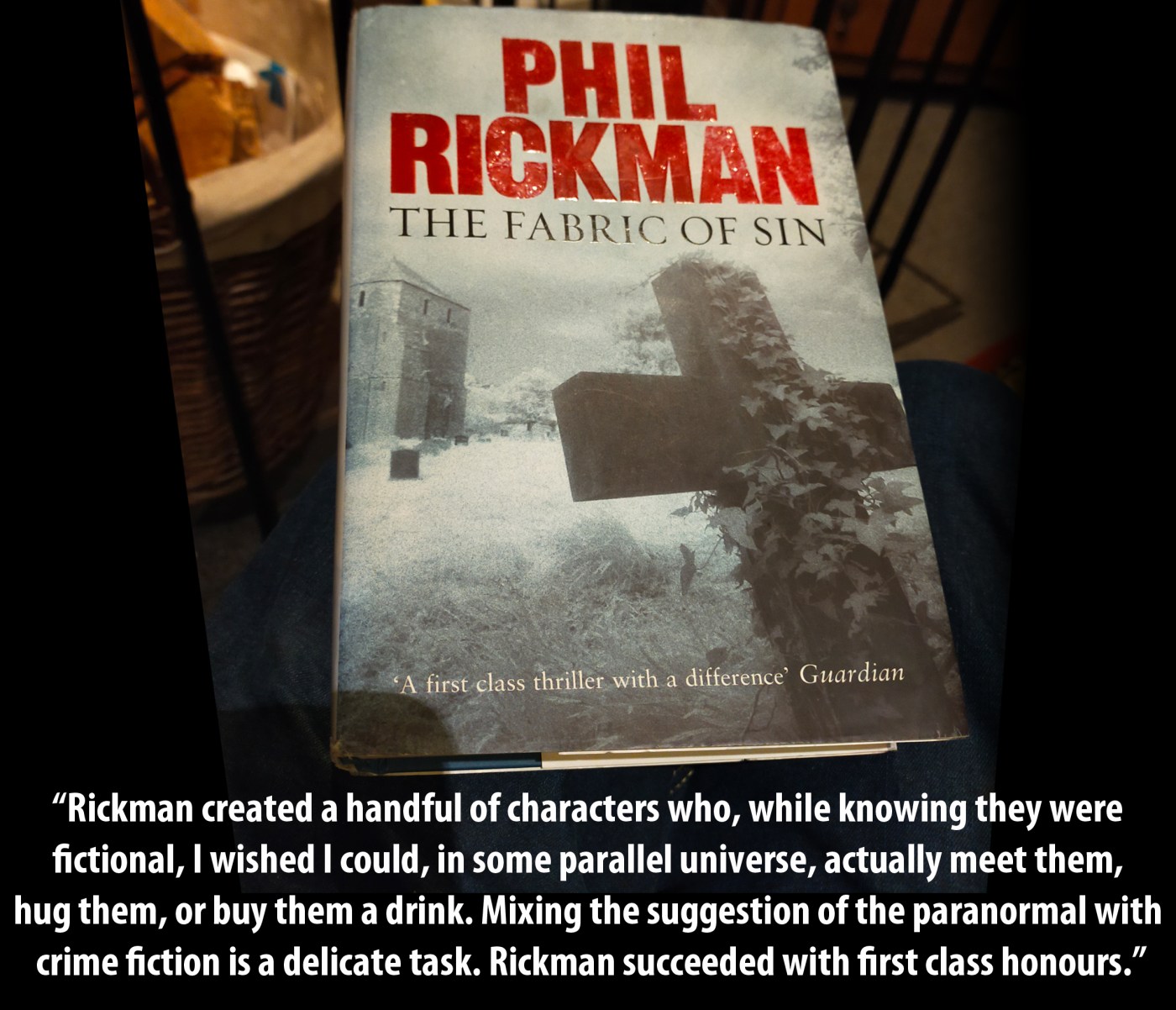
In the end, in a breath-taking final chapter, Merrily unmasks an all-too-human killer. I can only say that Rickman created a handful of characters who, while knowing they were fictional, I wished I could, in some parallel universe, actually meet them, hug them, or buy them a drink. Mixing the suggestion of the paranormal with crime fiction is a delicate task. Rickman succeeded with first class honours, and there was always a rational explanation to events. Except he always allowed room for one extremely potent word. But?

For more on Phil Rickman and his books, click the image below.

THE ECHO OF CROWS . . . Between the covers

The late Phil Rickman’s genius was to blend intriguing crime mysteries with with events that tapped into our sense of unease about the Unexplained, and I use the upper case with good reason. Here, in the final Merrily Watkins novel,a young multi million pound lottery winner is found shot dead in a field beside his Purdy shotgun, but there is more – so much more- going on.

I don’t know if Phil was religious, but he certainly knew so much about religion. Here, veteran exorcist Huw Owen, driven to distraction by the anaemic, lanyard-wearing leadership of the corporate Church of England, is about to throw in the towel, until he is distracted by a former colleague’s description of a frightening experience in the church at Clodock, allegedly built on the tomb of a murdered Dark Ages king, Clydawg. He visits his former mentee, Rev Merrily Watkins, vicar of Leintwardine, and responsible for exorcism in the diocese of Hereford. Naturally, given the state of the church’s corporate image, she is formally titled ‘Deliverance Consultant’

Longstanding readers of the series will know that the churches and chapels of Rickman’s border region are often deeply sinister places with tangible links to a pagan past, for example the celebrated carvings at St Mary and David church in Kilpeck, which featured prominently in All of a Winter’s Night.

The lottery winner – Eddy Davies – had bought a local farm, and had renovated the collection of neglected buildings. In one lived a young woman called Autumn Wise, whose parents had not long since been killed in an horrific car crash. We learn that Autumn is obsessed with the past and, in particular, the part played in folklore by Corvus Carone.

On a more practical and immediate level, when the police arrived at the farm following the discovery of Eddy’s body, Autumn was found in the farmhouse, cradling a shotgun. Autumn’s cottage was known as The Old Dairy, and it was there, centuries earlier that a man poisoned his wife in order to be with his young lover. The killer and his girlfriend were subsequently hanged outside Hereford gaol.

Across the series, which began in 1998 with The Wine of Angels, Merrily has tended not to see spirits or apparitions, but rather senses them, and believes that other people can see them. Here, when she visits The Old Dairy she actually witnesses something which shakes her to the core. The killer of Eddy Davis is eventually unmasked, but with little intervention in this case from spiritual forces. Rather, it is the intuition and hard work of the police in Hereford that close the case.

Phil Rickman died on 29th October 2024, therefore this is valete to what we might call the Merrily Watkins repertory company. There will be no more Gomer Parry, the aged digger driver, who acted like a one-man Greek Chorus throughout the series; no more Frannie Bliss the canny Scouse copper from Hereford; no more of Merrily’s quixotic daughter Jane, and her complex relationship with boyfriend Eiron; and no more Lol Robinson, the tortured singer songwriter and Merrily’s not-so-secret boyfriend. The Echo of Crows is a magnificent end to a much-loved series, and will be published by Corvus on 6th November. If you click the author image on the left, it will link to other reviews and features on the series.

THE FEVER OF THE WORLD . . . Between the covers

TFOTW spine013

It seems like half a lifetime since there was a Merrily Watkins novel – it was All of a Winter’s Night back in 2017 (click the title to read my review) and there has been one hell of a lot of water under the bridge for all of us since then including, sadly, Phil Rickman suffering serious illness. His many fans will join me in hoping that he is on the mend, and at last we have a new book! Old Ledwardine hands won’t need reminding, but for newcomers this graphic may be helpful.

MW CAST CORRECTED2

Now, as another celebrated solver of mysteries once said, “The game’s afoot!” We are in relatively modern times, March 2020, and the Covid Curse has begun to cast its awful spell. The senior Anglican clergy, including the Bishop of Hereford, are relentlessly determined to be woker than woke, and have decided that exorcism – or, to use the other term, deliverance – is the stuff or the middle ages, and clergy are being advised to refer any strange events to the NHS mental health teams. This, of course, puts Merrily Watkins’ ‘night job’ under threat. She and her mentor Huw Owen know that some people experience events which cannot simply be the result of their poor mental health.

The Merrily Watkins novels have a template. This is not to say they are formulaic in a derogatory sense. The template involves a crime – most often a murder or mysterious death. This is investigated by the West Mercia police, usually in the form of Inspector Frannie Bliss. The investigation then reveals what appear to be supernatural or paranormal characteristics, which then secures the involvement of the Rev. Merrily Watkins, vicar of Ledwardine.

Here, a prominent Hereford estate agent and enthusiastic rock climber, Peter Portis, has plummeted to his death from one of the peaks of a Wye Valley rock formation known as The Seven Sisters. A tragic accident? Perhaps. A parallel plot develops. In another parish, the vicar – a former TV actor called Arlo Ripley – has asked Merrily for help. One of his flock has reported seeing the spectre of a young girl and isn’t sure what to do. Enter, stage left, William Wordsworth. Not in person, obviously, but on a visit to the Wye Valley, the poet apparently met a young girl who claimed she could communicate with her dead siblings. The result was his poem We are Seven. That, and Lines Composed a Few Miles above Tintern Abbey are the spine of this novel. Click the titles, and you will see the full texts of the poems. The girl who has entered the life of Maya Madden – a TV producer renting a cottage in the village of Goodrich – seems to be one and the same as Wordsworth’s muse.

Enter, stage right, another Hereford copper, David Vaynor. Nicknamed ‘Darth’ by his boss Frannie Bliss, he is an unusual chap. For starters, he has  a PhD in English literature, and his thesis was based on Wordsworth’s time in Herefordshire. To add to the strangeness, while he was researching his work, he went into what is known as King Arthur’s Cave, a natural cavity in the rock close to where Portis met his end. While he was in there, he has a residual memory of sinking – exhausted – into what was a natural rock chair – and then being visited by a succubus.¹

Yes, yes, – the poor lad was tired, a bit hormonal and having bad dreams. But wait. As Vaynor is doing his job, and interviewing those who knew Portis, he meets his daughter in law, and she reminds him horribly of the woman he ‘met’ on that fateful afternoon in King Arthur’s Cave.

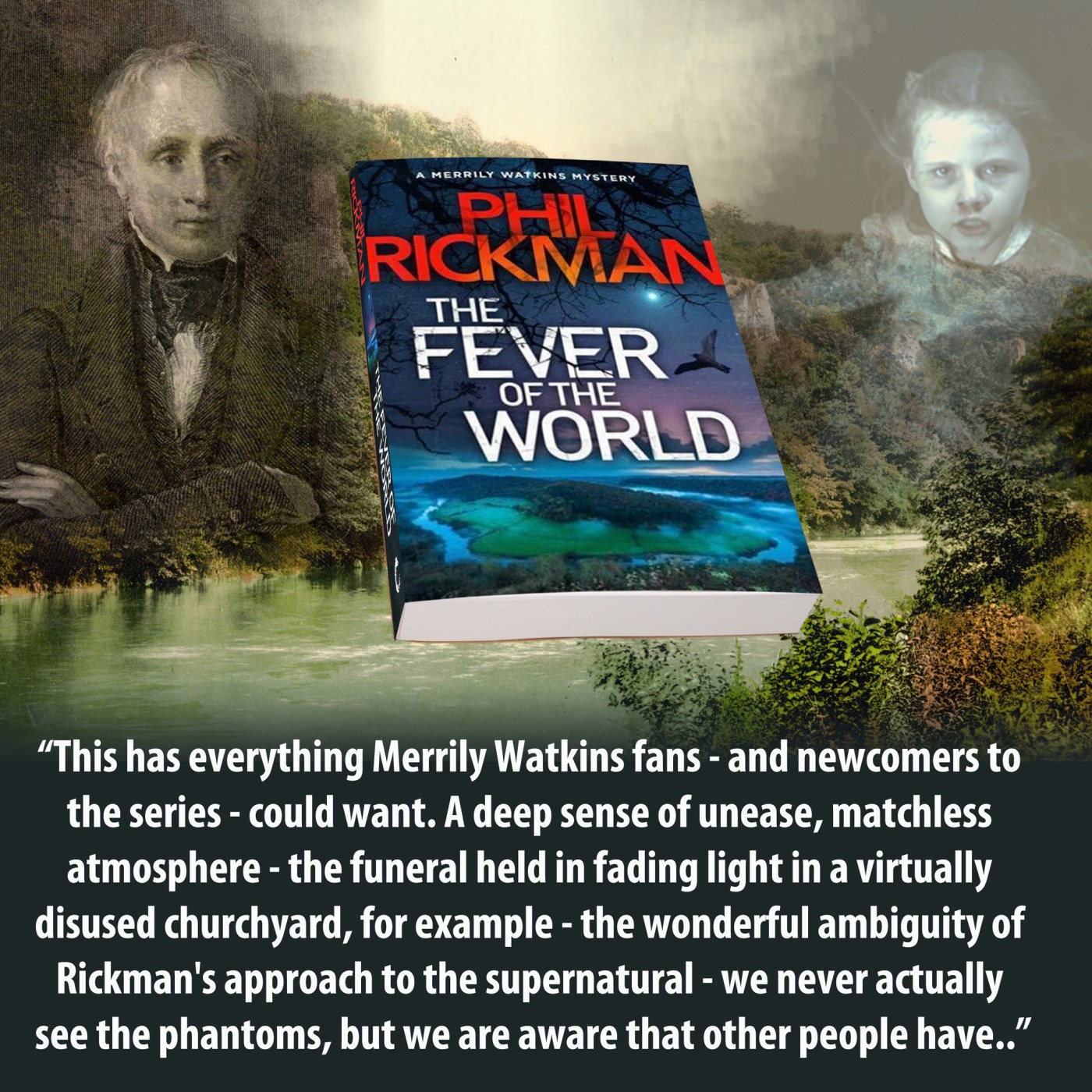
This has everything Merrily Watkins fans – and newcomers to the series – could want. A deep sense of unease, matchless atmosphere – the funeral held in fading light in a virtually disused churchyard, for example – the wonderful ambiguity of Rickman’s approach to the supernatural – we never actually see the phantoms, but we are aware that other people have – the wonderful repertory company of characters who interact so well, and also a deep sense that the past is never far away. There is also a palpable sense of irony that ‘the fever of the world’ is not just a metaphor from a Wordsworth poem, but was actually happening as the coronavirus took hold.

The Fever of the World is published by Corvus/Atlantic books and is out now.

¹A succubus is a demon or supernatural entity in folklore, in female form, that appears in dreams to seduce men, usually through sexual activity.

Blog at WordPress.com.

Up ↑