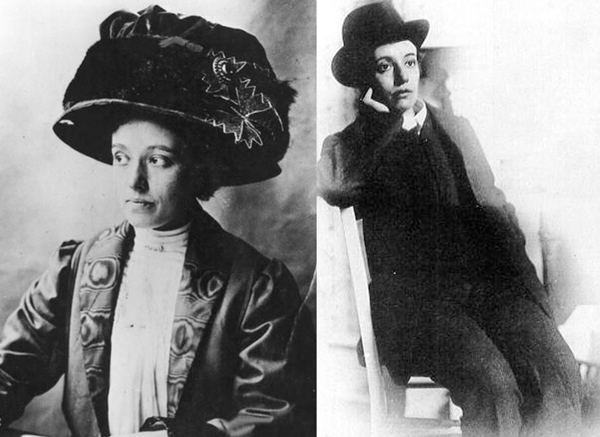
To write anything new or meaningful about the facts surrounding what is probably the world’s most celebrated – and baffling – unsolved murder mystery is virtually impossible. Despite this, it doesn’t stop writers of every stripe trying. Sometimes the results can be worthy. On other occasions, they can be simply embarrassing. One of the poorer efforts cost Patricia Cornwell a good part of her considerable fortune to try to convince the world that Jack The Ripper was none other than Walter Richard Sickert, the celebrated painter. Very few people outside the close circle of the creator of Kay Scarpetta resisted the temptation of a facepalm moment. So, no-one knows the identity of Jack The Ripper, and I imagine Ladbrokes (other bookmakers are available) would give you very long odds against anyone ever discovering his (other genders are available) identity.
Instead of going over old ground, in both a literal and figurative sense, I have taken a look at a trio of novels which, in different ways, have been influenced by the events of that terrible autumn in 1888. For all any of us know, these books may contain every bit as much truth as their factual counterparts.
The Curse Upon Mitre Square, A.D. 1530 – 1888 by John Francis Brewer (1888)
This was little more than a blood and thunder pamphlet. Its main – and perhaps sole – distinction is that it was actually published before the final canonical victim, Mary Jane 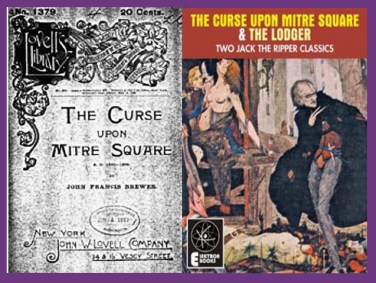 Kelly, met a bloody end in her Millers Court hovel. Of Brewer, we know very little, but his style can best be illustrated with a brief extract.
“With a demon’s fury the monk then threw down the corpse and trod it out of any recognition.
He spat upon the mutilated face and, with his remaining strength, he ripped the body open and cast the entrails round about.”
As the title suggests, Brewer focuses on the murder of Catherine Eddowes in Mitre Square, and his plot, such as it is, contends that the killer is none other that a spectral avenger, a mad monk no less, who haunts Mitre Square, allegedly the site of an ancient monastery. Surprisingly, or perhaps not, given the almost unassuaged thirst for Ripper material both in Britain and across The Atlantic, Brewer’s feverish account is still available in print. Whoever Brewer was, it is unlikely that his estate benefits from sales of the modern reprints. As you will see from the graphic, one later edition of the book was teamed up with another account, slightly more thoughtful, called The Lodger by Marie Belloc-Lowndes (1913)
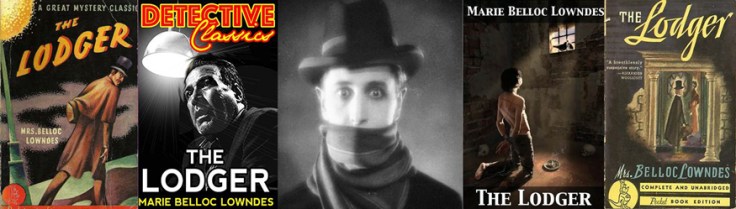
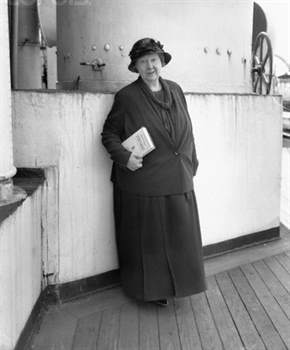 Belloc-Lowndes (right) was the older sister of the prolific writer and poet Hilaire Belloc, but she avoided her brother’s antimodern polemicism, and wrote biographies, plays – and novels which were very highly thought of for their subtlety and psychological insight into crime, although she preferred not to be thought of as a crime fiction writer. In The Lodger, Mr and Mrs Bunting have staked their life savings on buying a house big enough to take in paying guests, but just as their dream is on the verge of crumbling, salvation comes in the form of the mysterious Mr Sleuth, who knocks on the door and takes a room, paying up front with many a gold sovereign. As Mr and Mrs Bunting count their money – and their blessings – London is gripped with terror as a killer nicknamed ‘The Avenger’ stalks the streets searching for blood. The Buntings’ peace of mind evaporates as they suspect that their lodger is none other than The Avenger. Such is the quality of The Lodger that it has been filmed many times, most notably by Alfred Hitchcock in 1927. It would be remiss of me not to quote the famous bloodcurdling imprecation at the end of the book, directed at the hapless landlady.
“Your end will be bitter as wormwood and sharp as a two-edged sword.
Your feet shall go down to death, and your steps take hold on hell.”
 Colin Wilson, who died in 2013, (left) was the kind of man with whom the British establishment, certainly in the 1950s and 60s, was most deeply ill at ease. He was, as much by his own proclamation as that of others, intellectually formidable. He burst on the literary scene in 1957 with The Outsider, a journey through an existential world in the company of, among others, Camus, Nietzsche, Kafka, Sartre, Hermann Hesse and Van Gogh. His novel that concerns us is Ritual In The Dark. Published, after a long gestation, in 1960, it examines how The Ripper legend transposes itself onto the London streets of the late 1950s. It must be remembered that many of the murder sites were still more or less recognisable, at that time, to Ripper afficionados. The tale involves three young men, Gerard Sorme, Oliver Glasp and Austin Nunne. Sorme goes about his life well aware of the significance of past deeds, but also knowing that a present day killer is out and about, emulating the horrors of 1888. Wilson could be said to be one of the pioneers of psychogeography, a linking of past and present much used by modern writers such as Iain Sinclair and Peter Ackroyd. Sorme says,
 “I am lying here in the middle of London, with a population of three million people asleep around me,
and a past that extends back to the time when the Romans built the city on a fever swamp.I can’t explain what I felt. It was a sense of participation in everything. I wanted to live a million times more than anybody has ever lived.”
As it slowly dawns on Sorme that the killer is one of his close associates, he is forced to examine the nature of loyalty, guilt and responsibility. He learns that the deliverer of violent death can, by night, be a mysterious cloaked figure carrying a black bag, but by day can blend into the queue at the Post Office and go home on the number 59 ‘bus with complete impunity.
Other Ripper novels to explore include:
White Chappell, Scarlet Tracings (1987) by Iain Sinclair
The Last Sherlock Holmes Story (1978) by Michael Dibdin
Pentecost Alley (1996) by Anne Perry
A Study in Terror (1966) by Ellory Queen
Mercedes Marie: The story of Mary Jane Kelly (2016) by Fusty Luggs
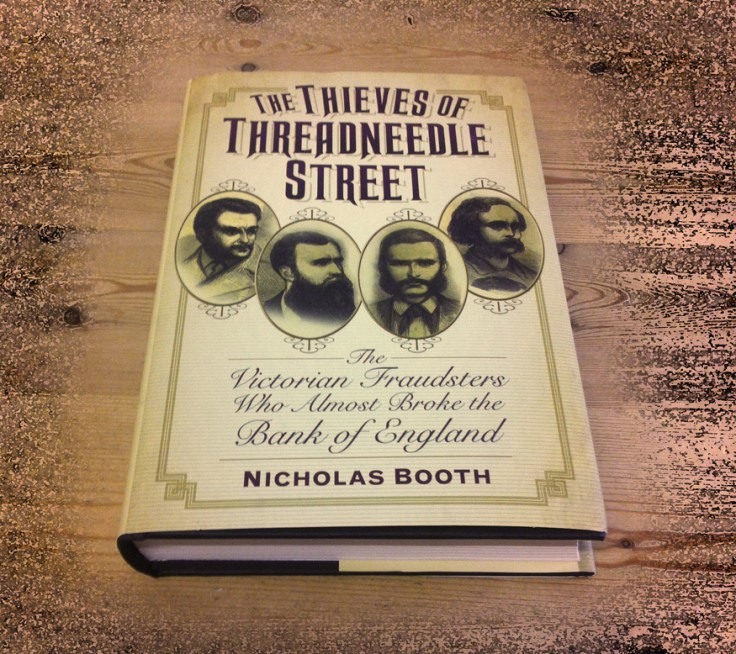
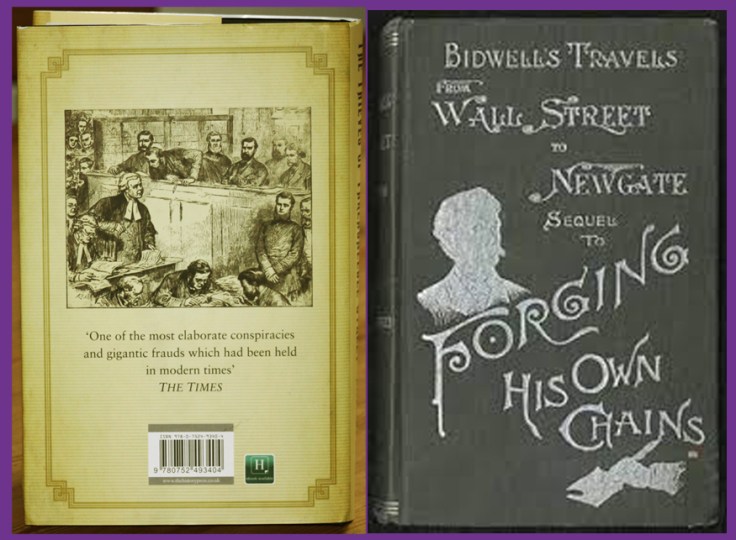
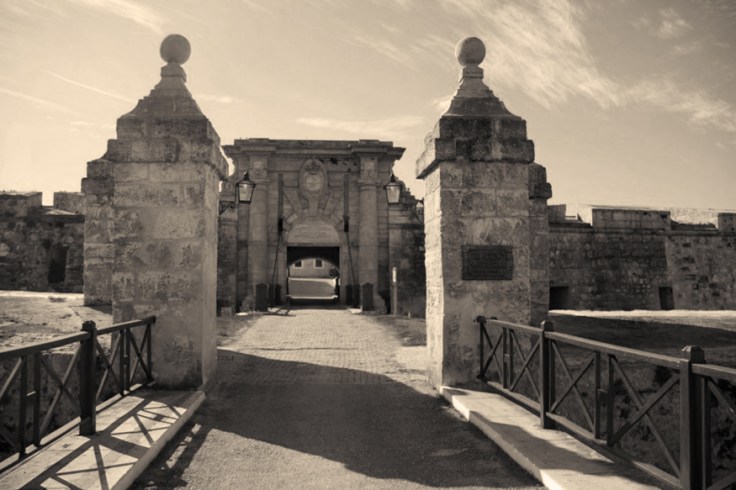
 Stout, florid and perspiring in the heat, William Pinkerton, (left) scion of the famous detective dynasty, had been characteristically indefatigable in tracking down his quarry, travelling from New York to London, and thence to Havana. Glassy eyed, hollow -cheeked and very tired, his prisoner was, in one estimation, “a smooth, easy talker and a person who is likely to inspire confidence with anyone with whom he talked”.
 he was just 27, and along with his eldest brother George (a serial womaniser and ne’er do well) and a couple of accomplices, he had – in Willie Pinkerton’s judgement – carried out the most daring forgery and fraud the world had ever known.
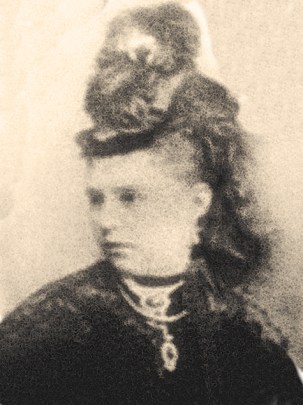 (left) was a beautiful, naive girl of 18 who had fallen for Austin in the summer of 1872. Austin was a professional American criminal who had recently moved his operations to London. Her family were living in genteel poverty near Marble Arch; and though he would have preferred her as his rich man’s plaything, she declined. It was marriage or nothing. Though assuaged by his self-evident wealth, only later did she find out that her honeymoon had been paid for with stolen money. But by then, it was too late to do anything.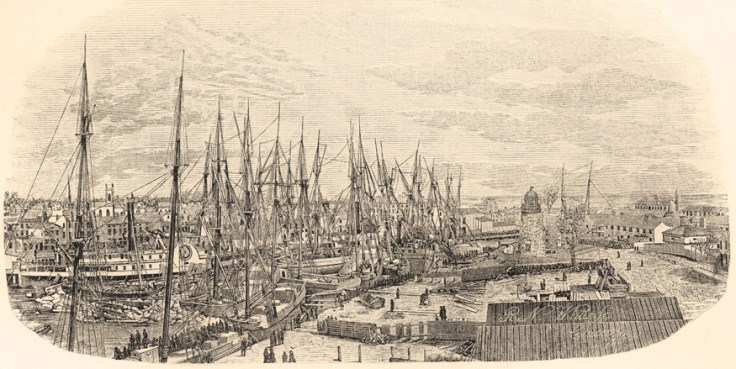
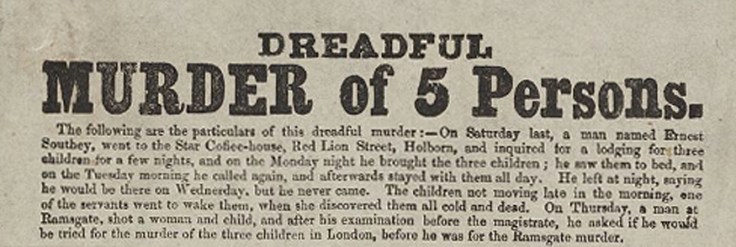
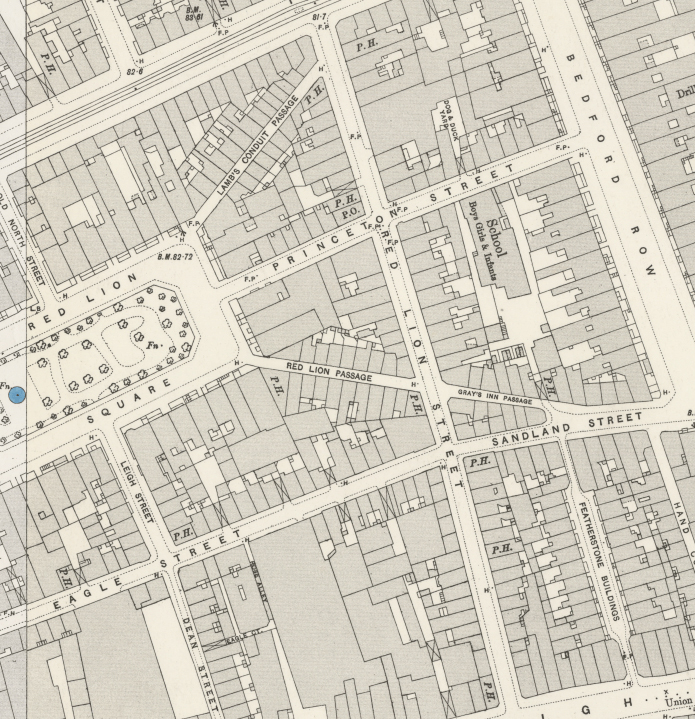
 “On the 9th of August last I was requested by Dr. ROBERTS, of Lamb’s Conduit-street to visit Star’s Hotel, where, as he informed me, three children were supposed to have been murdered, and that in case of so serious a nature he deemed it advisable to have a second opinion. On the third floor, in the front room, No. 6 of the above-named hotel I saw two boys lying on their backs in bed quite dead. The younger of the two, ALEXANDER WHITE, aged eight was near the back, the elder, THOMAS WILLIAM WHITE, aged nine years, toward the front part of the bed. The bodies of both were cold and stiff, and although their countenances wore the placidity of slumber they nevertheless bore the pallor of death. The eyes were half open; the pupils semi-dilated. On turning down the bedclothes both bodies presented a mottled appearance, from the extreme lividity of some parts, the deadly pallor of others. The attitude of the youngest child was that of a comfortable repose. The head slightly inclined to the left side. The hands were folded upon the abdomen. The legs gently crossed. The fingers of the right hand still retained within them a penny-piece, which fell from their stiffened grasp while the body was being turned upon its side, with the view of detecting marks of violence.”
 “In the back bedroom, No. 8, of the same floor lay the dead body of a somewhat emaciated but handsomely featured boy, HENRY WILLIAM WHITE, aged ten years. The attitude and complexion of this child closely resembled that of his brothers. His expression was calm, the eyelids were closed, the pupils were natural, the face was deadly pale. A small quantity of fluid had flowed from the mouth on to the collar of his shirt, and that part of the left cheek in contact with it was mottled red and purple. The legs and toes were slightly bent the hands partially closed, the nails and finger tips intensely livid. A spot of feculent matter soiled the sheet. The rigidity of death was well marked in every l imb, and livid discolorations in all the depending parts of the body. No marks of violence were observable, but a slight odor was perceptible about the mouth. The whole chamber had a peculiar ethereal smell.”
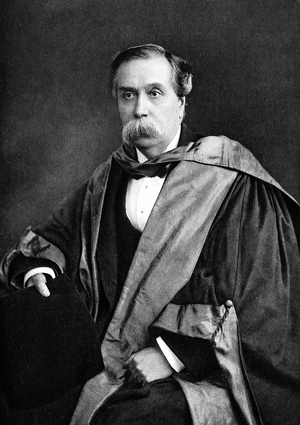
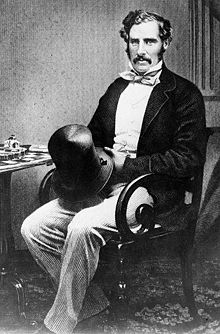 The Home Secretary, Sir George Grey (left), announced a £100 reward for the apprehension of Southey. It was to prove unnecessary. Having poisoned the three boys, the fugitive, who obviously subscribed to the old adage about sheep and lambs, had traveled down to the Kent seaside town of Ramsgate where, it transpired, his real wife and daughter lived. Having met them, and pleaded for their forgiveness for his long absence and neglect, he then shot them both dead with a pistol. He was caught red-handed, and gave himself up without a struggle.
 charged with murder, for criminal murders as well in the truest, strongest sense of the charge. I deny and repudiate the charge, and charge it back on many who have by their gross and criminal neglect brought about this sad and fearful crisis. I charge back the guilt of these crimes on those high dignitaries of the State, the Church, and justice who have turned a deaf ear to my heartbroken appeals, who have refused me fellow help in all my frenzied efforts, my exhausted struggles; who have impiously denied the sacredness of human life, the mutual dependence of man, and the fundamental and sacred principles on which our social system is based. Foremost among these I charge the Hon. D. Lord Palmerston, the Attorney General, Sir George Grey, the Hon. Mr. Gladstone, the Earl of Shaftesbury, Lord Ebury, Lord Townshend, Lord Elcho, Lord Brougham, Sir E. B Lytton, Mr Disraeli, Sir J. Packington, Earl Derby, Lord Stanley, Mr Crossley, and the Bishop of Bath and Wells. I Under all the terrible run of my life I have done for the best.”
 Whether the wretched man was exhibiting an early version of what we would come to know as The Blackadder Defence – wearing underpants on the head and sticking knitting needles up the nostrils, in the hope that he would be considered totally mad – we shall never know. Forward’s lawyer half-heartedly went for a plea of insanity, but his efforts were ignored.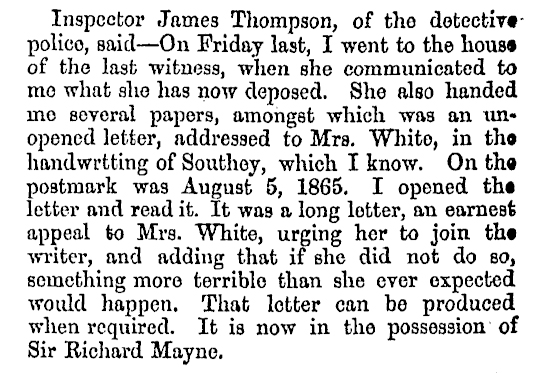

 Arriving at the Gaol just before midday they immediately went to the cell where Forward was held. The executioner was Calcraft who acted as executioner at Stafford and in the “Midland Counties”. The prisoner asked for permission to speak and “exclaimed in an audible voice”, ” I desire to say in the presence of you who are now assembled, and in the presence of Almighty God, into whose immediate presence I am now about to depart, that I die trusting only to the merits of the God-man Jesus Christ”.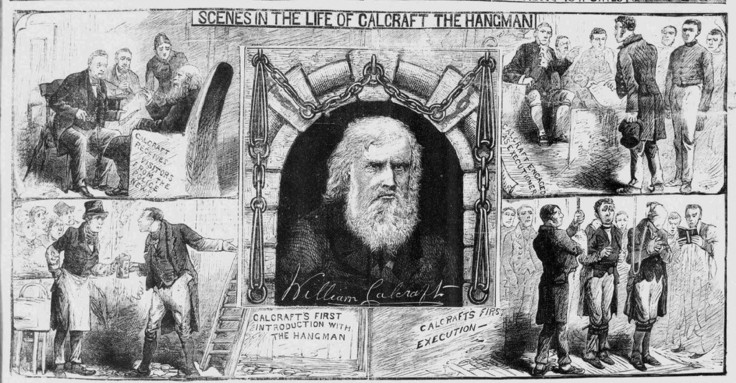

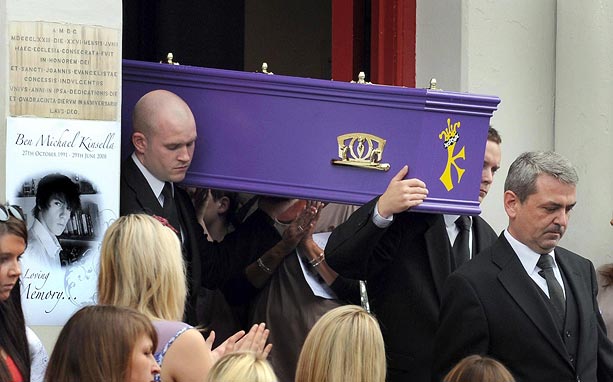
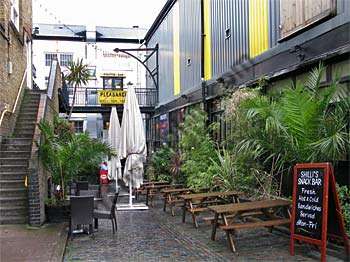 As they say, in America, “School’s Out!” On the evening of Saturday 28th June 2008, school was pretty much out for a group of teenage London boys. Their GCSE exams were finally over and, despite nor being legally old enough to drink, they were having a night out to celebrate. They went to Shillibeers (left), a popular bar and brasserie in Holloway. Among the group was Ben Kinsella, a 16 year-old pupil at Holloway School.



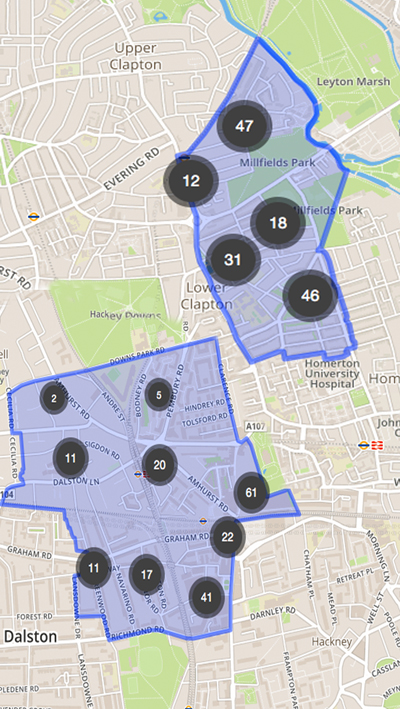 If you are a law-abiding person who stays away from dubious places after dark, and you have a good security system in your home, Hackney is probably a safe place to live. Provided, however, you are prepared to take your chances when out shopping, or otherwise about your lawful business. If you are a writer or artist who likes the kudos of having an address in a place which is seen as rather dangerous, and ‘cutting edge’ (literally) then your aspirations will be fulfilled. If you’re an estate agent who is selling the area as a vibrant, safe and stimulating place to bring up a family, then best of luck with that one.
 Ellis chose her path in adult life based on her natural vivacity and an appreciation that she could earn more from nude modelling and ‘clipping’ punters in a night club than she could by working in the typing pool or in a factory. As a child her home life had been chaotic, so she had developed the necessary survival skills to make her own way in the austere world of post-war Britain.
 Ellis and Blakely became lovers, if not partners, but neither was faithful to the other. Blakely was physically violent; Ellis was violently jealous. On 10th April, 1955 – Easter Sunday – Ellis waylaid Blakely as he left a Hampstead pub, the Magdala. She shot him dead with a .38 Smith and Wesson revolver. Despite the day, there was to be no resurrection.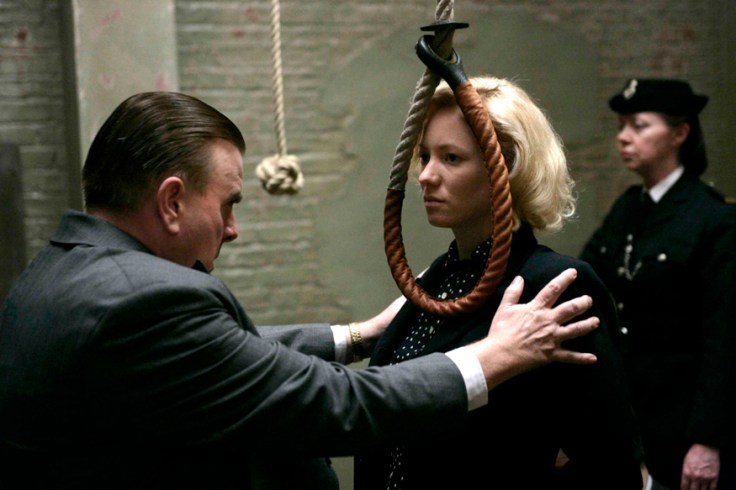
 Hawley Harvey Crippen was never a doctor, in the accepted sense. He was at best, a purveyor of quack medicines and homepathic cures to the gullible. He may even have been a backstreet abortionist, but that has never been proved. He was born in Michigan in 1862, but emigrated to England in 1897 with his second wife Cora. Cora was a second rate music hall entertainer and Crippen, tired of her charms, took up with a young typist named Ethel Le Neve.
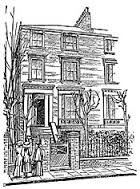 Crippen eventually raised the alarm, as she suspected foul play. The house was searched, and nothing was found. Crippen and Le Neve, however, were spooked, and fled to the continent, where they bought a passage on a steamer bound for Canada.