

Mark Billingham is certainly a man of many parts. To name a few, there is Gary, the dim-but-lovable stooge to the Sheriff of Nottingham in Maid Marian and her Merry Men, stand up comedian and scriptwriter, acoustic guitarist with Fun Lovin’ Crime Writers and, of course, best selling crime novelist. But author of historical fiction? Well yes, in a manner of speaking. In his afterword to his latest novel Cry Baby, Billingham says that in writing this prequel to the Tom Thorne series he had to imagine a world of clunky computers the size of refrigerators, telephone boxes and ‘phone cards, and pubs where people smoked.
We are, as ever in London, but it is the summer of 1996. The city and the country – at least many of the menfolk thereof – are transfixed with the European Cup. Crosses of St George flutter from the aerials of Mondeos up and down the land and pubs are rammed with supporters of Shearer, Sheringham, Southgate and company. Detective Sergeant Tom Thorne is trying to schedule his work around the matches, but when a boy is abducted from a London park, football has to take a back seat.
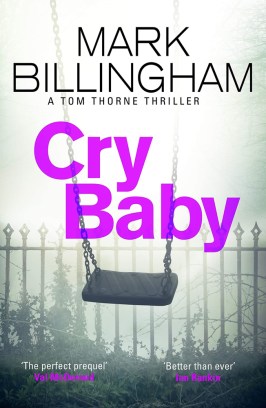 Kieron Coyne is playing with his mate Josh under the watchful eyes of their mothers, Cat and Maria. Cat goes off for a pee, Maria settles back on the park bench and lights a fag. One minute Kieron is there, the next he has disappeared. Josh emerges from the little wood where the boys were playing hide and seek. He neither saw nor heard anything of his friend.
A major police investigation kicks in, with Thorne doing the leg work at the best of his incompetent boss. We learn that Cat and Maria are both single mothers – had ‘lone parents’ been invented in 1996? – but in different circumstances. Kieron’s father is doing a long spell in a maximum security prison, while Maria’s doctor husband divorced her a couple of years back.
Hours turn into days and there is no sign of Kieron, dead or alive. A birdwatcher thinks he saw a boy getting into a car with a man he obviously knew, and a Crimewatch presentation by the late lamented Jill Dando turns up nothing more useful than imagined sightings the length and breadth of the country, and the usual false confessions from the mentally ill.
Thorne does find a suspect – a neighbour of Cat’s with a suspicion of ‘form’ for dodgy sexual activity – but the arrest of Grantleigh Figgis does not go well for either the police of the suspect.
Billingham manages the historical details very well, and we meet one or two regular characters from the Thorne series for the first time, none more dramatically than Phil Hendricks, the much-tattooed and oft-pierced pathologist. In a rare droll moment in a seriously dark book, Billingham has gentle fun with making Thorne’s gaydar so wonky that he has our man making enquiries as to why Hendricks hasn’t found the right woman to settle down with. We also meet Thorne’s soon-to-be-ex wife Jan, and fellow copper Russell Brigstocke who, as lovers of the series know, manages subsequently to keep his CV much cleaner than Thorne.
Fans of Billingham’s novels, both the Tom Thorne series and the stand-alones, know that he likes nothing better than a dramatic twist in the final few pages, and he doesn’t let us down here. There is something of a ‘where the **** did that come from’ moment when all the patient door-knocking, statement-taking and deduction of the coppers is spun on its head in a few dazzling pages of revelation. Cry Baby is published by Little, Brown and is out now.



 nora Andresson is a distinguished English actress. Perhaps slightly past her youthful allure, she remains a beauty who can pick and choose her projects, and her films are highly thought of. She has three problems clouding her horizon. The first is, as they say, a bastard. She has a brain tumour. It has been treated but she is only too aware that she may have won a battle, but not the war. Problems two and three are related – literally. She is separated from her Swedish husband, but they have a son – a young man called Malo – who is something of a wrong ‘un. The third problem relates to the words “they have a son”. Fact is, she does – her husband doesn’t. Malo’s father is actually a millionaire businessman named Hayden Prentice, and Malo was conceived during a drunken one-nighter just before Enora’s wedding. So why is Harold a problem? Although he is now an honest man, with legitimate investments and business interests, he made his initial fortune as a drug baron.
 he main plot of Sight Unseen hinges around the kidnapping of Malo’s Colombian girlfriend Clemmie. When a ransom demand of a million dollars is received her father, who, like many rich men from that benighted republic, has kidnap insurance, simply hands the case over to the experts. H, however, has other ideas, and decides to do things his way.
 Hayden Prentice is a brilliant creation and is, in many ways, at the centre of the book, as he was when we first met Enora in





 Alex Cross is in trouble. Big trouble. He is the victim of a beyond-the-grave revenge attack from his very first opponent, Gary Soneji. Gary is long dead, blown up by his own bomb in a subway. It is not beyond Patterson’s audacity to resurrect someone, but in this case it is supporters of the late Mr Soneji who are responsible for Cross being accused of homicide. He is lured to a warehouse where members of the Soneji cult are waiting for him. In the fire fight that follows, members of the cult are killed and wounded, but when Cross summonses emergency backup, no weapons other than Cross’s own can be found. The words happy, trigger and cop are immediately rearranged into a well-known phrase or saying by the sensation-hungry media.
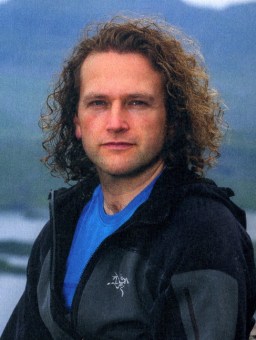
 Hand on heart, I have to admit to really enjoying this book. Patterson (right) hasn’t achieved his world-wide pre-eminence as a best selling writer by not being able to tell a story. The action comes thick and fast and in this book at least, the portrayal of Cross disproves the old adage about familiarity breeding contempt. Yes, Nana Mama is still there, serving up delicious meals for all and sundry and being annoyingly stoical in the face of her grandson’s adversity. Yes, Cross’s annoyingly geeky nine year-old son spots something that a top FBI data analyst has missed, but at least our man’s current love interest seems to be a good sort.
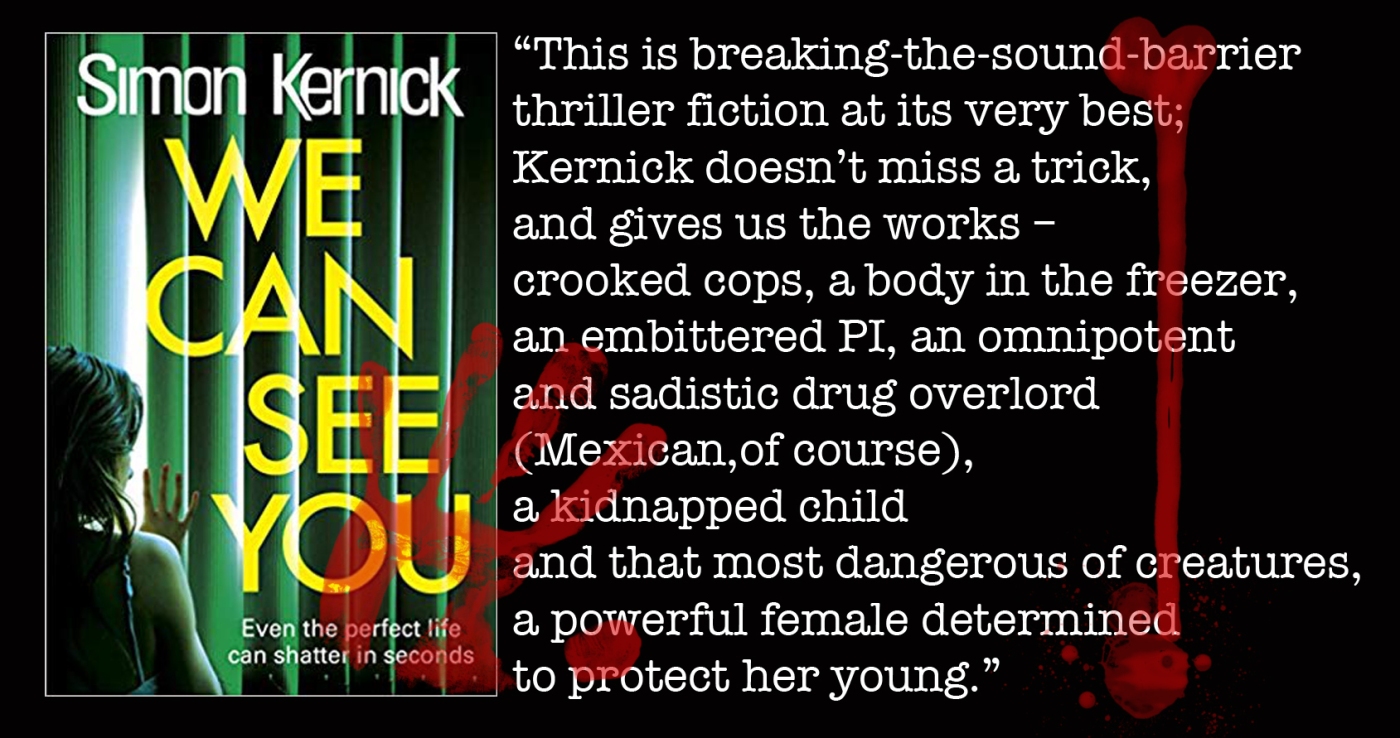
 If there is a league table which ranks ‘Every Parent’s Worst Nightmare’ events in terms of trauma, torment and terror, having a child kidnapped must come near the top. It could be argued that death is at least final and offers – however bleak a prospect that may be – a sense of closure and a chance for the living to rebuild their lives. But kidnap? Uh-uh; cue uncertainty, recrimination, the anxious waiting for that ‘phone call, the wondering, the sheer agony of not knowing. That is the fate of Tony and Yvonne Richards in the latest novel from Rachel Amphlett (left) when they return to their Kent home from a trip to Milan to find that their daughter Melanie has been taken. Neither Tony nor Yvonne is cut out to be Bryan Mills /Liam Neeson, and so they scrape together the ransom, make the drop, and frantically drive to the derelict industrial estate where Melanie, they hope, will be waiting for them. What they actually find delivers a killer blow – literally.
 Hunter tugs away at the few available frayed threads of the investigation until she has enough twine to weave a recognisable tapestry that shows a victim and those culpable for the crime. Larch does his best to belittle her efforts, but she has a strong supporter in her immediate boss, DI Devon Sharp. There is a very clever twist in the final third of the story when it becomes apparent that the latest kidnap victim is the estranged daughter of a member of the investigating team. It has become commonplace for fictional coppers to have chaotic personal lives, but there is a feelgood corner of this novel where the reader can take comfort in the warm relationship between Kay Hunter and her veterinarian husband, Adam.
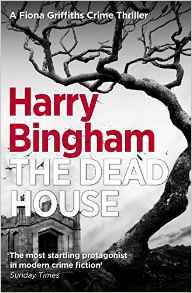 Newly promoted Detective Sergeant Fiona Griffiths, of South Wales Police, might be said to have a disability. She suffers from…..no, wait, we mustn’t use the word ‘suffers’, in case of causing offence. ‘Has’, maybe? OK, DS Griffiths has Cotard’s Syndrome. This strange condition can manifest itself in many ways, the most extreme of which convinces the person concerned that they are actually dead. Less extreme symptoms include partial disconnection between brain and body, and some of the traits of Asperger’s Syndrome, such as an inability to read or understand social gestures or convention.


 fullybooked2017