Search

fullybooked2017

Tag

Insanity

THE STEN GUN KILLER . . . A brutal murder in 1949 Leamington (1)

Towle header

SwadlingSwadling Street in Leamington is an unassuming thoroughfare, with houses which were built on the old Shrubland Estate between the wars. It was named after a Leamington councillor of the 1920s, and in 1931 it boasted twenty addresses. In January 1949, number 6 was occupied by Edward Sullivan. A 49 year-old Irishman and father of six children – three sons and three daughters – he worked as a builder’s labourer. Known to his mates – inevitably – as Paddy – he was working on a council house building project on Westlea Road, which was another between-wars development on what had been the Shrubland Estate.

Just a couple of hundred yards away was Bury Road – again, named after a local civic dignitary – and number 120 was the home of Gordon Towle. He was 19 years old, and lived with his wife Lilian, who he had married just three months earlier. He worked on the same building site as Edward Sullivan. Towle was a Leamington lad, and had earlier applied to join the army, but had been rejected on medical grounds. At the age of 10, he had damaged his head in an accident, and went to hospital to have the wound dressed, but was sent home again during what he remembered as “the bad raids”. There were three air raids on Leamington on 1940. The first, in August, resulted in no casualties, but as a result of subsequent raids in October and November, 7 people were killed. It seems that Towle’s mother had a history of mental illness, and had been taken in care, which resulted in Towle and his two brothers being sent to live with family friends in Rugby.

It’s worth, at this point, to digress slightly and look at what Leamington was like in 1949. The great diaspora of families from the teeming terraces south of High Street up to the new builds in Lillington had yet to happen. Names of WW2 casualties had been added to the town war memorial but, thankfully, not in the number that the stonemasons had been tasked with in 1919. The damage caused by the Luftwaffe bombs in an effort to target Lockheed and Flavels factories had been cleared away and, despite the huge swing away from the Conservative party in the 1945 general election, Leamington still had faith in its pre-war MP, Anthony Eden. I was just 18 months old in 1949, so my memories are totally unreliable but I can tell you that our house in Victoria Street still had gas lighting, a pump in the scullery, and a large ‘copper’ in which water was heated for the weekly bath.

So, back to Edward Sullivan and Gordon Towle. The two men had clearly rubbed each other up the wrong way. Sullivan had mocked Towle for his lack of military service. We know that Sullivan had a son in the British army, and he himself had been a regular soldier with the Royal Army Service Corps during The Great War. He stayed in the army after the Armistice and did a further four years service out in India, returning in 1923. People tend to forget that men from what was to become the Republic of Ireland played a gallant part in The Great War. There were also some who fought for the British in WW2, and they were treated in a shocking manner by the Irish state after the war.

Whatever the reasons for the animosity between Sullivan and Towle, things were about to come to a dramatic and bloody head. Heaven only knows how or why, but Gordon Towle had, secreted in his bedroom a Sten gun and hundred rounds of ammunition. Most lads growing up in the 1950s with access to Commando comics and other bloodthirsty stuff, will have an instant image of what a Sten gun looks like. It was a brutally simple piece of engineering – a sub machine gun designed for destruction rather than accuracy. A full magazine contained 32 rounds of 9mm bullets, and at short range it was a devastating weapon. In part two, we will discover how and why Gordon Towle had a Sten gun in his possession and – more importantly – what he did with it.

Sten Gun

PART TWO will go live on Thursday 1st April
THE ST MICHAEL’S ROAD MURDER . . . The madness of a daughter (part 2)

Gladys header

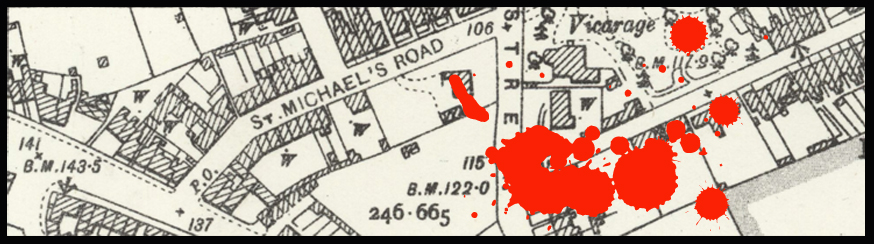
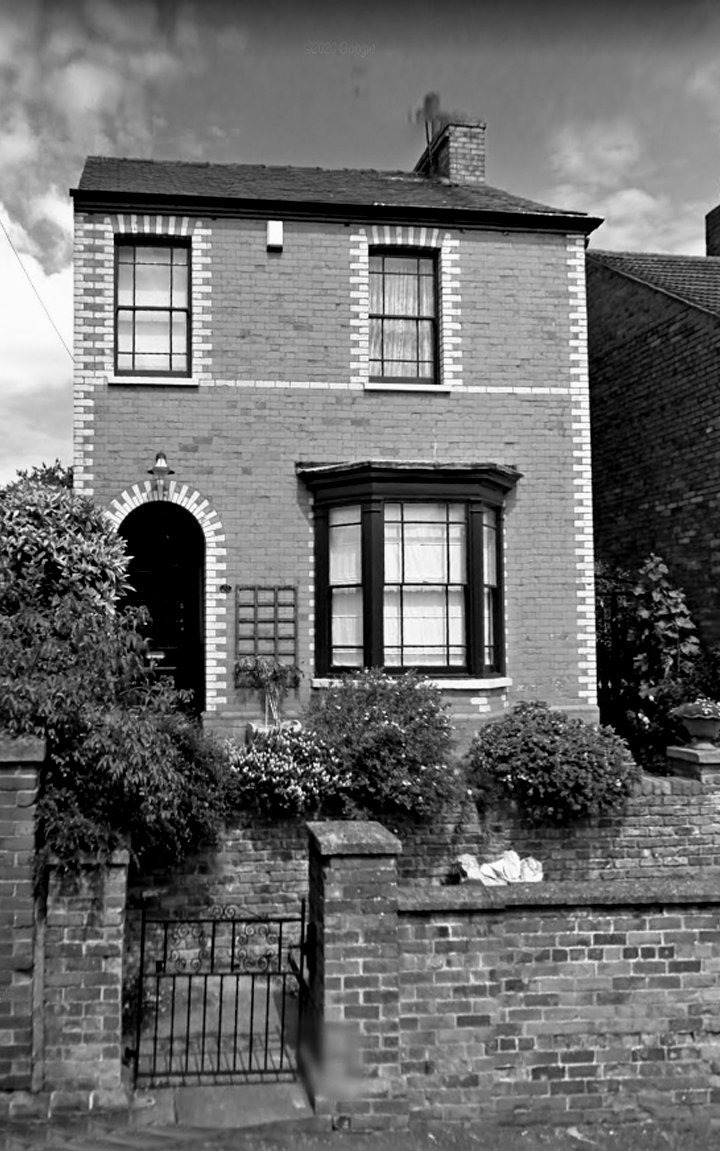
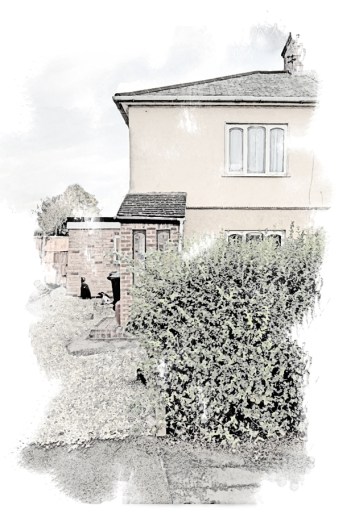
Louth. February 1950. Gladys Hirschberg is living with her mother Alice Wright at 32 St Michael’s Road (below). 55 year-old Gladys has had an eventful life. She married a soldier, Victor King, in 1916, was widowed the next year, and then went to Rhodesia with a new husband, and took his name, von Hirschberg. Gladys returned to England at the beginning of World War Two and served with the ATS. After a brief return to Rhodesia, she came back to Louth in 1946.

32 St Michaels

On the morning of Sunday 19th February, Mrs Lena Gibson who was a neighbour of Gladys and her mother answered a frantic knocking on her door to find Gladys, shaking and white faced. Gladys said to Lena:
You had better come and see. I have killed my mother. I hit her on the head with a hammer.”
Entering No.32, Lena was horrified to see Alice Wright unconscious on the sofa, with a dreadful head wound.

Todd

An ambulance was summoned and the police came and took Gladys into custody, She was formally charged with attempting to kill her mother. The senior officer who read the charge was none other than Superintendent George Todd (above), Gladys Hirschberg’s co-star in the Louth Playgoer’s production of The Winslow Boy in April the previous year.

Alice Wright never recovered consciousness and died two days later, so when Gladys Hirschberg appeared at Louth Magistrates Court on 21st February, the charge was murder. After another hearing on 11th March, Gladys was committed for trial at Lincoln Assizes in June.

It seems that Gladys was in such a bad way
that she was sent to Winson Green prison in Birmingham, because it had a secure mental unit, and it was from there that she came to trial at Lincoln on Tuesday 6th June. The presiding judge was George Lynskey.

This is the newspaper report of proceedings:

In court she wore a black coat and a grey jumper. She looked pale but seemed composed. She pleaded not guilty in a clear voice. While the Jury was sworn in she stood with bowed head and downcast eyes between two women prison officers. The courtroom was crowded, the majority there being women.

Hirschberg was defended by Mr. R. C. Vaughan. K.C.. and Mr. W. K Carter. Mr S.L.Elborne, prosecuting, said that Hirschberg had been living in Rodesia and had returned to England to look after her mother. Later, after living at home and then working in London, she had an offer of another job in Rhodesia, and her mother was going with her. The home and furniture were to be sold. Mrs Wright was over 80, and apparently the accused thought she was doing right by moving her to Rhodesia.

Hirschberg then became more troubled about the situation, and February 19th she told a neighbour that she had hit her mother on the head with a hammer and had killed her. Mrs Wright was found with severe head injuries and died later in hospital.

The neighbour, Lena Marjorie Gibson said Hirschberg had worried about taking her mother to Rhodesia and felt she was taking away her security by selling the house. Hirschberg had been widowed in the first war, married a Belgian and had said this marriage was unhappy. She had sought refuge in Army work during the war and became a junior commander in the ATS.

Mrs. Gibson described how Hirschberg became more worried, had financial worries when her husband stopped her allowance, and felt she was a failure and her life futile.

She had fits of depression and on one occasion was seen crouching in an animal attitude with staring eyes and twitching face.

“I was afraid she was no longer sane.” said Mrs. Gibson. She had also said herself she felt her mind was going. In statements to the police Hirschberg was alleged to have said that her mental state made her want to escape from her responsibilities. She tried to gas herself, and then decided it would be best if they both “went out” because some aspects of her life had been a failure.


“Quite suddenly a cloud came over me and 1 felt I must end it all for both,” Something in her brain told her she must do it but only part of her knew what she was doing with the hammer. She had hit herself on the head with the hammer. The last few weeks had been a terrible effort as if her hands and brain had not co-operated without terrific effort.

Clipping

Called for the defence, Dr J Humphreys of Birmingham prison said Hirschberg considered herself a failure in her job in London and had a feeling of guilt that her friends were having to do things for her mother which she felt she should have been doing. She was suffering from an acute sense of chronic depression which was a mental disease. While in prison,said the doctor, Hirschberg swallowed five needles because she said she wanted to suffer physical pain instead of the anguish she was feeling.

She had told him she was an outcast and dare not approach God in prayer – which was born out by the fact that she refused to go to the prison chapel or see the chaplain.

When she committed the act she would not know that what she was doing was wrong. Evidence that she was suffering from a mental disease was also given by Dr. M. Sim, a psychiatrist at a Birmingham hospital.


The prosecution didn’t challenge the assertion that Gladys Hirschberg did murder her mother whie insane, and she was sentenced to be detained “at Her Majesty’s Pleasure.”

There is a poignant postscript to this sad tale. A few years later, Messrs Falkner & Co, Solicitors, of 17 Cornmarket, Louth acted for Gladys Hirschberg as she applied to change her surname to King. This was of, course, in remembrance of Victor Algernon Robert King, her young husband who had perished in Flanders thirty seven years earlier. In this legal claim, her address was given as Crowthorne, Berkshire, which is home to the secure mental hospital known as Broadmoor.

Screen Shot 2021-02-17 at 14.45.50


THE ST MICHAEL’S ROAD MURDER . . . The madness of a daughter (part 1)

Gladys header

Gladys Wright was born in Louth in 1894. Her father, Edward Wright was a schoolmaster, and the census of 1911 has the family living at Egmont – No. 4 South Street, Louth. Edward Wright went on to become Headmaster of St Michael’s School, where his wife Alice also taught.

Wright census
In December1916, Gladys married a young man named Victor King, in Richmond, Surrey. Their marriage was to be short lived, however. Victor was Second Lieutenant in The Machine Gun Corps, and on 29th September, he was killed during the Third Battle of Ypres, better known perhaps as the Battle of Paschendaele. His name is one of 34,000 others inscribed on the Tyne Cot Memorial to the Missing, which indicates that if he was given a battlefield burial, his grave was later lost. A grimmer option is that his body was simply destroyed by shellfire.

Like so many other young widows, Gladys had the rest of her life to live, and at some point between the end of the Great War and the beginning of World War Two, she met and married a man called von Hirschberg. It seems that they tried to begin a new life in what was then Rhodesia, where the von Hirschberg family had lived for decades. Whatever happened to the marriage was never recorded publicly, but by World War Two, Gladys was back in England and serving in the Auxiliary Territorial Service – the ATS – a volunteer unit for women. After the war, the ATS became the WRAC, but Gladys chose not to continue with service life and, after another brief spell in Rhodesia, returned to Louth to live with her widowed mother Alice in her house in St Michael’s Road.

Gladys, now in her 50s, was a keen amateur actress and a member of the Louth Playgoers group. The only surviving photograph of her dates from 1949, when she played the role of Mrs Winslow in Terence Rattigan’s 1946 play, The Winslow Boy. One of the strange ironies of this story is that the gentleman playing Mr Winslow in the play was George Todd. When he wasn’t learning his lines, Todd was better known as Superintendent Todd of Louth police. He and his co-star were to meet again a year later in rather different circumstances.

Gladys031
Part two of this story will go live at 6.00pm on Sunday 21st February

THE MADNESS OF GEORGE TIMMS . . . Part One

Timms Header

Screen Shot 2021-01-01 at 21.36.11A lifetime ago, when I was a pupil (remember that word? These days they are ‘students’ or ‘learners’) at Warwick School, I remember a gentleman coming to speak to us in the assembly hall we knew as Big School. He was Mr Guy Nelson, and we knew nothing of him, but it transpires he was the current head of a family which had been a major industrial presence in Warwick for generations. The Nelsons had a variety of interests, including gelatine manufacture and meat shipping, but the time we were assembled to listen to him, the firm had been absorbed by bigger competitors.

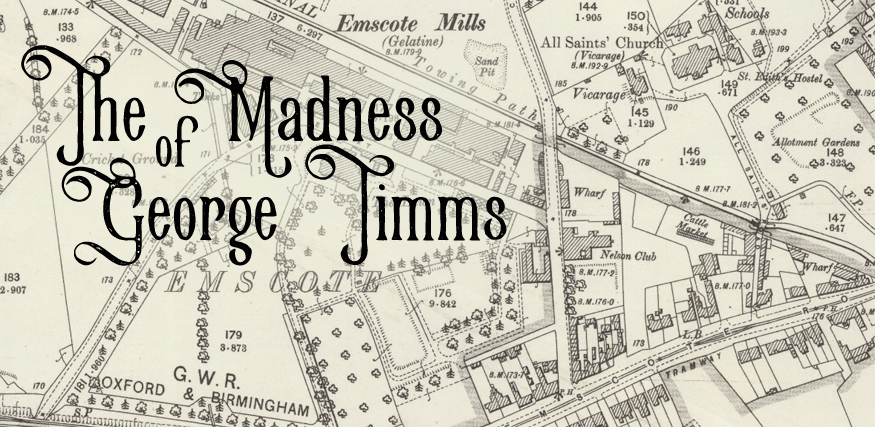
What the Nelsons stood for, however, was rather special. They were enlightened employers who took a philanthropic view of the relationship between worker and master. They built houses and social clubs for their workforce and, for some time, the area around their factory in Emscote was known as Nelson’s Village. Central to this was Charles Street, and this is where we come to the True Crime aspect of this feature.

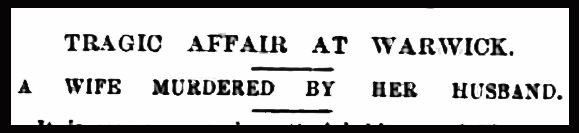
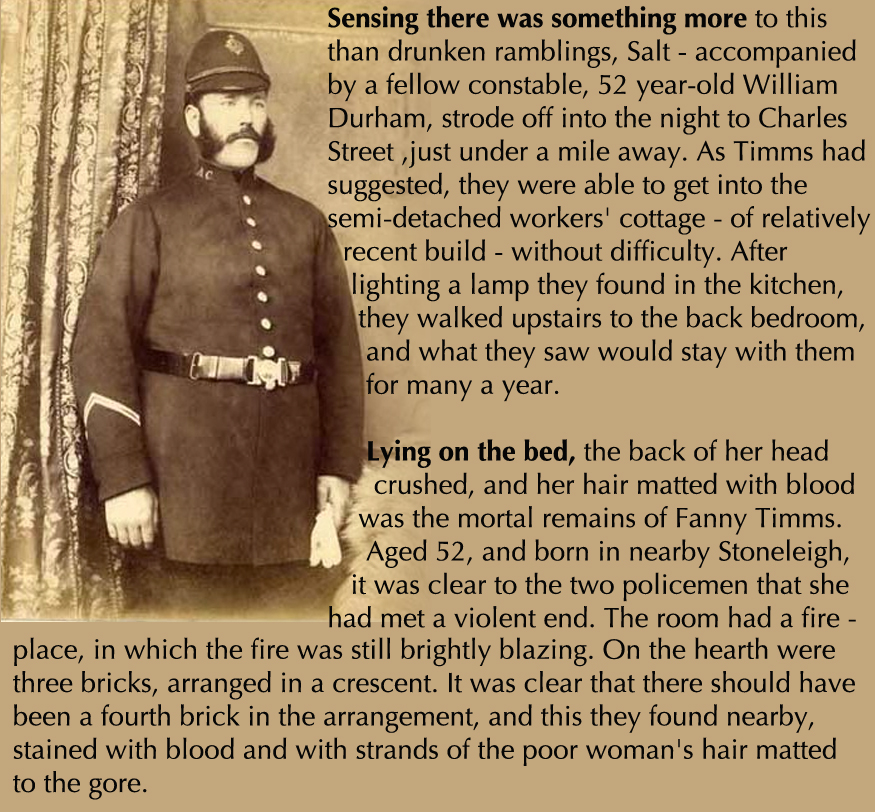
At a few minutes past one o’clock in the morning, on 19th January 1888, Police Constable Salt was stamping his feet and trying to keep warm as he stood on duty at the far end of Smith Street, Warwick. The silence of the night was broken by a man’s voice in the near distance, shouting and calling out.  Walking towards the disturbance, Salt shone his bulls-eye lantern into the dimly lit street, and he saw a figure come staggering towards him, lurching from one side of the road to the other, still shouting and moaning incomprehensibly.

With his free hand, Salt caught hold of the distressed man, and immediately noticed that his hands seem to be covered in blood. In a hoarse voice, the man cried out:

“I’ve murdered my wife; the Devil has tempted me to do it.”
“Where do you live?” asked Salt, but received no answer.
“Have you been home?” At this, the man replied,
“Yes – I’ve been to bed and got up again.”

A man called Henry Harris, who was the night-watchman at the nearby fire station, attracted by the fracas, joined the pair, and between them, he and PC Salt managed to march the man to the police station, which then stood at the top end of Northgate Street. manning the front desk was Police Constable Lewis. Salt informed Lewis what the man had told him, and Lewis asked for his name:

“My name is George Timms. I live at No. 1 Charles Street and, yes, I have murdered my wife. You will find her there. I have left the back door open.”

TIMS BANNER1

Body Text

From here, the pace of events quickened. The two constables, realising that this was something way above their pay grade, wasted little time in summoning the help of their senior officers. Dr. Guthrie Rankin of 23 Jury Street was called to the scene. What he found was later reported in the press as follows:

“On going into the bedroom he saw the woman lying on the bed, halfway across, and quite dead. Her face was lying in a pool blood. There was no evidence that any struggle had taken place. From a superficial examination, he found some wounds on the back of the scalp, from which the blood had evidently come. Death had only recently taken place. He made a post mortem examination some hours later. There were four scalp wounds, one of them very large, and the bone underlying the wounds was fractured in several places. Two the fractures penetrated to the brain. There was a large bruise over the back of the neck, and the back of the left shoulder was also discoloured. All these wounds were, undoubtedly, such as might be caused by blows from a brick.”

In Part Two of The Madness of George Timms
A FUNERAL
WARWICK ASSIZES
A NEW CAREER AS A SHOEMAKER

A LOUTH TRAGEDY . . . Part Two

ALT header

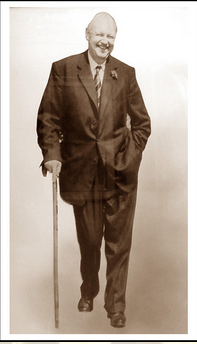
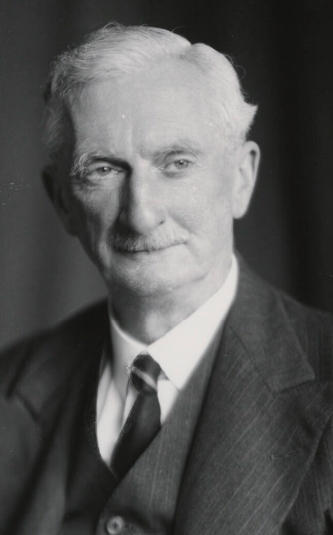
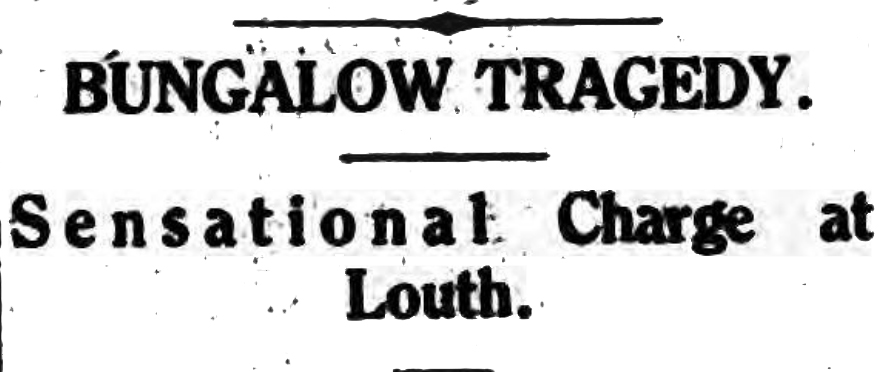
Heneage copyTHE STORY SO FAR … It is July 1927, and we are in the quiet market town of Louth in the Lincolnshire Wolds. King George V has his head on the stamps and coins, Stanley Baldwin is the Conservative Prime Minister, while in parliament, Sir Arthur Pelham Heneage (left) represents Louth. All is not quiet however in a wooden bungalow close to the level crossing on Stewton Lane. The body of Minnie Eleanor Kirby has been discovered lying on the floor of one of the rooms. She has been dead for some hours, and the cause of death is clearly a massive wound to the base of her skull.

Inspector Davies of Lincolnshire Constabulary, alerted by Mrs Kirby’s worried son Harry, has forced an entry into the bungalow and made the grisly discovery. A few feet away from the lifeless body of Minnie Kirby is a large axe, bloodstained, and which would later be identified by the pathologist as exactly fitting the fatal wound. Suspicion immediately falls on Minnie Kirby’s husband Bertram, and while the poor woman’s corpse is removed to the mortuary for further investigation, the police begin their search for him. It was not to be a long or difficult manhunt. The White Horse Inn was one of several pubs that Kirby was known to frequent, and on the evening of Tuesday 12th July, PC Morris and Inspector Davies found Kirby engrossed in a game of dominoes. After being informed that he was to be arrested, he is reported to have said:

“All right. I am going to be fair with you. I am not going to cause any trouble. My God, boy, you don’t know how things are! I hope you never will. You don’t know what I had to put up with.”

Head

Kirby “came quietly” and was taken to the police cells. He was initially remanded until the forthcoming Saturday, 16th July. He was brought before the magistrates, and was remanded again to allow the police to prepare a case to put to the public prosecutor. Needless to say, the atmosphere in the town was described as “electric” by one feverish reporter, who went on to write:

Toen hall“A big crowd assembled outside the Town Hall in an endeavour to catch a glimpse of the prisoner, but the proceedings took place at the Superintendent’s office at the County Police Station in another part of the town.

Here, in a small room, before Mr Mark Smith and Mr W. C Street, with only the Clerk (Mr H. E. Roberts), Supt. C. Skinner, Inspector Davies and members of the press, Kirby was brought in. He trembled violently, his eyes had a vacant stare and he had to be supported by two police officers.

The prisoner is of stout build, with greyish hair and he wore no collar, his shirt being open at the neck. He was represented by Mr R. H. Helmer, of the well-known Louth firm of solicitors, Allison and Helmer.”

Part of the dossier being prepared for the prosecutor was a number of letters Kirby had written, and which were found in the bungalow and in his possession when arrested. They suggested a man at the end of his tether, preparing to enter into some kind of a pact with his wife. One passage read:

“My wife is my greatest pride in life. . . We have realised our financial state affairs, and come to the conclusion that death is the only way out of them. Please bury darling Minnie and myself together. We have loved one another.”

He went on to write:

HEADLINE 5“I have fell across very hard times. My darling wife, who has been my greatest pal in life, has realised this fact as well. God bless her. No-one could wish for a better wife , mother or comforter than her. We have realised our financial state of affairs, and come to the conclusion that death is the only way out of the matter. I left the railway in order, as I thought, to better myself, and this failed. Eventually I found myself stranded with writs, etc, and we had nothing to eat at home.”

“I therefore volunteered to go away with the idea of obtaining work, but to no avail. After this, I walked from Louth to Boston. Here I say God bless my wife. God bless her. No man, whoever he was could possibly find a better wife than I have had. Anyhow, here is a point I wish the Coroner to take up, and when I say this I mean it to be published and not doctored, because it is absolutely the truth.”


He appeared to be passionately devoted to his youngest son, Norman:

“How pleased we are to hear you are little Norman. God bless him- how I love this little bairn – I am heartbroken. Will you ask my Auntie Julia- her name is under Mrs F Pocklington, “Eversleigh”, Carlton Road, Boston – to take during her lifetime my darling boy Norman. My Auntie Julia is the only relative he loves. He always wishes to see his Auntie Julia. Further, I wish to say my Auntie Julia and Uncle Fred have been my best friends throughout all my life – God bless them both. They have been the only faithful friends we have had through life. Please bury darling Minnie and myself together.. We have loved one another. Poor little Ralph out in Canada, and poor little Norman and Harry. Oh! he has been a good boy. God bless them all – Minnie, Harry, Ralph and Norman. God bless them all and Auntie Julia and Fred.”

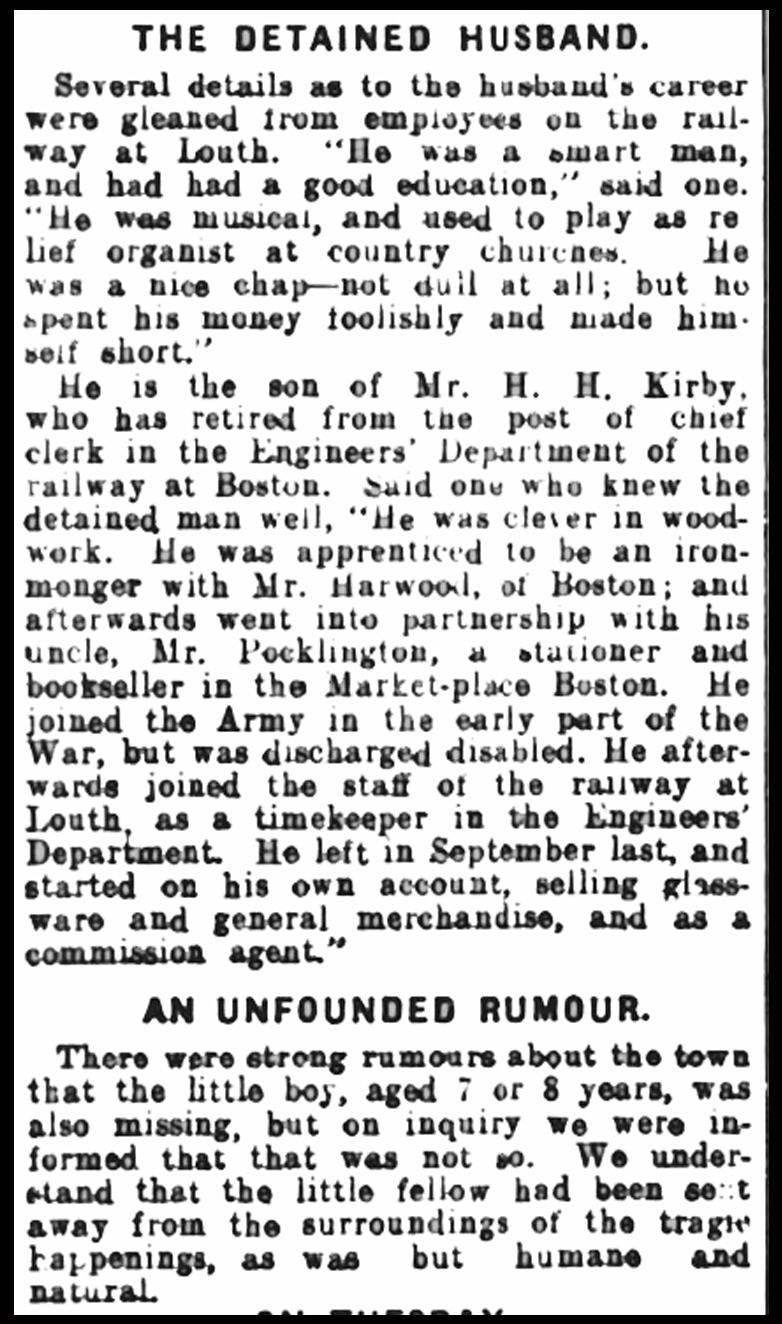
This wish that Norman would be fostered by the Pocklingtons is rather odd, because they were both elderly. Indeed, Mrs Pocklington’s “lifetime” would not extend much beyond the murder, as she died two years later. It must have been immediately obvious to the town solicitor representing Kirby – and, later, to his defence barrister at Lincoln Assizes – that the only way Kirby would escape with his life from this tragedy was for his representatives to plead that he was insane.

Image

In Part Three
THE EVENTS OF 10th and 11th JULY REVEALED IN COURT
INSANE OR WICKED?
A DATE WITH ALBERT PIERREPOINT

A LOUTH TRAGEDY . . . Part One

ALT header

Back in the 1950s and 60s I was a regular visitor to Louth. Mother was a Louth girl, and my grandmother, although born in Yorkshire, had lived in the area since before The Great War, first in a cottage in the grounds of Tathwell Hall, where her father was Head Groom, and then in the town itself. I used to stay with her in Tennyson Road during school holidays, and blissful days they were. I had made several friends in Louth, and we did what most lads did in those innocent days – played football and cricket and went fishing. The most intense of all our passions was, however, trainspotting.

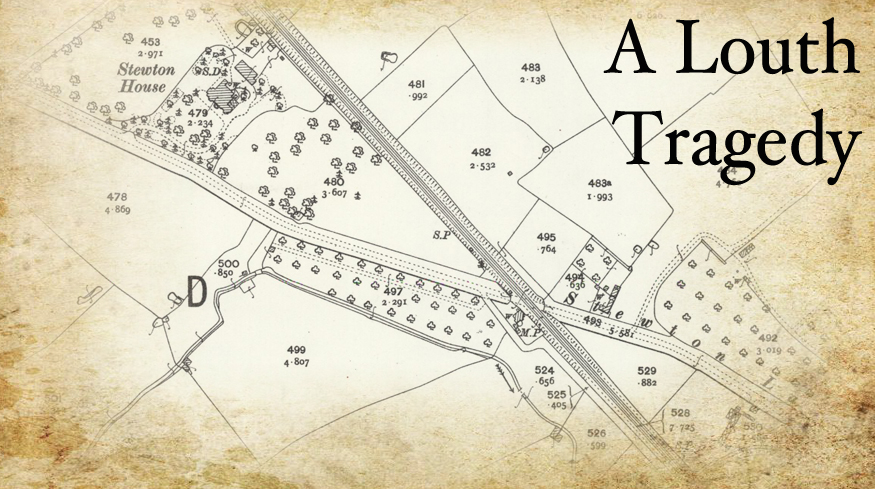
RunaboutEach summer, we used to buy what was called a Runabout Ticket. It cost twelve shillings and sixpence and was a small rectangle of stiff blue cardboard. On it was printed a stylized map of the railway network in the area. It meant we could travel on any train, between any of the stations, as often as we wanted, for a week. Crucially, it gave us access to the East Coast main line between Peterborough and Grantham, with its magnificent Gresley Pacifics and all manner of spectacular engines. At other times, however, we had to make do with the trains that ran through Louth on the Grimsby to Boston line, and one of our favourite places to trainspot was the level crossing on Stewton Lane. Between trains.we could muck about by the nearby stream where it ran through a little gully, which was known as Seven Trees Island. Happily undreamed of in those days was the fact that we were enjoying ourselves on the site of one of the most gruesome and tragic murder cases of the early twentieth century.

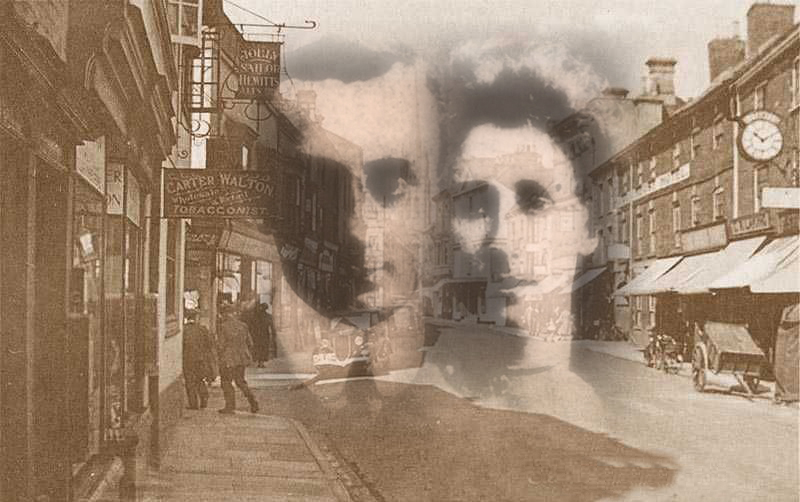
MINNIEIn 1927, just by the railway, there stood a small wooden bungalow, the home of Bertram Horace Kirby, 46, and his wife Minnie. They were not originally Louth people, both having come from Boston, where they had married – possibly in St Botolph’s – in 1905. They had three sons. The two oldest had left home. Harry, 21, lodged with Mrs Took in nearby Church Street, while Ralph, 17, had emigrated to Canada. There was a much later addition to the family. Leslie Norman Kirby was just 8 years old. Minnie Eleanor Kirby (right) was described as follows in subsequent press reports:

“Mrs. Kirby was tall, and of striking appearance. She was most friendly woman, and was liked very much by her neighbours. Her hobby was gardening. She had studied her subject, and she was an expert gardener, and passionately fond of her flowers. She was extremely well-read, and was a thoroughly cultured woman, clever in many ways, and musical. She was a keen churchwoman.

Mrs. Kirby was also an enthusiastic member of the Women’s Unionist Association, and canvassed in Louth at the last election. She had been educated in Boston at Miss Stothert’s High School, and for about 10 years she was head clerk at Mr. A. Simpson’s furniture store, in the Market-place. She was very well-known in Boston. At school, she was a very apt pupil, and we are informed that Miss Stothert “thought a lot of her.” During her schooldays the took part in “The Mandarin”, and other plays. She was extremely fond of rowing, and frequently enjoyed her favourite exercise on the Witham.”

KIRBYBertram Horace Kirby (left) was a year younger than his wife. He also had musical talent, and while they lived in Boston he had been church organist in the town, and the village of Frampton. He had applied himself to various trades while living in the Boston area, but had worked for almost ten years for the London and North Eastern Railway. By 1927, however, he had given this job up, and had attempted to strike out on his own as a commercial dealer.

In the early evening of Sunday 10th July , Harry Kirby called at his parents’ home, and took his mother for a stroll. Although he had moved out of the bungalow because he and his father “couldn’t get along” he had noticed nothing untoward in the atmosphere between his mother and father. He was later to admit that his father “was prone to violent tempers when he had taken drink.”

Despite all seeming well with his parents, Harry Kirby must have had a sixth sense that prompted him to visit the bungalow on Tuesday 12th July. He found the doors locked and the curtains drawn, and could make nobody hear. He walked into the town and asked for help from the police. He returned with Inspector Davies who must have also sensed something was wrong, and forced his way into the bungalow through a rear window. What he found confirmed Harry Kirby’s fears that a tragedy was about to unfold. Minnie Kirby was lying dead on the floor of the living room, on her stomach, with her head turned to one side. At the base of her skull was a savage wound which had almost separated her head from her body.

In Part Two
AN ARREST INTERRUPTS A GAME OF DOMINOES
ANGUISHED LETTERS

THE DARKEST PLACE … Between the covers

TDP header

There can be few tropes – either using visual imagery or words – to match the allure of an disused and desolate lunatic asylum. The more Victorian and ‘Gothick’ the building is, the more it is likely to attract both those brave but foolhardy folk known as Urban Explorers – and writers of atmospheric thrillers. Place the building on a desolate island off the south western coast of Ireland and we have a dream – or nightmare – location for a murder mystery. Then let the tale be told by one of our finest modern writers of crime fiction and, as Wilkins Micawber once said, “Result, happiness.” Happiness at least for those of us who love a good read, but there is less joy for the characters in Jo Spain’s latest novel, The Darkest Place.

TDP coverDublin copper DI Tom Reynolds is summoned from the dubious delights of his family Christmas to solve a murder. Readers of the previous three Tom Reynolds books might think there is little remarkable about that, but this time the corpse has been in the ground for rather longer than usual. Forty years, in fact. On the island of Oileán na Caillte, the pathologists have been disinterring corpses from a mass grave of the unfortunates who passed away as patients of the long-defunct psychiatric institution, St Christina’s. Those involved in the grim task discover nothing illegal, as all the residents of the burial pit were laid to rest in body bags, tagged and entered onto the hospital records. With one exception. That exception is the corpse of one of St Christina’s medical staff Dr Conrad Howe, who mysteriously disappeared forty Christmases ago. No body bag or tag for Dr Howe, but a rather surreptitious last resting place wedged between two other corpses.

For Howe’s widow Miriam the discovery comes as a shock but a release of sorts. For all the Christmases in between she has, like a latter day Mrs Hailsham, laid out the seasonal trappings in the same way each year, half hoping that her husband would return. Her children, now grown up, have humoured her in this ritual up to a point, as has a doctor colleague of her husband’s, Andrew Collins, who retains his connection to Oileán na Caillte. The fact that Collins has been hopelessly in love with Miriam all this time is not lost on Reynolds as he tries to discover who killed Howe with – as tests on his bones reveal – a length of electrical flex which left copper traces on his thoracic vertebrae.

Reynolds is no-one’s fool. As he pores through the almost indecipherable scrawl of Howe’s diary (we share that task with him, but minus the scrawl) he realises that the truth about who killed the idealistic physician involves not only the dead of Oileán na Caillte, but those who are still very much alive. One of the most telling lines in the diary says:

“It is though we are sharing this island with the devil.”

JSOther than that dark angel, the cast of suspects includes another former physician, now himself just days away from death, and others whose culpability in the inhuman treatment of St Christina’s patients has left psychological scars, some of which have become dangerously infected. Of course, this being, among other things, a brilliant whodunnit, Jo Spain (right) allows Tom Reynolds – and us readers – to make one major assumption. She then takes great pleasure, the deviously scheming soul that she is, in waiting until the final few pages before turning that assumption not so much on its head as making it do a bloody great cartwheel.

Jo Spain is a brilliant writer. It really is as simple as that. She takes the humble police procedural and not only breathes new life into it, but makes it dance and jitterbug like a flapper on cocaine. Not content with that, she shifts a heavy old stone covering some of the less palatable aspects of her country’s history, and lets us gaze squeamishly at some of the nasty things that click and scuttle about beneath, disturbed by exposure to the light.

The previous Tom Reynolds novel was Sleeping Beauties, and you can check that out by clicking the blue link. Do the same to see the review of her brilliant standalone novel The Confession. The Darkest Place is published by Quercus and will be available on 20th September.

Quercus

Blog at WordPress.com.

Up ↑