
Search

fullybooked2017

Tag

Historical Crime Fiction

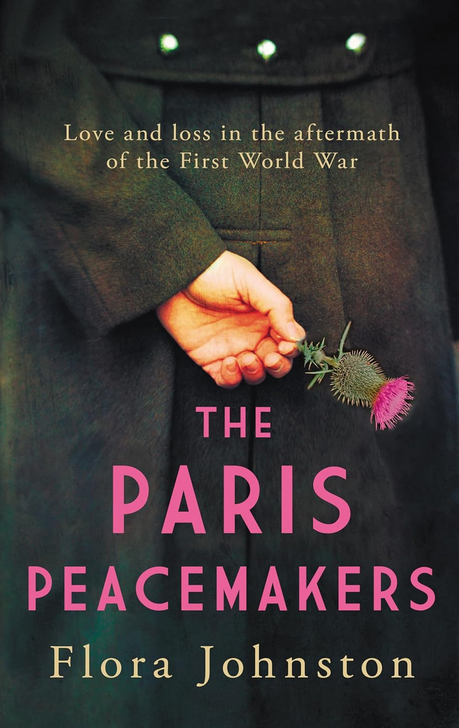
THE PARIS PEACEMAKERS . . . Between the covers

TPP SPINE041 copy

The guns that began their incessant thunder in August 1914 are, at last, silent. The German field army has surrendered, the Kaiser’s High Seas Fleet lies at anchor in Scapa Flow, and Wilhelm himself has abdicated. In Paris, the great, the good – but more importantly, the victorious –  are assembling to pick the bones out of five years of carnage. Meanwhile, we meet the Rutherford family. Their home is in Thurso, on the stormy north eastern coast of Scotland. Jack is just one of nearly 900,000 British men to have paid what was poetically called ‘the supreme sacrifice’. His sisters are both now in France: Corran is with a charity in Dieppe, bringing some sort of education to young soldiers who have had academic opportunities denied them for the last five years. Stella is in Paris, having been engaged as one of the hundreds of typists needed to record the decisions and arguments in the drama shortly to be played out at Versailles. Alex is still on Royal Navy duties, with his ship keeping a watchful eye on a war that is still being fought between Russian Bolsheviks and the Tsarists they overthrew.The novel follows the lives and loves of the Rutherford girls.

Flora Johnston handles the historical background well. It is now widely acknowledged that the Treaty of Versailles did not end the war between Germany and her enemies. It merely put it in on hold for twenty years. There was not to be a new world, or anything remotely like the ‘land fit for heroes’ that optimists imagined, either in Britain or France,and certainly not in Germany. In vain did US President Wilson strive for some kind of settlement that would be for all time. Who can blame France – with 1.4 million dead, thousands of villages reduced to rubble, its industry shattered and a priceless architectural heritage destroyed – for wanting to make Germany pay?

We see 1919 through many different eyes, and this is a story skillfully told. Arthur, Corran’s teacher colleague is embittered by the sacrifices his own parents made to educate him, and white-knuckled with anger that, back home, his own family, protesting against the lack of jobs, are faced with baton charges by police. Rob Campbell, once Corran’s intended fiancée, is worn down and traumatised by his work as a battlefield surgeon. His fondest hope is purely escapist, and it is that one day he might be able to relive his glory days on the rugby pitch. But with so many of his fellow players rotting under the French and Belgian soil, what hope does he have?

The game of rugby is a powerful motif in this story. in an England-Scotland game in March 1914 the thirty young men are at the peak of fitness, chests bursting with pride. Too many of those chests would, in the coming turmoil, simply become targets for German bullets and shell fragments. On New Year’s Day 1920, the first game of any consequence to follow the war was played, between France and Scotland. It is a small and hesitant step forward, but there are too many missing names of the teamsheets.

The story is a remarkable blend of history, romance and social observation. Flora Johnston is a fly on the wall at a bitter ceremony in a young man’s bedroom that must have been repeated countless times across Britain and, indeed, France, and Germany:

She felt again the overwhelming sadness of sorting through Jack’s possessions yesterday. All over the country there were houses like this, filled with the ephemera of hundreds of thousands of lives that had unexpectedly ceased to exist. Clothes and footballs, bicycles and egg collections, razors and comics and diaries and gramophone records. So much of it: surely far too much for the nations attics or rubbish heaps or junk shops to absorb.”

The Peacemakers of Paris reaches out to so many different readers. WW1 buffs who appreciated Birdsong and Pat Barker’s trilogy will find something here. Those who like romance, a hint of heartbreak, but an optimistic ending will also be happy. Most importantly, anyone who enjoys a novel which is well researched with convincing characters will not be disappointed. Published by Allison & Busby, the book is available now.

Screen Shot 2024-04-17 at 17.30.01

THE GRAND ILLUSION . . . Between the covers

TGU spine036 copy

London. The early summer of 1940. British military leaders, politicians and the general public are wondering quite what to make of Dunkirk. Yes, over three hundred thousand allied servicemen have been rescued from the jaws of Hitler’s Blitzkrieg, but they have left behind them their weapons, millions of rounds of ammunition and countless thousands of gallons of fuel. The British Expeditionary Force might still exist, but it has few rifles, artillery pieces or tanks (even if their were any fuel to propel them).

Against this gloomy backdrop, we meet Daphne Devine and Jonty Trevelyan. They are busy entertaining audiences at London theatres with their conjuring act. Daphne is, of course, the archetypal ‘glamorous assistant’, flashing her shapely legs before the climax of their act, where she apparently gets sawn in half by The Grand Mystique. In much more secret places than the Metropolitan Edgware Road, intelligence officers are wondering just how they can remove the gloves from the British establishment who don’t yet realise that their Nazi opponents have torn up the rules of war and are fighting a very dirty fight. Just as Daphne and Jonty are enlisted as unlikely secret weapons, news comes that the  SS Arandora Star, taking hundreds of internees and prisoners of war to Canada has been  torpedoed and sunk by a German U-boat with the loss of more than 800 lives. Daphne’s Italian uncle is one of those lost.

Unsure of what is to be asked of them, Daphne and Jonty say goodbye to normal life, and are whisked off to a high security unit which seems to specialise in camouflage, pretence and making German aircraft make as many mistakes as possible in identifying targets on the ground. Then, events make another lurch in the direction of the unexpected. The ‘behind-the-scenes’ directors of this unlikely drama have become aware that the Nazi high command are, to a man, deeply susceptible to the occult and the power of astrology.  This is the list. The initials are fairly obvious, although I admit to wondering what Reinhardt Heydrich was doing their, as this was only 1940. Then I remembered Hitler’s deputy, that strange who flew a plane to Scotland, and spent the last years of his life in Spandau Prison.

TGI quote

Then, Syd Moore introduces us to the delightful fulcrum on which the rest of the novel pivots. In a briefing Daphne and Jonty are astonished to learn that they are required not just to create an illusion of some astral phenomenon which will deter Hitler and his cohort from invading Britain, but to actually dabble in the Black Arts and recreate the demonic force which – so they are told – wreaked hell and destruction on The Spanish Armada in 1588, thus enabling Sir Francis Drake to continue his game of bowls, safe in the knowledge that the spell has already been cast.

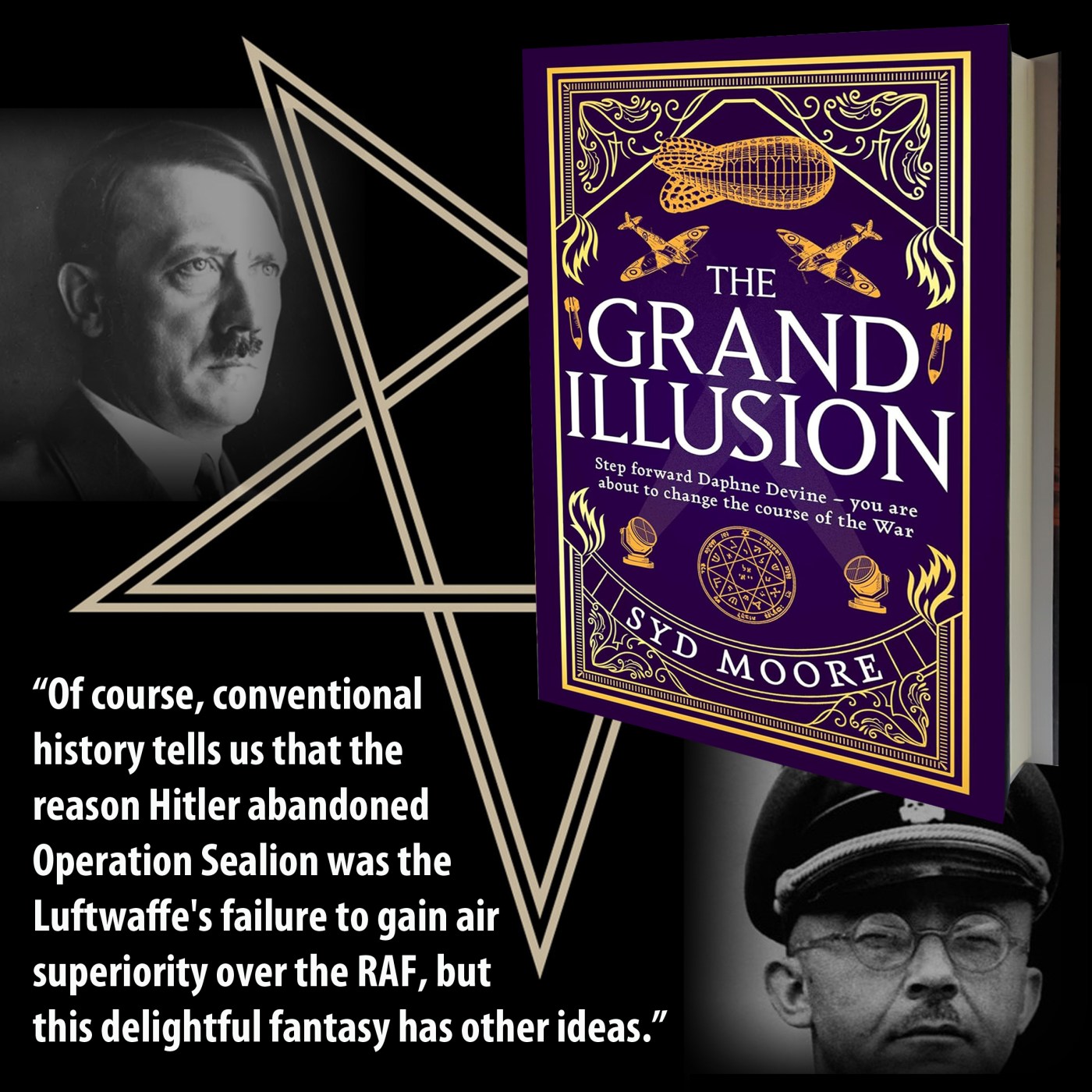
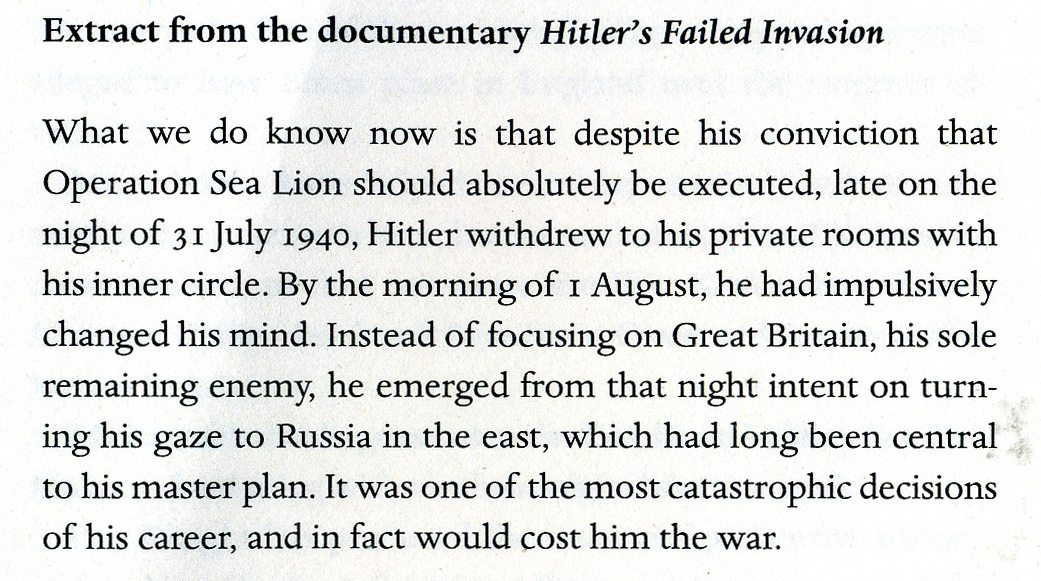
On 31st July 1940, In the full knowledge that there are German spies nearby, observing their every move, Daphne and the other specialists create an elaborate and dramatic psychic event. It is a spectacular illusion. Or is it just an illusion? That is the enigma with which Syd Moore leaves us. Of course, conventional history tells us that the reason Hitler abandoned Operation Sealion was the Luftwaffe’s failure to gain air superiority over the RAF, but this delightful fantasy has other ideas.

TGU quote038 copy

The Grand Illusion is published by Magpie Books and is available now.

THE SCREAM OF SINS . . . Between the covers

TSOS header

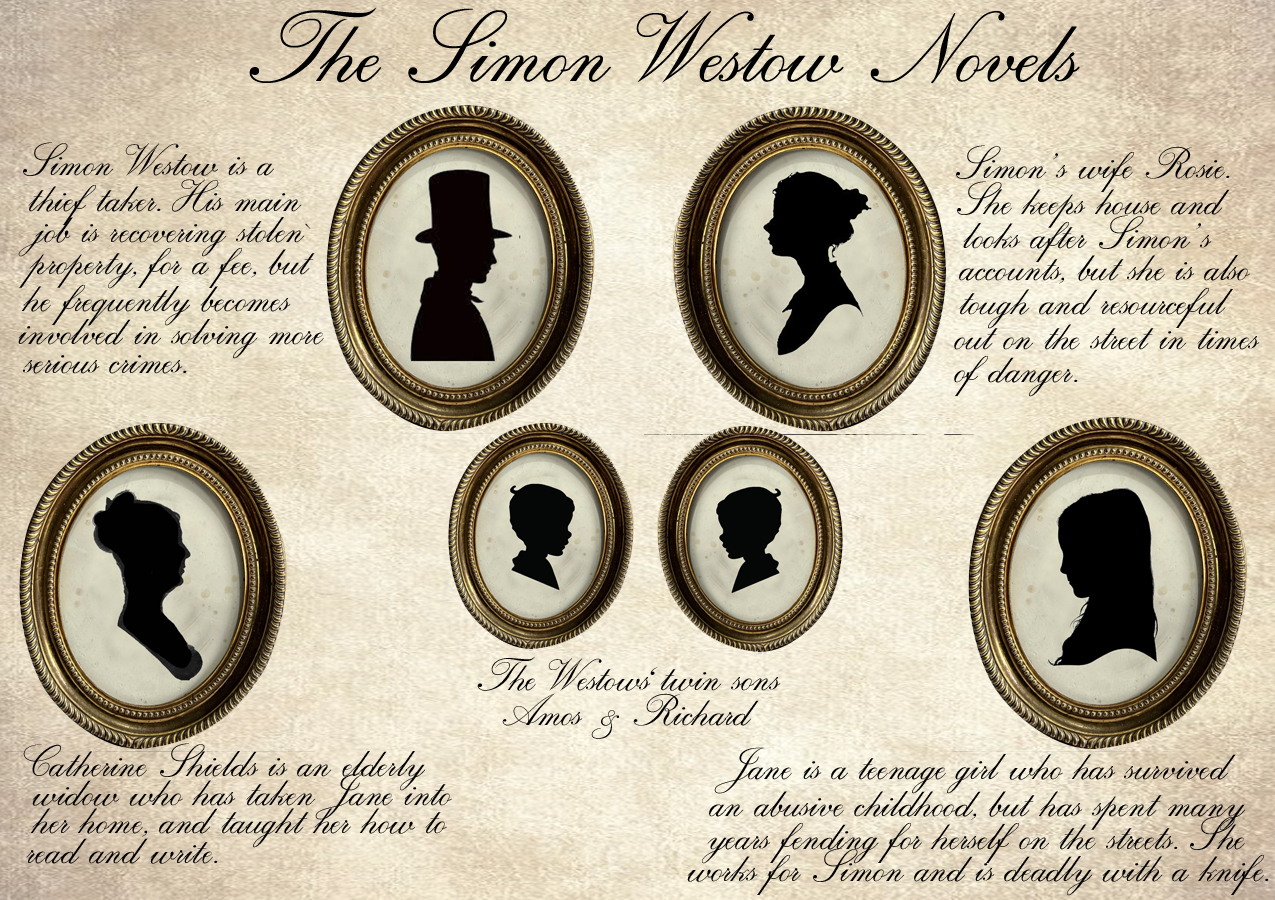
Leeds, Autumn 1824. Simon Westow is engaged by a retired military man, Captain Holcomb, to recover some papers which have been stolen from his house. They concern the career of his father, a notoriously hard-line magistrate. Newcomers to the series may find this graphic helpful to establish who is who.

TSWN graphic

Westow takes the job, but is concerned when Holcomb refuses to reveal what might be in the missing papers, thus preventing the thief taker from narrowing down a list of suspects. As is often the case in this excellent series, what begins as case of simple theft turns much darker when murder raises its viler and misshapen head.

Jane, Westow’s sometime assistant, has taken a step back from the work as, under the kind attention of Catherine Shields, she is learning that there is a world outside the dark streets she used to inhabit. The lure of books and education is markedly different from the law of the knife, and a life spent lurking in shadowy alleys. Nevertheless, she agrees to come back to help Westow with his latest case, which has turned sour. When Westow, suspecting there is more to the case than meets the eye, refuses to continue looking for the missing documents, Holcomb threatens to sue him and ruin his reputation.

More or less by accident, Westow and Jane have uncovered a dreadful series of crimes which may connected to the Holcomb documents. Young girls – and it seems the  younger the better – have been abducted for the pleasure of certain wealth and powerful ‘gentlemen’. Jane, galvanised by her own bitter memories of being sexually abused by her father, meets another youngster from the streets, Sally.

Sally is a mirror image of Jane in her younger days – street-smart, unafraid of violence, and an expert at wielding a viciously honed knife. Jane hesitates in recruiting the child to a way of life she wishes to move away from, but the men involved in the child abuse must be brought down, and Sally’s apparent innocence is a powerful weapon.

As ever in Nickson’s Leeds novels, whether they be these, the Victorian era Tom Harper stories, or those set in the 1940s and 50s, the city itself is a potent force in the narrative. The contrast between the grinding poverty of the underclass – barely surviving in their insanitary slums – and the growing wealth of the merchants and factory owners could not be starker. The paradox is not just a human one. The River Aire is the artery which keeps the city’s heart beating, but as it flows past the mills and factories, it is coloured by the poison they produce. Yet, at Kirkstall, where it passes the stately ruins of the Abbey it is still – at least in the 1820s – a pure stream home to trout and grayling. Just an hour’s walk from Westow’s beat, there are moors, larks high above, and air unsullied by sulphur and the smoke of foundry furnaces.

The scourge of paedophilia is not something regularly used as subject matter in crime fiction, perhaps because it is – and this is my personal view – if not the worst of all crimes, then at least as bad as murder.  Yes, the victims that survive may still live and breathe, but their innocence has been ripped away and, in its place, has been implanted a mental and spiritual tumour for which there is no treatment. Two little girls are rescued by Westow, Jane and Sally and are restored to their parents, but what living nightmares await them in the years to come we will never know.

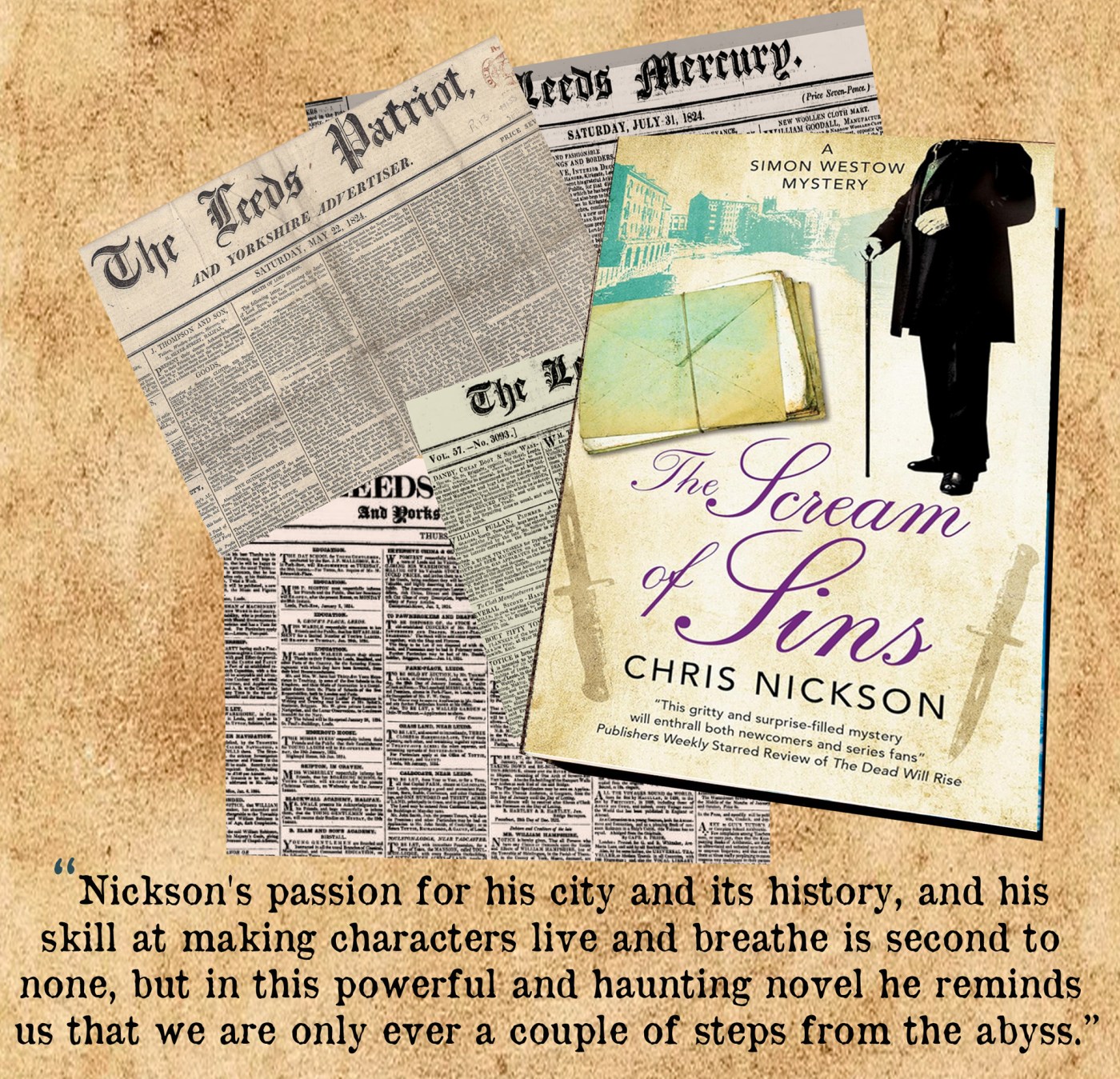
I have come to admire Nickson’s passion for his city and its history, and his skill at making characters live and breathe is second to none, but in this powerful and haunting novel he reminds us that we are only ever a couple of steps from the abyss. The Scream of Sins will be published by Severn House on 5th March.

THE CHARTER OF OSWY AND LEOFLEDE . . . Between the covers

CHARTER HEADER

We are in the final decade of the twelfth century, in the market town of Wisbech, a place dominated by its Norman castle, and split by two rivers: the smaller, the Wysbeck is little more than a gentle stream, and can be crossed on stepping stones; the larger, the Welle Stream is more significant, and can only be crossed at high tide by ferry.

In the 124 years since England was conquered by the Normans, the old native tongue of the Saxons has become a foreign language, in both written and spoken forms. Sir John of Tilneye, a young man who was schooled in the old language by monks when just a boy, is called upon to translate an old manuscript which appears to be at the centre of a criminal conspiracy. Ostensibly, it is dull and tedious stuff relating transfers of land and property in the days before the Normans came. Someone, however, is convinced that it contains a clue to something extremely valuable.

Wisbech is neither more nor less lawless than other towns in the area, but when a series of fires and break-ins follow one after the other, the Bishop of Ely’s seneschal Sir Nicholas Drenge is determined to discover what is going on. Each of the incidents seems connected to a fatal fire which destroyed a house in the town. Its owner, Aelfric, who perished in the blaze, was Saxon nobility, but like most of his countrymen, all he had left was his memories. His lands and riches had long been appropriated by the descendants of the 7000 men who landed at Pevensey on 28th September 1066. So why burn down his house? What was he hiding? Drenge and his men-at-arms eventually catch the man who they think is the killer, but when he is murdered while in their custody, the mystery deepens.

Insofar as this is just a detective novel, Drenge is the principle character. No genius, perhaps, but steady and unwavering as he slowly unpicks the knot of lies, legends and loose connections that surround the mystery of Aelfric’s death. Diane Calton Smith gives us some fairly innocent romancing between Sir John and Rose de Hueste, the old man’s granddaughter, but above all she describes a place that is, literally, buried beneath the feet of townsfolk of modern Wisbech. The two rivers have traded identities to an extent. The inoffensive Wysbeck is now the deep and powerful tidal River Nene, while The Welle Stream – thanks to major 17thC drainage – shrank to being a canal in the 1800s, but was eventually filled in and is now a dual carriageway. As for the castle, it still carries the name, but is now merely a dilapidated Georgian house which no-one is quite sure what to do with.

Calton Smith weaves her plot this way and that, and doesn’t surrender the answers until the final pages. This is superior story-telling, and a magical glimpse into a world long since gone; that world created echoes, however, and if you listen attentively, they can still be heard. The Charter of Oswy and Leoflede is published by New Generation and is available now. I reviewed an earlier book by this author, and this link will take you there.

MURDER AT HOLLY HOUSE . . . Between the covers

MAHHSPINE

Screen Shot 2023-11-26 at 18.28.51The novel is subtitled The Memoirs of Inspector Frank Grasby, and Denzil Meyrick (left) employs the reliable plot-opener of someone in our time inheriting a wooden crate containing the papers of a long-dead police officer, and exploring what was committed to paper. Will crime writers in a hundred years hence have their characters discovering a forgotten folder in the corner of someone’s hard drive? I doubt it – it won’t be anywhere near as much fun.
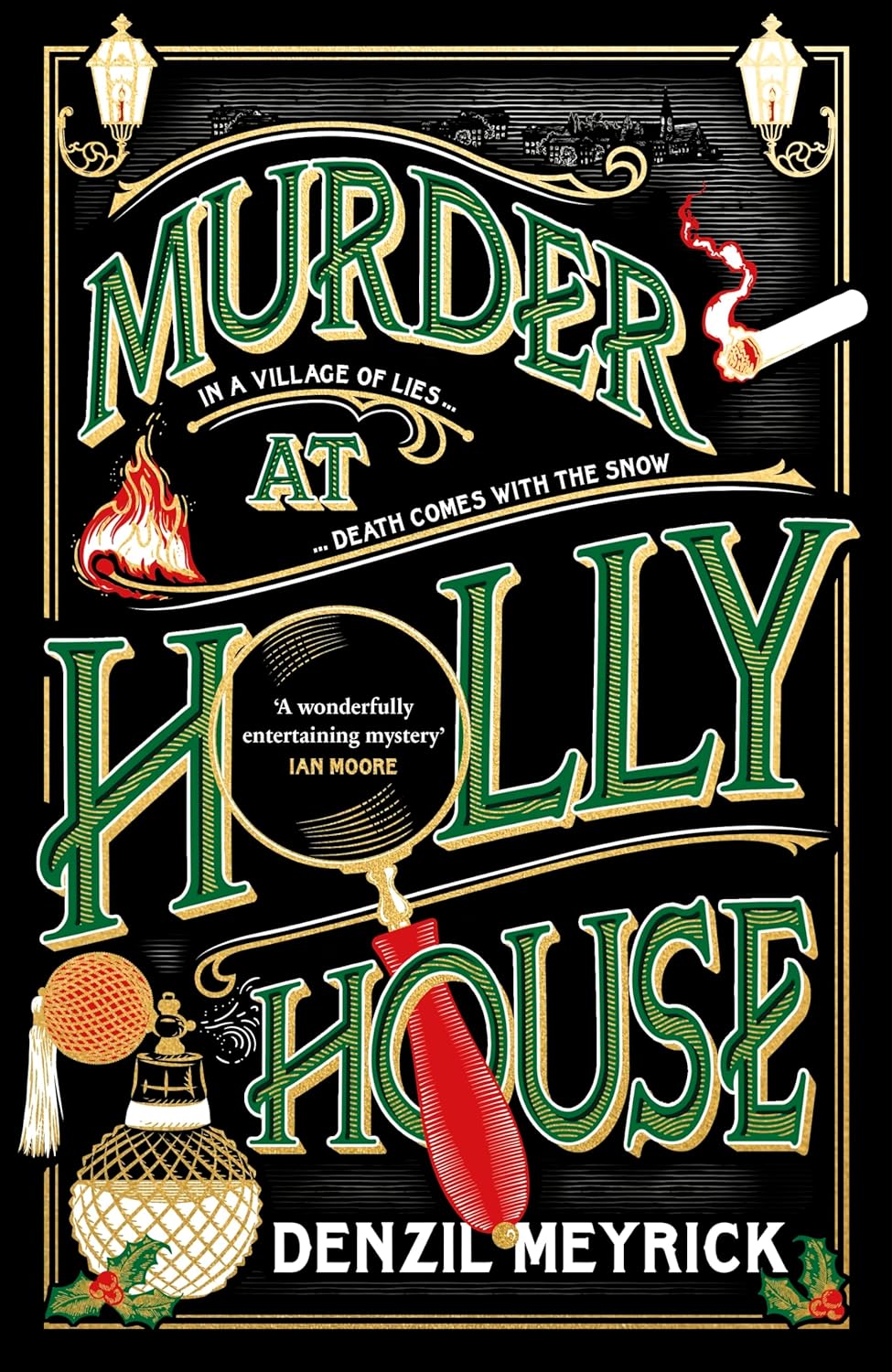

We are in December 1952, although the book starts with an intriguing police report from three years earlier, the significance of which becomes apparent later. Frank Grasby is in his late thirties, saw one or two bad things during his army service, but is now with Yorkshire police, based in York. He is a good copper, albeit with a weakness for the horses, but has made one or two recent blunders for which his punishment is to be sent of the remote village of Elderby, perched up on the North Yorkshire moors. Ostensibly he is there to investigate some farm thefts, but the Chief Constable just wants him out of harm’s way – and the public eye – for a month or two.

Meyrick unashamedly borrows a few ideas from elsewhere. Rather like Lord Peter Wimsey’s car getting stuck in the snow at the beginning of The Nine Tailors, Grasby’s battered police Austin A30 gives up the ghost just short of the village as the snow swirls down, and he has to make the rest of the journey on foot. In Elderby he finds, in no particular order:

♣ A pub called The Hanging Beggar.
♣ Police Sergeant Bleakly – in charge of the local nick, but afflicted with narcolepsy due to his grueling time with the Chindits in Burma.
♣ A delightful American criminology student called Daisy Dean.
♣ A bumptious nouveau-riche ‘Lord of the Manor’ called Damnish (a former tradesman from Leeds, ennobled for his support of the government).
♣ A strange woman called Mrs Gaunt, with whom Grasby and Daisy lodge. Mrs G has a pet raven that sits on her shoulder, and seems to have a mysterious connection to Grasby’s father, an elderly clergyman.

The first corpse enters neither stage right nor left, but rather stage above, when Grasby inadvertently solves Lord Damnish’s smoky fireplace by dislodging an obstruction – a recently deceased male corpse. Next, the American husband of the local GP is found dead in the churchyard. Chuck Starr was a journalist embedded with the Allied forces on D-Day, was appalled by what he saw, and has been writing an exposé on military incompetence. His manuscript – yes, you guessed it – has gone missing.

The more Grasby tugs and frets away at a series of loose ends, the more the fabric of Elderby – as a jolly bucolic paradise inhabited by a few harmless eccentrics – begins to unravel and our man finds himself in the middle of a potentially catastrophic conspiracy.

Some crime novels lead us to thinking dark thoughts about the human condition, while others delight us with their ingenuity, humour and turns of phrase. This is definitely in the latter category but, amidst the entertainment, Meyrick reminds us that war leaves mental scars that can be much slower to heal than their physical counterparts. He takes the threads of familiar and comfortable crime fiction tropes, and weaves a Christmas mystery in a snowy village, but with the shadows of uneasy post-war international alliances darkening the fabric. Murder at Holly House is beautifully written, full of sharp humour, but it is also a revealing portrait of the political tensions rife in 1950s Britain. It is published by Bantam and is available now.
MAHH cover

FREEDOM’S GHOST . . . Between the covers

fg spine030 copy

“He now found a strange kind of peace when sitting alone with the dead. The dead were dependable. The dead had no pretence, no argument. If one only knew how to ask, the dead were always willing to share their dying secrets, their last link to the mortal world. They always told the truth”

This is Duncan McCallum, a Scottish physician who has settled in Massachusetts in the febrile years leading up to the American Revolution. I read and reviewed earlier books in this series, Savage Liberty (2018) The King’s Beast (2020) – to see what I thought, just click the links.The political situation against which the events of this novel is played out are complex. The British are determined to hold on to their American colonies despite resistance from a disparate alliance of groups, including the French, native American tribes and – most significantly – the fledgling revolutionary movement – The Sons of Liberty – whose leading lights are Benjamin Franklin and Samuel Adams.

King George’s grip on his American colonies is, however, tight and wide ranging. Not only do Redcoat platoons patrol the streets of Boston and the port of Marblehead – where this novel begins – but it is illegal to import sugar and other staples from anywhere but a British colony, and the import of industrial machinery – such as the Hargreaves Spinning Jenny – is strictly prohibited. McCallum, however, is no firebrand. He, unlike his lover Sarah Ramsey, seeks a bloodless and civilised transfer of power from Britain to America. His worst nightmare is a violent uprising resulting in a bloody conflict with the professional British army.

McCallum’s work is cut out when, within the space of a few days, two British army officers are murdered. One is found crucified in a shipping warehouse, his eyelids sewn open and his mouth sewn shut. Another soldier is hauled up in a fishing net and readily identifiable despite the work of crabs and other marine predators. McCallum realises that the British army – in the shape of the  29th Regiment of Foot –  now believes it has more than enough reasons to turn Marblehead upside down their search for vengeance. His problems become worse when he discovers that Sarah is hiding group of escaped slaves from Barbados, and is hoping to smuggle them away to her property up on the Canadian border.

When the warehouse of a merchant called Bradford – a man fully in sympathy with The Sons of Liberty – is burnt to the ground, with him still inside it, tortured and tied to a stake, McCallum vows vengeance. But who are the culprits? British military, for sure, but acting on whose orders? Are they renegades? McCallum’s relationship with the occupying force is ambiguous; he is made welcome in the forts and barracks because of his medical skills, but can he be trusted? He is suspicious when Sarah receives an invitation to visit New York to meet none other than the Commander in Chief of all British forces in America, General Thomas Gage. Ostensibly, he wants to use Sarah’s rapport with the warlike Iroquois-speaking tribes on the border to foster better relations with the British, and McCallum senses something more sinister when Sarah goes missing.

When McCallum eventually arrives in New York, he finds Sarah safe and well, and he meets General Gage. finding that his medical reputation has gone before him, as the General asks him to do a thorough health and hygiene inspection of the main fort. This suits McCallum very well, as he is by now engaged in an audacious plan to switch a shipload of faulty gunpowder – the Americans are unable to manufacture ‘King George’s Powder’ due to a shortage of essential ingredients – with top grade British propellant.

Eliot Pattison has produced an intoxicating blend of real events – such as the killing of Crispus Attucks – with all the imagination demanded of a modern political thriller. Freedom’s Ghost will be published by Counterpoint on 24th October

RUSTED SOULS . . . Between the covers

RS HEADER

First sixLeeds, March 1920. Tom Harper is Chief Constable of the City force and, with just six weeks until his retirement, he is dearly hoping for a quiet ride home for the final furlong of what has been a long and distinguished career. His hopes are dashed, however, when he is summoned to the office of Alderman Ernest Thompson, the combative, blustering – but very powerful – leader of the City Council. Thompson has one last task for Harper, and it is a very delicate one. The politician has fallen a trap that is all too familiar to many elderly men of influence down the years. He has, shall we say, been indiscreet with a beautiful but much younger woman, Charlotte Radcliffe. Letters that he foolishly wrote to her have “gone missing” and now he has an anonymous note demanding money – or else his reputation will be ruined. He wants Harper to solve the case, but keep everything completely off the record. Grim-faced, Harper has little choice but to agree. It is due to Thompson’s support and encouragement that he is ending his career as Chief Constable, with a comfortable pension and an untarnished reputation. He chooses a small group of trusted colleagues, swears them to secrecy, and sets about the investigation.

He soon has other things to worry about. A quartet of young armed men robs a city centre jewellers, terrifying the staff by firing a shot into the ceiling. They strike again, but this time with fatal consequences. A bystander tries to intervene, and is shot dead for his pains. Many readers will have been following this excellent series for some time, and will know that tragedy has struck the Harper family. Tom’s wife Annabelle has what we know now as dementia, and requires constant care. Their daughter Mary is a widow. Her husband Len is one of the 72000 men who fought and died on the Somme, but have no known grave, and no memorial excep tfor a name on the Thiepval Memorial to The Missing.. Unlike many widows, however, she has been able to rebuild her life, and now runs a successful secretarial agency. Leeds, however, like so many  communities, is no place fit for heroes:

“‘Times are hard.’
“I know,” Harper agreed.
It was there in the bleak faces of the men, the worn-down looks of their wives, the hunger that kept the children thin. The wounded ex-servicemen reduced to begging on the streets. Things hadn’t changed much from when he was young. Britain had won the war but forgotten its own people.”

Last five

Nickson’s descriptions of his beloved Leeds are always powerful, but here he describes a city – like many others – reeling from a double blow. As if the carnage of the Great War were not enough, the Gods had another spiteful trick up their sleeves in the shape of Spanish Influenza, which killed 228000 people across the country. Many people are still wearing gauze masks in an attempt to ward off infection.

The hunt for the jewel robbers and Ernest Jackson’s letters continues almost to the end of the book and, as ever, Nickson tells a damn good crime story; for me however, the focus had long since shifted elsewhere. This book is all about Tom and Annabelle Harper. Weather-wise, spring is definitely in the air, as bushes and trees come back to life after the bareness of winter, but there is a distinctly autumnal air about what is happening on the page. Harper is, like Tennyson’s Ulysses, not the man he was.

We are not now that strength which in old days
Moved earth and heaven, that which we are, we are;
One equal temper of heroic hearts,
Made weak by time and fate, but strong in will.

As he tries to help at the scene of a crime, he reflects:

There was nothing he could do to help here; he was just another old man cluttering up the pavement and stopping the inspector from doing his job.”

As for Annabelle, the lovely, brave and vibrant woman of the earlier books, little is left:

The memories would remain. She’d have them too, but they were tucked away in pockets that were gradually being sewn up. All her past was being stolen from her. And he couldn’t stop the theft.”

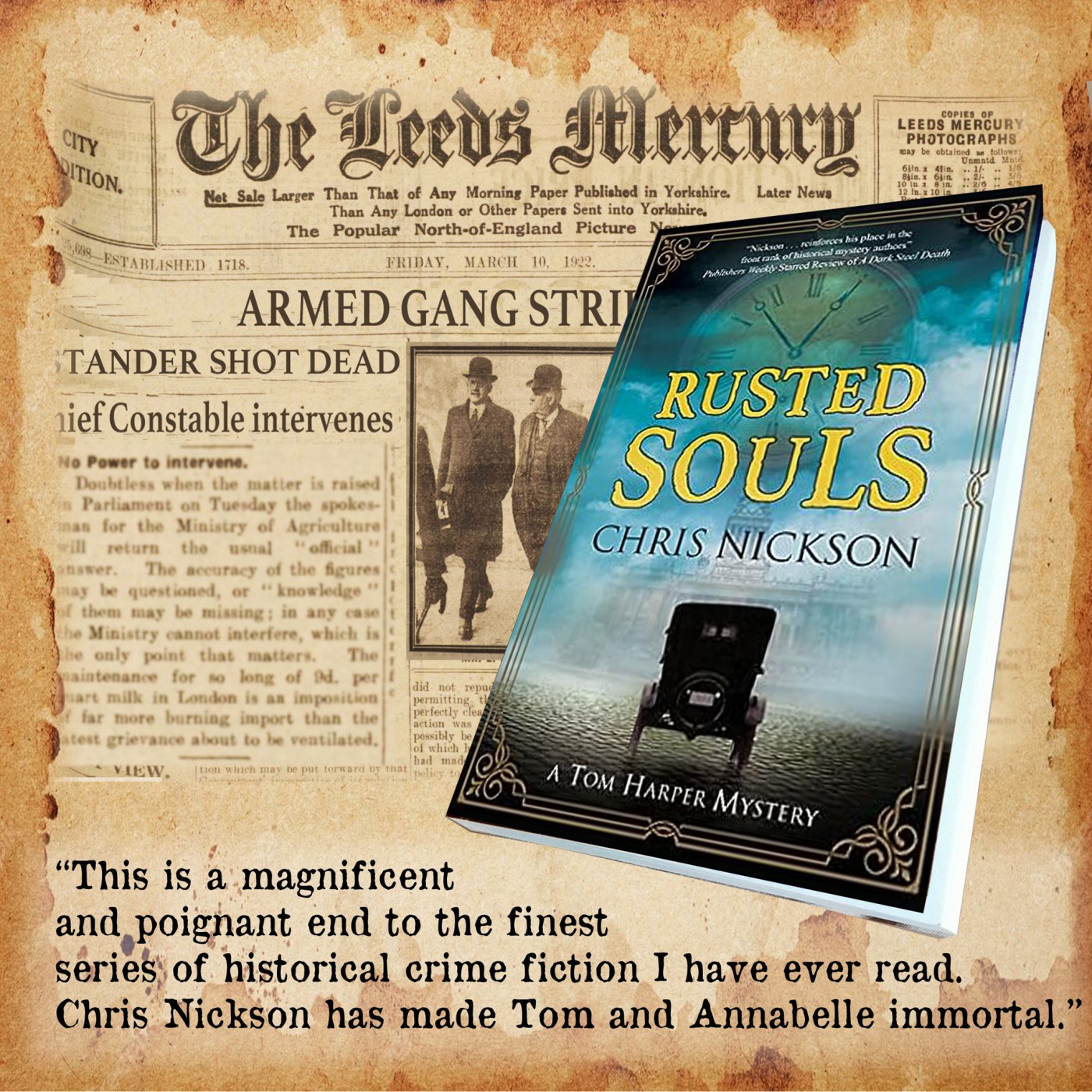
This is a magnificent and poignant end to the finest series of historical crime fiction I have ever read. It is published by Severn House and will be available on 5th September. For more about the Tom Harper novels, click this link.


THE WIT AND WISDOM OF BERNIE GUNTHER

PK

Over the thirty years and fourteen books of the series, Philip Kerr’s wonderful antihero Bernie Gunther was never afraid to speak his mind, both to us as readers, and often to the real-life characters – as diverse as Reinhardt Heydrich, William Somerset Maugham and Eva Peron – who peopled the stories. Sometimes he could be profound, sometimes savagely funny, but always observant. Here is a selection of his best lines.

Most of us who love great novels were aware that Philip Kerr was ill, and it was a moment of great sadness when we learned of his death in March 2018. We could not grieve in the full sense of the word. That was for his family. But we could only dream of what other adventures PK could have dreamed up for his magnificent creation, had he been granted more years. As it was, Metropolis – ironically, the book featuring Bernie at his youngest – was published posthumously. The Gunther books will be read as long as people have the desire to learn about 20thC history and the people who – for good or ill – shaped it. Also, as long as there are readers who enjoy a well-turned insult and a melancholy gaze into the human soul, Bernie Gunther will live for ever.

VOICES OF THE DEAD . . . Between the covers

VOTD spine009 copy

Edinburgh physician Dr Will Raven returns for the fourth in the series set in Edinburgh in the middle years of the nineteenth century. Ambrose Parry is the husband and wife writing team of Chris Brookmyre and Dr Marisa Haetzman. For new readers, a brief ‘heads-up’ about the personal dynamics between the main characters might be useful. Raven is assistant to – and disciple of – Professor James Young Simpson, pioneer anaesthetist and the only real life character in the book. Sarah Fisher was once Simpson’s housekeeper and, briefly, Raven’s lover, but he has since married, as did she, but her husband is now dead. She has a burning ambition to become a doctor.

VOTD cast

When Raven is summoned to Surgeon’s Hall by his friend Henry Littlejohn he becomes caught up in a chain of events which range from the comically macabre through to the murderous. Wrapped in a blanket and  deposited in the bottom of a cupboard, a human foot has been discovered. The head of the College, the aloof and irascible Dr Archibald Christie has been informed. Anxious to avoid any whiff of scandal, and aware that Raven has something of a reputation as an amateur investigator, Christie orders Raven to discover the origin of the foot without alerting the police. Things spiral beyond Raven’s control, however, when other body parts are located. Along with the irascible detective James McLevy, all concerned initially make a wrong assumption about the person whose limbs seem to be randomly scattered around the city. Will Raven’s past is punctuated with several episodes that might be described as unfitting for a respectable physician, and one such – by way of an all-too-human ghost from the past – sets him back on his heels.

We are soon drawn into a fascinating parallel plot involving the  ‘science’ of mesmerism. Its creator, the German physician Franz Mesmer has been dead for over thirty years, but displays of what we now call hypnotism are still able to draw crowds. The flames of interest in mesmerism are being found by the activities of two people. One, Richard Kimble is more of a stage illusionist but the other, Doctor Harland Malham, seems to have better credentials, so much so that Sarah is extremely interested in what he is doing. Her interest is heightened because, when meeting her for the first time, he suggests that she has an aptitude for mesmerism and could possibly be taken on by him as a trainee. Raven of course is deeply sceptical, but is acutely aware of Sarah’s determination to succeed in the medical profession by one way or another. Is she being duped? And who is the mysterious local businessman, Mr Somerville, to whom Sarah has become attracted?

One of the key elements in this series – and this book is no exception – is the nature of the relationship between Raven and Sarah, now Raven is married. He already has one child, a small son, and another is on the way. He is devoted to his wife Eugenie, but there is always a frisson between him and Sarah and we wonder, as readers, where this will end.

It doesn’t take a critical genius to work out that Brookmyre is providing the plotting and textual nuances while Haetzman is providing the (sometimes grisly)medical details and sense of medical authenticity. This is certainly one literary partnership that works very well, and the world of 1850s Edinburgh is portrayed in vigorous detail, contrasting the often squalid lives of the poor with the very different world of the more advantaged. The bottom line is that this is a bloody good crime novel, full of twists and turns, convincing historical ambience and main characters we believe in. It is published by Canongate Books and is available now.

Blog at WordPress.com.

Up ↑