Search

fullybooked2017

Tag

Historical Crime Fiction

POWDER SMOKE . . . Between the covers

I absolutely adored Andrew Martin’s Jim Stringer novels from the word go. The Necropolis Railway was set around the actual railway line near Waterloo that took hearse carriages containing the coffins that would be buried in the relatively new Brookwood Cemetery in Surrey, and introduced Jim Stringer, a young railwayman who would join the Railway police, and solve many mysteries, including novels set during Jim’s wartime experience on The Somme, Mesopotamia, and post-war India.

Now, we are in 1925, and Jim is a Detective Inspector based in York. The story is based on a strange encounter Jim had at the York Summer Gala in the summer of that year. He meets his boss, who insists they go and watch one of the attractions – a Wild West Show. They see the usual antics – a fake Red Indian, a ‘gunslinger’ who throws knives at his provocatively dressed female partner, then shoots clay pipes out of her mouth. Both the woman, the Red Indian and the cowboy are about as American as Yorkshire Pudding, but in the audience is a genuine American (who acts as a stooge for the performers, and a celebrated couple in the entertainment business, celebrated film star Cynthia Lorne  and her producer husband, Tom Brooks.

The gunslinger, Jack ‘ Kid’ Durrant, is not only good with guns, but has ambitions to writer cowboy novels, rather after the celebrated author of Riders of The Purple Sage, Zane Grey (1872 – 1939) Not only that, the relationship between Lorne, Brooks and himself is, as they say, interesting. When Lorne is found dead, with Brooks and Durrant both missing, it is assumed that Durrant is the killer. Although it is not strictly a matter for the Railway Police, Jim feels personally involved, and visits the place where the three were last seen – the grounds of Bolton Abbey in Wharfedale. This allows Andrew Martin (left) to introduce us to what is known as one of the most dangerous rivers in Europe, The Strid. This natural phenomenon sees the River Wharfe forced through a narrow ravine, just a few feet wide. It has been described as the river ‘running sideways’, rather like a twisted ribbon and is believed to be prodigiously deep. No-one goes into it and ever comes out alive.


The best series are enlivened by recurring subsidiary characters, and one has been ever present in the Jim Stringer novels, in the shape of his wife Lydia. We met her when she was young Jim’s landlady in the first novel. Although understandably distant when Jim was on military duties in France, Mesopotamia and India, she has remained by his side. I am not sure how Martin does it but, without being in the least explicit, he makes her quite the most alluring copper’s wife in detective fiction, and their courtship in The Necropolis Railway was – and you’ll have to read the book to understand the contradiction – chastely erotic.

Central to the appeal is, of course, the heartbreaking descriptions of a railway that we once had, but threw away in various acts of criminal negligence and wrong-headedness. The magnificent smoke and almost animal fury of the engines, the cathedrals that were the stations, the legions of uniformed officials, and the fact that in 1925 you could take a train from almost anywhere to somewhere else with minimal discomfort. All now gone and, in the words of the hymn;

“They fly forgotten, as a dream
Dies at the opening day.”

Jim, of course, tries to get to the bottom of of the mystery, party because – in spite of his devotion to Lydia – he was slightly smitten by the deceased movie star. The melancholy denouement involves a London and North Eastern Railway locomotive,and a definite sense of closure – if not satisfaction – for our man. In one sense, none of this matters, as our total engagement with the pubs, hotels, railway world, social quirks of the 1920s, and the lingering legacy of The Great War has given us that comfortable sensation we feel after feeling sated after a delicious meal. Powder Smoke is published by Corsair and is available now.

THE BETRAYAL OF THOMAS TRUE . . . Between the covers

Thomas True is the son of the Rector of Highgate. Now a sought after London suburb, in the early 18th century, at the time in which this novel is set, it was a country village. The young man has, for some years, been aware of his homosexuality and, unfortunately, so has his fire and brimstone father, who has done his best to beat out of his son what he sees as ‘the Devil’. Thomas has saved up his allowance and is determined to escape the misery.

Unknown to his parents, Thomas has been writing to his cousin Amelia in London, with a view to living with her and her parents. Within minutes of jumping down from the mail coach into the mire of a London street, he has been drawn into a world that is both breathlessly exciting and profoundly dangerous. The world of the molly houses in London was already well established, and would continue as a forbidden attraction well beyond the scandal of the Cleveland Street raid in 1889 in which Queen Victoria’s grandson, Prince Albert Victor was implicated, although there has never been any conclusive evidence that he was a customer of this male brothel. A molly? There is a lengthy explanation here.

Thomas meets a young man called Jack Huffins who is quick to recognise the lad as a kindred spirit, and he introduces him to Mother Clap’s which is, I suppose, the eighteenth century equivalent of a gay nightclub. We also meet a significant figure in the story, a burly stonemason called Gabriel Griffin. Working on the recently completed St Paul’s cathedral is his day job, but by night he is the bouncer at Mother Clap”s. He is also a man in perpetual mourning, haunted by his wife and child who died together three years earlier.

Hovering in the background to the revelry at Mother Clap’s is The Society for the Reformation of Manners. They actually existed, as did Mother Clap’s. The Society was, collectively, a kind of Mary Whitehouse (remember her?) of the day, and they existed to root out what they saw as moral decay, particularly of a sexual nature. They were far more sinister than the Warwickshire-born Christian campaigner however, as back then, men convicted of sodomy, buggery and ‘unnatural behaviour’ could be – and often were – hanged. The Society has inserted ‘ a rat’ into  Mother Clap’s community. Quite simply, he is paid by his masters to identify participants, and give their names to two particularly repugnant officers of The Society, Justice Grimp and Justice Myre (Grimpen Mire, anyone?) The main  plot centres on the search for the identity of ‘the rat’.

At times, the picture that AJ West (his website is here) paints of London is as foetid, grotesque and full of nightmarish creatures as that seen when zooming in to a detail in one of Hieronymus Bosch’s apocalyptic paintings. West’s London is largely based on history, but there are moments, such as when Thomas and Gabriel are captured by a tribe of street urchins in their dazzlingly strange lair, that the reader slips off the real world and drifts somewhere else altogether.

What the author does well is to show up the anguish and insecurity of the men who feel compelled to posture and pose as mollies, in an attempt to nullify the boredom of their respectable family lives. The bond of love that develops between Thomas and Gabriel is genuine, and certainly more powerful than the silly nicknames and grotesque flouncing at Mother Clap’s. The book ends with heartbreak. Or does it? Given that Gabriel is susceptible to ghosts, he is perhaps not a reliable narrator, and AJ West’s last few paragraphs suggest that the Society has, like the President of the Immortals at the end of Tess of the d’Urbervilles, ended its sport with Thomas and Gabriel. This paperback edition is out today, 3rd July, from Orenda Books.

KING DIDO . . . Past times, old crimes

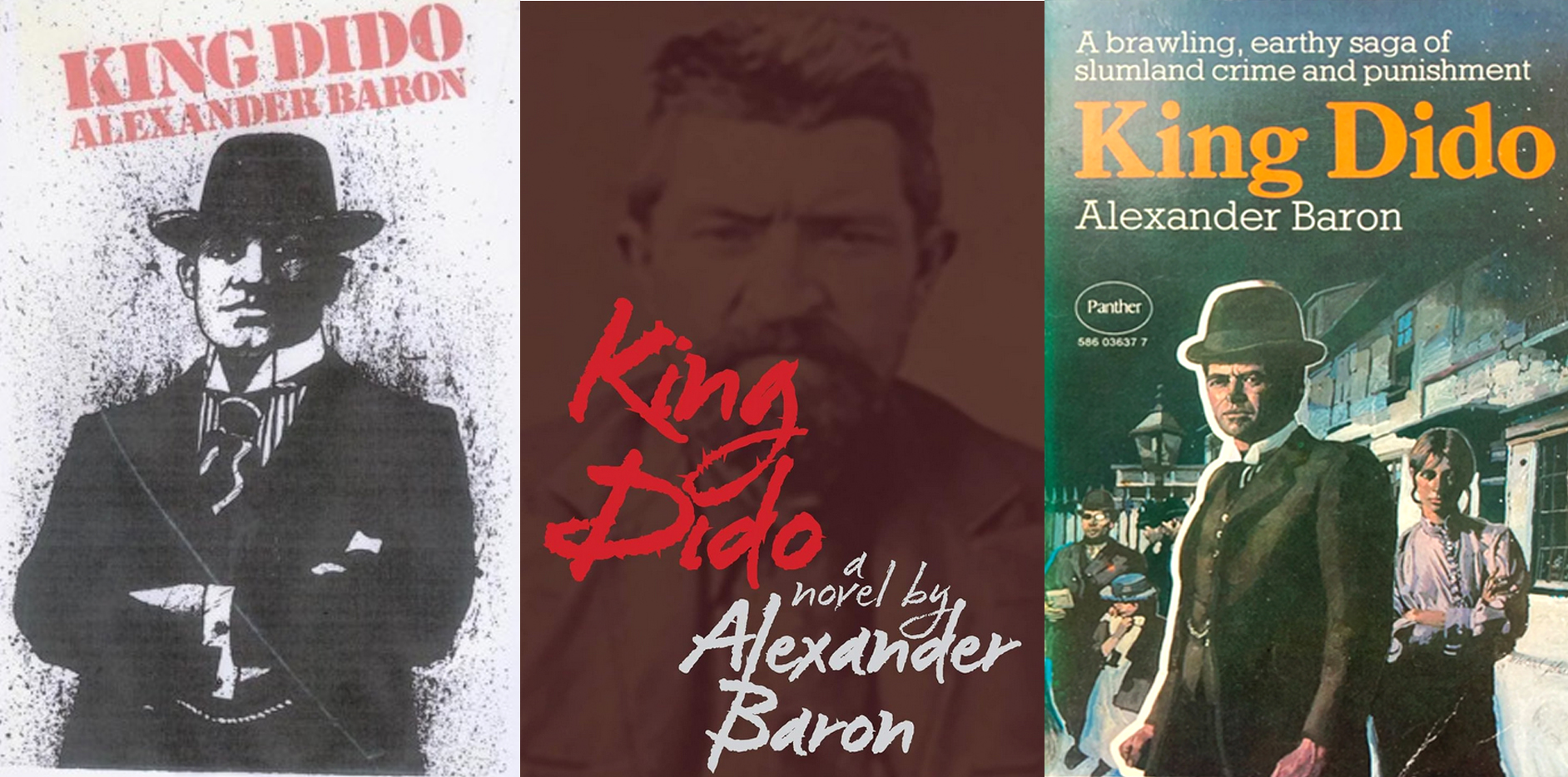
Alexander Baron (1917 – 1999) is a writer who has returned to the consciousness of the reading public in recent times because the Imperial War Museum have republished his two classic WW2 novels From The City, From The Plough, There’s No Home, and the third in the trilogy, the collection of short stories The Human KInd. His compassion and his acute awareness of the highs and lows of men and women at war have embedded the trilogy into the culture of WW2,  just as the poems of Owen, Sassoon and Gurney are inescapably linked with The Great War. King Dido (1969) is a book of a very different kind.

We are in the East End of London, and it is the summer of 1911, not long after the coronation of King George V and Queen Mary. Dido is, by trade, a dock worker but, after a violent encounter with the district’s 1911 version of the Krays, he takes over the streets and becomes  a kind of Reg. Not Ron, because Dido is not a psychopath, but the ‘tributes’ he collects make him a decent living. After a turbulent back alley encounter with a young waitress called Grace, Dido does ‘right thing’ and marries her. They live in redecorated rooms above the rag recovery business Dido’s mother runs. There has been a trend in crime fiction in recent years, which I call ‘anxiety porn’, but it is nothing new. More politely, these are known as ‘domestic thrillers.’ Mostly, they describe perfectly ordinary people whose lives gradually disintegrate, not through epic events, but because normal social tensions, misunderstandings, misplaced ambitions and tricks of fate turn their lives upside down. So it is here. Grace, blissfully unaware of how Dido earns his money, tries to put her feet on the next series of rungs in the ladder that leads to gentrification. However, the family’s journey on the board game of life becomes, via the snakes, a downward one, and it is a painful descent.

Baron grew up as Joseph Alexander Bernstein in Hackney, but he was actually born In Maidenhead, his mother having been evacuated there as a result of Zeppelin raids on London. His father was a master furrier, so it is clear that there is nothing autobiographical about his characterisation of Dido Peach. What is evident in the book is that Baron was aware of the existence of subtle strata within the East End poor. By 1911 the Huguenots had long since moved away, leaving such places as Christ Church Spitalfields and the elegant houses in Fournier Street as their memorials. There remained what could be called the ‘dirt’ poor, and then the ‘genteel’ poor – such as Mrs Peach and her family. What doesn’t feature in the novel, but was exactly contemporaneous, was the upsurge in activity by Eastern European activists, mostly exiles from Russia. The Houndsditch Murders and the resultant Siege of Sidney Street was that same year, while The Tottenham Outrage had been two years earlier. Both events remain writ large in East End history.

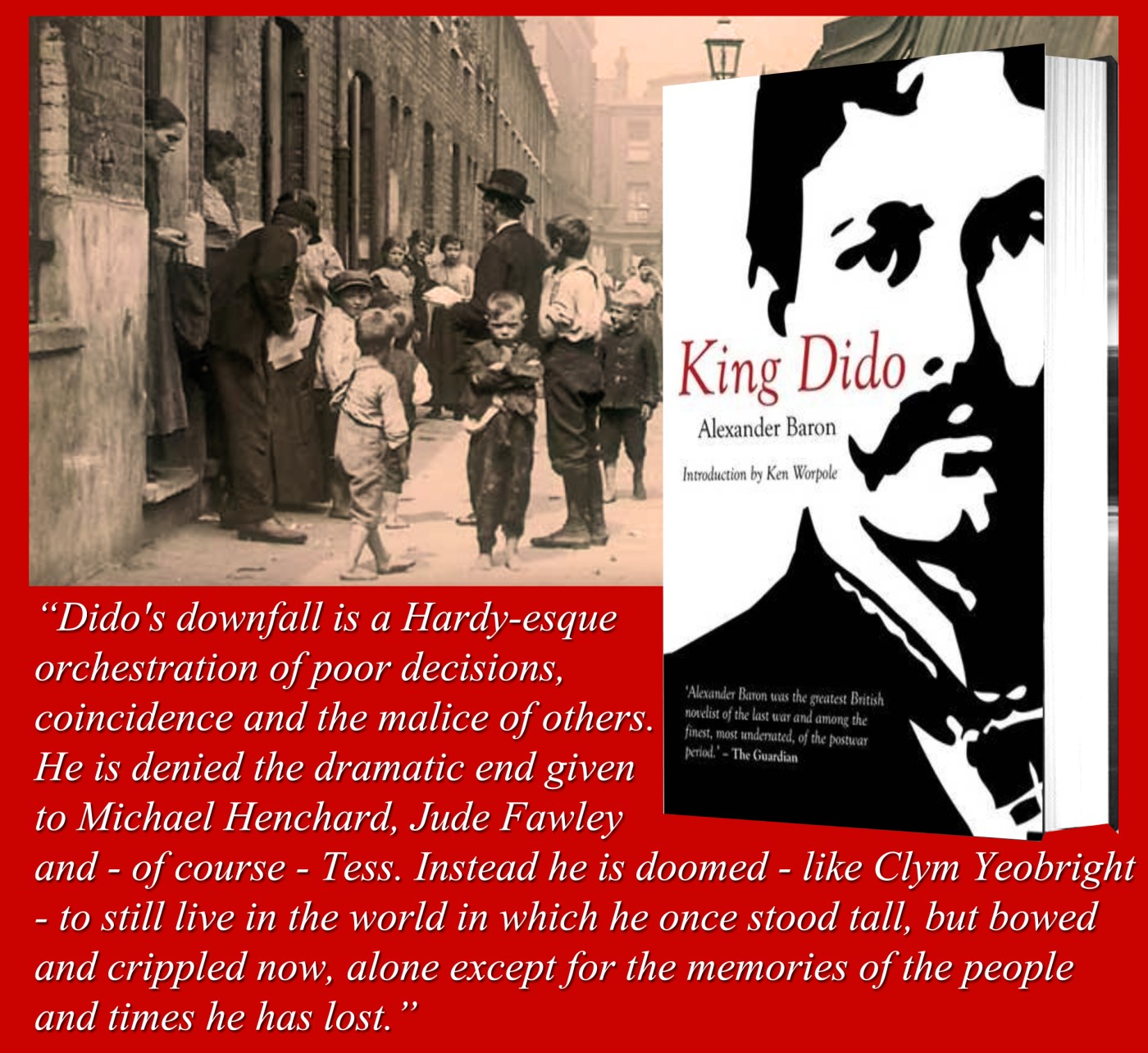
In the end, Dido’s downfall is a Hardy-esque orchestration of poor decisions, coincidence and the malice of others. He is denied the dramatic end given to Michael Henchard, Jude Fawley and – of course – Tess. Instead he is doomed – like Clym Yeobright – to still live in the world in which he once stood tall, but bowed and crippled now, alone except for the memories of the people and times he has lost. Baron’s prose here, just as in his better known books, is vivid, clear and full of insights.

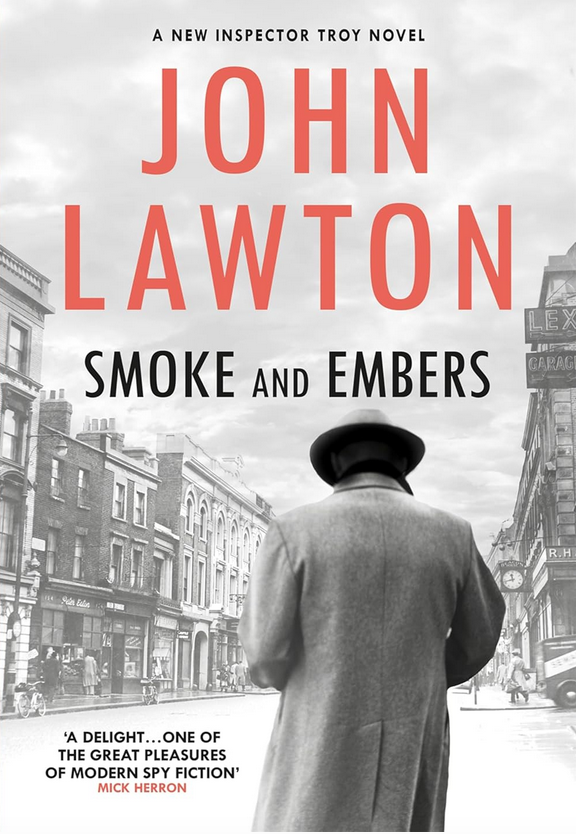
SMOKE AND EMBERS . . . Between the covers

Fans of John Lawton’s wonderful Fred Troy books, which began with Blackout (1995) will be delighted that the enigmatic London copper, with his intuitive skills and shameless womanising, makes an appearance here. Throughout the series Troy, son of an exiled Russian aristocrat and media baron, subsequently crosses the paths of all manner of real life characters including, memorably, Nikita Kruschev. For those interested in Troy’s back-story, this link Fred Troy may be of interest. He is not, however, central to this story. We rub shoulders with him, for sure, and also with his brother Rod, a Labour MP who serves in Clement Attlee’s postwar government. We are also reminded of characters from the previous novels – Russian soldier and spy Larissa Tosca, and the doomed Auschwitz cellist Meret Voytek. The book begins with sheer delight.

“Brompton Cemetery was full of dead toffs. Just now Troy was standing next to a live one. John Ernest Stanhope FitzClarence Ormond Brack, 11th Marquis of Fermanagh, eligible bachelor, man-about-town, and total piss artist.”

As ever in Lawton’s novels, the timeframe shifts. He takes us to 1945, the year of Hitler’s final annihilation, and to 1960 and the capture of Adolf Eichmann. Central to story is the fate of Europe’s Jews, their destruction at the hands of the Nazis, and then their almost complete rejection by Poland, Palestine, Britain, America and Russia after what was, for them, a hollow victory in 1945. Lawton’s story hinges on the lives of three young men. First is Sam Fabian, a German Jew, a mathematician and physicist who is saved from Auschwitz by a misfiring SS Luger and a compassionate Red Army officer. Then we have Jay Heller, a gifted English Jew who, immediately after joining up in 1940, is head hunted into the British intelligence services. Finally, we have Klaus LInz von Niegutt, minor member of what remains of the German aristocracy, who finds his way – or is led – into the SS. He is, however, not a violent man, and only does the bare minimum to remain ‘one of the chosen’. His significance in the novel is that he was one of the scores of staff – cooks, clerks and secretaries – who were in Hitler’s bunker in those fateful days at the end of April 1945.

With an audacious plot twist, Lawton gets Sam Fabian to England, where he finds work with a millionaire German Jew called Otto Ohnherz whose empire while not overtly criminal, is founded on the success of ventures that, while not quite illegal, are extremely profitable. He can afford to employ the best professionals. This is his barrister:

It was said of Jago that by the time he’d finished a cross-examination, the witness would be swearing Tom, Tom, the Piper’s son had been nowhere near the pig and had in fact been eating curds and whey with Miss Muffet at the time.”

When Ohnerz dies, Jay takes over the empire, and becomes involved with maintaining Ohnerz’s rental property business. While making sure the money still rolls in, he sets out to improve the houses, particularly those rented by tenants recently arrived from the Caribbean. It is when Jay’s broken body is found on the pavement below his headquarters that the story seemingly takes a turn towards the impossible. What Troy and the pathologist discover certainly had me scratching my head for a while. Lawton’s use of separate narratives and times allows him to set a seemingly unsolvable conundrum regarding the ultimate fates of  Jay, Sam and Klaus. To be fair, he provides clues, using a rather clever literary device. I won’t reveal what it is, but when you reach the last section of the book, you may need to revisit earlier pages. Smoke and Embers shows a profound understanding of the dark realpolitik that followed the end of the war in Europe, and is full of Lawton’s customary wit and wizardry. It is published by Grove Press UK and is available now.


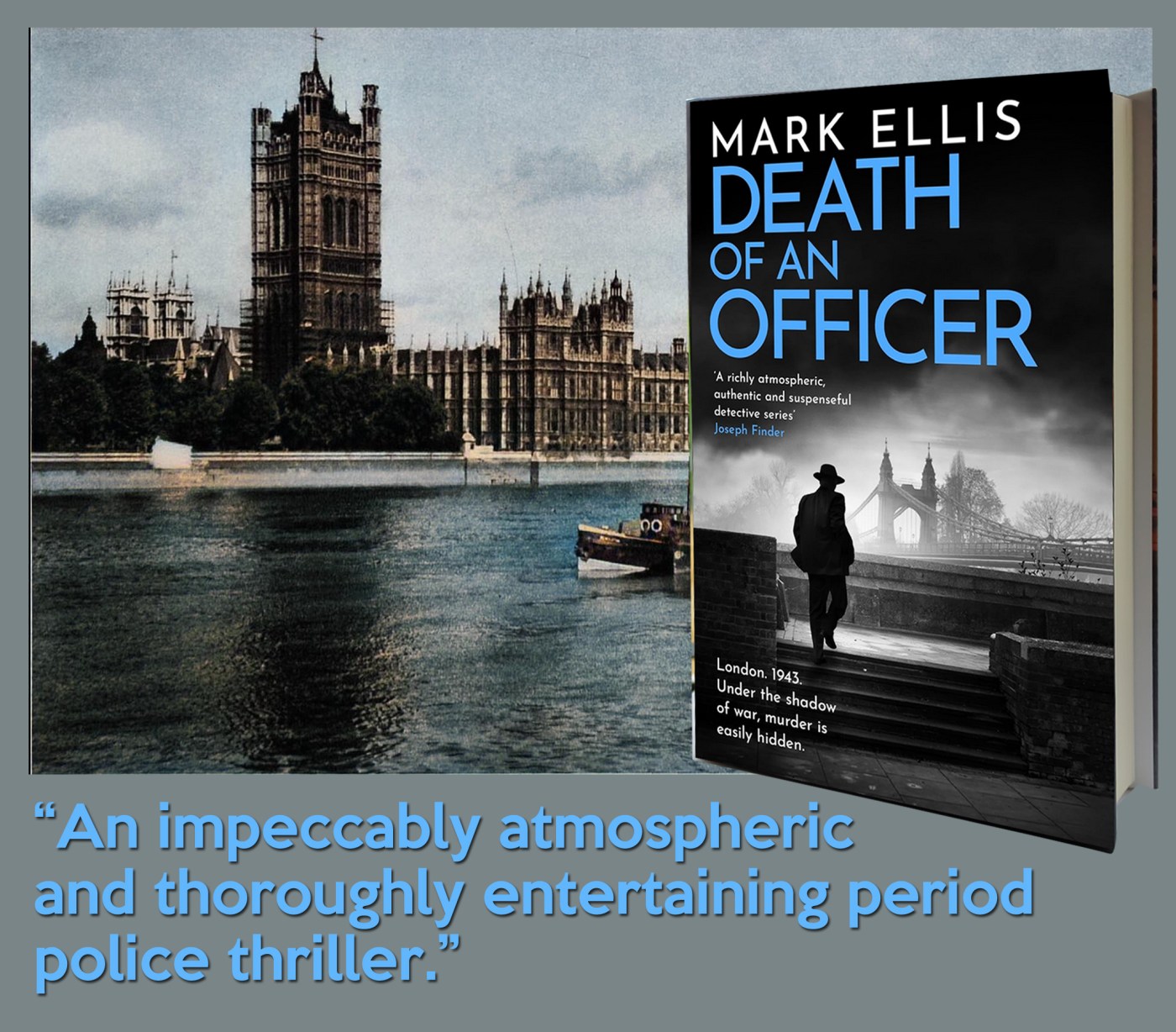
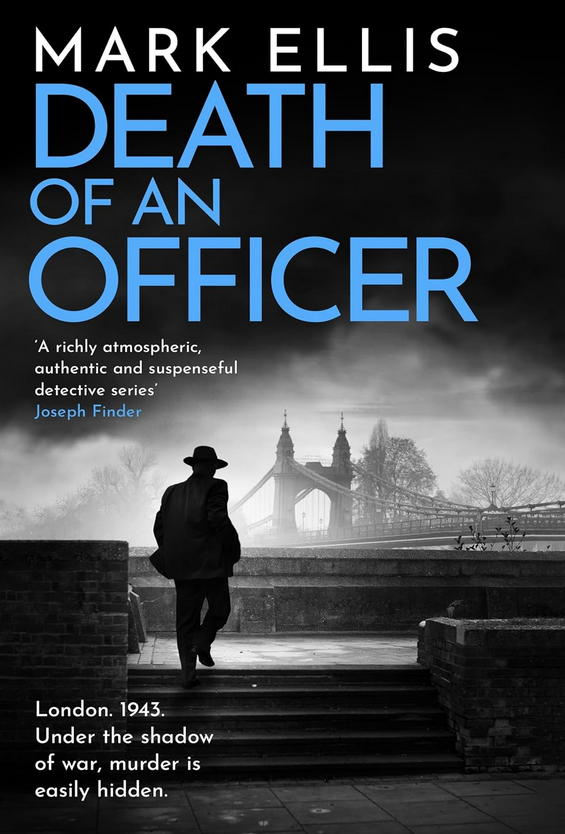
DEATH OF AN OFFICER . . . Between the covers

Detective Chief Inspector Frank (christened Francisco) Merlin is a thoroughly likeable and convincing central character in this murder mystery, set in 1943 London. As in all good police novels, there is more than one murder. The first we are privy to is that of a seemingly inoffensive consultant surgeon, Mr Dev Sinha, found dead in his bedroom, apparently bludgeoned with a hefty statue of Ganesha, the Hindu elephant god. Sinha’s wife has been diagnosed with a serious mental illness, and has been packed off to an institution near Coventry ( no jokes please) but when she is interviewed she is more lucid than those around her have been led to believe.

Added to Merlin’s list of corpses is that of south London scrap dealer called  Reg Mayhew, apparently victim of the delayed detonation of a German bomb. Unfortunately for the investigators, the word ‘corpse’, suggesting an intact body, is misleading. Mayhew’s proximity to the blast has given the lie to the old adage about someone’s inability to be in two places at once.

Clumsily concealed beneath bomb site rubble in the East End is the well-dressed (evening attire and dress shirt) remains of Andrew Corrigan, a Major in the US army. It seems he was a ‘friend’ of a rich and influential MP, Malcolm Trenton. 

Merlin’s investigations take him towards the contentious issue of Indian independence, and it seems that the murdered consultant was a member of a committee comprising prominent British Indians who support Subhas Chandra Bose, a firebrand nationalist who is seeking support from Nazi Germany and Japan, in the belief that they would win the war, and then look favourably on an independent India.

Like all good historical novelists, Mark Ellis has done his homework to make sure we feel we are in the London of spring 1943. We are aware of the recent Bethnal Green Tube disaster, that Mr Attlee is a key member of Churchill’s coalition government, and that a Dulwich College alumni has just had his latest novel, The Lady in the Lake, published. We also know that the Americans are in town. As Caruso sang in 1917, the boys are definitely ‘Over There!‘Among the 1943 intake is Bernie Goldberg, a grizzled American cop, now attached to Eisenhower’s London staff.

I am old, but not so ancient that I can remember WW2 London. Many fine writers, including Evelyn Waugh in his Sword of Honour trilogy, and John Lawton with his Fred Troy novels, have set the scene and established the atmosphere of those times, and Mark Ellis treads in very worthy footsteps. There is the dismal food, the ever present danger of air raids, the sheer density of the evening darkness and the constant reminder of sons, brothers and husbands risking their lives hundreds of miles away. Ellis also reminds us that for most decent people, the war was a time to pull together, tighten the belt, shrug the shoulders and get on with things. Others, the petty and not so petty criminals, saw the chance to exploit the situation, and get rich quickly.

Central to the plot is ‘the love that dare not speak its name‘ in the shape of an exclusive club organised by Maltese gangsters. Mark Ellis reminds us that there were no rainbow pedestrian crossings or Pride flags flying over public buildings in 1943, and that there was an ever-present danger that men in public life were susceptible to blackmail on account of their sexual preferences. With a mixture of good detective work and a bit of Lady Luck, Merlin and his team solve the murders. The book’s title is ambiguous, in that Major Andrew Corrigan certainly fits the bill, but there is one other officer casualty – I will leave you to find out for yourself his identity by reading this impeccably atmospheric and thoroughly entertaining period police thriller. It will be published by Headline Accent on 29th May.

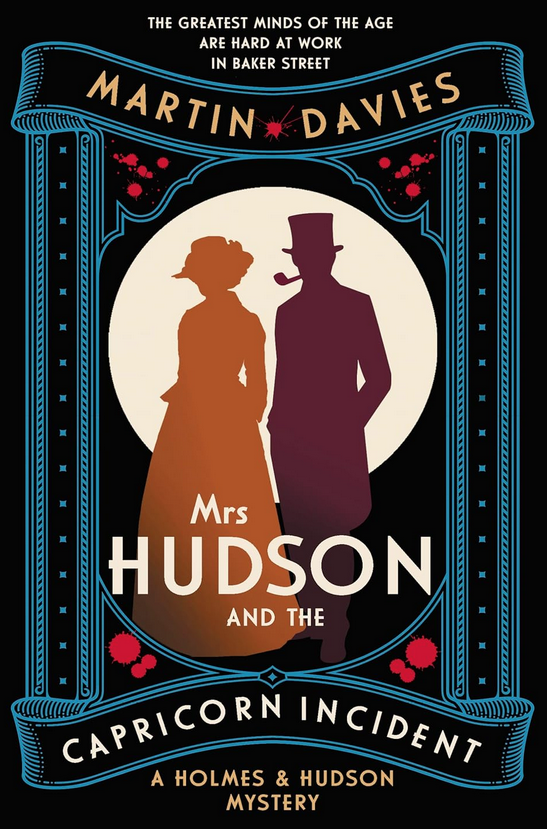
MRS HUDSON AND THE CAPRICORN INCIDENT . . . Between the covers

The canonical 56 short stories and four novellas featuring Sherlock Holmes have left so-called ‘continuation’ authors with plenty of subordinate characters to draw on. Dr Watson, inspector Lestrade, Moriarty and brother Mycroft have each been the central character in novels. I suppose it was only a matter of time before Mrs Hudson took centre stage. Martin Davies took up the challenge in 2002 with Mrs Hudson and the Spirit’s Curse, but here, events are narrated by a girl called Flotsam, who recalls events rather in the way that the good Doctor reminisces about the cases his old friend solved.

Flottie was an orphan girl, saved from a life of degradation by the kindness of Mrs Hudson, but is now a very bright young woman who has seeks education where and whenever she can find it. She is now highly literate and socially adept (but still working downstairs).The story unfolds through her eyes and ears. The substantive plot centres on Rosenau, a tiny Duchy in the Balkans, squeezed between the competing demands of the ailing Ottoman empire, Austria-Hungary and fervent Serbian nationalists. It’s survival depends on an impending marriage between Count Rudolph and Princess Sophie who, hopefully will provide a legitimate heir, ensuring the Duchy’s survival. Rosenau is, of course, fictional, but the Balkan powder keg was, at the turn of the century, frighteningly real. Everything goes awry when, first, the Count goes missing while on a European skiing trip and, second, when the princess is abducted from a London residence.

Reviewers and critics are perfectly entitled to question the validity of the still-vibrant Sherlock Holmes industry. Why, over a century after the last Conan Doyle tale was published, are we still seeing (and here, choose your own description) continuations, homages, pastiches and re-imaginings of crime fiction’s most celebrated character? The answer is simple – because people buy the books or borrow them from the library. Conan Doyle tired of his man, and tried to end it all, in the hope that readers would be drawn towards his other novels, like Micah Clarke or the Brigadier Gerard series. He was forced to relent. As a former prime minister said, “You can’t buck the market.” She was correct, and it must be assumed that two decades after the first novel in the series, people still buy these books and, for publishers, that is it and all about it.

Is this book any good? Yes, of course. Conan Doyle planted a seed which has grown into the mother of all beanstalks, and the Sherlock Holmes phenomenon is as busy as it ever was. Martin Davies reconnects us to a world which is endlessly appealing: chaste bachelors of independent means, a strictly ordered society, a London unsullied by antisemitic mobs, a railway system that ran with clockwork precision, handwritten letters delivered several times daily, a world that challenged the chant of Macbeth’s witches, ‘fair is foul and foul is fair’. This moral ambiguity has no place in the world of Mrs Hudson or Flottie. The tone of the book? Light of heart in some ways, with a certain amount of comedy. Here, a caricature aristocratic old gent opines on marriage:

“Wedding, for goodness sake? Weddings are ten a penny. When I was a lad, a man got married in the morning, introduced his wife to his mistress at lunchtime, and was at the races in the afternoon. And so long as he honored his debts, no one thought the worse of him.”

The humour reminded me very much the very underrated series of Inspector Lestrade novels by MJ Trow. As in those novels. this author provides some good jokes: A famous actress confides in Flottie.

“The important thing is to remember that your skirts are your enemy and speed is your friend. Which is quite the opposite of how we usually think about things, isn’t it?”

She is talking about the new enthusiasm among young women for cycling.

I have made this point before, but it is worth repeating. The canonical Holmes short stories were just that – short. Conan Doyle could take one problem, and allow his man to solve it in just a few pages. Even the four novels were brief. Short stories don’t sell these days and the concept of novels serialised in print and paper magazines is dead and buried, therefore modern Holmes emulators have to spin out the narrative to the regulation 300-400 pages. So, there has to be subplots and other investigations going on, and this almost always means that the narrative tends to drift. So it is here, with the Rosenau crisis sharing the pages with the search for someone called Maltravers, a serial swindler. Martin Davies handles this dilemma as well as anyone else, and presents us with an entertaining tale that is well worth a few hours of anyone’s time. There were occasional longeurs, but the last few pages were rather wonderful. Mrs Hudson and the Capricorn Incident is published by Allison & Busby and is available now.

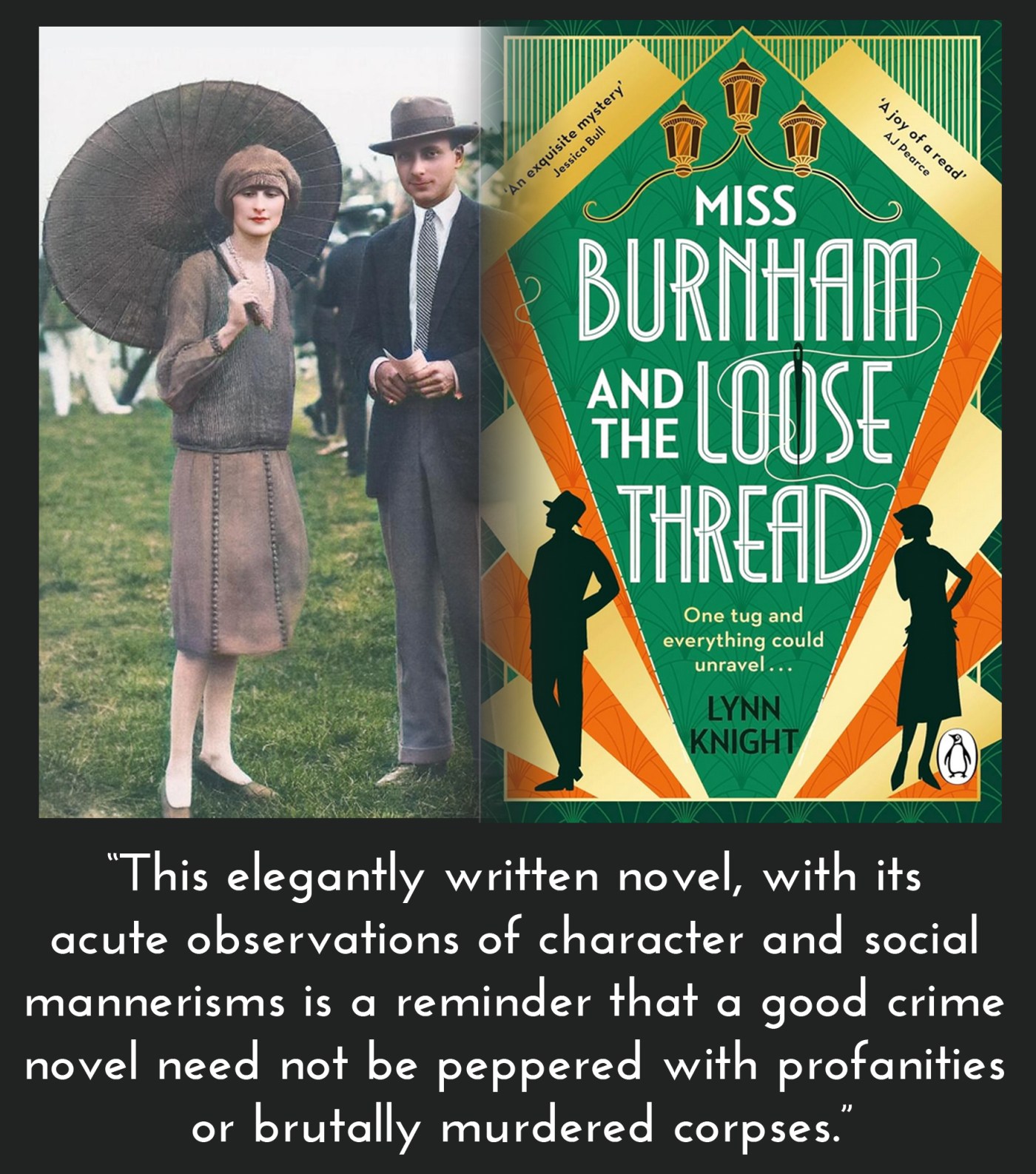
MISS BURNHAM AND THE LOOSE THREAD . . . Between the covers

It is the spring of 1925 and we are in suburban London. Rose Burnham is a talented designer-dressmaker, and has set herself up in business with her sisters. She isn’t making a fortune, but she hopes that the improving weather will bring in new orders. One of her regular customers is Phyllis Holmes, whose late father has left her relatively well off, even though she is basically a handmaiden to her demanding mother. In an attempt to broaden her social life, the shy and sheltered Phyllis has fallen into the clutches of a man – recommended by Cupid’s Arrows, a matrimonial agency  –  who is, to use the epithets of the time, both a bounder and a cad. Lynn Knight may have had these wonderful lines by Sir John Betjeman in mind:

“Let us not speak, for the love we bear one another—
Let us hold hands and look.”
She such a very ordinary little woman;
He such a thumping crook;
But both, for a moment, little lower than the angels
In the teashop’s ingle-nook.”

The so-called War To End All Wars has been over, at least in Europe, for seven years, but it casts a long shadow:

“Here was Mrs. Carlton, an optimistic bride when Rose first saw her at Webb and Maskry in the spring of 1914. But now a desperate wife seeking refuge in clothes. If she could fill her days with dress fittings and like distractions, she would be able to spend less time looking at her husband’s disfigured face.”

When Miss Holmes visits Rose’s workshop and tearfully confesses that she can neither pay her existing bills nor commission any new dresses because she has been swindled, Rose must act. Yes, she is sympathetic to her client’s dilemma, but if she cannot track down the man who has appropriated Phyllis’s fortune – around £40,000 in today’s money – she knows that she and her sisters will be unemployed, and probably be forced to return to their previous lives as shop assistants. Rose decides to present herself at Cupid’s Arrows as an anxious spinster, in the hope that she will be pointed in the direction of the man who stole the heart of Phyllis Holmes – not to mention her money. Lynn Knight has a wonderful eye – and ear – for the 1920s. Invited to a soirée, Rose observes her fellow guests: “

“Three men in their own larger circle, feet spread firmly apart, like a Gilbert and Sullivan chorus, were broadcasting their views to the room. Single emphatic words; coal – taxes – prices – punctuated their talk. Except for a side parting, a watch chain and a Ramsay McDonald mustache, there was little to distinguish one man from the next.”

This elegantly written novel, with its acute observations of character and social mannerisms is a reminder that a good crime novel need not be peppered with profanities or brutally murdered corpses. Finally, a word to readers whose interests tend to lie in the dark streets and lurid neon of Noir, or those who like their crime novels red in tooth and claw, with a high corpse count. Yes, this story may seem soufflé light and lacking in high drama, but it is a beautifully observed study of social mores and expectations in a society that was still trying to find its feet after an international cataclysm. The focus is almost entirely on the female characters, and the underlying theme is that of women – tens of thousands of whom took on men’s roles during the war – who are determined not to return to pre-1914 status quo.

Parallel to this world of emerging female emancipation, Lynn Knight also highlights a society where men over the age of 25 are shaped by – and judged on – what they did and where they were between 1914 and 1919. Some (literally) limped back into their pre-war world. Some struggled to survive in a land Lloyd George egregiously promised would be “fit for heroes to live in.” Others, like the tricksters of Cupid’s Arrow, turned to more reprehensible methods to make a living. This novel is published by Bantam, and is available now.

THE QUICK AND THE DEAD . . . Between the covers

tqatd spine013 copy

The Thameside borough of Southwark, 1597. Kit Skevy aged 20, is a street criminal employed – or perhaps enslaved – by a man whose trade would, in our day, be described as gangster. Will Twentyman is feared for his violence and venality. He also controls Mariner Elgin. A few years older than Kit, she is a cut-purse, a thief who specialises in relieving wealthy people of their cash. She has a complex history, having once worked on a sailing ship disguised as a boy. When her first menstruation betrayed her, she was locked up for the remainder of the voyage, and now belongs to Twentyman.

One of Twentyman’s more profitable sidelines is grave robbery, delivering corpses to anatomists or those engaged in alchemy. When a group of armed men discover Kit and Mariner exhuming a body, Kit happens to be carrying a vial of a strange substance he recovered from the body of a friend who died in a fire caused by an alchemical experiment. The vial breaks and the the liquid, perhaps something like phosphorus, ignites and plays across his fingers.

Kit is taken prisoner and his captors, wrongly, believe that he has strange powers. Kit learns that his captor is Lord Isherwood, but the nobleman’s son, Lazarus – himself an alchemist in search of hidden truths, befriends him, and orchestrates his escape. Perhaps ‘befriends him’ is euphemistic, as there is an erotic attraction between the two of them.

At one point, Emma Hinds suggests that Kit may have the anatomical irregularity of possessing both male and female characteristics. The author describes herself as “a Queer writer and playwright living in Manchester whose work explores untold feminist narratives”, so this novel is not a run-of-the-mill historical tale. Mariner also escapes from Twentyman’s grip after being drawn to Lady Elody Blackwater, a wealthy widow who is also consumed by the search for the elixirs of alchemy. There is sexual electricity between the two women and, despite their social differences, they become lovers. There is a thread of eroticism running through this book, which is unusual in ostensibly similar historical fiction.

In the last few pages of the novel we are drawn into the burgeoning world of late Elizabethan theatre, and we are introduced to an ambitious actor/playwright from Warwickshire. Emma Hinds brings us a vivid (and sometimes lurid) vision of a dystopian late-Elizabethan – era London, peopled by whore-masters, alchemists, body snatchers, cut-purses and political opportunists. Kit and Mariner are unconventional heroes. If nothing else, they are street fighters who know all the tricks to enable them to survive in a Southwark so grotesque that it might have been painted by Hieronymus Bosch.

The contrast between the middens initially occupied by Kit and Mariner, and the rose-water life style of the gentry could not be starker. The relationship between the two is that of brother and sister as each is attracted to people of their own sex. The Quick and The Dead is a complex and, in some ways, a challenging, novel. Emma Hinds has clearly spent long hours on the topography of late 17thC London, and the bizarre attempts by alchemists to attempt things which science would eventally prove to be impossible.. It was only in the age of Newton, a century later, that the work of alchemists was finally sidelined.

The author also reminds us that despite the heroics of Drake, and the fortuitous weather, Spanish/Catholic claims to the crown of England did not end in 1588. As Kit and Mariner go from crisis to crisis, a second Spanish invasion fleet is waiting at anchor in the middle distance. The Queen would only have another four years to live, and the agents of Scotland’s King James are already busy.

This is a compelling portrait of late Elizabethan England, an absorbing mix of fierce politics, wonderful architecture and drama, but sullied by bestial social conditions. Emma Hinds seems to be telling us that same-sex relationships were, in those days, not the burning issue that they were later to become. She may be right. In the novel the name of Christopher Marlowe is occasionally evoked, and one school of thought suggests that homosexuality brought about his downfall but, whatever his preferences, he was not hunted down in the way that Oscar Wilde and Alan Turing were to be in more recent times. The Quick and The Dead is publlshed by Bedord Square and available now.

Screen Shot 2024-12-30 at 12.46.56

THE WICKED OF THE EARTH . . . Between the covers

twote003 header

I live in what could be called Cromwell Country. Oliver’s former house in nearby Ely is a tourist attraction, and he is well commemorated in Huntingdon. Was he a Great Englishman? He was certainly an excellent military commander and a successful politician, but I find him hard to warm to. This novel takes us back to the England of 1650. The Civil Wars were over, the King was dead, but the peace was deeply uneasy.

The political situation in 1650 was complex. The country was ruled by the Council of State, a group of forty or so senior politicians who held supreme executive power. It would be another three years before Oliver Cromwell became Head of State, styling himself as Lord Protector. The most significant former Royalists were businessmen and merchants. Their riches and commercial acumen were essential for the country to regain some form of equilibrium after the turmoil of the war years irrespective of their having backed the losing side.

James Archer, a native of Newcastle, is something of a contradiction. He made himself locally notorious by breaking away from his Royalist roots and signing up to fight for Parliament. Although still in his twenties, he has seen – and participated in – great violence, including Cromwell’s barbaric campaign in Ireland. He is sent back to his home town by the Council of State, ostensibly to check that the former King’s men who ran the  vital mining and shipping of coal were playing by the rules.

Archer’s subsidiary mission is to investigate the findings of the now infamous Newcastle Witch trials, which took place in 1649 and 1650. The deaths of these women are only of procedural interest to the Council, but Archer certainly has a dog in the fight, as his sister Meg was one of the accused.

What made me distinctly uncomfortable in Bergin’s narrative is his  reminder that a society dominated and swayed by hellfire preaching and scriptural quotes is a deeply unstable one. Archer observes the Newcastle town-folk, crowded on the benches of St Nicholas Church, quaking as Dr. Jenison, “so skeletally angular that it appeared he was already half way to the grave,” spits out his sectarian venom, and his demeaning view of the place of women in society. Thank goodness we have no places of worship in Britain where this still goes on. Oh, wait….

After a series of violent encounters, Archer becomes the victim of a conspiracy involving the Great and The Good of Newcastle’s commercial and political world, and he resolves to abandon the town, and head north into the countryisde to search for his sister. As the bruised and battered Archer ventures into border country, he notices something.
“…no men were to be seen. The old had died in the hard winters, the young not yet returned from the wars.”

It is in the Teeside village of Norham that Archer finally earns the truth about his sister, and Bergin has created a masterly ironic twist that is worthy of Thomas Hardy. There is so much to admire in this novel, but one or two things stand out. The fight scenes – and there are several – are superbly described, and the reader can almost hear the clash of steel, and smell the sweat and blood of the participants. Bergin’s historical research is immaculate, as befits a Cambridge history graduate, and his portrayal of the dark and foetid alleys of 17th century Newcastle is vivid and memorable. Published by Northodox Press, this fine novel is available now.

Screen Shot 2024-11-20 at 16.52.37

Blog at WordPress.com.

Up ↑